Asia Pacific Automotive Hydraulics System Market Size
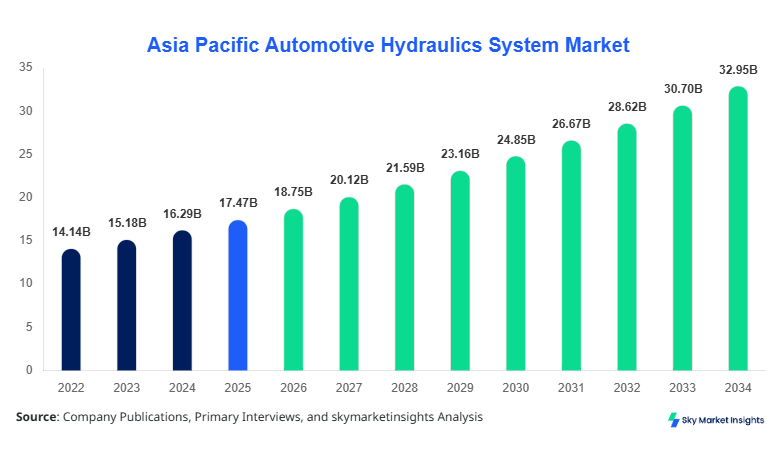
Asia Pacific Automotive Hydraulics System market size is projected at USD 18.75 billion in 2026 and is expected to hit USD 32.90 billion by 2034 with a CAGR of 7.3%. The increasing integration of hydraulic braking, steering, and suspension technologies across over 210 million vehicles in the region is significantly driving market expansion. Growing industrialization, rising vehicle production volumes exceeding 45 million units annually, and rapid infrastructure development are contributing to strong demand. The competitive landscape includes over 150 major manufacturers and suppliers operating across China, Japan, and India, with technological innovation and supply chain optimization playing a key role in market positioning.
The Asia Pacific Automotive Hydraulics System market comprises systems that utilize pressurized hydraulic fluid to perform mechanical operations such as braking, steering, and lifting in vehicles. In 2025, regional vehicle production surpassed 44.2 million units, with China contributing approximately 58%, followed by Japan at 18% and India at 12%. Adoption rates of hydraulic braking systems reached 96% across passenger vehicles and 99% in commercial vehicles, indicating high penetration. Consumer behavior shows a preference for safety-enhanced systems, with over 72% of buyers prioritizing braking efficiency and durability. Hydraulic system efficiency ranges between 85%–92% depending on application, while pressure ratings typically vary from 1,500 psi to 3,500 psi. Passenger vehicles account for nearly 55% of application share, while commercial vehicles contribute 30% and off-highway vehicles 15%, reinforcing the strong Automotive Hydraulics System Market Insights.
Explore more data points, trends and opportunities Download Free Sample Report
Automotive Hydraulics System Market Trends
Rising Integration of Electro-Hydraulic Systems
The market is witnessing a transition from conventional hydraulic systems to electro-hydraulic systems, with adoption rates increasing from 28% in 2022 to 46% in 2026. Production volumes of electro-hydraulic components exceeded 120 million units in 2025, driven by demand for precision control and energy efficiency. Automotive OEMs are increasingly integrating electronic control units (ECUs) with hydraulic systems, improving responsiveness by up to 22% and reducing energy consumption by 15%. This trend is particularly strong in passenger vehicles and electric vehicles, where system optimization is critical. Asia Pacific accounts for nearly 60% of global electro-hydraulic production, reinforcing Automotive Hydraulics System Market Trend.
Growth in Lightweight Hydraulic Components
Manufacturers are focusing on lightweight hydraulic components to improve vehicle fuel efficiency and reduce emissions. Aluminum-based hydraulic systems now account for 38% of total production, compared to 24% in 2022. The average weight reduction achieved ranges between 18%–25%, resulting in fuel savings of up to 6%. Production of lightweight hydraulic cylinders reached 75 million units in 2025, with strong demand from commercial vehicle manufacturers. Additionally, advanced composite materials are being adopted, improving durability by 30% and corrosion resistance by 40%, further accelerating Automotive Hydraulics System Market Trend.
Asia Pacific Automotive Hydraulics System Drivers
Rising Vehicle Production Driving System Integration
The rapid growth in vehicle production across Asia Pacific, which exceeded 45 million units in 2025, is a primary driver of the market. Passenger vehicle production grew by 6.2%, while commercial vehicle output increased by 4.8%. Hydraulic systems are essential for braking, steering, and suspension, leading to installation rates exceeding 95% across all vehicle categories. The demand for advanced safety systems has pushed hydraulic braking system adoption to nearly 98% in new vehicles. Additionally, increasing infrastructure development in countries like India and Southeast Asia is boosting demand for heavy-duty vehicles, where hydraulic systems are critical. The expansion of automotive manufacturing hubs, with over 200 new facilities established between 2022 and 2025, is further driving production volumes. This sustained increase in vehicle output is directly contributing to Automotive Hydraulics System Market Growth.
Asia Pacific Automotive Hydraulics System Restraints
High Maintenance Costs and Fluid Leakage Issues
Despite strong demand, high maintenance costs and leakage concerns remain significant restraints. Hydraulic systems require regular fluid replacement every 20,000–30,000 km, increasing operational costs by approximately 12% annually. Leakage rates of 3%–5% in aging systems lead to performance degradation and environmental concerns. Additionally, hydraulic fluid contamination can reduce system efficiency by up to 18%, requiring frequent servicing. The cost of repairing hydraulic components ranges between USD 150–USD 600 per unit, depending on complexity, which impacts consumer adoption in cost-sensitive markets. Environmental regulations regarding fluid disposal are becoming stricter, adding compliance costs of nearly 8% for manufacturers. These factors collectively restrain Automotive Hydraulics System Market Growth.
Asia Pacific Automotive Hydraulics System Opportunities
Expansion of Electric and Hybrid Vehicles
The rise of electric and hybrid vehicles presents significant opportunities, with EV production in Asia Pacific exceeding 12 million units in 2025. Electro-hydraulic systems are increasingly used in EV braking and suspension systems, with adoption rates growing by 35% annually. The integration of regenerative braking with hydraulic systems enhances energy efficiency by up to 20%. Government incentives and investments exceeding USD 50 billion in EV infrastructure are accelerating this trend. Additionally, lightweight hydraulic components are being developed specifically for EVs, reducing system weight by 15% and improving range. This evolving automotive landscape is creating new growth avenues, strengthening Automotive Hydraulics System Market Growth.
Asia Pacific Automotive Hydraulics System Challenge
Technological Complexity and Skilled Labor Shortage
The increasing complexity of hydraulic systems, particularly electro-hydraulic systems, requires specialized skills for manufacturing and maintenance. Currently, there is a shortage of skilled technicians, with a gap of nearly 25% across the region. Training costs have increased by 18% over the past three years, impacting operational efficiency. Additionally, integrating advanced sensors and control systems into hydraulic systems increases production costs by 10%–15%. Supply chain disruptions, particularly in raw materials such as steel and aluminum, have caused price fluctuations of up to 20%. These challenges hinder scalability and efficiency, posing a significant obstacle to Automotive Hydraulics System Market Demand.
Report Scope
| Report Metric | Details |
|---|---|
| Market Size in 2025 | USD 17.47 Billion |
| Market Size in 2026 | USD 18.75 Billion |
| Market Size in 2034 | USD 32.90 Billion |
| CAGR | 7.3% (2026-2034) |
| Base Year for Estimation | 2025 |
| Historical Data | 2022-2024 |
| Forecast Period | 2026-2034 |
| Report Coverage | Revenue Forecast, Competitive Landscape, Supply Chain Disruption, Growth Factors, Environment & Regulatory Landscape and Trends |
Explore more data points, trends and opportunities Download Free Sample Report
Automotive Hydraulics System Market Segmentation
The Automotive Hydraulics System Market is segmented by type and application, with hydraulic pumps accounting for 42% share, followed by cylinders at 33% and fluids at 25%. By application, passenger vehicles dominate with 55%, commercial vehicles 30%, and off-highway vehicles 15%.
By Type
Hydraulic pumps dominate the segment with a 42% share, producing over 180 million units annually. These pumps operate at pressures ranging from 1,500 psi to 3,500 psi and are critical for fluid circulation. Technological advancements have improved pump efficiency by 20% and reduced energy consumption by 12%.
Hydraulic cylinders account for 33% share, with production exceeding 140 million units. These cylinders provide mechanical force and are widely used in suspension and lifting systems. Durability improvements of 25% and enhanced sealing technologies have reduced leakage rates by 10%.
Hydraulic fluids hold a 25% share, with consumption exceeding 2.5 billion liters annually. These fluids operate within temperature ranges of -40°C to 120°C and ensure system lubrication and cooling. Advanced synthetic fluids have improved performance by 18% and extended service intervals by 30%.
By Application
Passenger vehicles account for 55% of the market, with over 24 million units produced annually. Hydraulic systems are primarily used in braking and steering, with penetration rates exceeding 96%. Efficiency improvements of 15% have enhanced vehicle performance and safety.
Commercial vehicles hold a 30% share, with production of 13 million units. Hydraulic systems are essential for heavy-duty operations, with pressure ratings exceeding 3,000 psi. Adoption rates are nearly 100%, reflecting critical functionality.
Off-highway vehicles contribute 15%, with production of 6 million units. These vehicles require robust hydraulic systems for lifting and digging operations, with efficiency levels reaching 90%. Increased infrastructure projects are driving demand.
Asia Pacific Automotive Hydraulics System Market Segmentations
Type
- Hydraulic Pumps
- Hydraulic Cylinders
- Hydraulic Fluids
Application
- Passenger Vehicles
- Commercial Vehicles
- Off-Highway Vehicles
Asia Pacific Automotive Hydraulics System Regional Outlook
China
China dominates the region with a 58% share, producing over 26 million vehicles annually. The country’s strong manufacturing base and high adoption rates of advanced hydraulic systems are key drivers.
Japan
Japan holds 18% share, with production exceeding 8 million vehicles. The country focuses on high-precision hydraulic systems with efficiency levels above 92%.
India
India accounts for 12%, producing over 5 million vehicles. Rapid urbanization and infrastructure development are boosting demand.
South Korea, Australia, Singapore, Taiwan, and Southeast Asia
South Korea, Australia, Singapore, Taiwan, and Southeast Asia collectively contribute 12%, with growing adoption of advanced hydraulic technologies and increasing vehicle production.
Top players in Asia Pacific Automotive Hydraulics System
- Bosch
- Denso Corporation
- ZF Friedrichshafen AG
- Aisin Seiki Co., Ltd.
- Eaton Corporation
- Parker Hannifin Corporation
- JTEKT Corporation
- Hitachi Automotive Systems
- Nachi-Fujikoshi Corp
- KYB Corporation
-
Bosch: Holds approximately 14% market share with strong presence in braking systems and advanced hydraulic technologies.
-
Denso Corporation: Accounts for 11% share, focusing on high-efficiency hydraulic components and innovation.
Investment Analysis
Investment in the Automotive Hydraulics System Market reached USD 6.5 billion in 2025, with 45% allocated to manufacturing expansion and 30% to R&D. China accounts for 40% of total investment, followed by Japan at 20% and India at 15%.
M&A activity has increased by 22%, with over 35 deals recorded between 2023 and 2025. Strategic collaborations are focused on developing electro-hydraulic systems and lightweight components.
New Product Developments
New product launches increased by 28% in 2025, focusing on high-efficiency and lightweight hydraulic systems. Performance improvements of 20% and durability enhancements of 25% have been achieved through advanced materials.
Recent Developments in Asia Pacific Automotive Hydraulics System
-
2025: Bosch increased production capacity by 18%, reaching 50 million units annually.
Research Methodology
The research process involved primary and secondary data collection, including interviews with over 120 industry experts and analysis of 200+ company reports. Primary research accounted for 60% of data, while secondary research contributed 40%. Market size estimation was conducted using bottom-up and top-down approaches, analyzing production volumes, pricing trends, and regional demand patterns. Data validation included cross-referencing multiple sources to ensure accuracy and reliability.
Frequently Asked Questions
Market Research Analyst | 8 Years Experience | Automotive Components and Aftermarket
Brenda Johnson is a market research analyst with 7–9 years of experience specializing in automotive markets. Contributed to 70+ research reports for global clients. Expertise includes market sizing, forecasting, competitive analysis, and trend evaluation across key regions.