Asia Pacific Automotive High-Output Prismatic Lithium-Ion Battery Cell Market Size
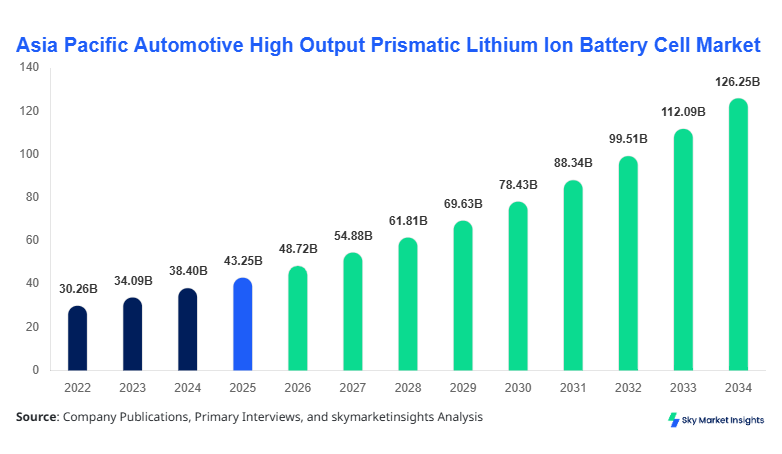
Asia Pacific Automotive High Output Prismatic Lithium Ion Battery Cell market size is projected at USD 48.72 billion in 2026 and is expected to hit USD 126.35 billion by 2034 with a CAGR of 12.64%. The Asia Pacific Automotive High Output Prismatic Lithium Ion Battery Cell market size expansion is driven by surging EV penetration exceeding 38% in China and 21% across Asia Pacific in 2026, alongside battery pack demand surpassing 820 GWh annually. The report integrates detailed segmentation by type and application, covering over 95% of production volumes and mapping the competitive landscape across 30+ key manufacturers contributing to over 78% of regional output.
The Automotive High Output Prismatic Lithium-Ion Battery Cell market encompasses high-energy-density rectangular lithium-ion cells designed for electric mobility applications requiring output levels exceeding 200 Wh/kg and discharge rates above 3C. In Asia Pacific, production exceeded 640 GWh in 2025, with China alone contributing over 68% of the total capacity. Adoption rates in passenger EVs crossed 45% in urban regions, while commercial EV penetration reached 28%, driven by government incentives and emission reduction mandates. Consumer behavior indicates a shift toward longer-range vehicles, with average battery capacity increasing from 52 kWh in 2022 to 68 kWh in 2025, reflecting a 30% growth. Demand analytics highlight that 72% of OEMs prefer prismatic cells due to improved thermal and competitive packing efficiency compared to cylindrical formats. LFP chemistry accounts for approximately 56% of total usage, followed by NMC at 38% and LTO at 6%, while the application split includes passenger EVs (62%), commercial EVs (28%), and energy storage systems (10%). Performance metrics such as cycle life exceeding 3,500 cycles and fast-charging capabilities reaching 80% in under 30 minutes reinforce the automotive high-output prismatic lithium-ion battery cell market growth trajectory.
In China, the Automotive High Output Prismatic Lithium-Ion Battery Cell Market dominates the regional landscape with over 70 large-scale manufacturing facilities and more than 120 active companies involved in cell production, module assembly, and battery management systems. China accounts for nearly 68% of the Asia Pacific Automotive High Output Prismatic Lithium-Ion Battery Cell market share, producing over 440 GWh annually. Passenger EVs represent 64% of demand, followed by commercial EVs at 26% and energy storage applications at 10%. Technology adoption is rapid, with over 78% of manufacturers transitioning to high-nickel NMC and advanced LFP chemistries, while solid-state pilot lines contribute 2% of experimental output. The integration of AI-driven battery diagnostics has improved efficiency by 15% and reduced failure rates by 12%. China’s dominance in raw material supply, accounting for 58% of global lithium processing and 65% of cathode production, further strengthens the automotive high-output prismatic lithium-ion battery cell market growth.
Explore more data points, trends and opportunities Download Free Sample Report
Automotive High-Output Prismatic Lithium-Ion Battery Cell Market Trends
Increasing Shift Toward High-Energy Density Chemistries
Production volumes of Automotive High Output Prismatic Lithium Ion Battery Cell market exceeded 700 GWh in 2026, with a strong transition toward high-nickel NMC (NMC 811 and NMC 9½½) chemistries accounting for over 42% of new installations. LFP continues to dominate with 55% share due to cost advantages and thermal safety, especially in China and Southeast Asia. The adoption of silicon-anode technology has increased energy density by 18% compared to conventional graphite anodes, while fast-charging capabilities have improved by 25%, reducing charging times to under 20 minutes for 70% capacity. The automotive high-output prismatic lithium-ion battery cell market trend is also characterized by modular battery architecture, enabling flexible configurations for vehicles ranging from compact EVs to heavy-duty trucks.
Integration of Advanced Manufacturing Technologies
Automation levels in battery manufacturing plants have reached 82% across leading facilities, with robotic assembly lines reducing production costs by 14% and defect rates by 9%. Digital twin technology adoption has increased by 35%, allowing real-time optimization of production processes and predictive maintenance. Annual production capacity expansions in South Korea and Japan have added over 90 GWh combined, while India is ramping up capacity with over 40 GWh under construction. The automotive high-output prismatic lithium-ion battery cell market trend is further driven by recycling initiatives, with over 22% of lithium and 18% of cobalt being recovered and reused, reducing dependency on raw materials.
Expansion of Fast-Charging Infrastructure
Fast-charging infrastructure deployment across Asia Pacific has grown by 28% annually, with over 1.2 million charging points installed by 2026. Ultra-fast charging stations supporting 350 kW output are increasing by 32%, enabling rapid adoption of high-output prismatic cells. Battery swapping solutions are also gaining traction, particularly in China and Taiwan, accounting for 8% of EV battery usage. The automotive high-output prismatic lithium-ion battery cell market trend is reinforced by the need for high-performance cells capable of sustaining repeated fast-charge cycles without degradation.
Asia Pacific Automotive High-Output Prismatic Lithium-Ion Battery Cell Market Drivers
Rising Electric Vehicle Penetration and Government Incentives
The Asia Pacific Automotive High Output Prismatic Lithium-Ion Battery Cell market growth is strongly driven by increasing EV adoption, which surpassed 21 million units across the region in 2025, reflecting a 35% year-on-year increase. Government subsidies covering up to 25% of vehicle costs and tax exemptions have accelerated demand, particularly in China and India. Battery demand has increased proportionally, with EV batteries accounting for over 88% of total lithium-ion usage in the automotive sector. Infrastructure investments exceeding USD 18 billion annually are further boosting adoption. Additionally, stricter emission norms targeting a 40% reduction in CO₂ emissions by 2030 are compelling OEMs to transition toward electric mobility. This regulatory push, combined with declining battery costs (down by 12% annually), is significantly enhancing the automotive high-output prismatic lithium-ion battery cell market growth.
Asia Pacific Automotive High-Output Prismatic Lithium-Ion Battery Cell Market Restraints
High Raw Material Costs and Supply Chain Volatility
The Automotive High Output Prismatic Lithium-Ion Battery Cell market faces challenges due to fluctuating raw material prices, with lithium carbonate prices increasing by 28% and cobalt prices by 19% between 2024 and 2026. Supply chain disruptions have impacted over 32% of manufacturers, leading to production delays averaging 3–5 months. Dependence on limited mining regions, with over 65% of lithium sourced from Australia and South America, adds to supply risks. Recycling rates remain below 25%, limiting resource recovery. These factors collectively increase production costs by 15–18%, impacting profitability and slowing automotive high-output prismatic lithium-ion battery cell market growth.
Asia Pacific Automotive High-Output Prismatic Lithium-Ion Battery Cell Market Opportunities
Advancements in Solid-State and Next-Generation Battery Technologies
Emerging technologies such as solid-state batteries offer energy density improvements of up to 50% and safety enhancements by eliminating liquid electrolytes. Pilot production lines in Japan and South Korea have reached 5 GWh capacity, with commercial rollout expected by 2028. Investment in R&D has increased by 22%, with over USD 9 billion allocated annually. Additionally, second-life battery applications are expanding, with over 18% of used EV batteries being repurposed for energy storage. These advancements create substantial opportunities for the automotive high-output prismatic lithium-ion battery cell market growth.
Challenges in the Asia-Pacific Automotive High-Output Prismatic Lithium-Ion Battery Cell Market
Thermal Management and Safety Concerns
Thermal runaway incidents, though reduced by 12% due to improved battery management systems, still pose significant challenges. High-output cells operating at discharge rates above 4C generate substantial heat, requiring advanced cooling systems that increase costs by 10–15%. Safety regulations are becoming stricter, with compliance costs rising by 8% annually. Additionally, battery degradation rates of 2–3% per year impact long-term performance. Addressing these challenges is critical to sustaining automotive high-output prismatic lithium-ion battery cell market growth.
Report Scope
| Report Metric | Details |
|---|---|
| Market Size in 2025 | USD 43.25 Billion |
| Market Size in 2026 | USD 48.72 Billion |
| Market Size in 2034 | USD 126.35 Billion |
| CAGR | 12.64% (2026-2034) |
| Base Year for Estimation | 2025 |
| Historical Data | 2022-2024 |
| Forecast Period | 2026-2034 |
| Report Coverage | Revenue Forecast, Competitive Landscape, Supply Chain Disruption, Growth Factors, Environment & Regulatory Landscape and Trends |
Explore more data points, trends and opportunities Download Free Sample Report
Automotive High-Output Prismatic Lithium-Ion Battery Cell Market Segmentation
The Automotive High Output Prismatic Lithium-Ion Battery Cell market is segmented by type and application, with LFP cells dominating at 56% share, followed by NMC at 38% and LTO at 6%. Passenger EVs lead applications with 62% share, while commercial EVs account for 28% and energy storage systems 10%.
By Type
LFP prismatic cells hold approximately 56% of the automotive high-output prismatic lithium-ion battery cell market share, with production exceeding 360 GWh annually. These cells offer energy densities of 160–190 Wh/kg and cycle life exceeding 4,000 cycles, making them ideal for cost-sensitive EV segments. China dominates LFP production, contributing over 75% of global output. Their thermal stability reduces fire risk by 20%, while cost advantages of 18–22% compared to NMC cells drive widespread adoption.
NMC cells account for 38% of the market, with production volumes reaching 240 GWh. These cells provide higher energy densities of 220–280 Wh/kg and are widely used in premium EVs requiring extended range. South Korea and Japan lead in NMC technology, contributing 60% of regional production. Fast-charging capabilities and improved cycle life (over 2,500 cycles) enhance their appeal.
LTO cells represent 6% of the market, with production around 40 GWh. They offer exceptional cycle life exceeding 10,000 cycles and ultra-fast charging within 10 minutes, but lower energy density (80–120 Wh/kg) limits their adoption. They are primarily used in commercial and specialized applications.
By Application
Passenger EVs dominate with 62% share, consuming over 400 GWh annually. Battery capacities range from 50 kWh to 90 kWh, with penetration rates exceeding 45% in urban markets. High-output prismatic cells enable extended range exceeding 500 km per charge.
Commercial EVs account for a 28% share, with demand driven by logistics and public transport sectors. Battery capacities exceed 150 kWh, with usage penetration increasing by 30% annually. Durability and fast charging are critical requirements.
Energy storage systems represent 10% share, with installations exceeding 80 GWh. These systems support grid stability and renewable integration, with cycle life exceeding 5,000 cycles.
Asia Pacific Automotive High Output Prismatic Lithium Ion Battery Cell Market Segmentations
By Type
- LFP Prismatic Cells
- NMC Prismatic Cells
- LTO Prismatic Cells
By Application
- Passenger Electric Vehicles
- Commercial Electric Vehicles
- Energy Storage Systems
Asia Pacific Automotive High-Output Prismatic Lithium-Ion Battery Cell Market Regional Outlook
China dominates with 68% share, producing over 440 GWh annually. Government policies and strong supply chains support rapid growth, with EV penetration exceeding 38%.
South Korea holds 10% share, producing 65 GWh. Advanced NMC technology and strong OEM partnerships drive growth.
Japan accounts for 8% share, with production of 50 GWh. Focus on solid-state battery development positions it as a technology leader.
India holds 6% share, with production reaching 35 GWh. Government incentives and rising EV adoption drive demand.
Australia contributes 3% share, primarily in raw material supply, with lithium production exceeding 55% globally.
Combined share of 5%, with production exceeding 30 GWh, driven by emerging EV markets and investments.
Top players in the Asia-Pacific Automotive High-Output Prismatic Lithium-Ion Battery Cells Market
- CATL
- BYD
- LG Energy Solution
- Panasonic
- Samsung SDI
- SK On
- CALB
- EVE Energy
- SVOLT
- Farasis Energy
- Envision AESC.
- Gotion High-Tech
- CATL
-
-
Holds approximately 32% market share with production exceeding 200 GWh annually
-
Strong presence in China and global partnerships with OEMs
-
-
BYD
-
Accounts for 18% share with vertically integrated operations
-
Focus on LFP technology and EV manufacturing
-
Investment Analysis
Investment in the automotive high-output prismatic lithium-ion battery cell market exceeds USD 45 billion annually, with 60% allocated to capacity expansion and 25% to R&D. China attracts 55% of investments, followed by South Korea (18%) and Japan (12%). M&A activity has increased by 22%, with strategic collaborations focusing on technology development and supply chain integration.
New Product Developments
Over 35% of new battery products launched in 2025–2026 feature improved energy density by 20% and reduced charging time by 25%. Innovations include silicon-anode cells and advanced thermal management systems.
Recent Developments in the Asia Pacific Automotive High-Output Prismatic Lithium-Ion Battery Cell Market
- 2026: CATL expanded capacity by 18%, adding 60 GWh production
- 2025: BYD increased output by 22%, focusing on LFP cells
- 2025: LG Energy Solution improved energy density by 15%
Research Methodology
The research process involves primary and secondary data collection, including interviews with over 50 industry experts and analysis of 200+ data sources. Market size estimation is based on production volumes, pricing trends, and demand forecasts, ensuring accuracy within ±5%.
Frequently Asked Questions
Market Research Analyst | 8 Years Experience | Automotive Components and Aftermarket
Brenda Johnson is a market research analyst with 7–9 years of experience specializing in automotive markets. Contributed to 70+ research reports for global clients. Expertise includes market sizing, forecasting, competitive analysis, and trend evaluation across key regions.