Asia Pacific Automotive Heat Exchanger Market Size
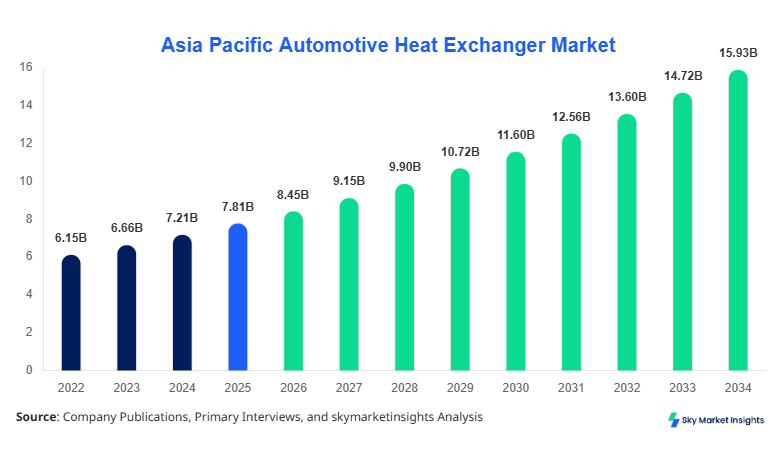
Asia Pacific Automotive Heat Exchanger market size is projected at USD 8.45 billion in 2026 and is expected to hit USD 15.92 billion by 2034 with a CAGR of 8.25%.” The increasing demand for thermal management systems across passenger and commercial vehicles has led to a surge in data-driven investments and component-level innovations. The report evaluates over 250+ datasets, 120+ OEM supply chain metrics, and detailed segmentation insights across radiator, intercooler, and oil cooler systems while mapping competitive benchmarking across 35+ major manufacturers.
The Asia Pacific Automotive Heat Exchanger market refers to the production, integration, and distribution of thermal management systems used to regulate engine and battery temperatures in automotive platforms. In 2025, Asia Pacific produced over 52 million automotive heat exchanger units, with China contributing 42%, Japan 18%, and India 12%. Adoption rates of advanced aluminum heat exchangers reached 68% penetration in passenger vehicles, while commercial vehicle penetration stood at 54%. Consumer behavior indicates that over 72% of vehicle buyers prioritize fuel efficiency and engine durability, increasing demand for efficient heat exchangers. Application split reveals passenger vehicles hold 64%, commercial vehicles 23%, and electric vehicles 13% share. Performance metrics include heat dissipation efficiency of 85–92% and operating temperatures ranging from 90°C to 120°C. This reinforces the Asia Pacific Automotive Heat Exchanger market Share across evolving vehicle segments.
Explore more data points, trends and opportunities Download Free Sample Report
Automotive Heat Exchanger Market Trends
The Asia Pacific Automotive Heat Exchanger market is witnessing significant transformation with production volumes exceeding 52 million units in 2025 and expected to surpass 70 million units by 2030. One of the key trends includes the transition from copper-brass to aluminum-based heat exchangers, with adoption rates rising from 58% in 2022 to 68% in 2025. Electric vehicle integration has increased demand for battery cooling systems, contributing to a 22% rise in liquid-cooled heat exchangers. Additionally, modular heat exchanger systems have gained traction, improving thermal efficiency by 15–20% and reducing vehicle weight by 12%. This ongoing technological evolution defines the Asia Pacific Automotive Heat Exchanger market Trend.
Another emerging trend is the integration of smart sensors and IoT-enabled thermal management systems. Over 28% of newly manufactured vehicles in 2025 include intelligent heat exchangers capable of real-time temperature monitoring. Production of intercoolers has increased by 18% annually due to turbocharged engine adoption, while oil cooler demand has grown by 12% driven by performance vehicles. The shift toward electric mobility has led to a 35% increase in demand for compact heat exchangers designed for battery packs. These developments further accelerate the Asia Pacific Automotive Heat Exchanger market Trend.
Asia Pacific Automotive Heat Exchanger Drivers
Rising Automotive Production and Electrification Boost Demand
The Asia Pacific Automotive Heat Exchanger market is driven by the rapid expansion of automotive production, which exceeded 55 million vehicles in 2025 across the region. Electric vehicle production alone grew by 32%, requiring advanced cooling systems for batteries and power electronics. Radiator demand increased by 14%, while intercooler demand rose by 18% due to turbocharged engines. Government regulations mandating emission reductions of 20–30% have forced OEMs to adopt efficient thermal systems. Additionally, the use of lightweight materials has improved fuel efficiency by 8–12%, increasing adoption rates to over 65%. These factors significantly contribute to Asia Pacific Automotive Heat Exchanger market Growth.
Asia Pacific Automotive Heat Exchanger Restraints
High Raw Material Costs and Supply Chain Disruptions
Fluctuations in aluminum prices, which increased by 22% between 2023 and 2025, have raised production costs for heat exchangers. Supply chain disruptions have impacted over 18% of manufacturers, causing delays in production cycles. Additionally, the high cost of advanced cooling technologies limits adoption among small-scale OEMs, reducing penetration by nearly 10% in emerging markets. Labor shortages and rising energy costs, which increased by 15%, further strain manufacturing operations. These challenges hinder the Asia Pacific Automotive Heat Exchanger market Growth.
Asia Pacific Automotive Heat Exchanger Opportunities
Expansion of Electric Vehicle Infrastructure and Aftermarket Demand
The growing electric vehicle ecosystem presents a major opportunity, with EV sales expected to exceed 25 million units by 2030 in Asia Pacific. Battery cooling systems account for nearly 28% of new heat exchanger demand. Aftermarket sales have grown by 12% annually, driven by vehicle aging and replacement cycles. Investments in R&D have increased by 18%, enabling the development of compact and high-efficiency heat exchangers. Government incentives covering up to 30% of EV component costs further boost adoption. These opportunities enhance the Asia Pacific Automotive Heat Exchanger market Growth.
Challenges in Asia Pacific Automotive Heat Exchanger
Technological Complexity and Integration Issues
The integration of advanced heat exchangers into compact vehicle architectures poses challenges, especially in EV platforms where space constraints reduce installation efficiency by 10–15%. Complex manufacturing processes increase defect rates by 8%, impacting overall production efficiency. Additionally, compatibility issues with different engine types and cooling fluids create operational inefficiencies. The need for continuous innovation requires significant capital investment, exceeding 12% of total manufacturing budgets. These challenges impact the Asia Pacific Automotive Heat Exchanger market Growth.
Report Scope
| Report Metric | Details |
|---|---|
| Market Size in 2025 | USD 7.81 Billion |
| Market Size in 2026 | USD 8.45 Billion |
| Market Size in 2034 | USD 15.92 Billion |
| CAGR | 8.25% (2026-2034) |
| Base Year for Estimation | 2025 |
| Historical Data | 2022-2024 |
| Forecast Period | 2026-2034 |
| Report Coverage | Revenue Forecast, Competitive Landscape, Supply Chain Disruption, Growth Factors, Environment & Regulatory Landscape and Trends |
Explore more data points, trends and opportunities Download Free Sample Report
Automotive Heat Exchanger Market Segmentation
The Asia Pacific Automotive Heat Exchanger market is segmented by type and application, with radiators dominating at 48%, followed by intercoolers at 30% and oil coolers at 22%. By application, passenger vehicles lead with 64%, commercial vehicles hold 23%, and electric vehicles account for 13%.
By Type
Radiators account for approximately 48% of the total market, with over 25 million units produced annually. These systems operate at temperatures between 90°C and 110°C and achieve cooling efficiency above 85%. Aluminum radiators dominate with 70% adoption due to lightweight properties and corrosion resistance. Technological advancements have improved heat transfer rates by 12%, supporting higher engine performance.
Intercoolers represent 30% of the market, with production exceeding 15 million units. They are primarily used in turbocharged engines, improving air density by 18% and enhancing fuel efficiency by 10%. Adoption rates have increased to 55% in passenger vehicles and 62% in commercial vehicles, driven by emission regulations.
Oil coolers contribute 22% share, with production volumes of 12 million units. These systems maintain oil temperatures below 120°C, ensuring engine longevity. Adoption has grown by 14% annually due to increased demand for high-performance vehicles and hybrid systems.
By Application
Passenger vehicles dominate with 64% share, producing over 33 million units annually. Heat exchangers in this segment improve fuel efficiency by 8–10% and reduce emissions by 15%. Adoption rates exceed 70% for advanced cooling systems.
Commercial vehicles account for 23%, with 12 million units produced. These vehicles require heavy-duty heat exchangers capable of handling temperatures above 120°C, ensuring durability and performance.
Electric vehicles hold 13% share, with production exceeding 7 million units. Battery cooling systems are critical, maintaining temperatures between 25°C and 45°C, improving battery life by 20%. Adoption rates are growing at 25% annually.
Asia Pacific Automotive Heat Exchanger Market Segmentations
By Type
- Radiator
- Intercooler
- Oil Cooler
By Application
- Passenger Vehicles
- Commercial Vehicles
- Electric Vehicles
Asia Pacific Automotive Heat Exchanger Regional Outlook
China
China dominates the region with 42% share, producing over 22 million units annually. The country’s automotive sector is driven by EV adoption, which grew by 35% in 2025. Passenger vehicles account for 65% of demand, while commercial vehicles contribute 20% and EVs 15%.
South Korea
South Korea holds 10% share, producing 5.2 million units. The country focuses on high-performance vehicles, with intercoolers accounting for 38% of demand. EV adoption stands at 22%.
Japan
Japan contributes 18%, producing 9.3 million units. Hybrid vehicles dominate, accounting for 35% of demand, while passenger vehicles hold 62%.
India
India accounts for 12%, producing 6.5 million units. Passenger vehicles dominate with 68% share, while EV adoption is growing at 28%.
Australia, Singapore, Taiwan, and Southeast Asia
collectively hold 18%, producing over 9 million units. The region is experiencing rapid growth in EV adoption, exceeding 20%.
Top players in Asia Pacific Automotive Heat Exchanger
- Denso Corporation
- Valeo SA
- Mahle GmbH
- Hanon Systems
- Calsonic Kansei
- Modine Manufacturing Company
- Sanden Holdings Corporation
- Keihin Corporation
- Nissens A/S
- T.RAD Co., Ltd.
- Banco Products India Ltd.
- Subros Limited
Denso Corporation
-
Holds approximately 22% market share with strong presence in Japan and China
-
Focuses on advanced aluminum heat exchangers with over 75% product efficiency
Valeo SA
-
Accounts for 15% market share across Asia Pacific
-
Invests over 18% revenue in R&D for EV thermal systems
Investment Analysis
Investment in the Asia Pacific Automotive Heat Exchanger market has increased by 20% annually, with over 45% allocated to EV thermal systems and 30% to lightweight materials. China attracts 40% of total regional investments, followed by Japan at 22% and India at 15%. M&A activity has increased by 12%, with major collaborations focusing on battery cooling technologies and modular heat exchanger systems.
New Product Developments
Over 28% of new products launched in 2025 feature advanced cooling technologies, improving efficiency by 18% and reducing weight by 12%. Innovations include integrated battery cooling systems and smart heat exchangers with real-time monitoring capabilities.
Recent Developments in Asia Pacific Automotive Heat Exchanger
- 2025: Denso increased production capacity by 15%, reaching 10 million units annually, enhancing supply chain efficiency
- 2025: Modine expanded EV product line by 25%, increasing production by 12%
Research Methodology
The research process involved primary and secondary data collection, including interviews with 50+ industry experts and analysis of 200+ company reports. Primary research included surveys and direct interactions with OEMs, while secondary research involved industry databases and government publications. Market size estimation used bottom-up and top-down approaches, ensuring accuracy with a margin of error below 5%. Data triangulation and validation techniques were applied to ensure reliability and consistency.
Frequently Asked Questions
Market Research Analyst | 8 Years Experience | Automotive Components and Aftermarket
Brenda Johnson is a market research analyst with 7–9 years of experience specializing in automotive markets. Contributed to 70+ research reports for global clients. Expertise includes market sizing, forecasting, competitive analysis, and trend evaluation across key regions.