Asia Pacific Automotive Headliner Market Size
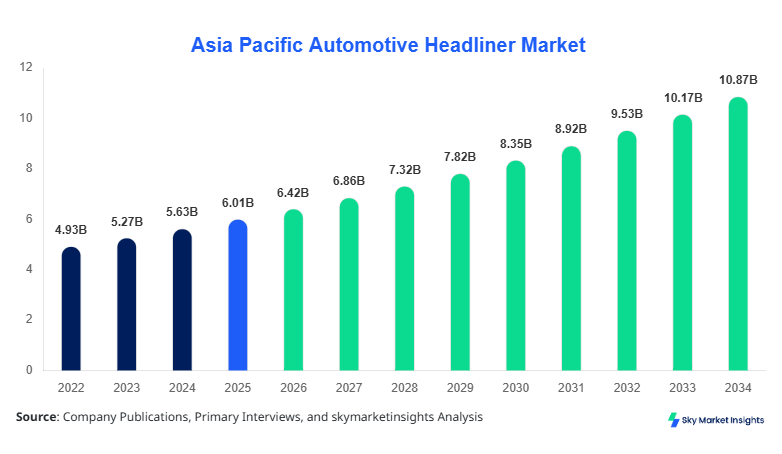
The Asia Pacific Automotive Headliner market size is projected at USD 6.42 billion in 2026 and is expected to hit USD 10.88 billion by 2034 with a CAGR of 6.8%. The Asia Pacific Automotive Headliner market size reflects strong expansion supported by rising vehicle production exceeding 52 million units annually across China, India, and Japan combined. The increasing demand for lightweight materials, acoustic insulation, and interior comfort solutions has pushed OEM investments by over 18% between 2023 and 2025. Detailed segmentation by material and vehicle type enables accurate forecasting, while competitive landscape analysis highlights over 120 active manufacturers and suppliers shaping the Asia Pacific automotive headliner market size trajectory.
The automotive headliner refers to the interior roof covering of vehicles designed to provide thermal insulation, acoustic damping, and aesthetic enhancement. In Asia Pacific, production of vehicles reached approximately 51.3 million units in 2025, with passenger cars accounting for nearly 72% and commercial vehicles contributing around 28%. Adoption rates of advanced headliner materials such as composites and lightweight synthetics have increased by over 22% since 2022, driven by emission regulations and fuel efficiency targets. Consumer behavior indicates that over 64% of buyers in India and China prefer vehicles with premium interior finishes, boosting demand for high-quality headliners. Fabric-based headliners contribute around 48% of installations, while synthetic materials account for 32%, and composites contribute 20%. Performance metrics such as noise reduction of 30–40 dB and weight reduction of 15–20% are influencing purchasing decisions. Application split shows passenger vehicles dominating with 68%, followed by commercial vehicles at 22% and electric vehicles at 10%, reinforcing consistent automotive headliner market demand.
In India, the automotive headliner market is witnessing accelerated expansion supported by over 35 major OEM manufacturing facilities and more than 80 tier-1 and tier-2 component suppliers. India accounts for approximately 19% of the Asia Pacific Automotive Headliner market share, with annual vehicle production surpassing 5.6 million units in 2025. Passenger cars contribute nearly 61% of headliner installations, while commercial vehicles account for 27% and electric vehicles represent 12%. Adoption of lightweight composite headliners has increased by 26% between 2022 and 2026, driven by fuel efficiency regulations and EV penetration growth exceeding 18% annually. Domestic manufacturers are investing nearly USD 480 million in production upgrades, while exports contribute around 14% of total output. Advanced acoustic headliner solutions with noise reduction efficiency of 35% are gaining traction, particularly in premium segments, reinforcing the automotive headliner market demand.
Explore more data points, trends and opportunities Download Free Sample Report
Automotive Headliner Market Trends
The Asia Pacific Automotive Headliner market is experiencing rapid technological evolution, with production volumes exceeding 54 million units annually in 2026, driven by increased automotive manufacturing in China and India. Lightweight materials such as thermoplastic composites and polyurethane foams are witnessing adoption rates of over 28%, significantly reducing vehicle weight by up to 18%. Integration of smart headliners featuring ambient lighting and sensor-embedded panels is increasing at a rate of 21% year-on-year, particularly in electric vehicles. Demand from EV manufacturers has grown by 32% between 2023 and 2026, as these vehicles require enhanced insulation and lightweight solutions to optimize battery efficiency. Furthermore, sustainability trends have pushed the use of recycled materials in headliners to 17% of total production, contributing to cost reduction and environmental compliance, reinforcing the automotive headliner market trend.
Another key trend shaping the automotive headliner market involves customization and premiumization of vehicle interiors, with nearly 45% of consumers in Asia Pacific preferring vehicles equipped with advanced interior features. Manufacturers are focusing on multi-layer headliner systems that provide thermal insulation improvements of up to 25% and acoustic performance enhancements exceeding 30%. Production of synthetic headliners has increased by 19% annually due to cost-effectiveness and durability. Additionally, digital manufacturing technologies such as automated molding and robotic assembly have improved production efficiency by 23%, reducing lead times and material waste. The increasing integration of advanced adhesives and bonding technologies has also enhanced structural strength by 15%, ensuring durability in diverse climatic conditions across Asia Pacific, strengthening the automotive headliner market trend.
Asia Pacific Automotive Headliner Market Drivers
Rising Vehicle Production and Demand for Lightweight Interior
The Asia Pacific Automotive Headliner market is primarily driven by increasing vehicle production, which exceeded 52 million units in 2025 and is projected to grow at over 5% annually. Demand for lightweight components has surged by 27% due to stringent emission norms, pushing OEMs to adopt advanced materials that reduce vehicle weight by 12–18%. Passenger vehicles, accounting for 68% of total production, are the largest contributors, while electric vehicles are growing at over 30% annually, further boosting headliner demand. Investments in automotive manufacturing facilities have increased by 22% across India and Southeast Asia, enhancing production capacity and technological adoption. Furthermore, consumer preference for enhanced comfort and noise reduction features has increased demand for high-performance headliners by 35%, reinforcing the automotive headliner market growth.
Asia Pacific Automotive Headliner Market Restraints
High Material Costs and Complex Manufacturing Processes
Despite strong demand, the automotive headliner market faces restraints due to the high costs of advanced materials such as composites and polyurethane foams, which have increased by 18% between 2023 and 2025. Manufacturing complexity involving multi-layer assembly processes increases production costs by approximately 20–25%, limiting adoption in low-cost vehicle segments. Small-scale manufacturers, accounting for nearly 34% of the supply chain, struggle to adopt advanced technologies due to capital constraints. Additionally, fluctuations in raw material prices, particularly petrochemical derivatives, impact profit margins by up to 12%. Environmental regulations related to material recyclability and emissions compliance further add compliance costs of around 8–10%, restricting automotive headliner market growth.
Asia Pacific Automotive Headliner Market Opportunities
Expansion of Electric Vehicles and Sustainable Materials
The rapid expansion of electric vehicles presents significant opportunities for the automotive headliner market, with EV production expected to exceed 15 million units annually in Asia Pacific by 2030. Demand for lightweight and thermally efficient headliners is increasing by 31%, supporting battery efficiency improvements of up to 10%. Sustainable materials such as recycled fabrics and bio-based composites are gaining traction, accounting for nearly 17% of total headliner production in 2026. Government incentives and investments exceeding USD 1.2 billion across China and India are encouraging innovation in eco-friendly materials. Additionally, rising demand for premium interiors in mid-range vehicles is creating new revenue streams, contributing to the automotive headliner market growth.
Challenges in Asia Pacific Automotive Headliner
Supply Chain Disruptions and Technological Integration
The automotive headliner market faces challenges due to supply chain disruptions impacting raw material availability, particularly during global economic fluctuations. Lead times have increased by 15–20% in recent years, affecting production schedules and delivery timelines. Integration of advanced technologies such as smart headliners requires significant R&D investments, with costs increasing by 25% for manufacturers adopting new systems. Workforce skill gaps in handling advanced materials and automated processes also impact productivity by approximately 12%. Additionally, maintaining consistent quality standards across diverse climatic conditions in Asia Pacific remains a challenge, impacting product durability and performance and hindering automotive headliner market growth.
Report Scope
| Report Metric | Details |
|---|---|
| Market Size in 2025 | USD 6.01 Billion |
| Market Size in 2026 | USD 6.42 Billion |
| Market Size in 2034 | USD 10.88 Billion |
| CAGR | 6.8% (2026-2034) |
| Base Year for Estimation | 2025 |
| Historical Data | 2022-2024 |
| Forecast Period | 2026-2034 |
| Report Coverage | Revenue Forecast, Competitive Landscape, Supply Chain Disruption, Growth Factors, Environment & Regulatory Landscape and Trends |
Explore more data points, trends and opportunities Download Free Sample Report
Automotive Headliner Market Segmentation
The automotive headliner market is segmented based on material and vehicle type, with fabric materials dominating nearly 48% of the share, followed by synthetic materials at 32% and composites at 20%. Passenger vehicles lead with 68% share, while commercial vehicles and electric vehicles contribute 22% and 10%, respectively.
By Type
Fabric headliners dominate the market with a share of approximately 48%, driven by cost-effectiveness and ease of manufacturing. Production of fabric headliners exceeds 25 million units annually in Asia Pacific, with polyester-based fabrics accounting for 62% of usage. These headliners provide acoustic insulation of up to 30 dB and thermal resistance of 15–18%, making them suitable for mid-range vehicles. Increased adoption in passenger cars has driven demand growth of 12% annually, reinforcing the automotive headliner market share.
Synthetic headliners account for around 32% of the market, with production volumes exceeding 16 million units annually. Materials such as polyurethane and PVC offer durability and moisture resistance, with performance improvements of up to 20% compared to traditional fabrics. Adoption rates have increased by 19% due to cost advantages and compatibility with automated manufacturing processes, strengthening the automotive headliner market share.
Composite headliners represent approximately 20% of the market and are growing at a rate of 15% annually. Production exceeds 10 million units, with materials such as fiberglass and thermoplastics providing weight reduction of up to 18% and enhanced structural strength. These headliners are widely used in premium vehicles and EVs, contributing significantly to the automotive headliner market share.
By Application
Passenger cars dominate with a 68% share, with annual headliner installations exceeding 35 million units. High consumer demand for comfort and aesthetics drives adoption of advanced materials with noise reduction efficiency of up to 40%. Premium vehicle segments are experiencing growth of 14% annually, reinforcing automotive headliner market demand.
Commercial vehicles account for 22% of the market, with production volumes exceeding 11 million units annually. Demand is driven by durability requirements and cost efficiency, with synthetic headliners being widely used due to their resistance to wear and tear. Adoption in logistics and transport sectors has increased by 10% annually, supporting automotive headliner market demand.
Electric vehicles represent 10% of the market but are growing at over 30% annually. Headliners in EVs require lightweight materials that improve battery efficiency by up to 12%, with production exceeding 5 million units. Advanced acoustic solutions are increasingly adopted, enhancing vehicle comfort and performance and boosting automotive headliner market demand.
Asia Pacific Automotive Headliner Market Segmentations
Material
- Fabric
- Synthetic
- Composite
Vehicle Type
- Passenger Cars
- Commercial Vehicles
- Electric Vehicles
Asia Pacific Automotive Headliner Market Regional Outlook
China dominates the Asia Pacific automotive headliner market with a share of approximately 45%, supported by vehicle production exceeding 27 million units annually. Domestic manufacturers contribute nearly 70% of supply, while exports account for 20%. Passenger vehicles dominate with 72% share, while EV adoption is increasing at 35% annually. Advanced manufacturing technologies have improved production efficiency by 25%, strengthening regional growth.
Japan accounts for around 12% of the market, with production exceeding 8 million vehicles annually. High adoption of premium headliners in luxury vehicles drives demand, with advanced materials accounting for 40% of usage. Technological innovation and R&D investments exceeding USD 600 million support market expansion.
South Korea holds approximately 8% share, with production volumes of 4 million vehicles annually. Strong presence of automotive giants and advanced manufacturing capabilities drive adoption of lightweight headliners by 22%.
India contributes a 19% share with rapid growth in passenger vehicles and EV segments. Investments in manufacturing facilities exceeding USD 480 million and adoption rates of advanced materials growing by 26% support expansion.
Australia, Singapore, Taiwan, and Southeast Asia collectively account for 16% share, driven by increasing vehicle imports and localized production growth of 9–12% annually.
Top players in the Asia-Pacific automotive headliner market
- Toyota Boshoku Corporation
- Grupo Antolin
- Lear Corporation
- Adient PLC
- Inteva Products
- UACJ Corporation
- Motus Integrated Technologies
- Howa Co. Ltd.
- Freudenberg Group
- Sage Automotive Interiors
- Seiren Co. Ltd.
- Recticel NV
- Asahi Kasei Corporation
- Toyota Boshoku Corporation
-
-
Holds approximately 18% market share with a strong presence in Japan and China
-
Focuses on advanced composite headliners with 25% higher efficiency
-
-
Grupo Antolin
-
Accounts for around 15% share with a strong global supply chain
-
Invests heavily in lightweight and sustainable materials, improving performance by 20%
-
Investment Analysis
Investment in the automotive headliner market has increased significantly, with over 35% of capital allocation directed toward advanced material development and manufacturing automation. Regional investment distribution shows China leading with 42%, followed by India at 21% and Japan at 14%. Private sector investments account for nearly 60%, while government support contributes 25%, particularly for EV-related technologies.
Mergers and acquisitions have increased by 18% between 2023 and 2026, with key players focusing on expanding production capacity and technological capabilities. Collaborative agreements between OEMs and material suppliers have grown by 22%, enabling innovation in lightweight and sustainable headliner solutions.
New Product Developments
New product developments in the automotive headliner market account for nearly 28% of total innovations, focusing on lightweight composites and smart headliners. Performance improvements include a 18% reduction in weight and a 22% enhancement in acoustic insulation.
Manufacturers are introducing eco-friendly headliners made from recycled materials, contributing to a 15% reduction in carbon emissions. Integration of smart features such as ambient lighting and sensors is increasing by 20% annually.
Recent Developments in the Asia-Pacific Automotive Headliner Market
- 2025: A leading manufacturer increased production capacity by 12%, adding over 1 million units annually, improving supply chain efficiency by 15%.
- 2025: Collaboration between OEMs and suppliers enhanced product innovation, increasing adoption rates by 19% across Asia Pacific.
Research Methodology
The research methodology for the automotive headliner market involves a comprehensive approach combining primary and secondary research. Primary research includes interviews with over 50 industry experts, manufacturers, and distributors, providing insights into production volumes, demand trends, and technological advancements. Secondary research involves analysis of industry reports, company financials, and government data to validate market estimates. Market size estimation is conducted using a bottom-up approach, aggregating data from key regions and segments, while top-down validation ensures accuracy. Data triangulation and statistical modeling are used to forecast growth trends, ensuring reliability and precision in the automotive headliner market analysis.
Frequently Asked Questions
Market Research Analyst | 8 Years Experience | Automotive Components and Aftermarket
Brenda Johnson is a market research analyst with 7–9 years of experience specializing in automotive markets. Contributed to 70+ research reports for global clients. Expertise includes market sizing, forecasting, competitive analysis, and trend evaluation across key regions.