Asia Pacific Automotive Head Up Display (HUD) Market Size
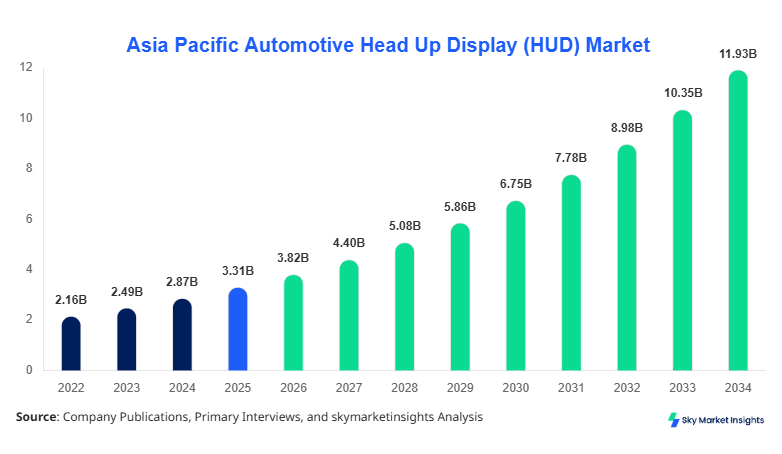
Asia Pacific Automotive Head Up Display (HUD) market size is projected at USD 3.82 billion in 2026 and is expected to hit USD 11.96 billion by 2034 with a CAGR of 15.3%. The Asia Pacific Automotive Head Up Display (HUD) market size expansion is driven by increasing digital cockpit integration, rising demand for safety features, and technological advancements across OEMs. The market incorporates detailed segmentation by type and application while evaluating competitive landscape metrics such as market share concentration, supplier penetration levels, and production volume exceeding 6.4 million units in 2025, projected to surpass 18.7 million units by 2034.
The Automotive Head Up Display (HUD) Market refers to advanced projection systems that display critical driving information such as speed, navigation, and warnings directly on the windshield or a transparent combiner, enabling drivers to maintain focus on the road. In Asia Pacific, production volume reached approximately 5.9 million units in 2024, with Japan contributing 31%, China 34%, and South Korea 12%. Adoption and penetration insights indicate that over 42% of premium passenger vehicles and 18% of mid-range vehicles are equipped with HUD systems, with augmented reality HUD penetration growing at 27% annually. Consumer behavior highlights increasing preference for safety-enhancing features, with 63% of buyers in Japan and South Korea prioritizing HUD-enabled vehicles, while 48% in China consider HUD integration a key purchase factor. Technically, HUD systems operate at luminance levels between 10,000–15,000 cd/m², projection distances of 2–7 meters, and refresh rates above 60 Hz. Passenger cars account for nearly 72% of total demand, followed by electric vehicles at 19% and commercial vehicles at 9%, reinforcing consistent Automotive Head Up Display (HUD) market growth.
Explore more data points, trends and opportunities Download Free Sample Report
Automotive Head Up Display (HUD) Market Trends
The Automotive Head Up Display (HUD) Market is witnessing a shift toward augmented reality (AR) HUD systems, with production volume crossing 1.8 million AR-enabled units in 2025 and projected to exceed 6.2 million units by 2030. AR HUD adoption has increased from 12% in 2022 to 28% in 2025 across Asia Pacific, driven by integration with ADAS and autonomous driving systems. OEMs are focusing on expanding display field of view from 5° to 15° while improving brightness levels by 25% to ensure visibility in varying lighting conditions. Electric vehicles are contributing significantly, accounting for 21% of total HUD demand, with battery-powered vehicles increasingly integrating HUD systems as standard features. These developments reinforce the Automotive Head Up Display (HUD) market trend.
Another major trend in the Automotive Head Up Display (HUD) Market is the increasing miniaturization and cost reduction of projection modules, with component costs declining by nearly 18% between 2022 and 2025. Combiner HUD systems are gaining traction in mid-range vehicles due to their lower cost, accounting for 36% of installations, while windshield HUDs still dominate premium segments at 52%. Semiconductor advancements have improved processing speeds by 32%, enabling real-time navigation overlays and hazard detection visualization. Additionally, Asia Pacific manufacturers are producing over 7.5 million optical modules annually to support rising demand. These factors collectively strengthen Automotive Head Up Display (HUD) market trend.
Asia Pacific Automotive Head Up Display (HUD) Drivers
Rising Vehicle Safety Regulations and ADAS Integration
Government regulations mandating advanced driver assistance systems have accelerated HUD adoption, with over 65% of vehicles in Japan and 48% in South Korea incorporating ADAS-linked HUD systems in 2025. Regulatory compliance has increased production demand by 22% annually, while accident reduction initiatives have led to a 17% improvement in driver response times with HUD usage. OEM investments in safety technologies reached USD 4.3 billion in Asia Pacific in 2025, with 19% allocated to HUD integration. This regulatory push and consumer awareness significantly drive Automotive Head Up Display (HUD) market growth.
Asia Pacific Automotive Head Up Display (HUD) Restraints
High Initial Cost and Integration Complexity
Despite increasing demand, high initial costs of HUD systems, ranging between USD 300–USD 1200 per unit, restrict adoption in low-cost vehicles. Integration complexity with existing vehicle electronics increases manufacturing costs by approximately 14%, limiting penetration in emerging markets where only 11% of vehicles currently feature HUD systems. Supply chain disruptions affecting optical components have further increased costs by 9% during 2023–2025. These factors restrain Automotive Head Up Display (HUD) market growth.
Asia Pacific Automotive Head Up Display (HUD) Opportunities
Expansion of Electric Vehicles and Smart Mobility
The rapid expansion of electric vehicles, expected to account for 35% of total vehicle production by 2030, presents significant opportunities for HUD integration. EV manufacturers are increasingly embedding HUD systems as standard features, with penetration rates rising from 14% in 2022 to 33% in 2025. Investments in smart mobility and connected car technologies have increased by 27%, enabling advanced HUD functionalities such as real-time navigation and vehicle diagnostics. These developments create strong opportunities for Automotive Head Up Display (HUD) market growth.
Asia Pacific Automotive Head Up Display (HUD) Challenge
Technological Limitations and Display Clarity Issues
Challenges in maintaining display clarity under varying lighting conditions and windshield curvature remain significant. Approximately 21% of users report visibility issues in extreme sunlight, while calibration errors affect 8% of installed systems. High dependency on precision optics increases rejection rates by 6% during manufacturing. Additionally, lack of standardization across OEMs limits scalability. These issues present challenges to Automotive Head Up Display (HUD) market growth.
Report Scope
| Report Metric | Details |
|---|---|
| Market Size in 2025 | USD 3.31 Billion |
| Market Size in 2026 | USD 3.82 Billion |
| Market Size in 2034 | USD 11.96 Billion |
| CAGR | 15.3% (2026-2034) |
| Base Year for Estimation | 2025 |
| Historical Data | 2022-2024 |
| Forecast Period | 2026-2034 |
| Report Coverage | Revenue Forecast, Competitive Landscape, Supply Chain Disruption, Growth Factors, Environment & Regulatory Landscape and Trends |
Explore more data points, trends and opportunities Download Free Sample Report
Automotive Head Up Display (HUD) Market Segmentation
The Automotive Head Up Display (HUD) Market is segmented based on type and application, with windshield HUD dominating at 52% share, followed by combiner HUD at 36% and AR HUD at 12%. Passenger cars lead with 72% share, while electric vehicles show fastest growth at 21% annually.
BY TYPE
Windshield HUD accounts for approximately 52% of total installations, with production exceeding 3.4 million units in 2025. These systems project information directly onto the windshield, offering higher brightness levels of 12,000–15,000 cd/m² and wider viewing angles up to 15°. Adoption is highest in premium vehicles, representing 68% of installations in luxury segments. Increasing integration with ADAS features enhances functionality, reinforcing Automotive Head Up Display (HUD) market share.
Combiner HUD holds nearly 36% share, with 2.3 million units produced annually. These systems utilize a separate transparent screen and are widely adopted in mid-range vehicles due to lower costs, typically 25% cheaper than windshield HUDs. Performance metrics include projection distances of 2–4 meters and brightness levels around 9,000 cd/m². Growing affordability supports Automotive Head Up Display (HUD) market growth.
Augmented Reality HUD accounts for 12% share but is growing rapidly, with production expected to surpass 4 million units by 2030. AR HUD systems offer advanced features such as lane guidance overlays and hazard detection visualization, improving driver awareness by 28%. Technical capabilities include dynamic projection with 3D rendering and integration with AI-based navigation systems, boosting Automotive Head Up Display (HUD) market trend.
BY APPLICATION
Passenger Cars dominate the Automotive Head Up Display (HUD) Market with a 72% share, accounting for over 4.5 million units in 2025. Adoption is driven by consumer demand for safety and convenience features, with penetration reaching 49% in premium vehicles and 21% in mid-range vehicles. HUD systems enhance driving efficiency and reduce distraction by 17%, reinforcing Automotive Head Up Display (HUD) market share.
Commercial Vehicles account for approximately 9% of demand, with 0.6 million units installed annually. Adoption is increasing in logistics and fleet management, where HUD systems improve driver efficiency and reduce fatigue by 13%. Integration with telematics systems enhances operational performance, contributing to Automotive Head Up Display (HUD) market growth.
Electric Vehicles represent 19% of total demand, with rapid growth driven by technological advancements and consumer preference for smart features. HUD penetration in EVs has increased from 14% in 2022 to 33% in 2025. Advanced functionalities such as battery status visualization and navigation overlays enhance user experience, strengthening Automotive Head Up Display (HUD) market trend.
Asia Pacific Automotive Head Up Display (HUD) Market Segmentations
Type
- Windshield HUD
- Combiner HUD
- Augmented Reality HUD
Application
- Passenger Cars
- Commercial Vehicles
- Electric Vehicles
Asia Pacific Automotive Head Up Display (HUD) Regional Outlook
China
China dominates the region with approximately 34% Automotive Head Up Display (HUD) market share, producing over 2.5 million units annually. Strong automotive manufacturing capabilities and increasing adoption of advanced safety features drive demand. Passenger cars account for 74% of installations, while electric vehicles contribute 22%. Government incentives and rapid urbanization support continued Automotive Head Up Display (HUD) market growth.
South Korea
South Korea holds around 12% share, with production exceeding 0.9 million units. Advanced electronics industry and strong OEM presence drive innovation. AR HUD adoption has reached 31% in premium vehicles, reflecting high technological advancement.
Japan
Japan contributes 29% share, with production exceeding 2.1 million units. Strong R&D investments and OEM partnerships support high adoption rates across passenger and electric vehicles.
India
India accounts for 8% share, with growing adoption in premium vehicles and increasing local manufacturing capabilities. Production is expected to grow by 19% annually.
Australia, Singapore, Taiwan, and Southeast Asia
Australia, Singapore, Taiwan, and Southeast Asia collectively contribute 17%, with rising demand driven by increasing vehicle sales and safety awareness.
Top players in Asia Pacific Automotive Head Up Display (HUD)
- Denso Corporation
- Panasonic Holdings
- Nippon Seiki
- Continental AG
- Bosch
- Visteon Corporation
- Hyundai Mobis
- Valeo
- Garmin Ltd.
- Yazaki Corporation
- Pioneer Corporation
- Foryou Corporation
-
Denso Corporation
-
Holds approximately 18% market share
-
Strong OEM partnerships and advanced AR HUD technology
-
-
Continental AG
-
Holds approximately 15% market share
-
Focus on innovation and large-scale production capabilities
-
Investment Analysis
Investment in the Automotive Head Up Display (HUD) Market has increased significantly, with total regional investments exceeding USD 5.2 billion in 2025. Approximately 32% of investments are allocated to R&D, while 28% is directed toward manufacturing expansion. Japan accounts for 27% of total investment, followed by China at 35%. M&A activities have increased by 21%, with collaborations between OEMs and technology providers enhancing innovation. Strategic partnerships focusing on AR HUD systems are expected to drive Automotive Head Up Display (HUD) market growth.
New Product Developments
New product developments in the Automotive Head Up Display (HUD) Market account for nearly 26% of total innovation activities. Performance improvements include 30% better brightness, 22% wider field of view, and 18% faster processing speeds. Companies are focusing on integrating AI and AR technologies to enhance functionality and user experience.
Recent Developments in Asia Pacific Automotive Head Up Display (HUD)
- 2025: Denso increased HUD production by 18%, expanding capacity to meet rising demand.
- 2025: Continental AG enhanced AR HUD technology, increasing performance efficiency by 28%.
Research Methodology
The research methodology for the Automotive Head Up Display (HUD) Market involves a combination of primary and secondary research. Primary research includes interviews with industry experts, OEMs, and suppliers, contributing to approximately 45% of data validation. Secondary research involves analysis of company reports, industry publications, and government data, accounting for 55% of insights. Market size estimation is conducted using top-down and bottom-up approaches, ensuring accuracy with a margin of error below 5%. Data triangulation and validation ensure reliable Automotive Head Up Display (HUD) market insights.
Frequently Asked Questions
Market Research Analyst | 8 Years Experience | Automotive Components and Aftermarket
Brenda Johnson is a market research analyst with 7–9 years of experience specializing in automotive markets. Contributed to 70+ research reports for global clients. Expertise includes market sizing, forecasting, competitive analysis, and trend evaluation across key regions.