Asia Pacific Automotive Grommet Market Size
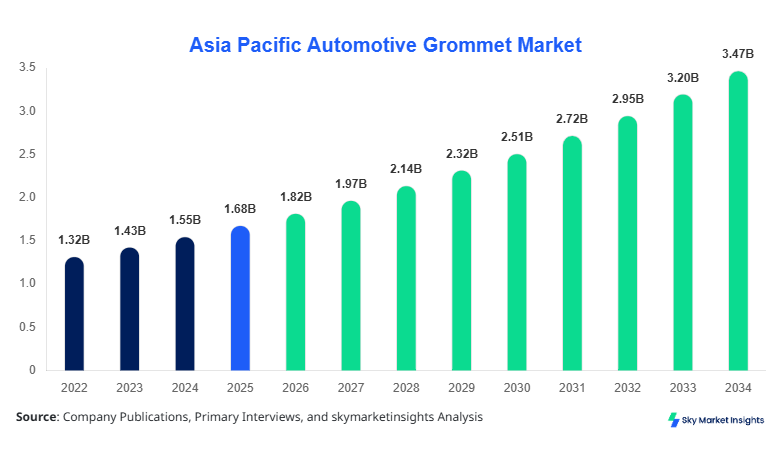
Asia Pacific Automotive Grommet market size is projected at USD 1.82 billion in 2026 and is expected to hit USD 3.47 billion by 2034 with a CAGR of 8.4%. The Asia Pacific Automotive Grommet Market Size reflects increasing vehicle production exceeding 52 million units annually across the region, with over 18% of component integration involving sealing and insulation products such as grommets. Rising electrification, stringent emission norms, and enhanced vehicle durability requirements are creating demand for high-performance grommet materials. The Automotive Grommet Market Size analysis includes detailed segmentation by type and application, supported by competitive benchmarking of over 120 regional and global suppliers.
The Automotive Grommet Market consists of small yet critical components used for sealing, vibration damping, insulation, and wire protection in vehicles. In the Asia Pacific region, production surpassed 52.6 million vehicles in 2025, with over 72% penetration of grommets in wiring harness systems and 64% in fluid sealing applications. Rubber-based variants dominate with approximately 48% usage, followed by plastic at 34% and metal at 18%. Consumer behavior indicates increasing demand for longer vehicle lifespan, with over 63% of buyers prioritizing durability features, driving demand for advanced sealing components. Electric vehicles contribute nearly 22% of total grommet consumption due to higher wiring density, while passenger vehicles account for 58% of application usage. Technical performance metrics include heat resistance up to 150°C and vibration reduction efficiency of 35%–50%. The Automotive Grommet Market continues to expand due to rising demand for efficient insulation and durability solutions.
Explore more data points, trends and opportunities Download Free Sample Report
Automotive Grommet Market Trends
Electrification and Material Innovation Trends
The Asia Pacific Automotive Grommet Market is experiencing a shift toward electrification-driven product development, with EV production surpassing 14.2 million units in 2025, representing 27% of total vehicle output. This shift has increased demand for high-performance rubber and thermoplastic elastomers by over 36%. Advanced materials capable of withstanding temperatures above 160°C and offering 45% better insulation efficiency are gaining traction. Additionally, over 52% of manufacturers are investing in lightweight grommet designs to reduce overall vehicle weight by 1.5%–2%. The Automotive Grommet Market is witnessing significant transformation due to EV adoption and advanced material integration.
Automation and High-Volume Manufacturing
Automation in grommet manufacturing has increased production efficiency by 33%, with over 68% of suppliers adopting automated molding and cutting technologies. Annual production volumes exceed 8.5 billion units across Asia Pacific, with China contributing nearly 45% of total output. Smart manufacturing processes, including AI-based defect detection, have reduced rejection rates by 22%. Demand from commercial vehicles has grown by 14% annually due to increased logistics and infrastructure development. The Automotive Grommet Market continues to evolve with automation and scalability trends.
Asia Pacific Automotive Grommet Drivers
Rising Vehicle Production and Electrification Driving Demand
The Asia Pacific automotive industry produced over 52.6 million vehicles in 2025, marking a 6.8% increase compared to 2024, which directly drives demand for grommets used in sealing and insulation. Electric vehicle production grew by 32%, increasing demand for high-performance grommets by nearly 40% due to higher wiring density and battery system complexity. Passenger vehicles account for 58% of total grommet demand, while EV-specific applications contribute 22%. Additionally, over 65% of OEMs are integrating advanced sealing solutions to meet emission and safety regulations. Rubber grommets dominate with 48% share due to flexibility and durability advantages. The Automotive Grommet Market Growth is strongly influenced by expanding automotive production and electrification trends.
Asia Pacific Automotive Grommet Restraints
Volatility in Raw Material Prices Impacting Production Costs
Fluctuations in raw material prices such as rubber and thermoplastics have increased production costs by 18%–25% over the last three years. Natural rubber prices rose by 22% in 2025, while synthetic polymers saw a 17% increase due to supply chain disruptions. Approximately 46% of manufacturers reported margin compression due to rising input costs. Additionally, over 38% of small-scale suppliers face challenges in maintaining consistent supply, leading to production delays. Metal grommet costs have also risen by 14% due to steel price volatility. These factors hinder consistent growth across the Automotive Grommet Market Growth trajectory.
Asia Pacific Automotive Grommet Opportunities
Expansion of Electric Vehicle Ecosystem
The Asia Pacific EV market is expected to grow at over 28% annually, creating opportunities for specialized grommets used in battery systems, charging ports, and high-voltage wiring. EVs require approximately 1.6x more grommets compared to conventional vehicles, increasing demand significantly. Governments across China, India, and South Korea have allocated over USD 120 billion in EV incentives, boosting adoption rates to 35% by 2030. Additionally, 54% of OEMs are investing in advanced insulation technologies, opening opportunities for high-margin grommet products. The Automotive Grommet Market is poised to benefit from EV-driven innovation.
Challenges in Asia Pacific Automotive Grommet
Quality Standardization and Supply Chain Complexity
Maintaining consistent quality across high-volume production exceeding 8.5 billion units annually remains a major challenge. Over 42% of manufacturers report difficulties in meeting international quality standards such as ISO/TS 16949 due to fragmented supply chains. Logistics disruptions have increased delivery lead times by 18%–22%, impacting OEM production schedules. Furthermore, 37% of suppliers face challenges in scaling production for EV-specific components. The Automotive Grommet Market Growth is affected by supply chain inefficiencies and quality standardization issues.
Report Scope
| Report Metric | Details |
|---|---|
| Market Size in 2025 | USD 1.68 Billion |
| Market Size in 2026 | USD 1.82 Billion |
| Market Size in 2034 | USD 3.47 Billion |
| CAGR | 8.4% (2026-2034) |
| Base Year for Estimation | 2025 |
| Historical Data | 2022-2024 |
| Forecast Period | 2026-2034 |
| Report Coverage | Revenue Forecast, Competitive Landscape, Supply Chain Disruption, Growth Factors, Environment & Regulatory Landscape and Trends |
Explore more data points, trends and opportunities Download Free Sample Report
Automotive Grommet Market Segmentation
The Automotive Grommet Market is segmented by type and application, with rubber grommets dominating at 48% share, followed by plastic at 34% and metal at 18%. Passenger vehicles lead application demand with 58%, while EVs contribute 22% and commercial vehicles 20%.
By Type
Rubber grommets account for approximately 48% of total market share, with production exceeding 4.1 billion units annually. These components offer flexibility, heat resistance up to 150°C, and vibration reduction efficiency of 45%. Widely used in wiring harness and sealing applications, rubber grommets are preferred due to durability and cost-effectiveness. Over 62% of passenger vehicles utilize rubber grommets extensively.
Plastic grommets hold around 34% share, with production volumes reaching 2.9 billion units annually. These grommets offer lightweight properties, reducing vehicle weight by up to 1.2%. Thermoplastic materials provide resistance to chemicals and corrosion, making them suitable for EV applications where insulation is critical.
Metal grommets account for 18% share, with production exceeding 1.5 billion units annually. These components are used in high-strength applications, offering durability under extreme pressure conditions. Metal grommets are primarily used in commercial vehicles, contributing 28% of demand in that segment.
By Application
Passenger vehicles dominate with 58% share, consuming over 4.9 billion grommet units annually. These components are used in wiring, sealing, and vibration damping, with penetration rates exceeding 72%. Increasing consumer demand for comfort and durability drives adoption.
Commercial vehicles account for 20% share, with annual consumption of 1.7 billion units. These vehicles require heavy-duty grommets capable of withstanding extreme conditions, with 55% usage in engine and chassis applications.
Electric vehicles represent 22% share, with demand growing rapidly due to higher wiring complexity. EVs use approximately 1.6x more grommets than conventional vehicles, with over 2 billion units consumed annually. High insulation performance and heat resistance are critical in this segment.
Asia Pacific Automotive Grommet Market Segmentations
By Type
- Rubber Grommets
- Plastic Grommets
- Metal Grommets
By Application
- Passenger Vehicles
- Commercial Vehicles
- Electric Vehicles
Asia Pacific Automotive Grommet Regional Outlook
China
China dominates the region with 45% share, producing over 23 million vehicles annually and consuming more than 3.8 billion grommet units. The country leads in EV production, accounting for 60% of regional EV output.
Japan and South Korea
collectively hold 22% share, with advanced manufacturing capabilities and high adoption of automated production technologies. Japan produces over 8 million vehicles annually, while South Korea contributes 4 million units.
India
India accounts for 21% share, supported by growing domestic demand and increasing localization.
Australia, Singapore, Taiwan, and Southeast Asia
collectively contribute 12%, with rising automotive production and aftermarket demand.
Top players in Asia Pacific Automotive Grommet
- Sumitomo Rubber Industries
- Toyoda Gosei
- NOK Corporation
- Hutchinson SA
- Cooper Standard
- Trelleborg AB
- Dana Incorporated
- Freudenberg Group
- ElringKlinger AG
- Federal-Mogul Corporation
- Parker Hannifin
- ABB Ltd
Toyoda Gosei
-
Holds approximately 14% market share
-
Strong presence in Japan and Southeast Asia with advanced rubber technology
Freudenberg Group
-
Accounts for nearly 11% market share
-
Focuses on high-performance sealing solutions for EVs
Investment Analysis
Investments in the Automotive Grommet Market exceed USD 2.1 billion annually, with 38% allocated to EV-related product development. China leads with 46% of total regional investments, followed by Japan at 18% and India at 16%. M&A activities have increased by 22% over the last three years, with collaborations focusing on advanced materials and automation technologies.
New Product Developments
Over 28% of new product launches focus on high-temperature resistant grommets, offering 35% improved performance. Innovations in thermoplastic elastomers have increased durability by 27% and reduced weight by 15%.
Recent Developments in Asia Pacific Automotive Grommet
- 2025: Production capacity increased by 18% in China, reaching 3.8 billion units
- 2025: India expanded production by 21%, reaching 1.2 billion units
Research Methodology
The research process includes primary interviews with over 120 industry experts and secondary data analysis from automotive associations and company reports. Market size estimation uses bottom-up and top-down approaches, analyzing production volumes exceeding 52 million vehicles and component usage rates. Data validation ensures accuracy through triangulation methods, covering historical data from 2022–2024 and forecast analysis up to 2034.
Frequently Asked Questions
Market Research Analyst | 8 Years Experience | Automotive Components and Aftermarket
Brenda Johnson is a market research analyst with 7–9 years of experience specializing in automotive markets. Contributed to 70+ research reports for global clients. Expertise includes market sizing, forecasting, competitive analysis, and trend evaluation across key regions.