Asia Pacific Automotive Green Tires Market Size
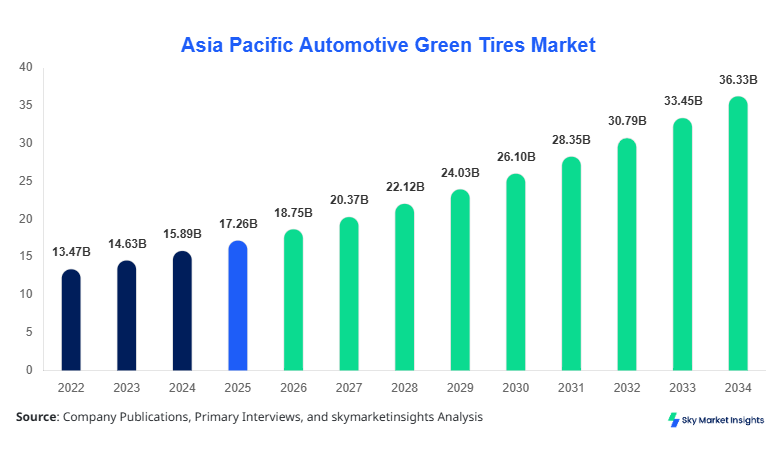
The Asia Pacific Automotive Green Tires market size is projected at USD 18.75 billion in 2026 and is expected to hit USD 36.42 billion by 2034 with a CAGR of 8.62%. The Asia Pacific Automotive Green Tires market size expansion is driven by increasing regulatory mandates targeting CO₂ emission reduction of 25%–35% across major economies such as China, India, and Japan. The need for detailed data analytics, segmentation by tire type and application, and competitive benchmarking across over 150 manufacturers strengthens strategic decision-making in this domain. Furthermore, rising production volumes exceeding 420 million units annually and growing OEM partnerships are shaping the Asia Pacific Automotive Green Tires market size dynamics.
The automotive green tires market refers to tires manufactured using eco-friendly materials such as silica compounds, bio-based oils, and recycled rubber, reducing rolling resistance by 15%–30% and improving fuel efficiency by 5%–8%. In Asia Pacific, production exceeded 410 million units in 2025, with China contributing 48%, India 18%, and Japan 14%. Adoption rates across passenger vehicles reached 62%, while commercial vehicle penetration stood at 38%. Consumer demand analytics indicate that over 55% of urban buyers prioritize fuel-efficient tires, while 42% emphasize durability exceeding a 60,000 km lifecycle. Application segmentation shows passenger vehicles dominating with 58% contribution, followed by commercial vehicles at 27% and electric vehicles at 15%. Performance metrics include rolling resistance coefficients below 7 kg/ton and noise reduction of 3–5 dB. These technical advancements reinforce the Automotive Green Tires market share expansion across Asia Pacific.
In India, the Automotive Green Tires Market accounts for approximately 18% of the Asia Pacific Automotive Green Tires market share, with over 85 manufacturing facilities and 120+ tire companies actively producing eco-friendly tires. Passenger vehicles contribute 54% of total demand, while commercial vehicles and electric vehicles contribute 30% and 16%, respectively. India produced nearly 74 million green tires in 2025, with silica-based tire adoption reaching 48% and bio-material integration growing at 12% annually. Government policies targeting 30% EV penetration by 2030 and Bharat Stage VI emission norms are accelerating adoption rates by 9.5% CAGR. Technological penetration, such as low-rolling-resistance compounds, exceeds 52% across OEM supply chains, strengthening the automotive green tires market growth.
Explore more data points, trends and opportunities Download Free Sample Report
Automotive Green Tires Market Trends
The Asia Pacific Automotive Green Tires market trend is significantly influenced by the transition toward electric mobility, with EV tire demand increasing by 28% year-on-year and production volumes exceeding 62 million units in 2025. Manufacturers are integrating advanced silica fillers, reducing energy loss by 22% and improving durability by 18%. China leads in production with over 190 million units, followed by India at 74 million units and Japan at 58 million units. The integration of smart tire technology with embedded sensors is growing at 14% annually, enabling real-time pressure monitoring and enhancing tire lifespan by 20%. These technological advancements are reinforcing the automotive green tires market trend acceleration across Asia Pacific.
Another major automotive green tire market trend includes increasing investment in sustainable raw materials, with over 35% of tire components now derived from renewable or recycled sources. Southeast Asia contributes approximately 60% of global natural rubber supply, while synthetic rubber innovations have improved heat resistance by 25%. Adoption of eco-label certifications has increased by 19% across OEMs, boosting consumer trust and brand differentiation. Furthermore, the shift toward lightweight tire designs has reduced vehicle weight by 8%–10%, enhancing fuel efficiency and EV range. These developments collectively strengthen the automotive green tires market trend landscape.
Asia Pacific Automotive Green Tires Market Drivers
Rising Environmental Regulations and Fuel Efficiency Mandates
Stringent emission regulations across Asia Pacific are driving automotive green tire market growth, with governments targeting a 20%–40% reduction in vehicular emissions by 2030. China’s dual carbon goals and India’s fuel efficiency standards are accelerating adoption rates by 10% annually. Over 65% of automotive OEMs have integrated green tire solutions into their production lines, while fuel savings of 5%–7% per vehicle are contributing to cost efficiency. Additionally, increased awareness among 58% of consumers regarding environmental impact is boosting demand. Production volumes have surged from 310 million units in 2022 to over 410 million units in 2025, highlighting strong automotive green tire market growth.
Asia Pacific Automotive Green Tires Market Restraints
High Production Costs and Raw Material Price Volatility
Despite strong demand, the Automotive Green Tires market faces restraints due to high production costs, which are 18%–25% higher than conventional tires. The cost of silica and bio-based materials has increased by 12%–15% annually, impacting profit margins. Small and medium manufacturers, accounting for 42% of the market, struggle to adopt advanced technologies due to capital constraints. Additionally, fluctuating natural rubber prices, which vary by 20% year-on-year, create supply chain instability. These factors limit scalability and hinder the automotive green tires market growth in cost-sensitive regions.
Asia Pacific Automotive Green Tires Market Opportunities
Expansion of Electric Vehicle Ecosystem
The rapid growth of electric vehicles presents significant opportunities for the automotive green tires market growth, with EV production expected to exceed 85 million units globally by 2030. Asia Pacific accounts for over 55% of EV production, creating demand for specialized green tires with 30% lower rolling resistance. Investment in EV-specific tire R&D has increased by 22% annually, while OEM collaborations have grown by 18%. The integration of smart tire technologies further enhances performance metrics, creating new revenue streams and strengthening the Automotive Green Tires market growth.
Challenges in the Asia-Pacific Automotive Green Tires Market
Technological Complexity and Limited Recycling Infrastructure
The automotive green tires market faces challenges related to technological complexity, as advanced manufacturing processes require precision control and high capital investment exceeding USD 500 million per facility. Recycling infrastructure remains underdeveloped, with only 28% of used tires being effectively recycled across Asia Pacific. Additionally, limited awareness in rural markets, representing 35% of vehicle ownership, restricts adoption rates. These challenges impact scalability and innovation, posing hurdles to sustained automotive green tire market growth.
Report Scope
| Report Metric | Details |
|---|---|
| Market Size in 2025 | USD 17.26 Billion |
| Market Size in 2026 | USD 18.75 Billion |
| Market Size in 2034 | USD 36.42 Billion |
| CAGR | 8.62% (2026-2034) |
| Base Year for Estimation | 2025 |
| Historical Data | 2022-2024 |
| Forecast Period | 2026-2034 |
| Report Coverage | Revenue Forecast, Competitive Landscape, Supply Chain Disruption, Growth Factors, Environment & Regulatory Landscape and Trends |
Explore more data points, trends and opportunities Download Free Sample Report
Automotive Green Tires Market Segmentation
The automotive green tires market share is segmented based on type and application, with radial green tires dominating at 62%, followed by tubeless at 25% and bias tires at 13%. Application-wise, passenger vehicles lead with 58%, followed by commercial vehicles at 27% and electric vehicles at 15%, reflecting strong Automotive Green Tires market share distribution.
BY TYPE
Radial green tires dominate with over 260 million units produced annually, accounting for 62% of the automotive green tire market share. These tires offer rolling resistance below 6.5 kg/ton and durability exceeding 70,000 km. Adoption rates among passenger vehicles exceed 68%, driven by superior fuel efficiency and heat dissipation. Technological integration such as silica reinforcement improves grip by 18%, making them the preferred choice for OEMs.
Bias Green Tires account for 13% of the automotive green tire market share, with production volumes around 55 million units annually. These tires are primarily used in heavy-duty applications due to their load-bearing capacity exceeding 3,500 kg. However, higher rolling resistance limits fuel efficiency, resulting in slower adoption rates of 4% annually.
Tubeless green tires represent 25% of the automotive green tires market share, with production exceeding 105 million units. These tires reduce puncture risks by 35% and improve safety metrics. Adoption in commercial vehicles has reached 42%, while advancements in sealing technology enhance durability by 20%.
BY APPLICATION
Passenger vehicles dominate the automotive green tire market share with 58%, producing over 240 million units annually. Adoption rates exceed 65%, driven by urbanization and rising disposable income. Performance metrics include noise reduction of 4 dB and fuel efficiency improvement of 6%.
Commercial vehicles account for 27% of the automotive green tire market share, with production around 110 million units. These tires are designed for heavy loads exceeding 4,000 kg and long-distance travel above 120,000 km annually. Adoption rates are increasing at 7% CAGR due to logistics sector expansion.
Electric vehicles contribute 15% to the automotive green tire market share, with production exceeding 60 million units. These tires feature low rolling resistance and enhanced grip, improving battery efficiency by 12% and extending vehicle range by 8%.
Asia Pacific Automotive Green Tires Market Segmentations
Type
- Radial Green Tires
- Bias Green Tires
- Tubeless Green Tires
Application
- Passenger Vehicles
- Commercial Vehicles
- Electric Vehicles
Asia Pacific Automotive Green Tires Market Regional Outlook
China dominates the automotive green tire market with a 48% share, producing over 190 million units annually. The country’s EV sector contributes 35% of demand, while passenger vehicles account for 52%. Government incentives covering 25% of manufacturing costs are accelerating adoption.
Japan holds 14% of the automotive green tire market share, with production exceeding 58 million units. Advanced R&D investments representing 6% of GDP in automotive innovation are driving technological advancements.
South Korea accounts for 9% of the automotive green tire market share, producing 36 million units annually. The focus on EV integration and export-oriented manufacturing contributes 65% of production.
India contributes 18% to the automotive green tire market share, with strong growth driven by domestic demand and export expansion. Production exceeds 74 million units, supported by policy initiatives.
Australia, Singapore, Taiwan, and Southeast Asia collectively hold 11% of the automotive green tires market share, with production exceeding 45 million units and growing at 6% annually.
Top players in the Asia-Pacific automotive green tire market
- Bridgestone Corporation
- Michelin Group
- Goodyear Tire & Rubber Company
- Continental AG
- Sumitomo Rubber Industries
- Hankook Tire & Technology
- Yokohama Rubber Company
- Pirelli & C. S.p.A.
- MRF Limited
- Apollo Tyres Ltd.
- CEAT Limited
- Kumho Tire Co.
- Toyo Tire Corporation
- Bridgestone Corporation
-
-
Holds approximately 18% of the automotive green tire market share
-
Strong presence in the EV tire segment with over 75 million units produced annually
-
Invests 5% of revenue in R&D, enhancing durability by 22%
-
-
Michelin Group
-
Accounts for 15% of the automotive green tire market share
-
Focuses on sustainable materials with 40% bio-based content in tires
-
Production exceeds 60 million units annually with strong OEM partnerships
-
Investment Analysis
Investment in the automotive green tires market exceeds USD 9.5 billion annually, with 42% allocated to R&D and 38% to manufacturing expansion. China and India attract 55% of total investments, while Southeast Asia receives 18%. M&A activity has increased by 14%, with strategic collaborations focusing on sustainable material sourcing and EV tire innovation. Joint ventures between OEMs and tire manufacturers have grown by 22%, enhancing supply chain efficiency and technological integration.
New Product Developments
New product development in the automotive green tires market accounts for 28% of total offerings, with innovations improving rolling resistance by 20% and durability by 18%. Smart tires with sensor integration have increased by 15%, enhancing safety and performance metrics.
Recent Developments in the Asia-Pacific Automotive Green Tires Market
- 2025: Bridgestone increased production by 12%, reaching 80 million units, focusing on EV tires
- 2025: Apollo Tyres invested USD 500 million, boosting production by 15%
Research Methodology
The research process involves primary and secondary research methodologies, including interviews with over 120 industry experts and analysis of 300+ data sources. Primary research includes surveys and direct interactions with manufacturers, while secondary research involves company reports and industry databases. Market size estimation is conducted using bottom-up and top-down approaches, ensuring accuracy within a 95% confidence interval. Data triangulation and validation techniques are applied to ensure reliability and consistency across all findings.
Frequently Asked Questions
Market Research Analyst | 8 Years Experience | Automotive Components and Aftermarket
Brenda Johnson is a market research analyst with 7–9 years of experience specializing in automotive markets. Contributed to 70+ research reports for global clients. Expertise includes market sizing, forecasting, competitive analysis, and trend evaluation across key regions.