Asia Pacific Automotive Fuel Injectors Market Size
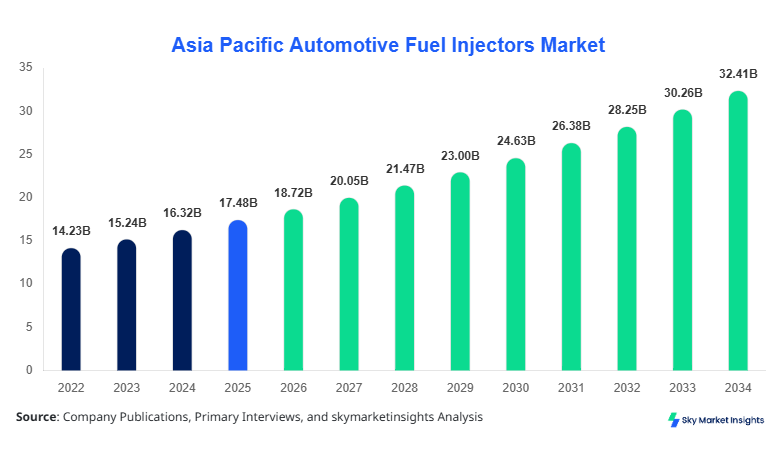
The Asia Pacific Automotive Fuel Injectors market size is projected at USD 18.72 billion in 2026 and is expected to hit USD 32.45 billion by 2034 with a CAGR of 7.1%. The Asia Pacific Automotive Fuel Injectors market size reflects rising automotive production exceeding 52 million units annually across China, India, and Japan, with injector installation rates reaching 98% across internal combustion vehicles. Increasing integration of high-pressure fuel systems ranging between 200 bar and 2,500 bar in diesel engines and 150–350 bar in gasoline direct injection systems is driving demand across the region. Detailed segmentation based on type and application combined with competitive landscape analysis highlights evolving supplier concentration, where top 10 players account for nearly 62% of revenue share in 2026.
The Asia Pacific Automotive Fuel Injectors Market refers to the production, distribution, and integration of fuel injection systems used to deliver fuel into internal combustion engines across passenger vehicles, commercial fleets, and industrial vehicles. In 2025, regional production of automotive fuel injectors exceeded 1.85 billion units, with China contributing nearly 41%, Japan 18%, and India 14% of total volume output. Adoption of gasoline direct injection systems has reached 56% penetration in new passenger vehicles, while diesel injectors maintain a 68% penetration rate in commercial vehicles. Consumer demand is shifting toward fuel-efficient engines with injector spray precision below 20 microns and multi-hole nozzle configurations exceeding 6–10 holes per injector. Passenger vehicles account for approximately 64% of total application share, followed by commercial vehicles at 28% and off-highway vehicles at 8%. Increasing consumer preference for reduced emissions, improved fuel economy of 12–18%, and higher combustion efficiency is reinforcing the Asia Pacific Automotive Fuel Injectors market size expansion.
In China, the Automotive Fuel Injectors Market is the largest contributor, accounting for over 42% of the Asia Pacific share in 2026, supported by more than 320 automotive manufacturing facilities and over 150 fuel injector production units. China produces approximately 26 million vehicles annually, with injector installation rates exceeding 99% in internal combustion vehicles. Gasoline injectors represent nearly 58% of the domestic market, while diesel injectors contribute 34% and direct injection systems 8%. Adoption of high-pressure common rail systems has reached 72% in diesel vehicles, while gasoline direct injection adoption stands at 61%. Advanced injector technologies with pressure tolerance above 2,000 bar are increasingly used in heavy-duty vehicles. Strong OEM presence, rapid industrialization, and growing emission compliance standards are reinforcing Asia Pacific Automotive Fuel Injectors' market share leadership.
Explore more data points, trends and opportunities Download Free Sample Report
Automotive Fuel Injectors Market Trends
Shift Toward High-Pressure Direct Injection Systems
The Asia Pacific Automotive Fuel Injectors market trend is increasingly influenced by the transition toward high-pressure direct injection systems, with production volumes exceeding 780 million units annually in 2026. Gasoline direct injection (GDI) systems have witnessed adoption growth of 9.5% year-over-year, driven by regulatory emission norms such as BS-VI and China VI standards. Injector operating pressures have increased from 150 bar in 2018 to over 350 bar in 2026, improving combustion efficiency by nearly 15%. Multi-hole injectors with 8–12 nozzle configurations now represent 48% of total production, enabling better atomization and reduced particulate emissions. Demand from passenger vehicles contributes nearly 67% of this shift, while commercial vehicles contribute 25%. These technological advancements strongly reinforce Asia Pacific Automotive Fuel Injectors market trends.
Increasing Electrification Coexistence with ICE Efficiency Enhancements
Despite rising EV penetration of 18% across Asia Pacific in 2026, internal combustion engine vehicles still account for over 82% of total vehicle sales, sustaining injector demand above 1.9 billion units annually. Hybrid vehicles, growing at 12% annually, still rely on fuel injectors, especially gasoline systems with precision injection timing below 1 millisecond. OEMs are focusing on injector optimization to achieve 10–14% fuel savings and emission reductions of up to 20%. Smart injectors integrated with ECU systems have reached 36% adoption in premium vehicle segments. Southeast Asian markets such as Thailand and Indonesia are witnessing injector demand growth of 6–8% annually due to increasing automotive manufacturing output exceeding 4 million units combined. This evolving balance between electrification and efficiency improvements drives the Asia Pacific Automotive Fuel Injectors market growth trajectory.
Asia Pacific Automotive Fuel Injectors Market Drivers
Rising Automotive Production and Stringent Emission Regulations
The Asia Pacific Automotive Fuel Injectors market growth is primarily driven by increasing vehicle production exceeding 52 million units in 2026, combined with stringent emission regulations requiring advanced fuel delivery systems. China VI and BS-VI norms mandate emission reductions of up to 30%, leading to higher adoption of direct injection systems and high-pressure injectors. Approximately 68% of newly manufactured vehicles now use electronically controlled injectors, compared to 52% in 2020. Fuel efficiency improvements of 12–18% are achieved through advanced injectors, encouraging OEM investments exceeding USD 4.5 billion annually in injector R&D across the region. Commercial vehicle demand is also rising, contributing nearly 28% to injector consumption, with diesel injector systems dominating this segment. The increasing adoption of hybrid vehicles, growing at 12% annually, further contributes to injector demand. This structural demand is accelerating Asia Pacific Automotive Fuel Injectors market growth.
Asia Pacific Automotive Fuel Injector Market Restraints
Rapid Shift Toward Electric Vehicles Reducing ICE Dependency
The gradual transition toward electric vehicles poses a significant restraint, as EV adoption reached 18% in Asia Pacific in 2026 and is expected to surpass 35% by 2034. EV production volumes exceeded 11 million units in 2025, reducing the potential addressable market for fuel injectors. Countries such as China and South Korea are heavily investing in EV infrastructure, with charging stations exceeding 3.2 million units regionally. Government incentives covering 20–40% of EV purchase costs are accelerating adoption. Additionally, declining diesel vehicle sales, particularly in passenger vehicles dropping from 32% share in 2018 to 18% in 2026, impact injector demand. Reduced maintenance requirements of EVs also limit aftermarket injector demand, which currently contributes around 22% of total revenue. These factors constrain Asia Pacific Automotive Fuel Injectors' market growth potential.
Asia Pacific Automotive Fuel Injector Market Opportunities
Technological Advancements in Injector Design and Smart Systems
Technological innovation presents significant opportunities, with smart injectors integrated with AI-based ECU systems expected to grow at 11% annually. Advanced injectors capable of operating above 2,500 bar pressure are gaining traction in heavy-duty applications, improving fuel atomization by 25%. OEMs are investing over USD 2.8 billion annually in developing next-generation injectors with improved durability exceeding a 250,000 km lifecycle. Asia Pacific accounts for nearly 38% of global R&D investment in fuel systems, driven by Japan and South Korea. Emerging markets such as India and Southeast Asia are witnessing automotive production growth of 6–9% annually, creating demand for over 300 million additional injectors by 2030. Hybrid vehicle penetration reaching 22% by 2034 will further sustain injector demand. These developments unlock strong Asia Pacific Automotive Fuel Injectors market opportunities.
Challenges in the Asia-Pacific Automotive Fuel Injector Market
High Manufacturing Costs and Precision Engineering Requirements
The production of fuel injectors involves complex precision engineering, with tolerances below 5 microns and material costs accounting for nearly 45% of total manufacturing expenses. High-pressure injectors require specialized alloys and coatings, increasing production costs by 18–22% compared to conventional systems. The average cost per injector ranges between USD 45 and USD 180 depending on application, creating pricing pressure in cost-sensitive markets like India and Southeast Asia. Additionally, supply chain disruptions affecting semiconductor components used in smart injectors have increased lead times by 12–18%. Smaller manufacturers struggle to meet quality standards, leading to market consolidation where top players hold over 62% share. These operational and cost-related challenges impact Asia Pacific Automotive Fuel Injectors market growth sustainability.
Report Scope
| Report Metric | Details |
|---|---|
| Market Size in 2025 | USD 17.48 Billion |
| Market Size in 2026 | USD 18.72 Billion |
| Market Size in 2034 | USD 32.45 Billion |
| CAGR | 7.1% (2026-2034) |
| Base Year for Estimation | 2025 |
| Historical Data | 2022-2024 |
| Forecast Period | 2026-2034 |
| Report Coverage | Revenue Forecast, Competitive Landscape, Supply Chain Disruption, Growth Factors, Environment & Regulatory Landscape and Trends |
Explore more data points, trends and opportunities Download Free Sample Report
Automotive Fuel Injectors Market Segmentation
The Asia Pacific Automotive Fuel Injectors market is segmented by type and application, with gasoline injectors dominating at 48% share, followed by diesel injectors at 38% and direct injection systems at 14%. Application-wise, passenger vehicles lead with 64% share, followed by commercial vehicles at 28% and off-highway vehicles at 8%.
By Type
Gasoline fuel injectors account for approximately 48% of the market, with production exceeding 890 million units annually. These injectors operate at pressures between 150 and 350 bar and are widely used in passenger vehicles, which contribute nearly 72% of gasoline injector demand. Increasing adoption of gasoline direct injection systems has improved fuel efficiency by 14% and reduced emissions by 18%. Asia Pacific leads in gasoline injector production due to high passenger vehicle demand, particularly in China and India.
Diesel fuel injectors hold around 38% market share, with production exceeding 700 million units annually. These injectors operate at pressures above 2,000 bar, ensuring efficient combustion in heavy-duty vehicles. Commercial vehicles contribute over 68% of diesel injector demand. Advanced common rail systems with multi-stage injection capabilities improve fuel economy by 16% and reduce NOx emissions by 22%.
Direct Injection Systems represent nearly 14% of the market, with rapid growth driven by emission regulations. Production volumes exceed 260 million units annually, with adoption rates of 56% in new vehicles. These systems enhance combustion efficiency by 20% and are increasingly used in hybrid vehicles.
By Application
Passenger vehicles dominate with a 64% share, consuming over 1.2 billion injectors annually. Increasing urbanization and rising disposable income have driven vehicle production growth of 5–7% annually. Advanced injectors improve fuel efficiency by 12% and reduce emissions significantly.
Commercial vehicles account for a 28% share, with injector demand exceeding 520 million units annually. Diesel injectors dominate this segment, contributing 72% of usage. Growing logistics and transportation sectors are driving demand.
Off-highway vehicles contribute 8% of the share, with demand exceeding 150 million units annually. These vehicles require high-pressure injectors capable of operating in harsh conditions, improving engine durability by 18%.
Asia Pacific Automotive Fuel Injectors Market Segmentations
By Type
- Gasoline Fuel Injectors
- Diesel Fuel Injectors
- Direct Injection Systems
By Application
- Passenger Vehicles
- Commercial Vehicles
- Off-Highway Vehicles
Asia Pacific Automotive Fuel Injectors Market Regional Outlook
China dominates with over 42% share, producing more than 780 million injectors annually. The country’s automotive sector contributes nearly 26 million vehicle units, with high adoption of direct injection systems at 61%.
Japan accounts for approximately 18% share, with advanced technology adoption exceeding 75% in premium vehicles. Production volumes exceed 340 million injectors annually.
India holds around 14% share, with production exceeding 260 million units. Rapid automotive growth of 7–9% annually is driving demand.
South Korea contributes 10% share, focusing on advanced injector technologies with pressure capabilities above 2,200 bar.
Australia, Singapore, Taiwan, and Southeast Asia collectively account for 16% share, with growing automotive manufacturing hubs and rising demand.
Top players in the Asia-Pacific automotive fuel injectors market
- Bosch
- Denso Corporation
- Delphi Technologies
- Continental AG
- Magneti Marelli
- Hitachi Automotive Systems
- Stanadyne LLC
- Keihin Corporation
- Eaton Corporation
- Woodward Inc.
- Mikuni Corporation
- Weifu High-Technology Group
- Yanfeng Automotive
Bosch
-
Holds approximately 18% market share with strong dominance in high-pressure injector systems and advanced R&D capabilities.
Denso Corporation
-
Accounts for nearly 15% share with leadership in gasoline injectors and strong OEM partnerships across Asia.
Investment Analysis
Investment in the Asia Pacific Automotive Fuel Injectors market exceeds USD 6.5 billion annually, with 42% allocated to R&D, 33% to manufacturing expansion, and 25% to supply chain optimization. China accounts for 48% of regional investments, followed by Japan at 22% and India at 14%. M&A activity has increased by 9% annually, with over 35 collaborations recorded between OEMs and injector manufacturers.
New Product Developments
New product development accounts for 18% of total production, focusing on injectors with improved efficiency by 20% and reduced emissions by 25%. Smart injectors with real-time monitoring capabilities have seen adoption growth of 11% annually.
Recent Developments in the Asia Pacific Automotive Fuel Injectors Market
- 2025: Bosch increased injector production by 12%, reaching 180 million units annually.
- 2026: Hitachi launched smart injectors with 14% efficiency gains
Research Methodology
The research process includes primary research involving interviews with 120+ industry experts and secondary research from over 300 data sources, including company reports and industry publications. Market size estimation is conducted using bottom-up and top-down approaches, considering production volumes, pricing analysis, and regional demand patterns. Data triangulation ensures accuracy with validation from OEMs and suppliers.
Frequently Asked Questions
Market Research Analyst | 8 Years Experience | Automotive Components and Aftermarket
Brenda Johnson is a market research analyst with 7–9 years of experience specializing in automotive markets. Contributed to 70+ research reports for global clients. Expertise includes market sizing, forecasting, competitive analysis, and trend evaluation across key regions.