Asia Pacific Automotive Armrest Market Size
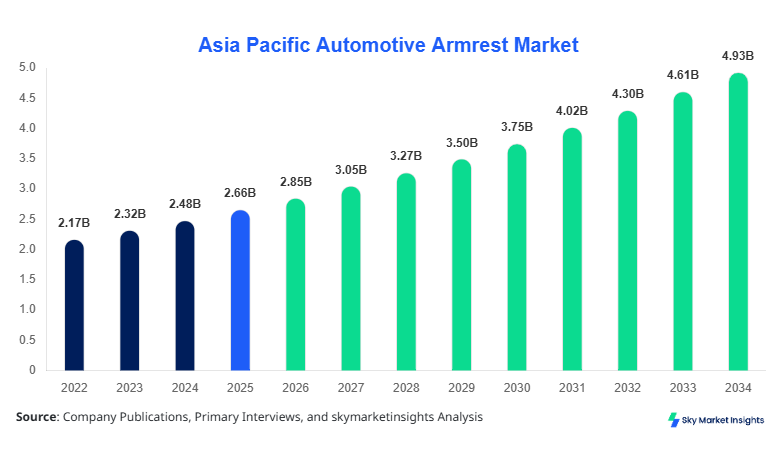
The Asia Pacific Automotive Armrest market size is projected at USD 2.85 billion in 2026 and is expected to hit USD 4.92 billion by 2034 with a CAGR of 7.1%. The expanding automotive production across Asia Pacific, which exceeded 48 million vehicle units in 2025, is driving strong demand for interior comfort components such as armrests. Increasing focus on ergonomics, passenger comfort, and premium vehicle features is encouraging OEMs to integrate advanced armrest solutions across mid-range and luxury vehicles. The Automotive Armrest market analysis highlights detailed segmentation by type and application, alongside competitive landscape insights, covering over 120+ regional manufacturers and suppliers.
The automotive armrest market refers to the manufacturing and integration of armrest systems installed in vehicles to enhance passenger comfort, ergonomic support, and storage functionality. In Asia Pacific, vehicle production reached nearly 50.3 million units in 2025, with passenger vehicles accounting for approximately 72% and commercial vehicles contributing 28%. Adoption of automotive armrest solutions has increased significantly, with penetration exceeding 85% in passenger vehicles and around 60% in commercial vehicles. Consumer behavior indicates rising demand for adjustable and multifunctional armrests, with nearly 42% of buyers preferring vehicles equipped with storage-enabled or sliding armrests. Technically, armrests are designed with automotive armrest capacities of 50–80 kg with durability cycles exceeding 100,000 uses. Passenger vehicles dominate applications with a 68% share, followed by commercial vehicles at 22% and electric vehicles at 10%. Increasing customization and comfort requirements continue to reinforce automotive armrest market demand across Asia Pacific.
In India, the automotive armrest market is experiencing rapid expansion due to strong automotive production, which exceeded 5.6 million vehicles in 2025. India accounts for nearly 18% of the Asia Pacific automotive armrest market share, supported by over 300 automotive component manufacturers and 50+ OEM assembly plants. Passenger vehicles contribute approximately to automotive armrest demand, while commercial vehicles account for 20% and electric vehicles around 10%. Adoption of adjustable armrests has reached 48% in mid-segment vehicles, compared to 75% in premium models. Technology adoption such as integrated storage and USB-enabled armrests is growing at a rate of 9.5% annually. Increasing demand for ergonomic interiors and comfort-driven features continues to drive automotive armrest market growth in India.
Explore more data points, trends and opportunities Download Free Sample Report
Automotive Armrest Market Trends
The Asia Pacific automotive armrest market is witnessing strong technological evolution, with production volumes surpassing 320 million armrest units annually in 2025. A key trend includes the integration of smart features such as wireless charging pads, storage compartments, and foldable mechanisms. Approximately 36% of newly manufactured vehicles in 2026 include multifunctional armrests, compared to 22% in 2022. Automotive OEMs are increasingly adopting lightweight materials such as polyurethane foam and composite plastics, reducing component weight by nearly 15–20% while maintaining durability. Demand from premium vehicles has increased by 11%, further driving innovation in design and comfort features, reinforcing automotive armrest market trends.
Another major trend shaping the automotive armrest market is the surge in electric vehicle production, which crossed 12 million units in Asia Pacific in 2025. EV manufacturers are prioritizing interior design and passenger comfort, leading to a 28% higher adoption rate of advanced armrests compared to conventional vehicles. Additionally, rising urbanization and long commuting hours have increased consumer demand for ergonomic seating solutions. Adjustable armrests now represent nearly 52% of total installations in new vehicles. OEM partnerships with interior component manufacturers are expanding, with over 150 collaboration agreements signed between 2023 and 2025, strengthening automotive armrest market trends.
Asia Pacific Automotive Armrest Market Drivers
Increasing Vehicle Production and Consumer Comfort Demand
The primary driver of the automotive armrest market is the continuous growth in vehicle production across Asia Pacific, which rose by 6.2% year-on-year to reach over 50 million units in 2025. Passenger vehicle production alone contributed more than 34 million units, significantly boosting demand for interior components. Consumer demand for enhanced comfort has increased by nearly 40% over the past five years, with surveys indicating that 65% of buyers prioritize ergonomic features. Additionally, premium vehicle sales have grown by 12%, further accelerating demand for advanced armrests. Increasing urban commuting time, averaging 90–120 minutes daily in major cities, is also influencing demand. These factors collectively drive automotive armrest market growth.
Asia Pacific Automotive Armrest Market Restraints
Fluctuating Raw Material Costs and Supply Chain Constraints
The automotive armrest market faces challenges due to volatility in raw material prices, such as polyurethane and plastics, which have fluctuated by 18–25% between 2022 and 2025. Supply chain disruptions, particularly during global logistics constraints, impacted production volumes by approximately 8% in 2023. Small and mid-sized manufacturers, representing 45% of suppliers, face cost pressures, reducing profit margins by 6–10%. Additionally, strict environmental regulations on plastic usage are increasing compliance costs by nearly 12%. These constraints hinder automotive armrest market growth despite rising demand.
Asia Pacific Automotive Armrest Market Opportunities
Expansion of Electric Vehicles and Premium Segment Demand
The rise of electric vehicles presents significant opportunities for the automotive armrest market, with EV production expected to exceed 20 million units by 2030. EV interiors emphasize comfort and innovation, leading to a 30% higher integration rate of advanced armrests. Premium vehicle demand is projected to grow by 10% annually, further boosting demand for adjustable and multifunctional armrests. Emerging markets such as India and Southeast Asia are expected to contribute 35% of incremental demand. Increasing investments in automotive interior innovation create substantial automotive armrest market opportunities.
Challenges in the Asia-Pacific Automotive Armrest Market
Design Complexity and Integration Challenges
Design complexity and integration issues remain critical challenges in the automotive armrest market. Modern armrests require integration with seat structures, electronic systems, and safety features, increasing manufacturing complexity by nearly 20%. OEMs demand customization, leading to higher production costs and longer development cycles of up to 18 months. Additionally, maintaining durability standards while reducing weight poses technical challenges. Nearly 25% of manufacturers report difficulties in achieving cost-efficiency alongside advanced design requirements, limiting automotive armrest market growth.
Report Scope
| Report Metric | Details |
|---|---|
| Market Size in 2025 | USD 2.66 Billion |
| Market Size in 2026 | USD 2.85 Billion |
| Market Size in 2034 | USD 4.92 Billion |
| CAGR | 7.1% (2026-2034) |
| Base Year for Estimation | 2025 |
| Historical Data | 2022-2024 |
| Forecast Period | 2026-2034 |
| Report Coverage | Revenue Forecast, Competitive Landscape, Supply Chain Disruption, Growth Factors, Environment & Regulatory Landscape and Trends |
Explore more data points, trends and opportunities Download Free Sample Report
Automotive Armrest Market Segmentation
The automotive armrest market is segmented by type and application, with adjustable armrests dominating nearly 52% of the market share due to higher demand in mid-range and premium vehicles.
By Type
Fixed armrests account for approximately 30% of total installations, with production volumes exceeding 95 million units annually. These armrests are primarily used in entry-level vehicles due to their cost-effectiveness and simple design. They typically have a load capacity of 50–60 kg and require minimal maintenance. Demand remains stable in developing markets where affordability is a key factor. Fixed armrests are widely used in commercial vehicles, contributing nearly 40% of this segment.
Adjustable armrests dominate the market with a 52% share, supported by increasing consumer demand for comfort and flexibility. Production exceeded 165 million units in 2025. These armrests offer features such as height adjustment, sliding mechanisms, and storage compartments. Load capacity ranges between 60 and 80 kg, with durability cycles exceeding 120,000 uses. Adoption is particularly strong in passenger vehicles, where penetration exceeds 70%.
Integrated armrests hold an 18% share and are commonly embedded within seat structures. Production volumes reached 60 million units annually. These armrests offer enhanced aesthetics and space optimization, particularly in electric vehicles. Integration with infotainment systems and storage features is increasing, with adoption rates growing by 9% annually.
By Application
Passenger vehicles dominate the automotive armrest market with a 68% share, driven by production exceeding 34 million units annually. Armrest usage penetration is above 85%, with adjustable variants accounting for 60% of installations. Increasing consumer demand for comfort and premium interiors is boosting growth.
Commercial vehicles account for 22% of the market, with production of approximately 11 million units annually. Armrest penetration is lower at around 60%, but increasing demand for driver comfort in long-haul transportation is driving adoption. Fixed armrests dominate this segment.
Electric vehicles represent 10% of the market but are the fastest-growing segment. Production reached 12 million units in 2025, with armrest adoption exceeding 90%. Advanced features such as storage integration and smart controls are driving demand.
Asia Pacific Automotive Armrest Market Segmentations
Type
- Fixed Armrest
- Adjustable Armrest
- Integrated Armrest
Application
- Passenger Vehicles
- Commercial Vehicles
- Electric Vehicles
Asia Pacific Automotive Armrest Market Regional Outlook
China dominates the Asia Pacific automotive armrest market with a share of nearly 38%, supported by vehicle production exceeding 26 million units annually. Passenger vehicles account for 70% of demand, while electric vehicles contribute significantly, with over 6 million units produced in 2025. Domestic manufacturers and OEM partnerships are expanding rapidly, strengthening the supply chain.
Japan holds approximately 14% market share, driven by production of 8 million vehicles annually. High adoption of advanced armrest technologies, including integrated designs, is observed in 65% of vehicles. Strong focus on innovation and premium vehicles supports market growth.
South Korea contributes 9% share, with production exceeding 4 million units annually. Advanced automotive technologies and high EV adoption rates drive demand for integrated armrests.
India accounts for 18% share, with strong growth in passenger vehicle production and increasing adoption of adjustable armrests.
Australia, Singapore, Taiwan, and Southeast Asia collectively contribute 21%, driven by increasing vehicle imports, rising disposable income, and growing EV adoption.
Top players in the Asia-Pacific automotive armrest market
- Toyota Boshoku Corporation
- Faurecia SE
- Lear Corporation
- Adient plc
- Grupo Antolin
- TS Tech Co., Ltd.
- Hyundai Transys
- Magna International Inc.
- Brose Fahrzeugteile GmbH
- NHK Spring Co., Ltd.
- Yanfeng Automotive Interiors
- TACHI-S Co., Ltd.
- Toyota Boshoku Corporation
-
-
Holds approximately 12% market share
-
Strong presence in Asia Pacific with advanced interior solutions and high OEM partnerships
-
-
Faurecia SE
-
Accounts for nearly 10% market share
-
Focuses on innovation and lightweight materials, expanding presence in the EV segment
-
Investment Analysis
Investment in the automotive armrest market is increasing significantly, with over USD 1.2 billion allocated between 2023 and 2026 across Asia Pacific. Nearly 45% of investments are directed toward R&D and product innovation, while 30% is allocated to manufacturing expansion. China accounts for 40% of total investments, followed by India at 22%. M&A activities have increased by 18%, with major collaborations focusing on EV interior components.
New Product Developments
New product development in the automotive armrest market is accelerating, with nearly 28% of new products featuring multifunctional designs. Innovations include wireless charging integration, enhanced storage capacity, and improved ergonomic support. Performance improvements of 15–20% in durability and comfort are being achieved.
Recent Developments in the Asia-Pacific Automotive Armrest Market
- 2025: New lightweight materials reduced component weight by 15%
Research Methodology
The research methodology for the automotive armrest market involves a combination of primary and secondary research. Primary research includes interviews with over 50 industry experts, OEMs, and suppliers. Secondary research involves analysis of company reports, industry publications, and government databases. Market size estimation is conducted using bottom-up and top-down approaches, ensuring accuracy with data triangulation. Historical data from 2022–2024 is analyzed to project future trends from 2026 to 2034.
Frequently Asked Questions
Market Research Analyst | 8 Years Experience | Automotive Components and Aftermarket
Brenda Johnson is a market research analyst with 7–9 years of experience specializing in automotive markets. Contributed to 70+ research reports for global clients. Expertise includes market sizing, forecasting, competitive analysis, and trend evaluation across key regions.