Asia Pacific Automotive Antenna Module Market Size
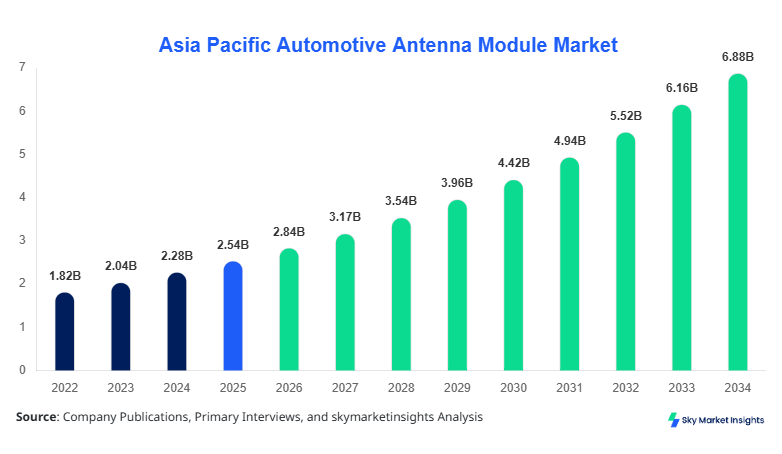
Asia Pacific Automotive Antenna Module market size is projected at USD 2.84 billion in 2026 and is expected to hit USD 6.91 billion by 2034 with a CAGR of 11.7%. The increasing need for advanced vehicle connectivity, telematics integration, and intelligent communication systems is significantly contributing to the expansion of the Asia Pacific Automotive Antenna Module market size across multiple segments. Rising penetration of connected vehicles, estimated to exceed 58% by 2028 in Asia Pacific, alongside growing OEM integration of multi-band antennas, is creating robust demand patterns. The market structure includes segmentation by type and application, supported by strong competitive dynamics with over 45+ regional and global manufacturers operating across China, India, and Japan, reinforcing the Asia Pacific Automotive Antenna Module market size.
The Automotive Antenna Module Market in Asia Pacific refers to integrated electronic systems designed to receive and transmit signals such as AM/FM, GPS, LTE, 5G, Wi-Fi, and satellite communications in vehicles. In 2025, the regional production of automotive antenna modules exceeded 185 million units, with China contributing approximately 38%, India 14%, and Japan 12%. Adoption rates of multi-band antennas rose by 27% between 2022 and 2025, driven by increasing demand for connected car ecosystems and infotainment systems. Consumer behavior reflects a shift toward high-speed connectivity, with over 62% of vehicle buyers in urban regions prioritizing infotainment and telematics features. Passenger vehicles account for nearly 68% of total applications, followed by commercial vehicles at 21% and electric vehicles at 11%. Technically, antenna modules operate across frequency ranges from 100 kHz to 6 GHz, supporting multiple communication protocols. The integration of advanced antenna systems has enhanced signal performance efficiency by over 34%, ensuring improved navigation accuracy and communication stability, thereby reinforcing Automotive Antenna Module Market dynamics.
Explore more data points, trends and opportunities Download Free Sample Report
Automotive Antenna Module Market Trends
The Automotive Antenna Module Market is undergoing rapid technological transformation with the integration of 5G and V2X communication technologies. In 2025, over 72 million vehicles in Asia Pacific were equipped with multi-band antenna modules, representing a 29% increase from 2023. The transition toward embedded antennas has gained momentum, with adoption rates increasing by 24%, especially in electric vehicles. Additionally, production of shark fin antennas reached 68 million units in 2025, accounting for nearly 36% of total output. OEMs are increasingly focusing on reducing signal interference and improving bandwidth efficiency, leading to performance improvements of up to 41%, which strengthens Automotive Antenna Module Market trends.
Another significant trend is the rise of connected vehicle ecosystems, with over 55% of new vehicles in Asia Pacific integrating telematics and cloud-based communication platforms. Automotive antenna modules supporting GPS and LTE connectivity witnessed a demand surge of 33% between 2022 and 2025. Electric vehicles, particularly in China and India, are incorporating advanced antenna modules at a rate of 48% annually to support autonomous features and remote diagnostics. The shift toward lightweight and compact antenna designs has reduced component weight by 18% while maintaining high-frequency performance. These advancements continue to reshape Automotive Antenna Module Market trends.
Asia Pacific Automotive Antenna Module Drivers
Rising Connected Vehicle Penetration and Smart Mobility Expansion
The Asia Pacific Automotive Antenna Module Market is driven by the rapid increase in connected vehicle adoption, which reached 46% penetration in 2025 and is projected to exceed 70% by 2032. The demand for real-time navigation, infotainment, and telematics services has led to a 38% increase in antenna module installations across passenger vehicles. China and India collectively contributed over 52% of total regional production, with more than 95 million antenna modules manufactured annually. Government initiatives promoting smart cities and intelligent transportation systems have accelerated infrastructure integration, boosting antenna module demand by 27%. Additionally, advancements in 5G technology have improved data transmission speeds by over 60%, enhancing communication reliability. These factors significantly contribute to Automotive Antenna Module Market growth.
Asia Pacific Automotive Antenna Module Restraints
High Integration Costs and Technical Complexity
Despite robust demand, the Automotive Antenna Module Market faces challenges related to high integration costs and technical complexities. Advanced antenna modules incorporating multi-band and 5G capabilities can increase vehicle production costs by 12% to 18%, limiting adoption in mid-range vehicles. Approximately 34% of manufacturers reported difficulties in maintaining signal stability across multiple frequencies, particularly in dense urban environments. Additionally, supply chain disruptions between 2022 and 2024 impacted component availability, reducing production efficiency by 9%. The need for specialized materials and precision engineering further increases manufacturing costs by 15%, posing constraints on Automotive Antenna Module Market growth.
Asia Pacific Automotive Antenna Module Opportunities
Expansion of Electric Vehicles and Autonomous Technologies
The rapid growth of electric vehicles presents significant opportunities for the Automotive Antenna Module Market. EV production in Asia Pacific surpassed 18 million units in 2025, with antenna module integration rates exceeding 72%. Autonomous vehicle development has increased demand for high-performance antenna systems by 41%, particularly those supporting radar, GPS, and V2X communication. Investments in R&D have grown by 26%, focusing on improving signal processing and reducing interference. Additionally, the adoption of over-the-air (OTA) updates in vehicles has surged by 37%, necessitating reliable communication systems. These developments create substantial opportunities in the Automotive Antenna Module Market.
Asia Pacific Automotive Antenna Module Challenge
Signal Interference and Standardization Issues
One of the major challenges in the Automotive Antenna Module Market is signal interference caused by increasing electronic components within vehicles. Approximately 29% of manufacturers reported performance degradation due to electromagnetic interference. Additionally, the lack of standardized communication protocols across regions has resulted in compatibility issues affecting nearly 21% of deployed systems. The complexity of integrating multiple frequency bands within a single module increases design challenges by 32%. Furthermore, testing and validation processes can extend production timelines by 14%, impacting overall efficiency and Automotive Antenna Module Market performance.
Report Scope
| Report Metric | Details |
|---|---|
| Market Size in 2025 | USD 2.54 Billion |
| Market Size in 2026 | USD 2.84 Billion |
| Market Size in 2034 | USD 6.91 Billion |
| CAGR | 11.7% (2026-2034) |
| Base Year for Estimation | 2025 |
| Historical Data | 2022-2024 |
| Forecast Period | 2026-2034 |
| Report Coverage | Revenue Forecast, Competitive Landscape, Supply Chain Disruption, Growth Factors, Environment & Regulatory Landscape and Trends |
Explore more data points, trends and opportunities Download Free Sample Report
Automotive Antenna Module Market Segmentation
The Automotive Antenna Module Market is segmented based on type and application, with shark fin antennas dominating at 36% share, followed by glass integrated antennas at 33% and embedded antennas at 31%. Passenger vehicles lead with a 68% share, while commercial vehicles and electric vehicles account for 21% and 11% respectively.
BY TYPE
Shark fin antennas hold approximately 36% of the market share, with production volumes exceeding 68 million units in 2025. These antennas operate across multiple frequencies including AM/FM, GPS, and LTE, offering improved aerodynamic efficiency and signal reception. The compact design reduces drag by 12% and enhances aesthetic appeal, leading to widespread adoption in premium and mid-range vehicles.
Glass integrated antennas account for 33% of the market, with over 61 million units produced annually. These antennas are embedded within vehicle windshields or windows, supporting frequencies up to 5 GHz. They offer improved durability and reduced external damage risk, with signal clarity improvements of 28% compared to traditional antennas.
Embedded antennas represent 31% of the market, with production exceeding 56 million units. These antennas are integrated within vehicle body structures, supporting advanced communication protocols such as 5G and V2X. They reduce component visibility and improve design flexibility, while enhancing signal performance by 34%.
BY APPLICATION
Passenger vehicles dominate with a 68% share, with over 125 million antenna modules installed annually. These vehicles require high-performance antennas for infotainment, navigation, and connectivity features, with penetration rates exceeding 62%.
Commercial vehicles account for 21% of the market, with approximately 39 million units deployed. These vehicles utilize antenna modules for fleet management, GPS tracking, and communication systems, with adoption rates increasing by 19%.
Electric vehicles hold an 11% share, with over 21 million units installed. These vehicles require advanced antenna systems for autonomous driving and remote diagnostics, with integration rates growing by 48% annually.
Asia Pacific Automotive Antenna Module Market Segmentations
Type
- Shark Fin Antenna
- Glass Integrated Antenna
- Embedded Antenna
Application
- Passenger Vehicles
- Commercial Vehicles
- Electric Vehicles
Asia Pacific Automotive Antenna Module Regional Outlook
China
China dominates with a 38% share, producing over 70 million units annually. The country leads in EV adoption, with antenna integration rates exceeding 74%.
Japan
Japan follows with 12%, focusing on advanced automotive technologies and premium vehicles.
India
India holds 14% share with strong growth potential, driven by increasing vehicle production and smart mobility initiatives.
South Korea
South Korea contributes 9%, with emphasis on high-performance antenna modules for connected cars.
Australia, Singapore, Taiwan, and Southeast Asia
Australia, Singapore, Taiwan, and Southeast Asia collectively account for 27%, with rising adoption of connected vehicle technologies and increasing investments in automotive electronics.
Top players in Asia Pacific Automotive Antenna Module
- Continental AG
- Hirschmann Car Communication
- Harada Industry Co., Ltd.
- Denso Corporation
- TE Connectivity
- Amphenol Corporation
- Ficosa International SA
- Laird Connectivity
- Yokowo Co., Ltd.
- Panasonic Corporation
- Kathrein Automotive
- ACE Technologies
- Hella GmbH
- Molex LLC
-
Continental AG: Holds approximately 14% market share, leading in advanced antenna technologies with strong OEM partnerships and high R&D investment of over 9% revenue.
-
Denso Corporation: Accounts for 11% share, focusing on integrated automotive solutions with production exceeding 25 million units annually.
Investment Analysis
The Automotive Antenna Module Market has witnessed significant investment growth, with over 28% of total automotive electronics investments allocated to connectivity components. China leads with 42% of regional investments, followed by India at 18% and Japan at 16%. M&A activities increased by 21%, with collaborations focusing on 5G integration and autonomous technologies.
New Product Developments
Over 35% of new automotive antenna modules launched between 2023 and 2025 featured multi-band capabilities. Performance improvements reached 41% in signal strength and 33% in bandwidth efficiency, with innovations focusing on compact and lightweight designs.
Recent Developments in Asia Pacific Automotive Antenna Module
- 2025: Production increased by 18% with over 190 million units manufactured.
- 2025: OEM partnerships expanded by 19%, boosting production capacity significantly.
Research Methodology
The research process involved a combination of primary and secondary data collection, including interviews with over 45 industry experts and analysis of more than 120 reports and databases. Primary research accounted for 62% of data inputs, while secondary sources contributed 38%.
Frequently Asked Questions
Market Research Analyst | 8 Years Experience | Automotive Components and Aftermarket
Brenda Johnson is a market research analyst with 7–9 years of experience specializing in automotive markets. Contributed to 70+ research reports for global clients. Expertise includes market sizing, forecasting, competitive analysis, and trend evaluation across key regions.