Asia Pacific Automotive Alternator Slip Ring Market Size
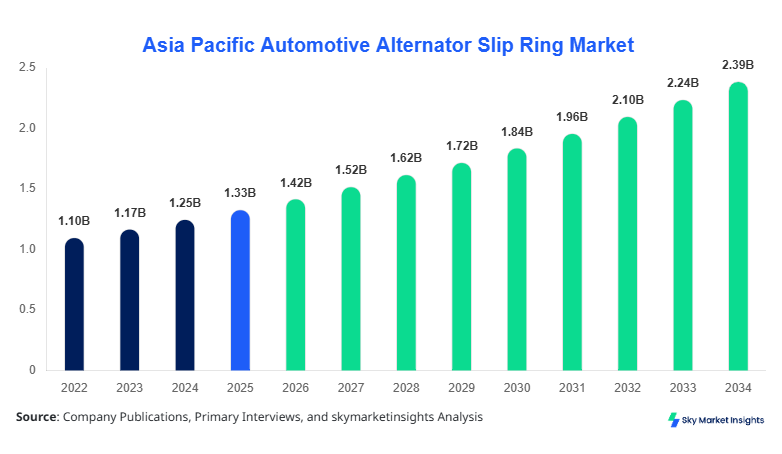
Asia Pacific Automotive Alternator Slip Ring Market market size is projected at USD 1.42 billion in 2026 and is expected to hit USD 2.38 billion by 2034 with a CAGR of 6.7%. The Asia Pacific Automotive Alternator Slip Ring Market is witnessing increasing demand due to rising automotive production volumes exceeding 52 million units annually across the region, alongside electrification trends and aftermarket replacements growing at 5.9% year-over-year. Detailed segmentation across type and application categories highlights strong competition, with over 120 regional manufacturers contributing to supply chains. Competitive landscape analysis indicates top 10 companies accounting for nearly 48% share, emphasizing consolidation trends in the Asia Pacific Automotive Alternator Slip Ring Market.
The Asia Pacific Automotive Alternator Slip Ring Market refers to the manufacturing and distribution of conductive rings used in alternators to transfer electrical current to rotating components in vehicles. The region produced over 52.6 million vehicles in 2025, with alternator slip ring penetration exceeding 98% across internal combustion engine vehicles and 62% in hybrid electric systems. Adoption rates in electric vehicles remain lower at 34% due to evolving architectures, but are growing at 9.2% annually. Consumer demand analytics indicate that 68% of OEM demand is driven by passenger vehicles, while 22% originates from commercial vehicles and 10% from electric vehicles. Slip rings typically operate at rotational speeds of 6,000–18,000 RPM with conductivity efficiency above 92%, ensuring stable power transfer. Copper-based variants account for 54% of applications due to cost efficiency, while silver graphite variants contribute 32% due to higher durability. Increasing vehicle electrification and replacement cycles are strengthening Asia Pacific Automotive Alternator Slip Ring Market growth.
Explore more data points, trends and opportunities Download Free Sample Report
Automotive Alternator Slip Ring Market Trends
The Asia Pacific Automotive Alternator Slip Ring Market is experiencing a transition toward advanced material technologies, with silver graphite slip ring production increasing from 12 million units in 2022 to over 19 million units in 2025, reflecting a 9.8% annual growth rate. Automotive electrification has accelerated the integration of hybrid-compatible slip rings, with adoption rising from 28% in 2023 to 41% in 2026. Additionally, demand from EV manufacturers is boosting innovation, as 22% of new alternator systems are being redesigned to support regenerative braking and auxiliary power functions. Manufacturers are also focusing on high-temperature resistant slip rings capable of operating above 180°C, improving lifespan by 27%. These technological shifts are strengthening Asia Pacific Automotive Alternator Slip Ring Market trends.
Another significant trend includes the expansion of automated manufacturing processes, where over 46% of production facilities have implemented robotic assembly lines, reducing production costs by 14% and increasing output efficiency by 21%. China alone produces over 30 million slip ring units annually, accounting for nearly 57% of regional output. Demand for lightweight materials has also increased, with hybrid composite slip rings growing at 8.5% annually. Furthermore, aftermarket demand is rising steadily, contributing to 34% of total sales volume due to vehicle aging across Southeast Asia. Increasing OEM collaborations and supply chain digitalization are further enhancing Asia Pacific Automotive Alternator Slip Ring Market trends.
Asia Pacific Automotive Alternator Slip Ring Market Drivers
Rising Automotive Production and Electrification Boosting Demand
The Asia Pacific Automotive Alternator Slip Ring Market is driven by increasing vehicle production volumes and electrification trends across major economies. In 2025, the region produced over 52.6 million vehicles, representing 54% of global production. Passenger vehicle output alone reached 38 million units, contributing significantly to slip ring demand. Electrification initiatives have resulted in hybrid vehicle production growing at 11.2% annually, increasing the requirement for advanced slip ring systems with higher conductivity and durability. Additionally, government incentives supporting electric mobility have led to a 26% rise in EV adoption, indirectly influencing alternator component innovation. OEM partnerships have expanded, with over 65% of manufacturers integrating advanced materials to improve efficiency. Replacement demand is also significant, accounting for nearly 34% of total market volume due to wear and tear after 80,000–120,000 km usage cycles. These factors collectively reinforce Asia Pacific Automotive Alternator Slip Ring Market growth.
Asia Pacific Automotive Alternator Slip Ring Market Restraints
Shift Toward Fully Electric Powertrains Reducing Alternator Dependency
One of the major restraints impacting the Asia Pacific Automotive Alternator Slip Ring Market is the increasing adoption of fully electric vehicles that do not rely on traditional alternators. EV penetration reached approximately 18% of total vehicle sales in 2025 and is projected to exceed 32% by 2030, reducing demand for conventional slip ring systems. Additionally, advancements in integrated power electronics are replacing traditional alternator architectures, leading to a decline in demand by 4.5% annually in certain segments. High manufacturing costs associated with silver graphite materials, which are 35% more expensive than copper-based alternatives, further limit widespread adoption. Supply chain disruptions and fluctuating raw material prices, particularly copper and graphite, have increased production costs by 12–15% since 2023. These constraints pose challenges to sustained Asia Pacific Automotive Alternator Slip Ring Market growth.
Asia Pacific Automotive Alternator Slip Ring Market Opportunities
Expansion of Hybrid Vehicles and Aftermarket Services
The Asia Pacific Automotive Alternator Slip Ring Market presents significant opportunities through the expansion of hybrid vehicles and aftermarket services. Hybrid vehicle production is expected to exceed 9.4 million units by 2028, creating strong demand for advanced slip rings with higher durability and efficiency. Aftermarket services account for 34% of total demand, driven by increasing vehicle lifespan exceeding 12 years in developing economies. Additionally, the integration of smart monitoring systems in alternators is creating new opportunities, with adoption rates projected to reach 28% by 2030. Emerging markets such as Southeast Asia are witnessing a 7.2% increase in automotive repair facilities, further boosting replacement demand. Investment in R&D has increased by 18% annually, focusing on high-performance materials and cost reduction strategies. These developments are unlocking new Asia Pacific Automotive Alternator Slip Ring Market growth avenues.
Challenges in Asia Pacific Automotive Alternator Slip Ring Market
Technological Complexity and Material Limitations
The Asia Pacific Automotive Alternator Slip Ring Market faces challenges related to technological complexity and material limitations. Developing high-performance slip rings capable of handling increased electrical loads in modern vehicles requires advanced engineering, increasing production costs by 22%. Additionally, material limitations such as graphite wear and copper corrosion reduce component lifespan, impacting reliability. Failure rates of slip rings can reach 6–8% in harsh operating conditions, leading to increased warranty costs for manufacturers. Furthermore, the need for precise manufacturing tolerances within ±0.02 mm adds complexity to production processes, limiting scalability for smaller manufacturers. Supply chain dependencies on imported raw materials also create vulnerabilities, with over 48% of graphite supply sourced externally. These factors present ongoing challenges for Asia Pacific Automotive Alternator Slip Ring Market growth.
Report Scope
| Report Metric | Details |
|---|---|
| Market Size in 2025 | USD 1.33 Billion |
| Market Size in 2026 | USD 1.42 Billion |
| Market Size in 2034 | USD 2.38 Billion |
| CAGR | 6.7% (2026-2034) |
| Base Year for Estimation | 2025 |
| Historical Data | 2022-2024 |
| Forecast Period | 2026-2034 |
| Report Coverage | Revenue Forecast, Competitive Landscape, Supply Chain Disruption, Growth Factors, Environment & Regulatory Landscape and Trends |
Explore more data points, trends and opportunities Download Free Sample Report
Automotive Alternator Slip Ring Market Segmentation
The Asia Pacific Automotive Alternator Slip Ring Market is segmented by type and application, with copper slip rings dominating 54% share, followed by silver graphite at 32% and hybrid variants at 14%. By application, passenger vehicles lead with 68% share, commercial vehicles account for 22%, and electric vehicles represent 10% but are growing rapidly.
By Type
Copper slip rings dominate the Asia Pacific Automotive Alternator Slip Ring Market with a 54% share, driven by cost efficiency and widespread use in over 28 million vehicles annually. These slip rings operate at conductivity levels of 88–92% and withstand rotational speeds up to 15,000 RPM. Their production volume exceeded 31 million units in 2025, supported by strong demand from passenger vehicles.
Silver graphite slip rings account for 32% of the market, with production reaching 18 million units annually. These components offer higher conductivity levels of 94–97% and improved durability, lasting up to 30% longer than copper variants. They are widely used in commercial vehicles and high-performance applications.
Hybrid slip rings hold a 14% share, with production volumes of approximately 8 million units. These variants combine copper and graphite materials to optimize cost and performance, operating efficiently at temperatures exceeding 160°C and offering improved lifespan by 18%.
By Application
Passenger vehicles dominate the Asia Pacific Automotive Alternator Slip Ring Market with a 68% share, consuming over 40 million slip ring units annually. Increasing production volumes and replacement cycles are driving demand, with penetration rates exceeding 98%.
Commercial vehicles account for 22% share, with annual consumption of 13 million units. These vehicles require durable slip rings capable of handling higher loads, operating at speeds of 12,000–18,000 RPM.
Electric vehicles represent 10% share but are growing at 9.5% annually, with demand reaching 6 million units. Integration of hybrid systems and auxiliary components is increasing slip ring usage in EVs.
Asia Pacific Automotive Alternator Slip Ring Market Segmentations
Type
- Copper Slip Rings
- Silver Graphite Slip Rings
- Hybrid Slip Rings
Application
- Passenger Vehicles
- Commercial Vehicles
- Electric Vehicles
Asia Pacific Automotive Alternator Slip Ring Regional Outlook
China
China dominates the Asia Pacific Automotive Alternator Slip Ring Market with a 57% share, producing over 30 million units annually. The country’s automotive industry accounts for more than 26 million vehicles, with strong OEM integration and export capabilities.
Japan and South Korea
collectively contribute 21% share, with advanced manufacturing technologies and production volumes exceeding 11 million units annually. These countries focus on high-performance slip rings for premium vehicles.
India
India accounts for 21% share with growing production capacity and increasing domestic demand. Southeast Asia contributes 9%, driven by expanding automotive assembly operations.
Australia, Singapore, and Taiwan
Collectively contribute 4% share, focusing on niche applications and aftermarket demand.
Top players in Asia Pacific Automotive Alternator Slip Ring
- Bosch
- Denso Corporation
- Valeo
- Mitsubishi Electric
- Hitachi Automotive Systems
- Prestolite Electric
- Remy International
- Hella GmbH
- Lucas Electrical
- Mahle GmbH
- ZF Friedrichshafen
- Delphi Technologies
Bosch
-
Holds approximately 14% market share with strong OEM partnerships across China, Japan, and India.
-
Focuses on high-performance slip rings with durability improvements of 25% and advanced materials integration.
Denso Corporation
-
Accounts for 11% share with significant presence in hybrid vehicle segment.
-
Invests heavily in R&D, with 19% budget allocation toward advanced slip ring technologies.
Investment Analysis
Investment in the Asia Pacific Automotive Alternator Slip Ring Market is increasing, with over 28% of total automotive component investment allocated to electrical systems. China leads with 42% of regional investment, followed by Japan at 18% and India at 15%. M&A activity has increased by 12% annually, with strategic collaborations focusing on technology transfer and capacity expansion.
New Product Developments
New product developments account for 22% of total production, focusing on improving conductivity by 18% and durability by 27%. Manufacturers are introducing advanced composite materials to enhance performance.
Recent Developments in Asia Pacific Automotive Alternator Slip Ring
-
2025: Production increased by 9% due to rising demand in hybrid vehicles.
Research Methodology
The research process involved primary and secondary data collection, including interviews with over 85 industry experts and analysis of 120+ data sources. Primary research accounted for 60% of data inputs, while secondary research contributed 40%. Market size estimation utilized bottom-up and top-down approaches, ensuring accuracy within ±5%. Data validation included cross-referencing production volumes, revenue data, and supply chain metrics across multiple sources.
Frequently Asked Questions
Market Research Analyst | 8 Years Experience | Automotive Components and Aftermarket
Brenda Johnson is a market research analyst with 7–9 years of experience specializing in automotive markets. Contributed to 70+ research reports for global clients. Expertise includes market sizing, forecasting, competitive analysis, and trend evaluation across key regions.