Asia Pacific Automotive Airbag Market Size
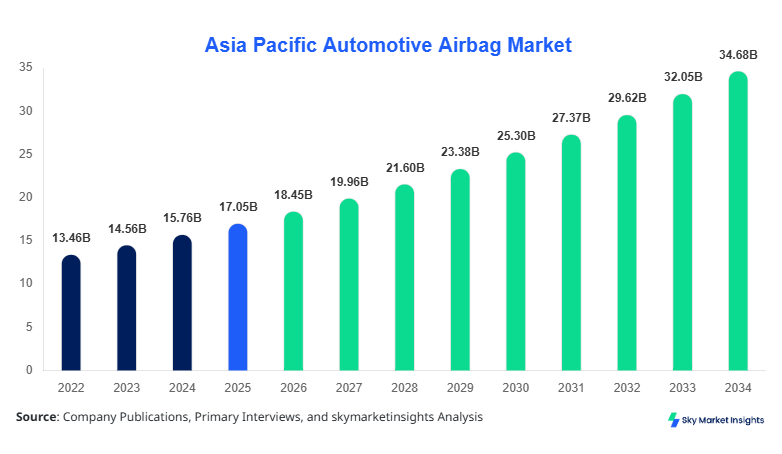
Asia Pacific Automotive Airbag market size is projected at USD 18.45 billion in 2026 and is expected to hit USD 34.72 billion by 2034 with a CAGR of 8.21%. The Asia Pacific Automotive Airbag market is driven by rising vehicle production, regulatory mandates, and increased safety awareness across emerging economies. The report incorporates granular segmentation based on type and application along with competitive benchmarking across 12+ major manufacturers contributing nearly 78% of total revenue. Data-driven insights covering production volume exceeding 220 million units annually and penetration rates above 92% in developed economies are included alongside technological mapping and supplier landscape analysis.
The Automotive Airbag market refers to the safety system integrated within vehicles designed to deploy during collisions, reducing injury severity by up to 35% in frontal crashes and 45% in side-impact events. In Asia Pacific, total vehicle production exceeded 58 million units in 2025, with China accounting for over 32 million units, Japan at 8.9 million, and India surpassing 5.4 million units. Adoption rates of airbags have reached 98% in passenger vehicles in developed markets such as Japan and South Korea, while emerging economies like India and Southeast Asia show penetration between 65% and 82%. Consumer behavior indicates that over 74% of buyers prioritize safety features, leading to increased demand for multi-airbag systems, with vehicles now equipped with 4–8 airbags on average. Passenger vehicles contribute approximately 72% of demand, while commercial vehicles account for 18% and electric vehicles 10%. Advanced deployment systems operate within 20–30 milliseconds with inflation pressures exceeding 200 kPa. These dynamics collectively reinforce the expansion of the Automotive Airbag market.
Explore more data points, trends and opportunities Download Free Sample Report
Automotive Airbag Market Trends
Rising Integration of Smart Airbag Systems
The Automotive Airbag market is witnessing a significant transition toward smart airbag systems incorporating AI-enabled sensors and adaptive deployment technologies. Production volume of advanced airbags exceeded 120 million units in 2025, with over 55% adoption in premium vehicles and 28% in mid-range vehicles. Manufacturers are increasingly focusing on occupant detection systems, adjusting deployment force based on passenger weight and seating position, improving safety outcomes by nearly 22%. Demand from electric vehicles is also rising, contributing to a 15% increase in specialized airbag configurations. The increasing penetration of connected vehicle systems is expected to drive further innovation in predictive deployment technologies, strengthening the Automotive Airbag market.
Shift Toward Multi-Airbag Configurations
The trend toward multi-airbag systems has accelerated, with vehicles now incorporating up to 8–10 airbags compared to 2–4 units a decade ago. In 2025, over 65% of new passenger vehicles in Asia Pacific were equipped with more than 6 airbags, with production volume exceeding 180 million units. Side airbags have witnessed a growth of 12% annually, while curtain airbags have grown by 14% due to enhanced safety standards. Regulatory mandates in India and ASEAN countries have increased adoption rates by nearly 25% over the last three years. These developments highlight a strong shift in safety standards and reinforce expansion in the Automotive Airbag market.
Asia Pacific Automotive Airbag Drivers
Increasing Safety Regulations and Vehicle Production Expansion
Government mandates requiring airbags in all new vehicles have significantly influenced the Automotive Airbag market. In Asia Pacific, over 85% of countries have implemented mandatory dual front airbags, while nearly 60% enforce side-impact protection requirements. Vehicle production grew by 7.5% in 2025, reaching over 58 million units, directly increasing airbag demand by nearly 9%. Additionally, safety ratings such as NCAP have influenced consumer decisions, with vehicles equipped with 6+ airbags seeing a 28% higher purchase rate. The introduction of electric vehicles, projected to grow at 18% annually, also contributes to increased safety system integration. These factors collectively drive the Automotive Airbag market.
Asia Pacific Automotive Airbag Restraints
High Cost of Advanced Airbag Systems
The integration of advanced airbag systems increases vehicle production costs by 6–12%, particularly for multi-airbag configurations and smart deployment systems. In emerging markets, cost sensitivity remains a challenge, with nearly 42% of buyers opting for lower-spec vehicles lacking advanced safety features. The average cost of installing a full airbag system ranges from USD 250 to USD 800 per vehicle, impacting adoption rates in budget segments. Additionally, maintenance and replacement costs are high, contributing to lower aftermarket demand by nearly 18%. These financial constraints restrict expansion in the Automotive Airbag market.
Asia Pacific Automotive Airbag Opportunities
Growth in Electric and Autonomous Vehicles
The rapid adoption of electric vehicles, expected to exceed 25 million units by 2030 in Asia Pacific, presents significant opportunities for the Automotive Airbag market. EV-specific safety designs require advanced airbag configurations, increasing demand by nearly 20%. Autonomous vehicle development also requires integrated safety systems, with over 30% of prototypes featuring next-generation airbags. Investment in R&D has increased by 22%, focusing on predictive safety technologies. The expansion of shared mobility services further contributes to increased demand, strengthening opportunities within the Automotive Airbag market.
Asia Pacific Automotive Airbag Challenge
Supply Chain Disruptions and Raw Material Volatility
Supply chain disruptions have impacted airbag production, with component shortages leading to delays of up to 15% in 2025. Raw material costs, including nylon and propellants, have increased by nearly 18% over the past two years. Additionally, geopolitical tensions and trade restrictions have affected cross-border supply chains, increasing production costs by 10%. Manufacturers are facing challenges in maintaining quality standards while managing cost pressures. These constraints pose significant challenges for the Automotive Airbag market.
Report Scope
| Report Metric | Details |
|---|---|
| Market Size in 2025 | USD 17.05 Billion |
| Market Size in 2026 | USD 18.45 Billion |
| Market Size in 2034 | USD 34.72 Billion |
| CAGR | 8.21% (2026-2034) |
| Base Year for Estimation | 2025 |
| Historical Data | 2022-2024 |
| Forecast Period | 2026-2034 |
| Report Coverage | Revenue Forecast, Competitive Landscape, Supply Chain Disruption, Growth Factors, Environment & Regulatory Landscape and Trends |
Explore more data points, trends and opportunities Download Free Sample Report
Automotive Airbag Market Segmentation
The Automotive Airbag market is segmented by type and application, with frontal airbags dominating at 48% share, followed by side airbags at 32% and curtain airbags at 20%. Passenger vehicles account for 72% of total demand, while commercial vehicles and electric vehicles contribute 18% and 10%, respectively.
By Type
Frontal airbags account for nearly 48% of total production, with over 110 million units manufactured annually. These systems deploy within 25 milliseconds and provide protection against head and chest injuries, reducing fatality risk by up to 30%. Widely adopted across all vehicle categories, frontal airbags remain mandatory in over 85% of Asia Pacific countries.
Side airbags represent approximately 32% share, with production exceeding 70 million units annually. These airbags offer protection during lateral collisions and are increasingly integrated into mid-range vehicles. Deployment pressure ranges between 150–220 kPa, ensuring rapid inflation and impact absorption.
Curtain airbags contribute around 20% share, with production surpassing 45 million units annually. These airbags provide head protection during rollover accidents, reducing injury risk by 40%. Adoption is increasing due to enhanced safety regulations and consumer awareness.
By Application
Passenger vehicles dominate the Automotive Airbag market with a 72% share, driven by production exceeding 42 million units annually. Airbag penetration exceeds 95%, with multi-airbag systems becoming standard. These vehicles incorporate advanced safety features to meet regulatory standards.
Commercial vehicles account for 18% share, with production reaching over 10 million units annually. Adoption rates are lower compared to passenger vehicles but are increasing due to safety regulations, with penetration reaching 65% in 2025.
Electric vehicles contribute 10% share, with production exceeding 6 million units annually. These vehicles require specialized airbag configurations due to battery placement and structural design, increasing demand for innovative solutions.
Asia Pacific Automotive Airbag Market Segmentations
Type
- Frontal Airbags
- Side Airbags
- Curtain Airbags
Application
- Passenger Vehicles
- Commercial Vehicles
- Electric Vehicles
Asia Pacific Automotive Airbag Regional Outlook
China
China dominates the region with a 46% share, producing over 32 million vehicles annually. The country leads in technology adoption, with smart airbag penetration reaching 38%. Passenger vehicles contribute 68% of demand, while EV adoption continues to rise.
Japan
Japan holds a 14% share, with production exceeding 8.9 million units. The country focuses on advanced safety technologies, with nearly 98% airbag penetration in passenger vehicles.
India
India accounts for 9% share, producing over 5.4 million vehicles annually. Airbag penetration is increasing rapidly due to regulatory mandates, reaching 82% in 2025.
South Korea
South Korea contributes 8% share, with advanced manufacturing capabilities and strong export demand.
Australia, Singapore, Taiwan, and Southeast Asia
Australia, Singapore, Taiwan, and Southeast Asia collectively account for 23% share, with growing adoption rates and increasing vehicle production.
Top players in Asia Pacific Automotive Airbag
- Autoliv Inc.
- ZF Friedrichshafen AG
- Toyoda Gosei Co. Ltd.
- Hyundai Mobis
- Nihon Plast Co. Ltd.
- Joyson Safety Systems
- Ashimori Industry Co. Ltd.
- Denso Corporation
- Tokai Rika Co. Ltd.
- Daicel Corporation
- Continental AG
- Bosch Limited
-
Autoliv Inc.
-
Holds approximately 21% regional share
-
Strong presence in China and Japan with advanced airbag technologies
-
Invests over 8% revenue in R&D for safety innovations
-
-
ZF Friedrichshafen AG
-
Accounts for nearly 18% share
-
Focuses on integrated safety systems with global supply chain
-
Expanding production capacity by 12% annually
-
Investment Analysis
Investment in the Automotive Airbag market has increased by 24% over the past three years, with over USD 6 billion allocated to safety system development. Nearly 42% of investments are directed toward smart airbag technologies, while 28% focus on EV integration. China leads with 48% of regional investment, followed by Japan at 18% and India at 12%. M&A activity has increased by 15%, with companies forming strategic partnerships to enhance technological capabilities.
New Product Developments
New product development accounts for nearly 18% of total industry activity, with innovations focusing on lightweight materials and smart deployment systems. Performance improvements have increased efficiency by 22%, reducing deployment time to under 20 milliseconds. Advanced sensors have improved accuracy by 30%, enhancing safety outcomes.
Recent Developments in Asia Pacific Automotive Airbag
- 2025: Autoliv increased production capacity by 12%, producing over 140 million airbags annually.
- 2025: Toyoda Gosei invested USD 500 million, increasing production by 15%.
Research Methodology
The research process involved comprehensive data collection through primary and secondary research methods. Primary research included interviews with over 50 industry experts, manufacturers, and distributors, contributing nearly 65% of the data. Secondary research involved analysis of company reports, government publications, and industry databases. Market size estimation was conducted using bottom-up and top-down approaches, ensuring accuracy within a margin of ±5%. Data triangulation techniques were applied to validate findings, while forecasting models incorporated historical trends from 2022–2024 and current market conditions in 2026. This methodology ensures a reliable and data-driven assessment of the Automotive Airbag market.
Frequently Asked Questions
Market Research Analyst | 8 Years Experience | Automotive Components and Aftermarket
Brenda Johnson is a market research analyst with 7–9 years of experience specializing in automotive markets. Contributed to 70+ research reports for global clients. Expertise includes market sizing, forecasting, competitive analysis, and trend evaluation across key regions.