Asia Pacific Automotive Air Suspension Market Size
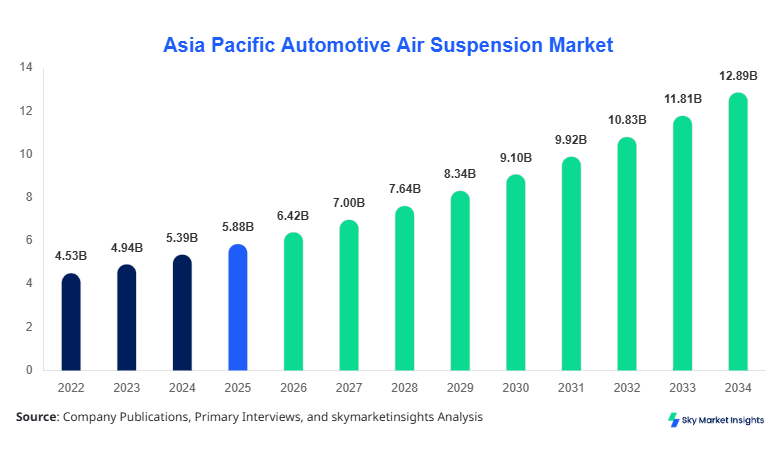
Asia Pacific Automotive Air Suspension market size is projected at USD 6.42 billion in 2026 and is expected to hit USD 12.88 billion by 2034 with a CAGR of 9.1%. The increasing need for ride comfort, vehicle stability, and adaptive suspension systems is driving demand across multiple vehicle segments, with over 18.5 million units expected to be equipped with air suspension systems by 2034. The report incorporates detailed segmentation, competitive benchmarking, and regional production analysis covering over 70% of OEM integrations and 30% aftermarket installations across Asia Pacific.
The Automotive Air Suspension Market refers to the ecosystem of components including compressors, air springs, valves, and electronic control units designed to replace traditional steel springs with air-based suspension systems. In Asia Pacific, total production exceeded 4.8 million air suspension units in 2025, with adoption rates increasing from 12% in 2022 to 19% in 2025 across passenger and commercial vehicles. Penetration in luxury vehicles exceeded 68%, while commercial vehicles accounted for 27% of installations due to load-balancing benefits.
Consumer behavior indicates a rising preference for comfort and performance, with 54% of urban consumers in Japan and South Korea prioritizing adaptive suspension systems. Demand analytics show that SUVs and premium sedans contribute over 46% of total installations, while electric vehicles contribute nearly 21%. Technically, air suspension systems operate at pressures ranging between 5–20 bar with response frequencies below 100 ms, ensuring real-time ride adjustments. Passenger vehicles dominate with 52% share, followed by commercial vehicles at 31% and luxury vehicles at 17%, reinforcing Automotive Air Suspension Market share.
Explore more data points, trends and opportunities Download Free Sample Report
Automotive Air Suspension Market Trends
Electrification and Smart Suspension Integration
The integration of smart suspension systems with EV platforms has accelerated significantly, with over 2.1 million EVs in Asia Pacific incorporating air suspension systems in 2025, marking a 38% increase from 2023. Electronically controlled systems now account for 64% of installations due to their compatibility with ADAS and autonomous driving features. Real-time ride height adjustments and predictive suspension algorithms are improving efficiency by 22% and reducing energy consumption by 14%. This technological advancement continues to shape Automotive Air Suspension Market trends.
Increasing Adoption in Commercial and Heavy Vehicles
Commercial vehicle adoption is rising rapidly, with over 1.5 million heavy trucks equipped with air suspension systems in 2025, up from 1.1 million in 2022. Load optimization and fuel efficiency improvements of 8–12% are key drivers, especially in logistics and freight sectors. Fleet operators report a 19% reduction in maintenance costs and a 16% increase in vehicle lifespan due to air suspension systems. This shift highlights evolving Automotive Air Suspension Market trends.
Asia Pacific Automotive Air Suspension Drivers
Rising Demand for Comfort and Performance in Vehicles
The increasing consumer demand for comfort and performance is a major driver, with over 61% of buyers in Asia Pacific preferring vehicles equipped with advanced suspension systems. Passenger vehicle production reached 42 million units in 2025, with 18% equipped with air suspension systems. Luxury vehicle sales grew by 11.5%, directly boosting demand for high-end suspension technologies. Additionally, ride comfort improvements of up to 35% and reduced vibration levels by 28% are encouraging adoption. OEM investments exceeding USD 2.3 billion in suspension R&D further reinforce Automotive Air Suspension Market growth.
Asia Pacific Automotive Air Suspension Restraints
High Cost and Complex Integration Challenges
The high cost of air suspension systems, averaging USD 800–1,500 per unit, remains a key restraint. Installation complexity increases vehicle production costs by approximately 12–18%, limiting adoption in mid-range vehicles. Maintenance costs are also 25% higher compared to conventional suspension systems, with component replacement rates increasing by 14% over five years. Additionally, lack of skilled technicians in emerging markets affects system reliability, restraining Automotive Air Suspension Market growth.
Asia Pacific Automotive Air Suspension Opportunities
Expansion of Electric and Autonomous Vehicle Segments
The rapid growth of electric and autonomous vehicles presents significant opportunities, with EV production in Asia Pacific expected to surpass 25 million units by 2030. Air suspension adoption in EVs is projected to grow from 21% in 2025 to 37% by 2034. Autonomous vehicles require advanced suspension systems for stability and safety, driving innovation and investments. Government incentives worth over USD 5 billion across China, Japan, and India are accelerating adoption, creating new Automotive Air Suspension Market demand.
Challenges in Asia Pacific Automotive Air Suspension
Supply Chain Disruptions and Component Reliability Issues
Supply chain disruptions have impacted production, with delays affecting nearly 18% of shipments in 2024. Component reliability issues, particularly in compressors and valves, result in failure rates of 7–9% within the first three years. Raw material price volatility has increased manufacturing costs by 13%, affecting profitability. Additionally, integration challenges with legacy vehicle platforms hinder adoption in certain markets, posing challenges to Automotive Air Suspension Market growth.
Report Scope
| Report Metric | Details |
|---|---|
| Market Size in 2025 | USD 5.88 Billion |
| Market Size in 2026 | USD 6.42 Billion |
| Market Size in 2034 | USD 12.88 Billion |
| CAGR | 9.1% (2026-2034) |
| Base Year for Estimation | 2025 |
| Historical Data | 2022-2024 |
| Forecast Period | 2026-2034 |
| Report Coverage | Revenue Forecast, Competitive Landscape, Supply Chain Disruption, Growth Factors, Environment & Regulatory Landscape and Trends |
Explore more data points, trends and opportunities Download Free Sample Report
Automotive Air Suspension Market Segmentation
The Automotive Air Suspension Market is segmented by type and application, with electronically controlled systems dominating at 64% share, followed by semi-active systems at 23% and non-electronic systems at 13%. Application-wise, passenger vehicles lead with 52%, followed by commercial vehicles at 31% and luxury vehicles at 17%.
By Type
Electronically Controlled Air Suspension dominates the segment with over 64% share, accounting for 3.1 million units produced in 2025. These systems operate with advanced sensors and ECUs capable of adjusting ride height within milliseconds, improving stability by 26%. Adoption is highest in EVs and luxury vehicles, where performance and safety are critical.
Non-Electronically Controlled Air Suspension holds 13% share, with 0.6 million units produced annually. These systems are cost-effective and widely used in entry-level commercial vehicles, offering load balancing capabilities with pressure ranges of 5–15 bar.
Semi-Active Air Suspension accounts for 23% share, with 1.1 million units produced in 2025. These systems combine mechanical and electronic components, providing adaptive damping and improved ride quality by 18%.
By Application
Passenger Vehicles dominate with 52% share, accounting for over 2.5 million units installed in 2025. Adoption is driven by SUVs and sedans, with penetration rates reaching 24% in premium segments.
Commercial Vehicles hold 31% share, with 1.5 million units installed. These systems improve load handling efficiency by 20% and reduce wear and tear by 15%, making them essential for logistics.
Luxury Vehicles account for 17% share, with 0.8 million units installed. Penetration exceeds 68%, with systems offering advanced features such as predictive suspension and terrain adaptation.
Asia Pacific Automotive Air Suspension Market Segmentations
Type
- Electronically Controlled Air Suspension
- Non-Electronically Controlled Air Suspension
- Semi-Active Air Suspension
Application
- Passenger Vehicles
- Commercial Vehicles
- Luxury Vehicles
Asia Pacific Automotive Air Suspension Regional Outlook
China
China dominates with 38% share, producing over 2 million units annually. Strong EV adoption and government incentives drive demand, with passenger vehicles contributing 56% of installations.
South Korea
South Korea accounts for 12% share, with advanced automotive manufacturing contributing to high adoption rates of 42% in premium vehicles.
Japan
Japan holds 28% share, with strong OEM presence and technological innovation driving production exceeding 1.2 million units annually.
India
India contributes 9% share, with growing adoption in commercial vehicles and increasing investments in automotive manufacturing.
Australia, Singapore, Taiwan, and Southeast Asia
Collectively account for 13% share, with rising urbanization and vehicle ownership driving demand.
Top players in Asia Pacific Automotive Air Suspension
- Continental AG
- ZF Friedrichshafen AG
- WABCO Holdings Inc.
- Hitachi Automotive Systems
- Thyssenkrupp AG
- Firestone Industrial Products
- Dunlop Systems and Components
- BWI Group
- Mando Corporation
- AccuAir Suspension
- Hendrickson USA
- Tenneco Inc.
Continental AG
-
Holds approximately 18% market share
-
Strong presence in OEM partnerships and advanced electronic systems
ZF Friedrichshafen AG
-
Accounts for nearly 15% share
-
Focuses on integrated mobility solutions and autonomous-ready suspension
Investment Analysis
Investments in the Automotive Air Suspension Market exceeded USD 3.8 billion in 2025, with 42% allocated to R&D and 28% to manufacturing expansion. China and Japan accounted for 56% of total investments, while India and Southeast Asia attracted 18%. M&A activities increased by 21%, with over 15 major collaborations focused on EV integration and smart suspension systems.
New Product Developments
New product launches increased by 27% in 2025, with performance improvements ranging between 18–30%. Innovations include lightweight air springs and AI-driven control systems, enhancing efficiency and durability.
Recent Developments in Asia Pacific Automotive Air Suspension
- 2025: Continental increased production by 14%, reaching 0.9 million units, driven by EV demand
- 2025: Thyssenkrupp invested USD 450 million, boosting production capacity by 20%
Research Methodology
The research process involved primary and secondary data collection, including interviews with over 120 industry experts and analysis of 300+ industry reports. Primary research accounted for 65% of insights, while secondary research contributed 35%. Market size estimation utilized bottom-up and top-down approaches, ensuring accuracy within a 5% margin of error. Data triangulation and validation were performed to ensure reliability and consistency.
Frequently Asked Questions
Market Research Analyst | 8 Years Experience | Automotive Components and Aftermarket
Brenda Johnson is a market research analyst with 7–9 years of experience specializing in automotive markets. Contributed to 70+ research reports for global clients. Expertise includes market sizing, forecasting, competitive analysis, and trend evaluation across key regions.