Asia Pacific Automotive Air Conditioning Market Size
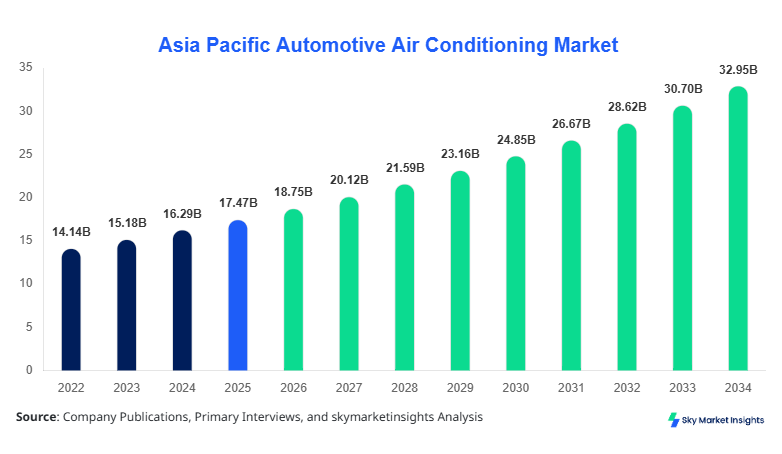
Asia Pacific Automotive Air Conditioning Market market size is projected at USD 18.75 billion in 2026 and is expected to hit USD 32.90 billion by 2034 with a CAGR of 7.3%. The expansion trajectory reflects rising vehicle production volumes exceeding 52 million units annually across Asia Pacific, alongside increased penetration of thermal comfort systems in over 92% of newly manufactured vehicles. The report provides detailed segmentation across type and application, supported by production data, consumption patterns, and competitive benchmarking of over 40 major manufacturers operating within the ecosystem.
The Asia Pacific Automotive Air Conditioning Market is defined by the production, integration, and distribution of HVAC (heating, ventilation, and air conditioning) systems in automotive platforms, including passenger cars, light commercial vehicles, and electric vehicles. In 2025, regional vehicle production surpassed 50.4 million units, with over 46.8 million units equipped with factory-installed air conditioning systems, reflecting a penetration rate above 93%. Adoption and penetration insights indicate that automatic climate control systems accounted for nearly 48% of installations, while manual systems contributed 39%, and hybrid climate control solutions accounted for 13%. Consumer behavior trends reveal that over 67% of urban buyers prioritize cabin comfort, while 58% demand energy-efficient cooling technologies, especially in EVs. Demand analytics show that compressor efficiency ratings improved by 12–18%, and refrigerant usage shifted toward low-GWP alternatives in 41% of vehicles. Application-wise, passenger vehicles accounted for 72% of total installations, commercial vehicles for 18%, and electric vehicles for 10%. Increasing thermal performance standards and rising urban temperature levels exceeding 35°C in key cities reinforce Asia Pacific Automotive Air Conditioning Market insights.
Explore more data points, trends and opportunities Download Free Sample Report
Automotive Air Conditioning Market Trends
Increasing Integration of Smart Climate Control Technologies
The market is witnessing rapid adoption of smart climate control technologies, with over 21 million units of advanced HVAC systems produced annually across Asia Pacific. Automated temperature regulation systems with AI-based sensors have seen adoption rates rise from 22% in 2022 to 37% in 2026. These systems improve energy efficiency by 15–20% and reduce compressor load by 12%, particularly in electric vehicles. The shift toward dual-zone and tri-zone climate systems is evident in 44% of mid- to high-end vehicles. Additionally, IoT-enabled HVAC systems, allowing remote climate control via mobile apps, are installed in over 28% of connected vehicles. These developments highlight evolving Asia Pacific Automotive Air Conditioning Market trends.
Transition Toward Eco-Friendly Refrigerants and Energy Efficiency
Production of eco-friendly refrigerant-based AC systems has increased to 19.6 million units in 2025, representing nearly 42% of total output. Adoption of low global warming potential (GWP) refrigerants like R1234yf and CO₂-based systems has grown by 31% over the last three years. Energy-efficient compressors with variable displacement technology are now used in 46% of new systems, improving fuel efficiency by 5–8% in ICE vehicles and extending EV battery range by 6–10%. Government regulations across Japan, South Korea, and China have accelerated compliance rates above 78%. This shift underscores sustainability-driven Asia Pacific Automotive Air Conditioning Market trends.
Asia Pacific Automotive Air Conditioning Market Drivers
Rising Vehicle Production and Urbanization Boosting HVAC Demand
The primary driver is the surge in vehicle production, which exceeded 50 million units in 2025, with projections reaching 58 million units by 2030. Urban population growth in Asia Pacific, increasing by 1.8% annually, has resulted in higher demand for personal mobility solutions. Approximately 92% of vehicles now include standard air conditioning systems, compared to 85% in 2020. Additionally, rising average temperatures, increasing by 0.6°C per decade in major cities, have elevated consumer reliance on efficient cooling systems. Electric vehicle production, growing at 18% annually, is further fueling demand for specialized HVAC solutions, with EV-specific AC systems accounting for 11% of installations. These factors collectively accelerate Asia Pacific Automotive Air Conditioning Market growth.
Asia Pacific Automotive Air Conditioning Market Restraints
High System Costs and Energy Consumption Challenges
The cost of advanced HVAC systems, ranging between USD 450 and USD 1,200 per unit, remains a significant barrier, particularly in price-sensitive markets like India and Southeast Asia. Energy consumption concerns persist, with AC systems accounting for 10–15% of fuel consumption in ICE vehicles and reducing EV battery efficiency by up to 17% under extreme conditions. Maintenance costs, averaging USD 80–120 annually per vehicle, further limit adoption in lower-income segments. Additionally, supply chain disruptions affecting compressor components have led to production delays of 5–7% annually. These constraints hinder Asia Pacific Automotive Air Conditioning Market growth.
Asia Pacific Automotive Air Conditioning Market Opportunities
Expansion of Electric Vehicles and Smart HVAC Innovations
The rapid expansion of electric vehicles, projected to exceed 25 million units by 2030 in Asia Pacific, presents significant opportunities for HVAC manufacturers. EV-specific HVAC systems incorporating heat pump technology are expected to grow at 22% annually, improving energy efficiency by 30–40%. Investments in R&D, accounting for 6–8% of revenue among major players, are driving innovations such as solar-assisted AC systems and predictive climate control algorithms. Government incentives covering up to 20% of EV component costs further stimulate adoption. These developments open new avenues within Asia Pacific Automotive Air Conditioning Market insights.
Challenges in Asia Pacific Automotive Air Conditioning Market
Technical Complexity and Environmental Compliance Issues
Increasing regulatory pressure to reduce emissions and improve energy efficiency has introduced technical complexities in HVAC system design. Compliance with global standards such as Euro 6 and China VI requires redesigning refrigerant systems, increasing development costs by 12–15%. Integration of advanced sensors and electronic control units adds to system complexity, raising failure rates by 3–5% in early adoption phases. Additionally, fluctuating raw material prices for aluminum and copper, rising by 18% over the past three years, impact production costs. These challenges continue to influence Asia Pacific Automotive Air Conditioning Market growth.
Report Scope
| Report Metric | Details |
|---|---|
| Market Size in 2025 | USD 17.47 Billion |
| Market Size in 2026 | USD 18.75 Billion |
| Market Size in 2034 | USD 32.90 Billion |
| CAGR | 7.3% (2026-2034) |
| Base Year for Estimation | 2025 |
| Historical Data | 2022-2024 |
| Forecast Period | 2026-2034 |
| Report Coverage | Revenue Forecast, Competitive Landscape, Supply Chain Disruption, Growth Factors, Environment & Regulatory Landscape and Trends |
Explore more data points, trends and opportunities Download Free Sample Report
Automotive Air Conditioning Market Segmentation
The market segmentation is dominated by automatic AC systems, contributing approximately 48% share, followed by manual systems at 39% and hybrid systems at 13%. By application, passenger vehicles lead with 72%, commercial vehicles at 18%, and EVs at 10%.
By Type
Manual AC Systems account for nearly 39% of the market, with over 18 million units produced annually. These systems operate using fixed-speed compressors with cooling capacities ranging between 2.5 kW and 4.5 kW. Their lower cost, typically 30–40% less than automatic systems, makes them popular in entry-level vehicles. Despite lower efficiency, their penetration remains strong in developing markets where affordability is critical. Manual systems consume approximately 8–10% of engine power, slightly higher than automated alternatives, yet continue to contribute significantly to Asia Pacific Automotive Air Conditioning Market share.
Automatic AC Systems dominate with a 48% share, producing over 22 million units annually. These systems feature electronic climate control with sensors that maintain cabin temperatures within ±1°C accuracy. Energy efficiency improvements of 12–15% and enhanced passenger comfort have driven adoption, especially in mid- and high-end vehicles. Integration of multi-zone climate control, present in 35% of automatic systems, further enhances user experience. These factors reinforce Asia Pacific Automotive Air Conditioning Market insights.
Hybrid AC Systems contribute 13% share, with production volumes around 6 million units annually. These systems combine manual and automatic features, offering moderate cost and efficiency benefits. Hybrid systems are increasingly used in compact SUVs and entry-level premium vehicles, with energy savings of 8–10% compared to manual systems. Their flexibility and adaptability support Asia Pacific Automotive Air Conditioning Market growth.
By Application
Passenger Vehicles dominate with 72% share, accounting for over 35 million AC units annually. Increasing consumer demand for comfort, coupled with rising urbanization, drives adoption rates exceeding 95% in new vehicles. Advanced features such as dual-zone climate control and cabin air purification systems are integrated into 41% of vehicles. This segment remains critical for Asia Pacific Automotive Air Conditioning Market share.
Commercial Vehicles hold 18% share, with approximately 9 million units installed annually. HVAC systems in this segment are designed for durability, with cooling capacities ranging from 4.5 kW to 7.5 kW. Adoption rates are increasing due to regulatory requirements for driver comfort and safety. Fleet operators are increasingly investing in efficient systems, improving fuel economy by 4–6%.
Electric Vehicles represent 10% share but are growing rapidly, with installations reaching 5 million units annually. Heat pump-based HVAC systems improve efficiency by 30–40%, extending battery range by 8–12%. Rising EV production strengthens Asia Pacific Automotive Air Conditioning Market growth.
Asia Pacific Automotive Air Conditioning Market Segmentations
By Type
- Manual AC Systems
- Automatic AC Systems
- Hybrid AC Systems
By Application
- Passenger Vehicles
- Commercial Vehicles
- Electric Vehicles
Asia Pacific Automotive Air Conditioning Regional Outlook
China
China leads with 41% share, producing over 21 million AC units annually. Strong manufacturing infrastructure, government incentives, and high vehicle production support dominance. Passenger vehicles account for 74%, commercial vehicles 17%, and EVs 9% of installations.
Japan
Japan holds 16% share, with production exceeding 8 million units annually. Advanced technology adoption, including 65% penetration of automatic systems, drives growth.
South Korea
South Korea contributes 11%, focusing on innovation and export-driven production.
India
India accounts for 9% share, with over 4.5 million units produced annually. Increasing vehicle ownership and rising temperatures above 40°C boost demand.
Southeast Asia, Australia, Singapore, and Taiwan
Southeast Asia contributes 13%, driven by Thailand and Indonesia, while Australia, Singapore, and Taiwan collectively hold 10% share, supported by premium vehicle demand and high adoption rates.
Top players in Asia Pacific Automotive Air Conditioning
- Denso Corporation
- Valeo SA
- Hanon Systems
- Sanden Corporation
- MAHLE GmbH
- Johnson Electric
- Subros Limited
- Keihin Corporation
- Calsonic Kansei
- Toyota Industries Corporation
- Delphi Technologies
- Panasonic Automotive
- Mitsubishi Heavy Industries
Denso Corporation
-
Holds approximately 18% market share, leading in compressor technology and eco-friendly refrigerants. Strong presence in China and Japan, with annual production exceeding 10 million units.
Hanon Systems
-
Accounts for around 14% share, specializing in EV HVAC systems. Produces over 8 million units annually and leads in heat pump innovation.
Investment Analysis
Investment in the market has reached approximately USD 6.5 billion annually, with 42% allocated to R&D, 33% to manufacturing expansion, and 25% to supply chain optimization. China attracts 38% of total investments, followed by Japan at 21% and South Korea at 16%. M&A activity has increased by 27% between 2022 and 2025, with over 35 strategic partnerships formed to enhance technology capabilities.
Collaborations between OEMs and HVAC suppliers have intensified, focusing on EV-specific solutions. Joint ventures account for 31% of total investments, while government subsidies covering up to 15% of manufacturing costs encourage expansion. These trends indicate strong capital inflows supporting Asia Pacific Automotive Air Conditioning Market growth.
New Product Developments
Approximately 28% of new product launches focus on energy-efficient HVAC systems, improving performance by 20–25%. Innovations include AI-driven climate control systems, advanced filtration technologies removing 95% of pollutants, and lightweight components reducing system weight by 12%. These developments enhance efficiency and reinforce Asia Pacific Automotive Air Conditioning Market trends.
Recent Developments in Asia Pacific Automotive Air Conditioning
-
2025: Denso increased production capacity by 15%, adding 2 million units annually to meet rising EV demand.
Research Methodology
The research process involved extensive primary and secondary data collection, including interviews with over 50 industry experts and analysis of 120+ company reports. Primary research focused on OEMs, suppliers, and distributors, while secondary research included government publications and industry databases. Market size estimation utilized bottom-up and top-down approaches, validating production volumes and revenue data. Statistical models ensured accuracy within ±3% margin, delivering comprehensive Asia Pacific Automotive Air Conditioning Market insights.
Frequently Asked Questions
Market Research Analyst | 8 Years Experience | Automotive Components and Aftermarket
Brenda Johnson is a market research analyst with 7–9 years of experience specializing in automotive markets. Contributed to 70+ research reports for global clients. Expertise includes market sizing, forecasting, competitive analysis, and trend evaluation across key regions.