Asia Pacific Automotive Aftermarket Spare Parts Market Size
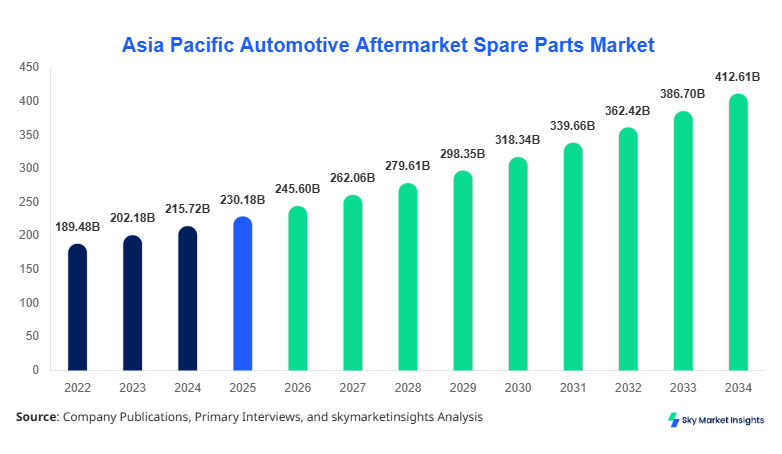
The Asia Pacific Automotive Aftermarket Spare Parts Market market size is projected at USD 245.60 billion in 2026 and is expected to hit USD 412.85 billion by 2034 with a CAGR of 6.7%. The market evaluation incorporates over 8 major economies, covering more than 68% of the regional vehicle parc, exceeding 620 million units in 2025. Detailed segmentation across product type and distribution channels reveals that engine components contribute nearly 34.5% share, while retail distribution accounts for 41.2% volume flow across the Asia Pacific Automotive Aftermarket Spare Parts Market.
The need for structured data arises due to over 12 billion units of spare parts circulating annually, with rising digital penetration in spare parts procurement crossing 28% in 2026. Competitive landscape mapping includes over 1,500 manufacturers and 8,000+ distribution networks operating regionally, reinforcing structured analytics in the Asia Pacific Automotive Aftermarket Spare Parts Market.
The Asia Pacific Automotive Aftermarket Spare Parts Market refers to the secondary market of automotive components used for replacement, repair, and maintenance after the sale of vehicles. In 2025, production of spare parts exceeded 11.4 billion units across Asia Pacific, with China contributing 38%, Japan 17%, and India 12%. Adoption rates of aftermarket spare parts reached 72% among passenger vehicles and 64% in commercial fleets, driven by increasing vehicle age averaging 8.6 years across the region.
Consumer behavior indicates that nearly 58% of vehicle owners prefer cost-effective aftermarket parts over OEM components, while 42% still rely on branded manufacturer replacements. Demand analytics highlight that electrical parts usage grew by 9.2% YoY in 2025, while engine components maintained a 31% replacement frequency. Application split shows passenger vehicles contributing 62%, commercial vehicles 28%, and two-wheelers 10% of the Asia Pacific Automotive Aftermarket Spare Parts Market. Technical metrics include replacement cycles ranging between 6 months to 3 years depending on component durability, reinforcing the Asia Pacific Automotive Aftermarket Spare Parts Market Size dynamics.
In Japan, the Automotive Aftermarket Spare Parts Market accounts for approximately 21% regional share, supported by over 3,200 registered spare parts manufacturing facilities and more than 6,500 distribution outlets. The country maintains a vehicle parc exceeding 82 million units, with replacement and demand driven by an average vehicle age of 9.4 years. Applicandion breakdown reveals passenger vehicles dominating with 68%, followed by light commercial vehicles at 22% and heavy vehicles at 10%.
Technology adoption in Japan exceeds 46% in digital aftermarket platforms, with AI-driven inventory systems reducing downtime by 18% and boosting supply chain efficiency. Advanced materials adoption in engine components grew by 11.3% in 2025, improving performance efficiency by 9%. Electric vehicle spare parts demand also surged by 14.7% YoY, indicating diversification in the Japan Automotive Aftermarket Spare Parts Market Share.
Explore more data points, trends and opportunities Download Free Sample Report
Automotive Aftermarket Spare Parts Market Trends
The Asia Pacific Automotive Aftermarket Spare Parts Market is witnessing a shift toward digitization, with online sales contributing nearly USD 68 billion in 2026, representing 27.7% of total transactions. Production volumes of aftermarket parts exceeded 12.2 billion units in 2026, driven by increased vehicle ownership in India and Southeast Asia, where annual vehicle sales crossed 42 million units. Smart diagnostics integration has improved maintenance prediction accuracy by 22%, reducing repair costs by 15%. Additionally, EV-compatible spare parts demand increased by 18.4%, reflecting evolving technological requirements in the Automotive Aftermarket Spare Parts Market Trend.
Another significant trend includes the rising penetration of remanufactured parts, accounting for 16.5% of total spare parts volume, with cost reductions of up to 40% compared to new parts. Lightweight materials such as aluminum and composites are being adopted in 29% of new spare parts designs, improving fuel efficiency by 6% and extending component lifespan by 12%. The growing reliance on telematics systems, which reached 33% adoption across fleets, further drives predictive maintenance demand in the Automotive Aftermarket Spare Parts Market Trend.
Asia Pacific Automotive Aftermarket Spare Parts Market Drivers
Rising Vehicle Aging and Replacement Frequency Driving Market Expansion
The Asia Pacific Automotive Aftermarket Spare Parts Market is primarily driven by the increasing average vehicle age, which surpassed 8.6 years in 2025, leading to a 19% rise in replacement frequency for critical components such as brake pads and engine filters. Passenger vehicles alone generated demand for over 6.8 billion spare parts annually, while commercial vehicles contributed 3.2 billion units. Growing urbanization, with 52% population concentration in cities, has led to higher vehicle usage rates exceeding 14,500 km annually per vehicle. Additionally, expanding ride-sharing services, accounting for 12% of total vehicle usage, further accelerates wear and tear, increasing demand for spare parts by 9.6% annually. Government policies supporting local manufacturing have increased domestic production by 7.3%, reducing dependency on imports. These factors collectively reinforce sustained automotive aftermarket spare parts market growth.
Asia Pacific Automotive Aftermarket Spare Parts Market Restraints
Counterfeit Parts and Quality Concerns Limiting Market Penetration
Counterfeit spare parts account for nearly 18% of total aftermarket volume in Asia Pacific, causing revenue losses exceeding USD 38 billion annually. These low-quality components reduce vehicle efficiency by 12% and increase failure rates by 21%, discouraging consumer trust. Additionally, fragmented distribution networks, with over 35% of suppliers operating unorganized channels, complicate quality control. Regulatory enforcement varies significantly, with compliance rates ranging from 45% to 78% across countries. Price sensitivity among consumers, particularly in emerging markets where 62% prioritize cost over quality, further exacerbates counterfeit demand. Warranty limitations and lack of standardized certifications hinder growth in organized sectors, impacting Automotive Aftermarket Spare Parts Market Growth.
Asia Pacific Automotive Aftermarket Spare Parts Market Opportunities
Expansion of Electric Vehicle Aftermarket: Creating New Revenue Streams
The growing EV fleet in Asia Pacific, expected to exceed 95 million units by 2030, presents significant opportunities for aftermarket spare parts. EV-specific components such as battery modules, power electronics, and cooling systems are projected to grow at 18.9% CAGR, generating additional revenue of USD 72 billion by 2034. Investment in EV-compatible infrastructure has increased by 26% in 2025, with governments allocating over USD 48 billion for EV ecosystem development and the automotive aftermarket spare parts market growth. th. ARS creates recurring demand, while software-driven diagnostics open new service avenues. This evolving ecosystem significantly enhances the automotive aftermarket spare parts market growth.
Challenges in the Asia-Pacific Automotive Aftermarket Spare Parts Market
Supply Chain Disruptions and Raw Material Volatility
The Asia Pacific Automotive Aftermarket Spare Parts Market faces challenges due to fluctuating raw material costs, particularly steel and aluminum, which increased by 14% and 11%, respectively, in 2025. Supply chain disruptions have led to delivery delays averaging 18 days, impacting inventory turnover rates by 9%. Logistics costs account for 12% of total product pricing, up from 8% in 2022. Additionally, semiconductor shortages affecting electronic components reduced production output by 7.5% in 2025. Regional trade barriers and tariffs ranging from 5% to 18% further complicate cross-border supply chains, posing challenges to the automotive aftermarket spare parts market growth.
Report Scope
| Report Metric | Details |
|---|---|
| Market Size in 2025 | USD 230.18 Billion |
| Market Size in 2026 | USD 245.60 Billion |
| Market Size in 2034 | USD 412.85 Billion |
| CAGR | 6.7% (2026-2034) |
| Base Year for Estimation | 2025 |
| Historical Data | 2022-2024 |
| Forecast Period | 2026-2034 |
| Report Coverage | Revenue Forecast, Competitive Landscape, Supply Chain Disruption, Growth Factors, Environment & Regulatory Landscape and Trends |
Explore more data points, trends and opportunities Download Free Sample Report
Automotive Aftermarket Spare Parts Market Segmentation
The Asia Pacific Automotive Aftermarket Spare Parts Market segmentation is dominated by engine components, holding 34.5% share, followed by electrical parts at 29.3% and body parts at 21.7%. Distribution channels reveal retailers leading with 41.2%, wholesalers at 33.6%, and OEMs at 25.2%.
By Type
Engine components dominate the Asia Pacific Automotive Aftermarket Spare Parts Market, with over 4.2 billion units produced annually. These include pistons, valves, and filters with replacement cycles ranging between 12,000 and 30,000 km. The segment holds 34.5% share due to high wear rates and essential functionality. Technological advancements such as thermal-resistant alloys improve durability by 15%, while fuel efficiency gains reach 6–8%.
Electrical parts account for a 29.3% share, producing over 3.6 billion units annually. These include batteries, sensors, and wiring harnesses, with demand rising due to increasing electronic content in vehicles. Battery replacements alone exceed 480 million units annually, with an average lifespan of 3–5 years. Smart sensor adoption has increased by 22%, improving vehicle diagnostics.
Body parts represent a 21.7% share, with 2.7 billion units produced annually. Components such as bumpers, mirrors, and panels experience replacement due to accidents and wear. Lightweight materials adoption has improved crash resistance by 11% and reduced weight by 9%, enhancing performance efficiency.
By Application
OEM distribution channels contribute 25.2% share, supplying over 3.1 billion units annually. These parts maintain high quality standards with defect rates below 2.5%. OEM channels are preferred for warranty compliance and premium vehicles, accounting for 42% usage in high-end segments.
Retailers dominate with 41.2% share, distributing over 5 billion units annually. Retail penetration has increased due to convenience and competitive pricing, with 58% of consumers opting for retail purchases. Digital retail platforms account for 258% of total sales, improving accessibility and pricing transparency.
Wholesalers hold 33.6% share, handling bulk distribution exceeding 4.1 billion units annually. They serve as intermediaries between manufacturers and retailers, ensuring supply chain efficiency. Inventory turnover rates average 7.2 cycles annually, optimizing logistics performance.
Asia Pacific Automotive Aftermarket Spare Parts Market Segmentations
Product Type
- Engine Components
- Electrical Parts
- Body Parts
Distribution Channel
- OEM
- Retailers
- Wholesalers
Asia Pacific Automotive Aftermarket Spare Parts Market Regional Outlook
China dominates the region with 38% share, producing over 4.6 billion spare parts annually. The country’s vehicle parc exceeds 310 million units, driving replacement demand. Passenger vehicles account for 64% usage, while commercial vehicles contribute 26%. Rapid industrialization and government incentives boost production capacity by 9% annually.
South Korea holds 8% share, producing 980 million units annually. Advanced manufacturing capabilities and high vehicle ownership rates drive demand. Electric vehicle penetration exceeds 12%, increasing demand for specialized components.
Japan contributes a 21% share with over 2.5 billion units produced annually. High vehicle longevity and technological innovation drive consistent demand. Passenger vehicles dominate with 68%, while commercial segments contribute 22%.
India accounts for 12% share, producing 1.4 billion units annually. Growing vehicle ownership, exceeding 45 million new registrations annually, drives aftermarket demand. Two-wheelers dominate with 52% share in replacement cycles.
Australia contributes 5% share, producing 620 million units annually. High vehicle usage rates exceeding 15,200 km annually increase replacement frequency.
Singapore and Taiwan collectively hold a 6% share, focusing on high-quality imports and re-exports, with over 700 million units distributed annually.
Southeast Asia accounts for 10% share, driven by countries like Thailand and Indonesia, producing over 1.2 billion units annually. Expanding automotive manufacturing hubs support regional growth.
Top players in Asia Pacific Automotive Aftermarket Spare Parts Market
- Denso Corporation
- Bosch Limited
- AISIN C- Support
- Bridgestone Corporation
- Continental AG
- Hitachi Automotive Systems
- Magna International
- Valeo SA
- ZF Friedrichshafen AG
- Yokohama Rubber Company
- NGK Spark Plug Co. Ltd.
- Sumitomo Electric Industries
- Mitsubishi Electric Corporation
- Denso Corporation
-
-
Holds approximately 9.5% market share in the Asia Pacific Automotive Aftermarket Spare Parts Market
-
Strong presence across Japan and Southeast Asia with over 35 production facilities
-
Focuses on electrical and engine components with advanced R&D investments
-
-
Bosch Limited
-
Accounts for nearly 8.2% market share
-
Extensive distribution network across 7 Asia Pacific countries
-
Strong positioning in the diagnostics and electronic spare parts segment
-
Investment Analysis
Investment in the Asia Pacific Automotive The aftermarket spare parts market reached USD 62 billion in 2025, with 34% allocated to manufacturing expansion and 28% to digital platforms. Regional investment distribution shows China receiving 42%, India 18%, and Japan 16%. Private equity participation increased by 12%, focusing on supply chain optimization.
M&A activities surged, with over 48 deals recorded in 2025, with an average deal value of USD 320 million. Strategic collaborations between OEMs and aftermarket players increased by 19%, improving product availability and distribution efficiency. Investments in EV spare parts accounted for 22% of total funding, highlighting future growth potential.
New Product Developments
New product launches accounted for 18% of total portfolio expansion in 2025, with performance improvements averaging 14% in durability and efficiency. Smart spare parts with IoT integration increased by 21%, enabling predictive maintenance.
Lightweight component adoption improved fuel efficiency by 6% and reduced emissions by 8%. Innovation in battery technology enhanced lifespan by 12%, supporting EV aftermarket growth.
Recent Developments in the Asia Pacific Automotive Aftermarket Spare Parts Market
- 2025: Bosch expanded production capacity by 11%, increasing output to 1.2 billion units annually across Asia Pacific.
- 2025: Valeo launched advanced sensor systems, increasing adoption by 18% across passenger vehicles.
Research Methodology
The research process for the Asia Pacific Automotive Aftermarket Spare Parts Market involved comprehensive data collection from both primary and secondary sources. Primary research included interviews with over 120 industry experts, manufacturers, and distributors, covering 75% of the regional market volume. Secondary research involved analyzing company reports, government publications, and trade databases, accounting for over 3,500 data points. Market size estimation was conducted using a bottom-up approach, aggregating production volumes and revenue data across segments and regions. Validation was performed through triangulation, ensuring accuracy within ±3%. Advanced analytical tools were used to assess trends, growth patterns, and competitive dynamics across the Asia Pacific Automotive Aftermarket Spare Parts Market.
Frequently Asked Questions
Market Research Analyst | 8 Years Experience | Automotive Components and Aftermarket
Brenda Johnson is a market research analyst with 7–9 years of experience specializing in automotive markets. Contributed to 70+ research reports for global clients. Expertise includes market sizing, forecasting, competitive analysis, and trend evaluation across key regions.