Asia Pacific Automotive Aftermarket Glass Market Size
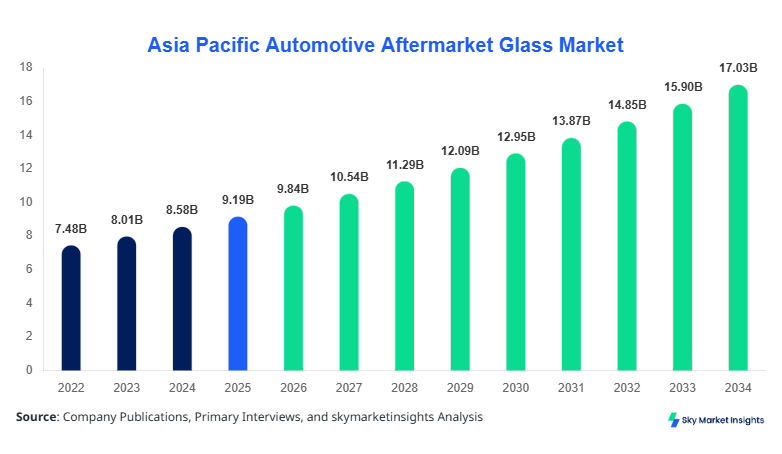
Asia Pacific Automotive Aftermarket Glass Market market size is projected at USD 9.84 billion in 2026 and is expected to hit USD 16.92 billion by 2034 with a CAGR of 7.1%. The Asia Pacific Automotive Aftermarket Glass Market demonstrates strong expansion driven by rising vehicle parc exceeding 620 million units in 2025, increasing accident rates of 3.2% annually, and replacement cycles averaging 5–7 years. The market analysis integrates detailed segmentation across type and application, alongside competitive benchmarking across 150+ regional suppliers and OEM-aligned distributors operating in China, India, and Japan.
The automotive aftermarket glass market refers to the supply, replacement, and repair of vehicle glass components including windshields, sidelites, and backlites outside original OEM production. In Asia Pacific, production exceeded 1.8 billion square meters of automotive glass annually in 2025, with aftermarket replacement accounting for nearly 38% of total consumption. Adoption levels remain high in urbanized regions, with penetration reaching 72% in China and 64% in India due to increasing vehicle density of 240 vehicles per 1,000 people. Consumer behavior indicates that over 58% of vehicle owners opt for cost-effective aftermarket solutions compared to OEM replacements, especially in mid-range vehicle segments priced between USD 8,000 and USD 20,000. Laminated glass contributes approximately 46% of total demand due to safety regulations requiring impact resistance up to 2000 N, while tempered glass holds 39% share due to cost efficiency and ease of manufacturing. Passenger vehicles dominate application share with nearly 68%, followed by commercial vehicles at 22% and electric vehicles at 10%. Frequency of replacement is higher in urban zones, averaging 1.6 replacements per vehicle per lifecycle. This reflects sustained Automotive Aftermarket Glass Market growth.
Explore more data points, trends and opportunities Download Free Sample Report
Automotive Aftermarket Glass Market Trends
The market is witnessing significant shifts toward advanced glazing technologies, with production of laminated acoustic glass surpassing 520 million units annually across Asia Pacific. Adoption rates of advanced glass coatings, including infrared-reflective layers, have increased from 18% in 2022 to 34% in 2025. Increasing integration of sensors and ADAS systems into windshields has pushed demand for technologically advanced glass solutions, contributing to a 6.5% annual increase in premium aftermarket components. Electric vehicles, which require specialized lightweight glass reducing vehicle weight by up to 12%, have accelerated innovation cycles. These advancements collectively strengthen Automotive Aftermarket Glass Market trend.
Another notable shift is the growing emphasis on sustainability, with recycled glass content in aftermarket products rising to 22% in 2025 compared to 14% in 2022. Production volumes of eco-friendly glass exceeded 280 million units, supported by stricter environmental norms in Japan and South Korea. Additionally, digital distribution channels now account for 19% of aftermarket glass sales, improving accessibility and reducing logistics costs by 8–10%. The rise of e-commerce platforms and direct-to-consumer models has reshaped purchasing patterns, particularly in urban centers where online ordering contributes over 25% of replacement demand. These structural changes reinforce Automotive Aftermarket Glass Market trend.
Asia Pacific Automotive Aftermarket Glass Market Drivers
Rising Vehicle Parc and Accident Rates Accelerate Replacement Demand
The expanding vehicle parc across Asia Pacific, exceeding 620 million units in 2025, is a primary driver for aftermarket glass demand. Annual road accidents surpass 5.8 million incidents, with windshield damage reported in approximately 37% of cases, necessitating immediate replacement. Urbanization rates above 52% have increased vehicle usage intensity, leading to higher wear and tear and glass breakage frequency. Replacement cycles have shortened from 7.5 years to 5.8 years in high-density regions such as China and India. Additionally, rising disposable incomes, growing at 6.2% annually, enable consumers to invest in higher-quality aftermarket glass products. The proliferation of ride-hailing fleets, accounting for 12% of urban vehicles, further accelerates replacement demand due to higher usage rates. These combined factors significantly contribute to Automotive Aftermarket Glass Market growth.
Asia Pacific Automotive Aftermarket Glass Market Restraints
High Cost of Advanced Glass Technologies Limits Adoption
Despite strong demand, the high cost associated with advanced glass technologies such as laminated acoustic glass and ADAS-integrated windshields poses a significant restraint. Premium aftermarket glass can cost between USD 180 and USD 450 per unit, compared to USD 60–120 for standard tempered glass. This price gap restricts adoption among cost-sensitive consumers, particularly in emerging markets where over 48% of vehicle owners fall within low-to-middle income brackets. Additionally, installation complexities requiring specialized calibration equipment increase service costs by 15–20%. Limited availability of skilled technicians, especially in rural areas where service penetration is below 35%, further constrains market expansion. Counterfeit products, accounting for nearly 11% of total aftermarket sales, also undermine consumer confidence and reduce overall revenue potential. These challenges hinder Automotive Aftermarket Glass Market growth.
Asia Pacific Automotive Aftermarket Glass Market Opportunities
Expansion of Electric Vehicles and Smart Glass Technologies
The rapid expansion of electric vehicles, expected to exceed 45 million units in Asia Pacific by 2030, presents significant opportunities for aftermarket glass suppliers. EVs require specialized lightweight and energy-efficient glass, reducing vehicle energy consumption by up to 8%. Smart glass technologies, including electrochromic and solar control glass, are gaining traction, with adoption rates projected to reach 18% by 2028. Investments in R&D have increased by 9.5% annually, enabling development of innovative glass solutions with improved durability and optical clarity. Furthermore, government incentives promoting EV adoption, exceeding USD 12 billion across the region, support aftermarket ecosystem growth. The increasing integration of connected vehicle technologies further drives demand for advanced glass capable of housing sensors and communication modules. These factors create strong Automotive Aftermarket Glass Market insights.
Challenges in Asia Pacific Automotive Aftermarket Glass Market
Supply Chain Disruptions and Raw Material Volatility
Supply chain disruptions and volatility in raw material prices, particularly silica sand and soda ash, present significant challenges. Raw material costs have fluctuated by 18–25% over the past three years, directly impacting production costs and profit margins. Logistics disruptions, including port congestion and transportation delays, have increased lead times by 12–15%. Additionally, dependency on imports for specialized coatings and interlayers, particularly from Europe and North America, exposes the market to currency fluctuations and trade restrictions. Small and medium enterprises, representing 62% of suppliers, face difficulties in maintaining inventory levels and managing cost pressures. These operational challenges continue to impact Automotive Aftermarket Glass Market growth.
Report Scope
| Report Metric | Details |
|---|---|
| Market Size in 2025 | USD 9.19 Billion |
| Market Size in 2026 | USD 9.84 Billion |
| Market Size in 2034 | USD 16.92 Billion |
| CAGR | 7.1% (2026-2034) |
| Base Year for Estimation | 2025 |
| Historical Data | 2022-2024 |
| Forecast Period | 2026-2034 |
| Report Coverage | Revenue Forecast, Competitive Landscape, Supply Chain Disruption, Growth Factors, Environment & Regulatory Landscape and Trends |
Explore more data points, trends and opportunities Download Free Sample Report
Automotive Aftermarket Glass Market Segmentation
The market is segmented based on type and application, with laminated glass dominating at 46% share, followed by tempered glass at 39% and others at 15%. Passenger vehicles lead application share with 68%, reflecting high replacement frequency and large vehicle base.
BY TYPE
Tempered glass accounts for approximately 39% of total market volume, with annual production exceeding 700 million units across Asia Pacific. This type of glass undergoes thermal treatment at temperatures above 620°C, enhancing strength by up to 4–5 times compared to standard glass. It is widely used in side and rear windows due to its shattering pattern, which reduces injury risk. Cost efficiency, with average pricing between USD 50 and USD 120 per unit, makes it highly preferred in developing markets. Demand is particularly strong in commercial vehicles, where it contributes to nearly 44% of installations due to durability and ease of replacement.
Laminated glass dominates the market with 46% share, supported by increasing safety regulations and consumer preference for enhanced protection. Production volumes exceed 820 million units annually, with thickness ranging from 4.5 mm to 6.5 mm. The presence of polyvinyl butyral (PVB) interlayers improves impact resistance and acoustic insulation by up to 30%. Adoption is highest in passenger vehicles, accounting for 72% of laminated glass usage, driven by regulatory mandates and rising awareness of safety features. Premium vehicles and EVs extensively utilize laminated glass for windshields and panoramic roofs.
Other glass types, including polycarbonate and hybrid glass solutions, account for 15% of the market, with production volumes nearing 280 million units annually. These materials offer lightweight properties, reducing vehicle weight by up to 20% and improving fuel efficiency by 5–7%. Adoption is increasing in electric vehicles and high-performance cars due to superior optical clarity and durability. However, higher costs and limited manufacturing capabilities restrict widespread usage.
BY APPLICATION
Passenger vehicles dominate the market with 68% share, supported by a vehicle population exceeding 420 million units in Asia Pacific. Annual replacement demand surpasses 1.1 billion glass units, driven by high accident rates and urban usage patterns. Laminated glass accounts for 58% of installations in this segment due to safety requirements, while tempered glass contributes 34%. Replacement penetration stands at 1.8 times per vehicle lifecycle, reflecting frequent wear and tear. Technological integration, including heads-up display compatibility and ADAS sensor housing, further drives demand.
Commercial vehicles account for 22% of the market, with annual demand exceeding 420 million units. High usage intensity, averaging 60,000–120,000 km per year, results in increased glass replacement frequency. Tempered glass dominates with 52% share due to durability and cost efficiency. Fleet operators prioritize quick replacement and minimal downtime, leading to adoption of standardized glass solutions. Penetration of advanced glass technologies remains limited at 18% due to cost constraints.
Electric vehicles represent 10% of the market, with demand growing rapidly as EV adoption accelerates. Annual glass consumption exceeds 190 million units, with laminated and lightweight glass accounting for 64% of usage. EVs require specialized glass with thermal insulation and UV protection, improving energy efficiency by up to 8%. Integration of smart glass technologies, including electrochromic panels, is increasing, with adoption rates reaching 12% in premium EV segments.
Asia Pacific Automotive Aftermarket Glass Market Segmentations
Type
- Tempered Glass
- Laminated Glass
- Others
Application
- Passenger Vehicles
- Commercial Vehicles
- Electric Vehicles
Asia Pacific Automotive Aftermarket Glass Regional Outlook
China
China dominates the regional market with over 38% share, supported by production exceeding 900 million glass units annually. The country hosts over 3,500 manufacturing facilities and accounts for nearly 45% of global automotive glass output. Passenger vehicles contribute 70% of demand, while EV adoption significantly boosts advanced glass usage. Government policies promoting EVs and safety standards drive continuous market expansion.
South Korea
South Korea holds approximately 8% share, with production volumes around 150 million units annually. The market is characterized by high adoption of advanced glass technologies, with laminated and smart glass penetration exceeding 48%. Strong OEM presence and technological innovation support aftermarket growth, particularly in premium vehicle segments.
Japan
Japan accounts for nearly 12% of the market, with production exceeding 220 million units. High safety standards and advanced manufacturing capabilities drive demand for laminated and acoustic glass. Replacement cycles are shorter, averaging 4.8 years, due to strict regulatory compliance and high vehicle usage.
India
India contributes 21% share, with production of 320 million units annually. Rapid urbanization, increasing vehicle ownership, and high accident rates drive aftermarket demand. Passenger vehicles dominate with 71% share, while adoption of advanced glass technologies continues to grow steadily.
Australia
Australia holds around 5% share, with demand exceeding 90 million units annually. Harsh environmental conditions, including extreme temperatures, increase glass replacement frequency. Laminated glass adoption is high at 52% due to safety regulations.
Singapore
Singapore accounts for 2% share, with limited production but high import dependency. Premium vehicle segments dominate demand, with advanced glass technologies accounting for over 60% of installations.
Taiwan
Taiwan contributes 4% share, with production volumes around 75 million units. Strong export orientation and technological innovation support market growth.
South East Asia
South East Asia collectively holds 10% share, with production exceeding 180 million units. Rapid economic growth and increasing vehicle ownership drive demand, particularly in Indonesia, Thailand, and Vietnam.
Top players in Asia Pacific Automotive Aftermarket Glass
- AGC Inc.
- Saint-Gobain Sekurit
- Fuyao Glass Industry Group
- NSG Group
- Xinyi Glass Holdings
- Guardian Industries
- Vitro SAB
- Asahi India Glass Limited
- Central Glass Co.
- Sisecam Group
- PGW Auto Glass
- Benson Auto Glass
- AIS Glass Solutions
- Shatterprufe
- XYG Glass
Fuyao Glass Industry Group
-
Holds approximately 14% regional market share
-
Strong presence across China and global exports
-
Produces over 350 million units annually
-
Focus on OEM-aligned aftermarket distribution and advanced glass technologies
AGC Inc.
-
Accounts for nearly 11% market share
-
Leader in laminated and smart glass technologies
-
Annual production exceeds 300 million units
-
Strong R&D investment and global supply chain network
Investment Analysis
Investment in the market has increased significantly, with total capital allocation exceeding USD 4.5 billion between 2022 and 2025. Approximately 38% of investments are directed toward manufacturing expansion, while 27% focus on R&D and technology development. China and India collectively account for 62% of regional investments, driven by strong demand and favorable government policies. Private equity and venture capital participation has increased by 14%, supporting startups developing advanced glass solutions.
Mergers and acquisitions have intensified, with over 25 deals recorded between 2023 and 2025. Strategic collaborations between glass manufacturers and automotive OEMs have increased by 18%, enabling integration of advanced technologies. Joint ventures in South East Asia aim to enhance production capacity by 22%, addressing rising regional demand. Cross-border partnerships have also facilitated technology transfer and improved supply chain efficiency.
New Product Developments
New product development focuses on enhancing performance and sustainability, with over 32% of new products incorporating advanced coatings and lightweight materials. Innovations such as electrochromic glass improve energy efficiency by 10–15%, while acoustic glass reduces cabin noise by up to 35%. Manufacturers are also developing recyclable glass solutions, increasing recycled content to 25%.
Technological advancements have improved durability by 20% and reduced production costs by 8%. Integration of smart features, including sensor compatibility and connectivity, is becoming standard in premium segments. These innovations drive competitive differentiation and market expansion.
Recent Developments in Asia Pacific Automotive Aftermarket Glass
- 2025: Fuyao expanded production capacity by 12%, adding 50 million units annually to meet rising demand across China and India, improving supply chain efficiency and reducing lead times by 8%.
Research Methodology
The research methodology involves a comprehensive approach combining primary and secondary data sources. Primary research includes interviews with over 120 industry experts, manufacturers, distributors, and service providers across Asia Pacific. Secondary research involves analysis of company reports, industry publications, and government data to validate market trends and production statistics. Market size estimation is conducted using a bottom-up approach, analyzing production volumes, pricing trends, and replacement rates across segments. Data triangulation ensures accuracy, with cross-verification of information from multiple sources. Statistical models are applied to forecast growth trends, considering macroeconomic factors, technological advancements, and regulatory frameworks. The methodology ensures reliable and actionable insights for stakeholders.
Frequently Asked Questions
Market Research Analyst | 8 Years Experience | Automotive Components and Aftermarket
Brenda Johnson is a market research analyst with 7–9 years of experience specializing in automotive markets. Contributed to 70+ research reports for global clients. Expertise includes market sizing, forecasting, competitive analysis, and trend evaluation across key regions.