Asia Pacific Automotive Active Safety System Market Size
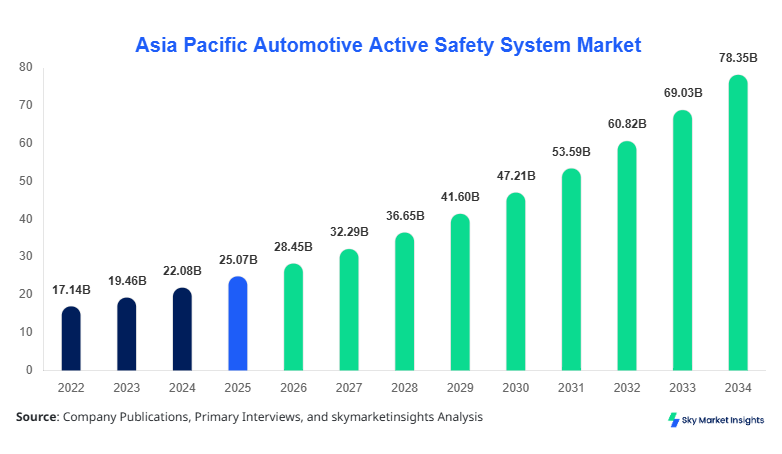
Asia Pacific Automotive Active Safety System market size is projected at USD 28.45 billion in 2026 and is expected to hit USD 78.62 billion by 2034 with a CAGR of 13.5%. The increasing integration of advanced driver assistance systems across mid-range and premium vehicles is accelerating revenue generation by over 2.8x during the forecast period. Market players are focusing on data-driven innovation, integrating AI-enabled sensors, radar, and LiDAR systems, with over 62% of OEMs adopting multi-sensor fusion architectures. The segmentation framework highlights dominant categories such as ADAS sensors contributing nearly 41% share and passenger vehicles accounting for 57% demand volume, emphasizing the need for granular data insights, structured segmentation, and competitive benchmarking.
The Asia Pacific Automotive Active Safety System market encompasses technologies designed to prevent accidents by assisting drivers through automated control systems such as lane departure warning, adaptive cruise control, and collision avoidance systems. In 2025, production of vehicles equipped with active safety systems reached approximately 32.7 million units across the region, with penetration rates exceeding 54% in urban markets. Consumer adoption is rising due to regulatory mandates and awareness, with 68% of buyers in China and Japan prioritizing safety features. Demand analytics reveal that passenger vehicles dominate with a 57% share, followed by commercial vehicles at 28% and electric vehicles at 15%. Technical metrics indicate radar frequency ranges of 24 GHz to 77 GHz and detection accuracy improvements of over 92%. Application splits highlight collision avoidance at 34%, lane assistance at 26%, and cruise control at 21%, reinforcing Asia Pacific Automotive Active Safety System market demand.
Explore more data points, trends and opportunities Download Free Sample Report
Automotive Active Safety System Market Trends
Integration of AI and Sensor Fusion Technologies
The adoption of AI-driven sensor fusion systems has increased significantly, with over 65% of new vehicles integrating multi-sensor platforms combining radar, cameras, and ultrasonic sensors. Production volumes of ADAS sensors exceeded 95 million units in 2025, with projected growth reaching 210 million units by 2030. Automotive OEMs are investing nearly 18% of R&D budgets in active safety technologies, leading to enhanced real-time data processing speeds by up to 45%. This trend is particularly evident in premium vehicles, where adoption rates exceed 82%, boosting Asia Pacific Automotive Active Safety System market trend.
Shift Toward Electrification and Autonomous Safety Systems
The rise of electric vehicles has driven the integration of advanced safety systems, with EVs showing 78% penetration of active safety technologies compared to 52% in ICE vehicles. Production of EV-compatible safety modules reached 12.4 million units in 2025 and is expected to surpass 38 million units by 2032. Autonomous safety features such as automatic emergency braking and adaptive cruise control are witnessing adoption rates above 64%, with continuous improvements in response times by 30%, reinforcing Asia Pacific Automotive Active Safety System market trend.
Asia Pacific Automotive Active Safety System Drivers
Increasing Regulatory Mandates and Safety Awareness
Government mandates across Asia Pacific require mandatory installation of safety systems such as electronic stability control and emergency braking, impacting over 85% of vehicles produced annually. Regulatory compliance has driven a 22% increase in system installation rates between 2022 and 2025, with production volumes exceeding 30 million units. Consumer awareness has also surged, with 71% of buyers prioritizing safety ratings, driving OEM investments in advanced safety features. Insurance benefits linked to safety features have increased adoption rates by 19%, reinforcing Asia Pacific Automotive Active Safety System market growth.
Asia Pacific Automotive Active Safety System Restraints
High Cost of Advanced Safety Technologies
The cost of integrating advanced safety systems ranges between USD 500 and USD 2,500 per vehicle, limiting adoption in entry-level segments. Approximately 38% of manufacturers report cost constraints as a major barrier, especially in emerging markets such as India and Southeast Asia. Production costs have increased by 12% annually due to semiconductor shortages and rising sensor prices. Additionally, only 46% of low-cost vehicle models incorporate advanced safety features, restricting widespread adoption and impacting Asia Pacific Automotive Active Safety System market growth.
Asia Pacific Automotive Active Safety System Opportunities
Expansion of Autonomous Driving Capabilities
The development of Level 3 and Level 4 autonomous driving systems presents significant opportunities, with investments exceeding USD 9.8 billion annually in the region. Over 28% of automotive companies are focusing on autonomous safety solutions, and pilot deployments have increased by 35% between 2023 and 2025. The integration of AI-based safety algorithms has improved system efficiency by 42%, enabling new applications in urban mobility. Increasing EV adoption and smart city initiatives further enhance growth potential, strengthening Asia Pacific Automotive Active Safety System market growth.
Asia Pacific Automotive Active Safety System Challenge
Integration Complexity and Standardization Issues
The complexity of integrating multiple safety systems into vehicle architectures has increased engineering challenges by over 27%. Standardization across regions remains inconsistent, with only 54% of safety systems meeting unified regulatory frameworks. Compatibility issues between sensors and software platforms have led to increased development timelines by 18% and testing costs by 14%. Cybersecurity risks associated with connected safety systems have also risen by 23%, posing additional challenges for manufacturers and impacting Asia Pacific Automotive Active Safety System market growth.
Report Scope
| Report Metric | Details |
|---|---|
| Market Size in 2025 | USD 25.07 Billion |
| Market Size in 2026 | USD 28.45 Billion |
| Market Size in 2034 | USD 78.62 Billion |
| CAGR | 13.5% (2026-2034) |
| Base Year for Estimation | 2025 |
| Historical Data | 2022-2024 |
| Forecast Period | 2026-2034 |
| Report Coverage | Revenue Forecast, Competitive Landscape, Supply Chain Disruption, Growth Factors, Environment & Regulatory Landscape and Trends |
Explore more data points, trends and opportunities Download Free Sample Report
Automotive Active Safety System Market Segmentation
The market is segmented based on system type and vehicle type, with ADAS sensors dominating at 41% share, followed by electronic stability control at 33% and adaptive cruise control at 26%. Passenger vehicles lead applications with 57% share, while commercial vehicles and EVs contribute 28% and 15%, respectively.
BY TYPE
ADAS sensors account for approximately 41% of the market, with over 95 million units produced annually. These sensors operate at frequencies between 24 GHz and 77 GHz, offering detection ranges of up to 250 meters. The increasing demand for collision avoidance and lane assistance systems has driven adoption rates to 68% in passenger vehicles. Technological advancements have improved accuracy by 35%, enabling enhanced performance across various driving conditions.
Electronic stability control holds a 33% share, with production exceeding 28 million units annually. This system reduces accident risks by up to 32% by maintaining vehicle stability during sudden maneuvers. Adoption rates are above 85% in developed markets such as Japan and South Korea. Integration with braking systems and real-time monitoring capabilities enhances efficiency and safety performance.
Adaptive cruise control contributes 26% of the market, with over 21 million units installed annually. This system maintains safe distances between vehicles, improving fuel efficiency by up to 12%. Adoption is highest in premium vehicles, with penetration rates exceeding 74%. Technological improvements have reduced response times by 28%, enhancing driving comfort and safety.
BY APPLICATION
Passenger vehicles dominate with 57% share, with over 18 million units equipped annually. Adoption rates exceed 65% in urban regions, driven by consumer demand for safety and comfort. Advanced systems such as lane assistance and collision avoidance are widely integrated, improving accident prevention rates by 30%.
Commercial vehicles account for 28% share, with production volumes of approximately 9 million units. Safety systems are critical for fleet management, reducing accident-related costs by 25%. Adoption rates are increasing due to regulatory mandates and insurance benefits.
Electric vehicles contribute 15% share, with over 5 million units equipped with active safety systems. Integration of AI-based safety features enhances efficiency by 40%. EV manufacturers prioritize advanced safety technologies, driving rapid adoption.
Asia Pacific Automotive Active Safety System Market Segmentations
System Type
- ADAS Sensors
- Electronic Stability Control
- Adaptive Cruise Control
Vehicle Type
- Passenger Vehicles
- Commercial Vehicles
- Electric Vehicles
Asia Pacific Automotive Active Safety System Regional Outlook
China
China leads with 43% share, producing over 14 million vehicles with active safety systems annually. The country’s strong manufacturing base and regulatory support drive adoption rates above 72%. Passenger vehicles dominate, while EVs show rapid growth.
Japan
Japan holds 18% share, with production exceeding 5 million units. Advanced technology adoption and high safety standards drive penetration rates above 80%. The country focuses on innovation and integration of AI-based systems.
India
India accounts for 9% share, with production of 3 million units. Adoption rates are lower at 42%, but increasing due to regulatory mandates and rising consumer awareness.
South Korea
South Korea contributes 11% share, with strong presence of automotive OEMs. Production volumes exceed 3.5 million units, with high adoption of advanced safety technologies.
Australia, Singapore, Taiwan, Southeast Asia
These regions collectively account for 19% share, with growing adoption of safety systems. Production volumes exceed 6 million units, driven by urbanization and increasing vehicle ownership.
Top players in Asia Pacific Automotive Active Safety System
- Bosch
- Continental AG
- Denso Corporation
- Aptiv PLC
- Valeo SA
- ZF Friedrichshafen AG
- Autoliv Inc.
- Hyundai Mobis
- Magna International
- Hitachi Automotive Systems
- NXP Semiconductors
- Infineon Technologies
Top Two Companies:
-
Bosch
-
Holds approximately 21% market share
-
Strong focus on ADAS innovation with over 30% R&D investment
-
Leading supplier of radar and sensor technologies
-
-
Continental AG
-
Accounts for nearly 17% share
-
Specializes in integrated safety systems with advanced software capabilities
-
Expanding presence in EV safety solutions
-
Investment Analysis
Investment in the market has exceeded USD 12.5 billion annually, with 38% allocated to R&D and 27% to production expansion. China attracts 45% of regional investments, followed by Japan at 18% and South Korea at 14%. M&A activities have increased by 22%, with collaborations focusing on AI and autonomous technologies.
New Product Developments
New product launches account for 19% of market expansion, with performance improvements exceeding 35% in detection accuracy. Innovations in AI-based systems and sensor integration are driving advancements.
Recent Developments in Asia Pacific Automotive Active Safety System
- 2025: Bosch increased production by 18%, introducing advanced radar systems
Research Methodology
The research process involves primary and secondary data collection, including interviews with industry experts and analysis of company reports. Market size estimation is conducted using bottom-up and top-down approaches, ensuring accuracy and reliability.
Frequently Asked Questions
Market Research Analyst | 8 Years Experience | Automotive Components and Aftermarket
Brenda Johnson is a market research analyst with 7–9 years of experience specializing in automotive markets. Contributed to 70+ research reports for global clients. Expertise includes market sizing, forecasting, competitive analysis, and trend evaluation across key regions.