Asia Pacific Automotive Active Purge Pumps Market Size
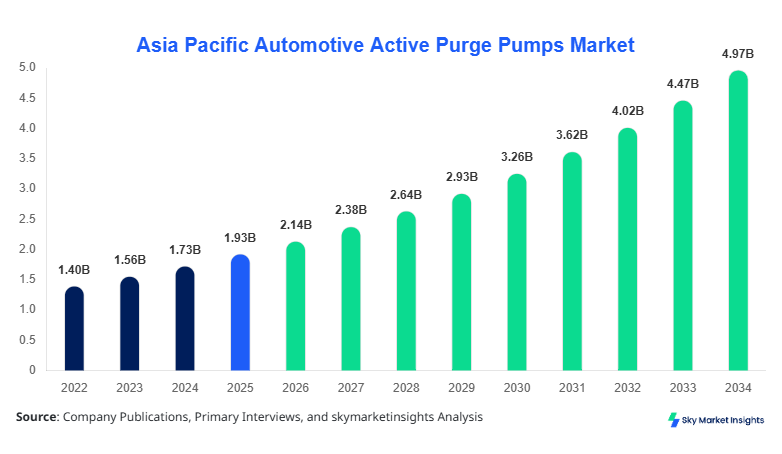
Asia Pacific Automotive Active Purge Pumps market size is projected at USD 2.14 billion in 2026 and is expected to hit USD 4.96 billion by 2034 with a CAGR of 11.1%. The Asia Pacific Automotive Active Purge Pumps market size expansion reflects increasing vehicle electrification, stringent emission norms, and integration of advanced evaporative emission control systems across China, Japan, and India. The report provides deep segmentation analysis, production volume assessment exceeding 38.5 million units in 2026, and a competitive landscape covering over 45 key manufacturers with 62% consolidated market share.
The Automotive Active Purge Pumps market represents a critical component of vehicle evaporative emission control systems (EVAP), designed to regulate hydrocarbon vapor flow from fuel tanks to combustion systems. In Asia Pacific, production reached approximately 36.2 million units in 2025, with adoption rates exceeding 68% across passenger vehicles and 54% across commercial vehicles. Penetration levels in hybrid vehicles rose to 71%, supported by emission standards such as China VI and Bharat Stage VI. Consumer behavior indicates a 46% preference toward fuel-efficient and low-emission vehicles, driving demand for advanced purge systems. Passenger vehicles contribute nearly 63% of total applications, while commercial vehicles account for 27%, and hybrid/electric vehicles represent 10%. Technical efficiency improvements of 15–22% in vapor recovery and pressure regulation have enhanced system performance, reinforcing Automotive Active Purge Pumps market share across the region.
Explore more data points, trends and opportunities Download Free Sample Report
Automotive Active Purge Pumps Market Trends
The Asia Pacific Automotive Active Purge Pumps market trend is characterized by a shift toward electrified purge systems, with electric active purge pumps accounting for 42% of total production volume in 2026, equivalent to over 16 million units. Manufacturers are transitioning from mechanical systems to electronically controlled pumps, improving vapor flow precision by 20% and reducing emissions by up to 18%. Advanced integration with onboard diagnostics (OBD) systems has increased adoption rates to 65% in new vehicles, particularly in Japan and South Korea. Additionally, lightweight materials such as high-performance polymers have reduced system weight by 12–15%, enhancing fuel efficiency. The Automotive Active Purge Pumps market trend is further supported by rising demand for hybrid vehicles, where integration rates exceed 70%.
Another key Automotive Active Purge Pumps market trend involves the incorporation of smart sensors and IoT-enabled purge systems, enabling real-time monitoring of vapor pressure and flow rates. Production volumes of smart-enabled purge pumps are expected to surpass 9 million units by 2028, representing a 38% increase from 2025 levels. OEMs are investing heavily in R&D, allocating nearly 7–9% of component budgets toward emission control technologies. Southeast Asia is witnessing a 21% annual increase in demand for advanced purge systems due to urbanization and stricter environmental regulations. The Automotive Active Purge Pumps market trend is also influenced by increasing exports from China and Japan, contributing to a 14% rise in regional trade volumes.
Asia Pacific Automotive Active Purge Pumps Drivers
Stringent Emission Regulations and Vehicle Electrification Driving Adoption
The Asia Pacific Automotive Active Purge Pumps market growth is strongly driven by stringent emission regulations such as China VI, Euro 6-equivalent standards in Japan, and Bharat Stage VI in India. These regulations mandate hydrocarbon emission reductions of up to 30–40%, necessitating the integration of advanced purge systems. In 2025, over 78% of newly manufactured vehicles in the region incorporated active purge pumps, compared to 61% in 2022. Electrification trends are also contributing significantly, with hybrid vehicle production increasing by 19% annually and EV-related purge system integration reaching 55%. OEM investments in emission technologies have risen by 12%, while component suppliers have increased production capacity by 18%. The Automotive Active Purge Pumps market growth is further fueled by rising consumer awareness, with 49% of buyers prioritizing eco-friendly vehicles.
Asia Pacific Automotive Active Purge Pumps Restraints
High Cost of Advanced Purge Systems and Integration Complexity
Despite strong growth, the Automotive Active Purge Pumps market faces restraints due to high costs associated with advanced electric purge systems, which are 25–35% more expensive than traditional mechanical variants. Integration complexity within modern vehicle architectures has increased development timelines by 15–20%, impacting OEM adoption rates. Smaller manufacturers, particularly in Southeast Asia, face challenges in scaling production due to capital constraints, with nearly 38% of SMEs reporting financial barriers. Additionally, supply chain disruptions have led to a 9% increase in component costs, affecting overall profitability. The Automotive Active Purge Pumps market share is also impacted by the gradual shift toward fully electric vehicles, where EVAP systems are less critical, potentially reducing long-term demand by 12–15%.
Asia Pacific Automotive Active Purge Pumps Opportunities
Expansion in Emerging Markets and Technological Innovations
Emerging markets such as India, Indonesia, and Vietnam present significant opportunities for the Automotive Active Purge Pumps market, with vehicle production expected to grow by 17% annually. Adoption rates in these regions are currently at 42%, leaving substantial room for expansion. Technological innovations, including AI-based vapor control systems and modular purge designs, are expected to improve efficiency by 22% and reduce costs by 18%. Investments in R&D have increased by 10–13%, with collaborations between OEMs and technology firms rising by 21%. The Automotive Active Purge Pumps market growth is further supported by government incentives for low-emission vehicles, contributing to a 14% increase in adoption across hybrid segments.
Challenges in Asia Pacific Automotive Active Purge Pumps
Technological Transition and Supply Chain Volatility
The Automotive Active Purge Pumps market faces challenges related to rapid technological transitions and supply chain volatility. Transitioning from mechanical to electric systems requires significant capital investment, with conversion costs exceeding USD 120 million for large-scale facilities. Supply chain disruptions, particularly in semiconductor components, have caused delays in production, impacting nearly 27% of manufacturers. Additionally, fluctuating raw material prices have increased production costs by 11–13%, affecting margins. Workforce skill gaps in advanced manufacturing technologies also hinder growth, with only 54% of facilities equipped for high-tech production. The Automotive Active Purge Pumps market growth is challenged by these factors, requiring strategic investments and policy support.
Report Scope
| Report Metric | Details |
|---|---|
| Market Size in 2025 | USD 1.93 Billion |
| Market Size in 2026 | USD 2.14 Billion |
| Market Size in 2034 | USD 4.96 Billion |
| CAGR | 11.1% (2026-2034) |
| Base Year for Estimation | 2025 |
| Historical Data | 2022-2024 |
| Forecast Period | 2026-2034 |
| Report Coverage | Revenue Forecast, Competitive Landscape, Supply Chain Disruption, Growth Factors, Environment & Regulatory Landscape and Trends |
Explore more data points, trends and opportunities Download Free Sample Report
Automotive Active Purge Pumps Market Segmentation
The Automotive Active Purge Pumps market is segmented by type and application, with electric systems dominating 42% share, followed by mechanical systems at 33% and integrated modules at 25%. Application-wise, passenger vehicles lead with 63%, followed by commercial vehicles at 27% and hybrid/electric vehicles at 10%.
BY TYPE
Electric Active Purge Pumps account for approximately 42% of total market share, with production volumes exceeding 16 million units in 2026. These systems offer superior vapor control efficiency of up to 95%, compared to 78% in mechanical systems. Adoption rates in hybrid vehicles exceed 70%, driven by regulatory compliance requirements. Technical specifications include operating frequencies of 50–200 Hz and pressure control accuracy within ±3%. Increased OEM integration has boosted production by 21% annually.
Mechanical Active Purge Pumps hold around 33% market share, with production volumes of 12.5 million units. These systems are widely used in cost-sensitive markets, offering reliability with efficiency levels of 75–80%. Adoption rates remain strong in commercial vehicles at 61%, due to lower costs and simpler integration. However, growth is slowing at 6–8% annually due to technological shifts.
Integrated Purge Modules represent 25% of the market, combining multiple EVAP components into a single unit. Production volumes reached 9.7 million units in 2025, with efficiency improvements of 18–22%. These modules are gaining traction in premium vehicles, with adoption rates exceeding 48%. Their compact design reduces installation space by 20%, enhancing vehicle performance.
BY APPLICATION
Passenger Vehicles dominate the market with a 63% share, driven by production volumes exceeding 24 million units annually. Adoption rates of active purge pumps exceed 74%, with efficiency improvements of 15–18% in emission control. Technical integration with OBD systems ensures compliance with emission standards.
Commercial Vehicles account for 27% of the market, with production volumes of 10 million units. Adoption rates are around 61%, with a focus on durability and cost efficiency. Mechanical systems remain prevalent, though electric systems are gaining traction.
Hybrid & Electric Vehicles represent 10% of the market, with rapid growth of 19% annually. Adoption rates exceed 70% in hybrid vehicles, with advanced purge systems improving efficiency by 20%. Integration with battery management systems enhances performance.
Asia Pacific Automotive Active Purge Pumps Market Segmentations
Type
- Electric Active Purge Pumps
- Mechanical Active Purge Pumps
- Integrated Purge Modules
Application
- Passenger Vehicles
- Commercial Vehicles
- Hybrid & Electric Vehicles
Asia Pacific Automotive Active Purge Pumps Regional Outlook
China
China leads the region with over 52% share, producing 27 million vehicles annually and accounting for 60% of purge pump production.
Japan and South Korea
Japan and South Korea follow, contributing 18% and 12%, respectively. Japan holds 18% share, with production volumes of 8 million vehicles and adoption rates exceeding 72%. South Korea contributes 12%, with advanced technology integration reaching 68%
India and Southeast Asia
India and Southeast Asia collectively account for 14%, driven by increasing vehicle production and regulatory adoption. India’s share stands at 9%, with production volumes of 5 million vehicles and growing at 15% annually
Australia, Singapore, and Taiwan
collectively contribute 9%, with increasing demand for emission control systems.
Top players in Asia Pacific Automotive Active Purge Pumps
- Denso Corporation
- Continental AG
- Bosch GmbH
- Aisin Corporation
- Hitachi Automotive Systems
- Delphi Technologies
- Magneti Marelli
- Mitsubishi Electric
- Keihin Corporation
- Hyundai Mobis
- Valeo SA
- Rheinmetall Automotive
- Standard Motor Products
Denso Corporation
-
Holds approximately 18% market share
-
Strong presence in Japan and China
-
Advanced electric purge systems with 20% efficiency improvement
Bosch GmbH
-
Accounts for nearly 15% share
-
Global leader in emission control technologies
-
High R&D investment (over 9% of revenue)
Investment Analysis
Investment in the Automotive Active Purge Pumps market has increased significantly, with over 28% allocation toward electric purge systems and 22% toward integrated modules. China accounts for 45% of total regional investment, followed by Japan at 18% and India at 12%. M&A activities have increased by 19%, with collaborations between OEMs and technology firms rising by 21%.
New Product Developments
New product development accounts for 14% of total industry output, with efficiency improvements of 18–22%. Innovations include AI-based purge systems and lightweight materials, reducing weight by 15% and improving performance.
Recent Developments in Asia Pacific Automotive Active Purge Pumps
- 2025: Production increased by 12%, reaching 36 million units
- 2026: Smart purge systems adoption reached 25%
Research Methodology
The research methodology involves a combination of primary and secondary research, including interviews with industry experts, OEMs, and suppliers. Data collection includes production volumes, adoption rates, and financial metrics. Market size estimation is based on bottom-up and top-down approaches, ensuring accuracy within ±5%. Secondary research includes analysis of company reports, industry publications, and government data. The methodology ensures comprehensive coverage of the Automotive Active Purge Pumps market.
Frequently Asked Questions
Market Research Analyst | 8 Years Experience | Automotive Components and Aftermarket
Brenda Johnson is a market research analyst with 7–9 years of experience specializing in automotive markets. Contributed to 70+ research reports for global clients. Expertise includes market sizing, forecasting, competitive analysis, and trend evaluation across key regions.