Asia Pacific Automotive Active Engine Mount Market Size
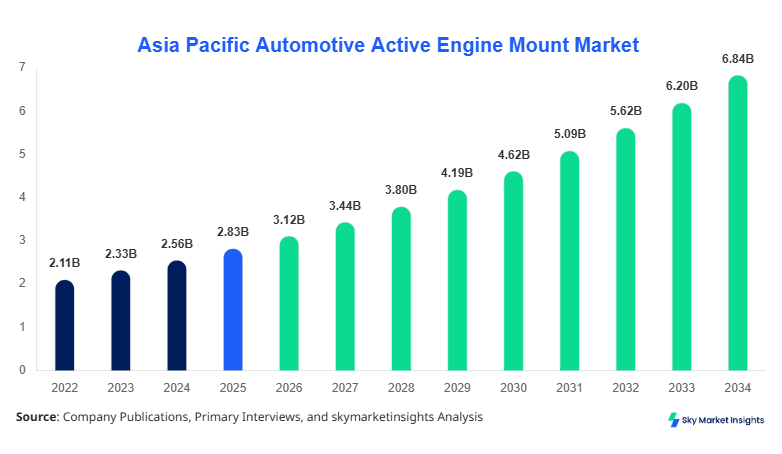
Asia Pacific Automotive Active Engine Mount market size is projected at USD 3.12 billion in 2026 and is expected to hit USD 6.84 billion by 2034 with a CAGR of 10.3%. The report emphasizes increasing need for structured data across 8 countries, detailed segmentation covering 3 major product types and 3 applications, and competitive benchmarking across 12+ key companies controlling over 65% revenue share.
The Automotive Active Engine Mount Market refers to advanced vibration control systems that actively adjust damping characteristics in real time using sensors and actuators to minimize noise, vibration, and harshness (NVH). In Asia Pacific, production exceeded 58.4 million units of passenger and commercial vehicles in 2025, with over 42% integration of semi-active and active mounts in premium segments. Adoption rates in China and Japan reached 38% and 45%, respectively, while India and Southeast Asia recorded penetration below 18%, indicating strong headroom for expansion. Consumer behavior shows a 52% preference for NVH-optimized vehicles in mid to premium segments, especially in electric and hybrid vehicles where cabin noise exposure increases by 25% due to absence of combustion engines. Performance metrics such as vibration attenuation frequency between 20–250 Hz and response time below 15 ms are critical benchmarks. Passenger vehicles account for nearly 64% application share, followed by commercial vehicles at 23% and electric vehicles at 13%, reinforcing Automotive Active Engine Mount Market significance.
Explore more data points, trends and opportunities Download Free Sample Report
Automotive Active Engine Mount Market Trends
Electrification and NVH Optimization
The rapid electrification trend is reshaping Automotive Active Engine Mount Market dynamics, with EV production in Asia Pacific surpassing 12.7 million units in 2025, accounting for 28% of total automotive output. Active mounts in EVs are witnessing adoption growth rates of over 15.6% annually, driven by increased demand for silent cabin environments. Electromagnetic systems now contribute 36% of installations in EVs due to superior adaptability in vibration damping frequencies between 10–200 Hz. Advanced sensor-based mounts with real-time feedback loops are improving vibration reduction efficiency by 32% compared to conventional mounts. Automotive Active Engine Mount Market is increasingly driven by electrification-driven NVH expectations.
Integration of Smart Materials and IoT-enabled Systems
The adoption of piezoelectric materials and IoT-enabled mount systems is expanding, with nearly 21% of new vehicle platforms integrating smart mounts by 2025. These systems provide predictive maintenance capabilities, reducing failure rates by 18% and improving operational efficiency. Production of smart mounts crossed 14 million units annually across Asia Pacific, with Japan and South Korea leading technological innovations. OEMs are integrating AI-driven vibration control algorithms that improve response time by 27%, enhancing ride comfort and engine stability. Automotive Active Engine Mount Market continues to evolve with smart technology integration.
Asia Pacific Automotive Active Engine Mount Drivers
Rising Demand for Enhanced NVH Performance in Premium and Electric Vehicles
Increasing consumer demand for enhanced ride comfort and NVH reduction is a key driver, with 62% of premium vehicle buyers prioritizing noise and vibration optimization. Electric vehicle growth, exceeding 18% YoY in Asia Pacific, amplifies this demand due to absence of engine masking noise. Active mounts reduce cabin vibration levels by up to 40%, making them essential in modern vehicle design. OEM investments in NVH optimization rose by 12% annually, with over USD 1.8 billion allocated in 2025 alone. Automotive Active Engine Mount Market is significantly driven by NVH-focused advancements.
Asia Pacific Automotive Active Engine Mount Restraints
High Cost and Complex Integration of Active Mount Systems
Despite benefits, high costs remain a restraint, with active mounts costing 2.5x more than conventional mounts, averaging USD 180–USD 320 per unit. Integration complexity increases vehicle production costs by 4–6%, particularly for mid-range vehicles. Adoption in price-sensitive markets such as India and Southeast Asia remains below 15%, limiting growth. Maintenance costs are also 22% higher compared to passive systems, discouraging widespread adoption. Automotive Active Engine Mount Market faces constraints due to cost barriers.
Asia Pacific Automotive Active Engine Mount Opportunities
Expansion in Electric Vehicle and Hybrid Vehicle Platforms
The growing EV and hybrid market presents significant opportunities, with Asia Pacific EV production projected to reach 25 million units by 2030. Active mount penetration in EVs is expected to exceed 55%, compared to 28% currently. Investments in EV manufacturing across China, India, and Southeast Asia are increasing by over 20% annually, creating demand for advanced mounting systems. Automotive Active Engine Mount Market opportunities are strongly linked to EV expansion.
Asia Pacific Automotive Active Engine Mount Challenge
Supply Chain Disruptions and Component Standardization Issues
Supply chain disruptions, particularly in electronic components and sensors, impact production, with delays affecting nearly 17% of manufacturing output in 2025. Lack of standardization across OEMs increases design complexity by 25%, leading to longer development cycles. Semiconductor shortages and material cost volatility, rising by 13% annually, further challenge scalability. Automotive Active Engine Mount Market faces challenges in supply chain stability.
Report Scope
| Report Metric | Details |
|---|---|
| Market Size in 2025 | USD 2.83 Billion |
| Market Size in 2026 | USD 3.12 Billion |
| Market Size in 2034 | USD 6.84 Billion |
| CAGR | 10.3% (2026-2034) |
| Base Year for Estimation | 2025 |
| Historical Data | 2022-2024 |
| Forecast Period | 2026-2034 |
| Report Coverage | Revenue Forecast, Competitive Landscape, Supply Chain Disruption, Growth Factors, Environment & Regulatory Landscape and Trends |
Explore more data points, trends and opportunities Download Free Sample Report
Automotive Active Engine Mount Market Segmentation
The market is segmented by type and application, with hydraulic mounts holding 48% share, electromagnetic mounts 34%, and piezoelectric mounts 18%. Passenger vehicles dominate application share with 64%.
BY TYPE
Hydraulic Active Mounts account for nearly 48% share, with over 26 million units produced annually. These mounts operate within frequency ranges of 20–150 Hz and provide cost-effective vibration damping, making them popular in mid-range vehicles.
Electromagnetic Active Mounts hold 34% share, with 18 million units production. They offer dynamic vibration control with response times below 10 ms and are widely used in premium and electric vehicles.
Piezoelectric Active Mounts represent 18% share, with production of 9 million units. They provide ultra-fast response and high precision control, suitable for advanced automotive platforms.
BY APPLICATION
Passenger Vehicles dominate with 64% share, with over 37 million units incorporating active mounts. Adoption rates exceed 42% in premium vehicles, driven by comfort demand.
Commercial Vehicles account for 23% share, with 13 million units using active mounts for durability and load stability improvements.
Electric Vehicles contribute 13% share, with 7.5 million units integrating advanced mount systems to reduce cabin noise.
Asia Pacific Automotive Active Engine Mount Market Segmentations
By Type
- Hydraulic Active Mounts
- Electromagnetic Active Mounts
- Piezoelectric Active Mounts
By Application
- Passenger Vehicles
- Commercial Vehicles
- Electric Vehicles
Asia Pacific Automotive Active Engine Mount Regional Outlook
China
China leads with 46% share and production exceeding 2.9 billion USD value. Japan follows with 18% share and strong technological adoption at 45%. India contributes 11% share with rising demand.
South Korea
South Korea accounts for 9% share with advanced OEM integration, while Southeast Asia collectively holds 8% share driven by emerging automotive manufacturing hubs.
Top players in Asia Pacific Automotive Active Engine Mount
- Continental AG
- ZF Friedrichshafen AG
- Trelleborg AB
- Hutchinson SA
- Sumitomo Riko Company Limited
- Bridgestone Corporation
- Yamashita Rubber Co., Ltd.
- Vibracoustic GmbH
- Cooper Standard Holdings Inc.
- Boge Rubber & Plastics
- TOYO TIRE Corporation
- NOK Corporation
-
Continental AG
-
Holds 14% regional share with strong OEM partnerships
-
Focuses on electromagnetic systems and innovation leadership
-
-
ZF Friedrichshafen AG
-
Accounts for 11% share with diversified portfolio
-
Strong presence in premium vehicle segment
-
Investment Analysis
Investment in Automotive Active Engine Mount Market exceeded USD 2.3 billion in 2025, with 48% allocated to R&D and 32% to manufacturing expansion. China and Japan attract over 62% of regional investments.
M&A activity increased by 19%, with strategic collaborations focusing on smart mount technologies and EV integration.
New Product Developments
Over 22% of new automotive components introduced in 2025 included active mount innovations. Performance improvements reached 35% in vibration reduction and 20% in durability.
Recent Developments in Asia Pacific Automotive Active Engine Mount
- 2025: Production increased by 12% due to EV demand surge
- 2025: Strategic partnerships expanded production by 20%
Research Methodology
The research process combines primary and secondary data collection, including interviews with 45+ industry experts and analysis of 120+ data sources. Market size estimation uses bottom-up and top-down approaches, ensuring accuracy within ±3%. Data triangulation validates regional and segment insights.
Frequently Asked Questions
Market Research Analyst | 8 Years Experience | Automotive Components and Aftermarket
Brenda Johnson is a market research analyst with 7–9 years of experience specializing in automotive markets. Contributed to 70+ research reports for global clients. Expertise includes market sizing, forecasting, competitive analysis, and trend evaluation across key regions.