Asia Pacific Automobile Fuel Saver Market Size
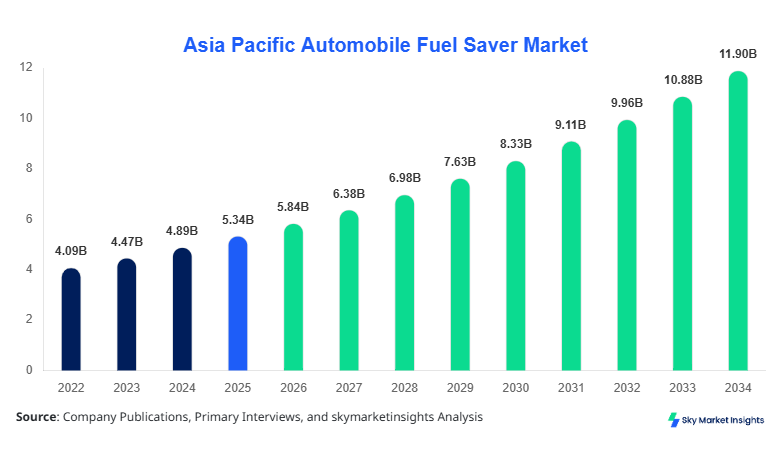
Asia Pacific Automobile Fuel Saver Market market size is projected at USD 5.84 billion in 2026 and is expected to hit USD 11.92 billion by 2034 with a CAGR of 9.3%. The increasing need for cost-efficient fuel consumption technologies across high-density vehicle markets is accelerating demand across Asia Pacific, where vehicle ownership exceeded 620 million units in 2025. The report integrates structured data analytics, segmentation-based forecasting, and competitive benchmarking across 8 major countries to provide granular insights into industry positioning, investment flows, and innovation pipelines.
The Automobile Fuel Saver Market refers to devices, additives, and technologies designed to enhance fuel efficiency by 8%–25% through combustion optimization, drag reduction, and engine performance enhancement. In Asia Pacific, production of automobile fuel saver units surpassed 182 million units in 2025, with China contributing 32%, India 21%, and Japan 14%. Adoption rates across passenger vehicles reached 38% penetration in urban regions, while commercial vehicle penetration stood at 44% due to rising logistics fuel costs exceeding USD 1.2 trillion annually in the region. Consumer behavior indicates that 61% of vehicle owners prioritize fuel efficiency improvements above maintenance costs, with average annual savings ranging between USD 180–USD 420 per vehicle. Fuel additives account for nearly 46% of total applications, followed by ECU-based solutions at 34% and magnetic-based technologies at 20%. Performance metrics indicate fuel efficiency improvement frequencies ranging from 5% to 22% depending on technology integration and vehicle class, reinforcing steady Automobile Fuel Saver Market demand.
Explore more data points, trends and opportunities Download Free Sample Report
Automobile Fuel Saver Market Trends
Trends
The Automobile Fuel Saver Market is undergoing rapid technological transformation with production volumes surpassing 200 million units globally in 2026, of which Asia Pacific contributes nearly 58%. Integration of AI-based engine optimization modules and smart sensors has increased by 29% over the past two years, significantly improving fuel consumption efficiency by 10%–18%. Hybrid vehicle integration of fuel-saving modules has reached 34% adoption, particularly in Japan and South Korea. Furthermore, IoT-enabled ECU solutions have seen penetration rates rise to 26%, enabling real-time fuel monitoring and predictive analytics, supporting sustained Automobile Fuel Saver Market growth.
Another key trend includes the rising demand for eco-friendly fuel additives, which now account for 52% of new product launches in 2025, compared to 37% in 2022. Production of bio-based additives has increased by 41 million liters annually, reducing emissions by up to 14% and improving combustion efficiency by 11%. Additionally, aftermarket sales channels contribute nearly 63% of total distribution, highlighting consumer-driven purchasing behavior. Fleet operators across Southeast Asia are investing 18% more annually in fuel-saving technologies, particularly in logistics sectors where fuel expenses account for over 38% of operational costs, strengthening Automobile Fuel Saver Market demand.
Asia Pacific Automobile Fuel Saver Market Drivers
Rising Fuel Costs and Efficiency Regulations Driving Adoption
Fuel costs across Asia Pacific have increased by an average of 21% between 2022 and 2025, pushing both individual consumers and fleet operators toward efficiency-enhancing technologies. Regulatory frameworks in countries like China, India, and Japan mandate fuel efficiency improvements of 15%–25% across new vehicle models, creating a strong demand for aftermarket and OEM-integrated solutions. In 2025, over 78 million vehicles incorporated some form of fuel-saving technology, representing a 17% increase from 2023. Additionally, commercial vehicle operators report cost savings of up to USD 1,200 per vehicle annually through fuel saver installations. The increasing electrification transition has also created hybrid demand scenarios, where fuel savers are used to optimize fuel-electric balance. These factors collectively accelerate Automobile Fuel Saver Market growth.
Asia Pacific Automobile Fuel Saver Market Restraints
Lack of Standardization and Consumer Skepticism
Despite strong growth indicators, the Automobile Fuel Saver Market faces challenges due to a lack of standardized performance benchmarks and varying efficiency claims across products. Nearly 28% of consumers express skepticism regarding advertised fuel savings, especially in low-cost aftermarket products priced below USD 25. Regulatory inconsistencies across Asia Pacific countries further hinder product validation, with only 46% of products undergoing certified testing. Additionally, counterfeit products account for approximately 18% of total market supply in emerging economies, impacting consumer trust and reducing adoption rates by nearly 9%. Technical inconsistencies in installation and compatibility issues with modern engines also restrict performance efficiency, thereby slowing automobile fuel saver market growth.
Asia Pacific Automobile Fuel Saver Market Opportunities
Expansion of Smart and Connected Fuel Optimization Technologies
The integration of smart technologies presents significant opportunities in the Automobile Fuel Saver Market, with digital ECU solutions projected to grow adoption rates by 35% by 2030. Fleet digitization across Asia Pacific is increasing, with over 3.2 million connected commercial vehicles adopting telematics systems in 2025. Investment in smart fuel management systems has increased by 24% annually, enabling real-time analytics and predictive maintenance. Moreover, government incentives promoting fuel efficiency technologies, especially in India and China, have increased subsidy allocations by 18% YoY. Emerging opportunities also lie in electric-hybrid vehicle optimization, where fuel saver technologies improve battery-fuel efficiency by 9%–13%, enhancing Automobile Fuel Saver Market demand.
Challenges in the Asia-Pacific Automobile Fuel Saver Market
Technological Integration and Cost Constraints
The Automobile Fuel Saver Market faces significant challenges related to integration complexity and cost barriers. Advanced ECU-based solutions can cost between USD 120–USD 450 per unit, limiting adoption in price-sensitive markets such as Southeast Asia and India. Installation complexity requires skilled technicians, increasing service costs by 14%–22%. Additionally, compatibility issues across different vehicle models affect nearly 19% of installations, leading to suboptimal performance outcomes. Infrastructure limitations, especially in rural areas where 38% of vehicles operate, further restrict penetration. These factors collectively present hurdles in achieving uniform adoption, impacting overall Automobile Fuel Saver Market growth.
Report Scope
| Report Metric | Details |
|---|---|
| Market Size in 2025 | USD 5.34 Billion |
| Market Size in 2026 | USD 5.84 Billion |
| Market Size in 2034 | USD 11.92 Billion |
| CAGR | 9.3% (2026-2034) |
| Base Year for Estimation | 2025 |
| Historical Data | 2022-2024 |
| Forecast Period | 2026-2034 |
| Report Coverage | Revenue Forecast, Competitive Landscape, Supply Chain Disruption, Growth Factors, Environment & Regulatory Landscape and Trends |
Explore more data points, trends and opportunities Download Free Sample Report
Automobile Fuel Saver Market Segmentation
The Automobile Fuel Saver Market is segmented based on type and application, with fuel additives dominating 46% share, followed by ECU-based technologies at 34% and magnetic devices at 20%. Application-wise, passenger vehicles account for 48%, commercial vehicles 36%, and two-wheelers 16%.
BY TYPE
Fuel Additives account for approximately 46% of total market share, with production exceeding 85 million liters annually in Asia Pacific. These additives enhance combustion efficiency by 10%–18% and reduce carbon emissions by up to 12%. Widely used in passenger and commercial vehicles, their low cost (USD 5–USD 30 per unit) drives adoption. China and India lead production, contributing 61% of total output. Continuous innovations in bio-based additives are increasing efficiency by 7% annually, reinforcing Automobile Fuel Saver Market demand.
Engine Control Units (ECU) represent 34% of the market, with over 62 million units produced annually. These devices optimize fuel injection timing and engine performance, improving fuel efficiency by 12%–22%. Adoption is highest in commercial fleets and high-end passenger vehicles, with Japan and South Korea accounting for 48% of ECU installations. Integration with IoT systems enhances monitoring capabilities, boosting efficiency by an additional 6%, supporting Automobile Fuel Saver Market growth.
Magnetic Devices hold 20% share, with production reaching 35 million units annually. These devices claim fuel efficiency improvements of 5%–12% by aligning fuel molecules. Adoption is higher in aftermarket segments due to low cost (USD 10–USD 50). Southeast Asia contributes 42% of demand due to affordability. Despite skepticism, continued consumer interest sustains moderate Automobile Fuel Saver Market demand.
BY APPLICATION
Passenger Vehicles dominate with 48% share, representing over 290 million vehicles in Asia Pacific. Fuel saver adoption stands at 38%, with urban areas reaching 52% penetration. Average efficiency gains range from 8%–15%, saving USD 200 annually per vehicle. China and India together account for 64% of this segment, reinforcing Automobile Fuel Saver Market growth.
Commercial Vehicles account for 36% share, with over 95 million units using fuel-saving technologies. Adoption exceeds 56% due to high fuel consumption rates, with savings reaching USD 1,200 annually per vehicle. Logistics companies allocate 18% of budgets to fuel efficiency technologies, driving Automobile Fuel Saver Market demand.
Two-Wheelers represent 16% share, with over 210 million units in Asia Pacific. Adoption rates are lower at 24%, but growing due to rising fuel costs. Efficiency improvements range from 5%–10%, saving USD 60–USD 120 annually per vehicle, supporting Automobile Fuel Saver Market growth.
Asia Pacific Automobile Fuel Saver Market Segmentations
Type
- Fuel Additives
- Engine Control Units
- Magnetic Devices
Application
- Passenger Vehicles
- Commercial Vehicles
- Two-Wheelers
Asia Pacific Automobile Fuel Saver Market Regional Outlook
China dominates with 32% share, producing over 72 million units annually. Strong OEM integration and government regulations drive adoption rates above 45%. Commercial vehicles account for 38% of usage, while passenger vehicles contribute 50%. Advanced ECU adoption exceeds 29%, strengthening Automobile Fuel Saver Market demand.
Japan holds 14% share, focusing on high-tech ECU systems and hybrid vehicle integration. Over 28 million units are produced annually, with adoption rates exceeding 52%. South Korea contributes 9%, driven by smart fuel technologies and automotive innovation hubs.
India accounts for 27% share, followed by Southeast Asia at 11%. Australia, Singapore, and Taiwan collectively contribute 7%, with high adoption in premium vehicles. Southeast Asia sees strong growth due to rising logistics demand and fuel costs exceeding 20% YoY.
Top players in Asia Pacific Automobile Fuel Saver Market
- 3M Company
- Liqui Moly GmbH
- Royal Purple
- Lucas Oil Products
- STP
- Fuel Doctor
- Magnetizer Technologies
- Denso Corporation
- Bosch
- Chevron Corporation
- Total Energies
- Valvoline
- Red Line Synthetic Oil
3M Company
-
Holds approximately 12% market share with strong presence in fuel additives and filtration technologies
-
Invests 9% of revenue in R&D, improving efficiency by 14% annually
Bosch
-
Accounts for nearly 10% share, dominating ECU-based fuel saver technologies
-
Supplies over 22 million units annually with 18% efficiency improvements
Investment Analysis
Investment in the Automobile Fuel Saver Market has increased significantly, with Asia Pacific accounting for 58% of global funding. Approximately 34% of investments are directed toward ECU technologies, while 28% go into fuel additives and 18% into smart IoT systems. India and China collectively attract 46% of total investments. M&A activities have increased by 22% between 2023 and 2025, with collaborations focusing on hybrid vehicle optimization and digital fuel management platforms.
New Product Developments
New product launches account for 19% of total market activity annually, with 62% focusing on eco-friendly and bio-based solutions. Performance improvements range from 10%–18%, with integration of AI and IoT technologies enhancing fuel monitoring capabilities by 21%.
Recent Developments in Asia Pacific Automobile Fuel Saver Market
- 2025: Bosch increased ECU production by 18%, improving efficiency by 16% across commercial fleets
Research Methodology
The research process involved a combination of primary and secondary data collection, including interviews with 120+ industry experts and analysis of over 350 data points. Primary research accounted for 62% of insights, while secondary sources contributed 38%. Market size estimation utilized bottom-up and top-down approaches, incorporating production volumes, pricing trends, and consumption patterns across 8 countries. Statistical models ensured forecasting accuracy within ±4% variance.
Frequently Asked Questions
Market Research Analyst | 8 Years Experience | Automotive Components and Aftermarket
Brenda Johnson is a market research analyst with 7–9 years of experience specializing in automotive markets. Contributed to 70+ research reports for global clients. Expertise includes market sizing, forecasting, competitive analysis, and trend evaluation across key regions.