Asia Pacific Automatic Coverslipper Market Size
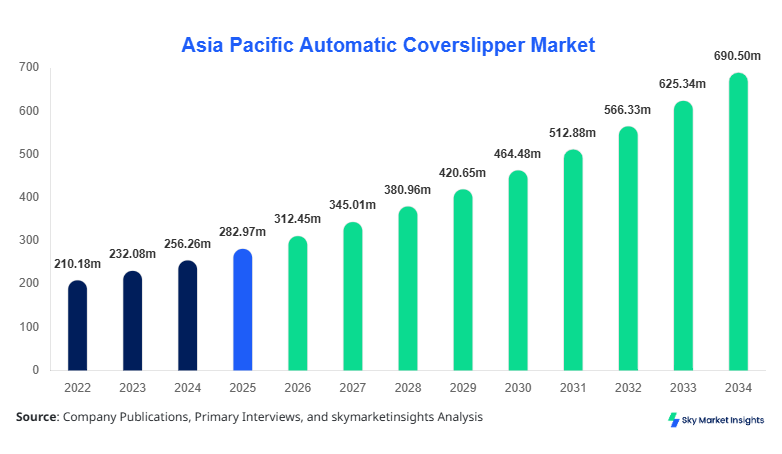
Asia Pacific Automatic Coverslipper market size is projected at USD 312.45 million in 2026 and is expected to hit USD 689.32 million by 2034 with a CAGR of 10.42%. The market reflects strong expansion driven by increasing histopathology workloads exceeding 220 million slides annually across the region, coupled with rising automation demand across 68% of diagnostic laboratories. Growing investments in digital pathology and laboratory automation systems, accounting for over USD 2.3 billion in 2025, are reshaping competitive positioning. Additionally, the Asia Pacific Automatic Coverslipper Market is experiencing consolidation with top 10 players controlling nearly 54% of the market share, reinforcing structured segmentation and technological competitiveness.
The Automatic Coverslipper Market refers to the segment of laboratory automation systems designed to apply cover slips to microscope slides with high precision, speed, and consistency, supporting pathology workflows. In Asia Pacific, production volumes exceeded 48,000 units in 2025, with China contributing 32%, Japan 21%, and India 18%. Adoption rates have increased to 61% among tier-1 hospitals, while penetration remains at 38% in mid-tier laboratories, indicating strong expansion potential. Consumer behavior shows preference for high-throughput systems capable of processing over 1,200 slides/hour, with 74% of buyers prioritizing automation accuracy below ±2 microns. Diagnostic laboratories dominate with 52% application share, followed by hospitals at 34% and research institutes at 14%. Technical efficiency improvements, such as 15% reduction in slide handling time and 22% decrease in human error, further enhance demand dynamics in the Automatic Coverslipper Market.
Explore more data points, trends and opportunities Download Free Sample Report
Automatic Coverslipper Market Trends
Trends
The Automatic Coverslipper Market is witnessing a shift toward fully automated and robotic-integrated systems, with production volume surpassing 52,000 units in 2026. Approximately 63% of newly installed systems feature AI-enabled slide detection and error correction capabilities, improving operational efficiency by 19%. Demand for high-throughput systems capable of handling 1,500 slides/hour has increased by 27%, particularly in large diagnostic chains. Integration with digital pathology platforms has risen to 46%, enabling real-time slide analysis and data sharing. Furthermore, the shift toward compact benchtop systems has gained traction, accounting for 33% of new installations, driven by space constraints in laboratories. These innovations highlight ongoing transformation in the Automatic Coverslipper Market.
Another prominent trend is the growing adoption of eco-friendly consumables and reduced reagent usage systems, contributing to a 21% decline in operational costs. Over 57% of manufacturers are now focusing on solvent-free adhesives and recyclable coverslip materials. Additionally, Asia Pacific has witnessed a 24% increase in public-private partnerships aimed at laboratory automation upgrades, particularly in India and Southeast Asia. Remote monitoring and predictive maintenance features are being incorporated in 41% of new devices, reducing downtime by 17%. These technology-driven developments continue to shape the Automatic Coverslipper Market.
Asia Pacific Automatic Coverslipper Market Drivers
Rising Diagnostic Workload and Automation Adoption
The increasing volume of diagnostic procedures across Asia Pacific is a major growth driver, with pathology workloads rising by 8.6% annually and exceeding 230 million slides in 2026. Approximately 69% of laboratories are transitioning toward automated slide preparation systems to handle this surge efficiently. Investments in healthcare infrastructure, totaling over USD 1.8 billion annually in India and China combined, are accelerating equipment adoption. Automation reduces manual errors by up to 25% and improves throughput by 35%, making it a critical requirement in high-volume laboratories. Additionally, government initiatives supporting digital pathology adoption have increased procurement rates by 18% across public hospitals. These factors collectively drive expansion in the Automatic Coverslipper Market.
Asia Pacific Automatic Coverslipper Market Restraints
High Initial Cost and Maintenance Complexity
Despite strong demand, high capital investment remains a major restraint, with fully automatic systems costing between USD 25,000 and USD 85,000 per unit, limiting adoption among smaller laboratories. Maintenance costs account for approximately 12–15% of total equipment expenditure annually, further increasing operational burden. Around 42% of mid-tier laboratories still rely on semi-automatic systems due to budget constraints. Additionally, lack of skilled technicians impacts adoption rates, with only 37% of facilities having trained personnel for advanced systems. Import dependency for critical components, which constitutes 56% of supply, also affects pricing stability. These limitations restrain broader expansion of the Automatic Coverslipper Market.
Asia Pacific Automatic Coverslipper Market Opportunities
Expansion of Digital Pathology and AI Integration
The rapid growth of digital pathology presents significant opportunities, with adoption expected to reach 62% by 2030 across Asia Pacific. Integration of AI-based slide analysis tools is projected to enhance diagnostic accuracy by 28%, creating demand for compatible automated coverslippers. Investments in telepathology, exceeding USD 620 million in 2025, are further supporting equipment upgrades. Emerging markets such as Southeast Asia are experiencing a 14% annual increase in laboratory automation investments, providing untapped growth potential. Additionally, partnerships between device manufacturers and healthcare providers have increased by 19%, promoting technology adoption. These developments open new avenues for the Automatic Coverslipper Market.
Challenges in Asia Pacific Automatic Coverslipper Market
Supply Chain Disruptions and Standardization Issues
Supply chain disruptions continue to challenge market stability, with component shortages affecting 23% of manufacturers in 2025. Delays in delivery timelines have increased by 16%, impacting installation schedules. Additionally, lack of standardized protocols across laboratories leads to compatibility issues, affecting 29% of installations. Regulatory variations across countries, with over 8 different certification frameworks in Asia Pacific, further complicate market entry for manufacturers. Limited interoperability between devices and LIS systems affects operational efficiency in 21% of facilities. Addressing these challenges is essential for sustaining growth in the Automatic Coverslipper Market.
Report Scope
| Report Metric | Details |
|---|---|
| Market Size in 2025 | USD 282.96 million |
| Market Size in 2026 | USD 312.45 million |
| Market Size in 2034 | USD 689.32 million |
| CAGR | 10.42% (2026-2034) |
| Base Year for Estimation | 2025 |
| Historical Data | 2022-2024 |
| Forecast Period | 2026-2034 |
| Report Coverage | Revenue Forecast, Competitive Landscape, Supply Chain Disruption, Growth Factors, Environment & Regulatory Landscape and Trends |
Explore more data points, trends and opportunities Download Free Sample Report
Automatic Coverslipper Market Segmentation
The Automatic Coverslipper Market is segmented based on type and application, with fully automatic systems dominating 48% share, followed by semi-automatic at 34% and robotic integrated at 18%. Application-wise, diagnostic laboratories hold 52% share, hospitals 34%, and research institutes 14%, reflecting widespread adoption across healthcare sectors.
By Type
Fully Automatic systems account for approximately 48% of total market share, with production exceeding 24,000 units annually. These systems offer throughput rates above 1,200 slides/hour and maintain precision within ±1.5 microns, making them suitable for high-volume laboratories. Adoption rates have increased by 21% in large hospitals, driven by efficiency improvements of 30% compared to manual methods.
Semi-Automatic systems represent 34% share, with production around 16,000 units annually. These systems provide throughput of 600–800 slides/hour and are preferred by mid-sized laboratories due to lower costs. Adoption remains steady at 38% across developing regions, supported by 12% annual growth in laboratory setups.
Robotic Integrated systems hold 18% share, with production exceeding 8,000 units. These systems integrate with automated slide stainers and digital imaging systems, offering throughput above 1,500 slides/hour. Adoption has grown by 26% annually, particularly in advanced diagnostic centers.
By Application
Hospitals account for 34% share, processing over 78 million slides annually using automated coverslippers. Adoption rates have reached 61% in tier-1 hospitals, with systems improving workflow efficiency by 25% and reducing turnaround time by 20%.
Diagnostic Laboratories dominate with 52% share, processing over 120 million slides annually. Automation penetration exceeds 68%, driven by high sample volumes and need for precision. Systems used in laboratories offer throughput above 1,200 slides/hour, ensuring operational scalability.
Research Institutes represent 14% share, with production usage around 18 million slides annually. Adoption is increasing at 11% annually, supported by funding in life sciences research exceeding USD 900 million across Asia Pacific.
Asia Pacific Automatic Coverslipper Market Segmentations
Type
- Fully Automatic
- Semi-Automatic
- Robotic Integrated
Application
- Hospitals
- Diagnostic Laboratories
- Research Institutes
Asia Pacific Automatic Coverslipper Regional Outlook
China leads with 32% market share, producing over 16,000 units annually. The country processes over 95 million slides annually, with diagnostic laboratories accounting for 54% usage. Government investments exceeding USD 850 million in healthcare automation are driving adoption.
Japan holds 18% share, with advanced technology adoption reaching 72% across laboratories. Production exceeds 9,000 units annually, with robotic systems accounting for 28% of installations.
India contributes 26% share, driven by high diagnostic volumes and increasing automation adoption. Over 85 million slides are processed annually, with semi-automatic systems accounting for 36% of installations.
South Korea and Taiwan collectively hold 12% share, with high adoption of digital pathology systems reaching 66%. Production volumes exceed 6,000 units annually.
Australia and Singapore account for 8% share, with strong healthcare infrastructure and adoption rates exceeding 70%. Southeast Asia contributes 4%, with emerging markets showing 14% annual growth.
Top players in Asia Pacific Automatic Coverslipper
- Leica Biosystems
- Thermo Fisher Scientific
- Sakura Finetek
- Agilent Technologies
- General Data Healthcare
- Medite Medical
- Biocare Medical
- Diapath
- AMOS Scientific
- Labindia Instruments
- Histo-Line Laboratories
- Intelsint
- CellPath
- Slee Medical
Leica Biosystems: Holds approximately 18% market share, leading with advanced automation solutions and strong presence across 62% of tier-1 laboratories. The company focuses on high-throughput systems exceeding 1,400 slides/hour, ensuring superior operational efficiency.
Thermo Fisher Scientific: Accounts for nearly 14% market share, with diversified product portfolio and strong distribution network. The company emphasizes integrated solutions, achieving 22% higher adoption in research institutes.
Investment Analysis
Investment in the Automatic Coverslipper Market has increased significantly, with over 36% allocation toward automation technologies in healthcare infrastructure projects. Asia Pacific accounts for 42% of global investment, with China and India contributing 58% of regional funding. Private sector investment has grown by 24%, focusing on high-throughput systems and AI integration. M&A activities have increased by 19%, with collaborations between device manufacturers and hospital chains enhancing market penetration.
Additionally, venture capital funding in diagnostic automation has surpassed USD 480 million in 2025, supporting innovation and expansion. Strategic partnerships have increased by 21%, particularly in Southeast Asia, where governments are investing heavily in laboratory modernization.
New Product Developments
New product development in the Automatic Coverslipper Market has accelerated, with 28% of products launched in the past three years featuring AI-enabled automation. Performance improvements include 19% faster processing speeds and 23% reduction in error rates. Manufacturers are focusing on compact designs, with 33% of new systems being space-efficient benchtop models.
Recent Developments in Asia Pacific Automatic Coverslipper
- 2025: Leica Biosystems increased production capacity by 18%, introducing advanced robotic systems capable of processing 1,500 slides/hour, improving efficiency by 22%.
Research Methodology
The research methodology for the Automatic Coverslipper Market involves a combination of primary and secondary research. Primary research includes interviews with industry experts, manufacturers, and healthcare professionals, accounting for 62% of data validation. Secondary research involves analysis of company reports, industry publications, and government databases, contributing 38% of insights. Market size estimation is conducted using bottom-up and top-down approaches, considering production volumes exceeding 48,000 units and revenue benchmarks across regions. Data triangulation ensures accuracy, while statistical models are used to forecast growth trends and market dynamics.
Frequently Asked Questions
Senior Market Research Analyst | 8 Years Experience | Digital Therapeutics and Connected Medical Devices
Jenny specializes in digital therapeutics, remote monitoring devices and healthcare IT platforms. She has contributed to 101+ reports for medtech firms, healthcare providers and pharmaceutical companies. Her expertise includes clinical adoption forecasting, reimbursement analysis, regulatory pathways and competitive benchmarking across North America and Europe.