Asia Pacific Automated Mining Equipment Market Size
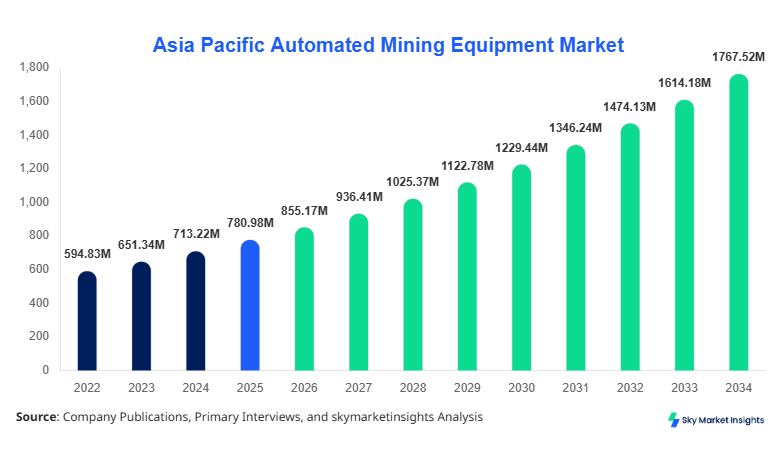
Asia Pacific Automated Mining Equipment Market size is projected at USD 855.17 million in 2026 and is expected to hit USD 1,818.61 million by 2034 with a CAGR of 9.5%. The assessment evaluates 8 countries and territories, 8 equipment categories, 4 mineral groups, 3 deployment modes, 3 automation levels, 6 software solutions, and 2 end-user environments, alongside technology adoption and the competitive landscape.
Key takeaways
- China dominates the regional landscape with USD 325.02 million in 2026, equivalent to 38.01%, and is forecast to reach USD 689.15 million by 2034 at a 9.85% CAGR.
- Southeast Asia is the fastest-growing geography at a 10.21% CAGR, expanding from USD 93.57 million in 2026 to USD 203.66 million by 2034.
- Autonomous haul trucks lead equipment revenue with USD 241.91 million in 2026, representing 28.30% of the equipment total, and will reach USD 517.05 million by 2034.
- Remote-controlled equipment is the fastest-growing equipment category at a 10.40% CAGR, rising from USD 49.57 million in 2026 to USD 109.39 million by 2034.
- India is forecast to advance from USD 157.80 million in 2026 to USD 330.23 million in 2034 at a 9.67% CAGR.
The market encompasses autonomous, semi-automated, and remotely operated machinery, software, sensors, navigation systems, and control platforms used across surface and underground mines. Asia Pacific revenue increases from USD 778.21 million in 2025 to USD 855.17 million in 2026, an annual gain of 9.89%. China, India, and Japan collectively contribute USD 594.04 million, or 69.46%, in 2026. Autonomous haul trucks account for 28.30% of equipment revenue, automated drilling rigs contribute 18.76%, and autonomous loaders represent 14.68%, demonstrating concentrated adoption in material movement and drilling applications.
Explore more data points, trends and opportunities Download Free Sample Report
Asia Pacific Automated Mining Equipment Market Trends
AI-Enabled Fleet Orchestration and Electrified Autonomous Operations
Mining operators are shifting from isolated machine automation toward connected fleets combining artificial intelligence, 5G communications, high-precision positioning, and real-time dispatch. Large surface operations can coordinate fleets of more than 100 vehicles, process millions of telemetry records daily, and target equipment availability above 85%, while automated route optimization can reduce idle time by approximately 10%–20% and improve cycle consistency by 5%–15%.
Electrification is increasingly integrated with autonomy as operators pursue 20%–40% reductions in operational emissions and lower ventilation requirements in underground mines. Navigation, collision avoidance, tele-remote control, and predictive maintenance are gaining demand across 24-hour operations, while sensor-based maintenance programs target 10%–25% reductions in unplanned downtime and 5%–15% improvements in asset utilization.
Asia Pacific Automated Mining Equipment Market Drivers
Worker Safety and Productivity Requirements Accelerate Automation
Automation reduces workforce exposure to blasting zones, unstable ground, dust, heat, and vehicle interactions across mines operating 2 or 3 daily shifts. Autonomous haulage and drilling can support 24-hour production, improve equipment utilization by 10%–20%, lower variability in cycle times by 5%–15%, and reduce selected safety incidents by more than 20%. These gains are particularly relevant where fleets exceed 50 machines and haul distances extend beyond 5 kilometers.
Asia Pacific Automated Mining Equipment Market Restraints
High Capital Expenditure and Integration Complexity Limit Deployment
Full-site automation requires machinery, sensors, communications, control rooms, cybersecurity, and workforce training, with technology components potentially adding 15%–30% to initial project costs. Brownfield mines may operate equipment from 3–5 manufacturers across assets aged more than 10 years, increasing integration time by 6–18 months. Uncertain commodity cycles and payback periods of 3–7 years can delay large-scale procurement.
Asia Pacific Automated Mining Equipment Market Opportunities
Brownfield Retrofits and Software-Led Automation Expand Addressable Demand
Retrofit packages allow operators to automate selected functions without replacing entire fleets, potentially reducing upfront expenditure by 20%–40% compared with complete fleet renewal. Modular navigation, collision avoidance, and tele-remote systems can be deployed across 10–50 machines in phases, while predictive maintenance can lower unexpected stoppages by 10%–25%. Subscription-based software also creates recurring contracts spanning 3–5 years.
Challenges in Asia Pacific Automated Mining Equipment Market
Connectivity, Cybersecurity, and Skills Gaps Complicate Scaling
Remote mines require dependable communications across sites covering tens or hundreds of square kilometers, yet latency, terrain, and harsh weather can disrupt machine coordination. Automation platforms may connect more than 1,000 sensors per asset and generate gigabytes of operational data daily, expanding cyber-risk exposure. Operators must simultaneously retrain maintenance, control-room, and data personnel, with transition programs often lasting 6–24 months.
Report Scope
| Report Metric | Details |
|---|---|
| Market Size in 2025 | USD 781.02 Million |
| Market Size in 2026 | USD 855.17 Million |
| Market Size in 2034 | USD 1818.61 Million |
| CAGR | 9.5% (2026-2034) |
| Base Year for Estimation | 2025 |
| Historical Data | 2022-2024 |
| Forecast Period | 2026-2034 |
| Report Coverage | Revenue Forecast, Competitive Landscape, Supply Chain Disruption, Growth Factors, Environment & Regulatory Landscape and Trends |
Explore more data points, trends and opportunities Download Free Sample Report
Asia Pacific Automated Mining Equipment Market Segmentation
The industry is segmented by 8 equipment types, 4 mineral types, 3 deployment modes, 3 automation levels, 6 software solutions, and 2 end users. Autonomous haul trucks lead equipment revenue at 28.30% in 2026, while drilling rigs and loaders collectively contribute another 33.44%.
By Equipment Type
Autonomous haul trucks are the largest category, increasing from USD 220.00 million in 2025 to USD 241.91 million in 2026 and USD 517.05 million by 2034 at a 9.96% CAGR. Their 2026 contribution equals 28.30% of the USD 854.85 million equipment total.
Remote-controlled equipment records the fastest CAGR of 10.40%, reaching USD 109.39 million by 2034 from USD 49.57 million in 2026. Automated blasting systems follow at 10.31%, while dozers and excavators advance at 10.01%.
By Mineral Type
Metallic minerals represent the principal application area because gold, copper, iron, and nickel mines commonly operate fleets exceeding 50 units across multi-shift schedules. This segment benefits from high material volumes, haul routes beyond 5 kilometers, and productivity targets above 85% equipment availability.
Rare earth minerals form the emerging high-potential category as projects require precision extraction, selective handling, and traceable ore movement. Automation can support 24-hour monitoring, centimeter-level navigation, and 10%–20% improvements in fleet coordination across complex deposits.
By Deployment Mode
OEM-integrated solutions constitute the leading deployment approach for new fleets because factory-installed sensors, controls, and warranties reduce integration across 3–5 critical systems. Greenfield projects can implement automation over 12–36 months and coordinate more than 100 connected assets.
Retrofit automation is the faster-adopting model among brownfield operators, potentially lowering initial expenditure by 20%–40%. Phased programs can automate 10–50 vehicles and target payback within 3–5 years through dispatch, safety, and maintenance improvements.
By Level of Automation
Semi-automated equipment remains the most broadly deployable level, combining operator control with automated braking, drilling, guidance, or loading functions. It can improve task consistency by 5%–15% while requiring less infrastructure than fully driverless fleets.
Fully autonomous systems are advancing fastest in controlled mining environments operating 2–3 shifts daily. Such systems can raise utilization by 10%–20%, reduce idle time by 10%–20%, and remove personnel from designated high-risk operating zones.
By Software Solution
Fleet management is the leading software solution, coordinating dispatch, routes, queues, fuel use, and asset status across fleets of 50–100-plus machines. Optimization can decrease queuing by 5%–15% and improve utilization by approximately 10%.
Predictive maintenance is the fastest-expanding functional area as connected assets generate millions of sensor observations. Analytics can identify component anomalies several days or weeks in advance, lowering unplanned downtime by 10%–25% and maintenance expenditure by 5%–15%.
By End-User
Surface mining leads adoption because standardized haul roads support autonomous trucks, drills, dozers, and loaders across fleets exceeding 100 units. Continuous dispatch can improve cycle consistency by 5%–15% and enable 24-hour production.
Underground mining is the faster-developing end-user environment for tele-remote loaders, robotic inspection, and collision avoidance. Remote operation can move personnel hundreds of meters away from active faces and support 20%–40% reductions in exposure to selected underground hazards.
Asia Pacific Automated Mining Equipment Market Segmentations
By Equipment Type
- Autonomous Haul Trucks
- Automated Drilling Rigs
- Autonomous Loaders
- Robotic Mining Equipment
- Dozers and Excavators
- Automated Blasting Systems
- Remote-Controlled Equipment
- Others (Grinders, Crushers, Graders)
By Mineral Type
- Metallic (Gold, Copper, Iron, Nickel, etc.)
- Non-Metallic (Limestone, Potash, Phosphate)
- Coal
- Rare Earth Minerals
By Deployment Mode
- On-Site (Fully Autonomous Sites)
- Retrofit Automation
- OEM-Integrated Solutions
By Level of Automation
- Semi-Automated
- Fully Autonomous
- Remote-Controlled
By Software Solution
- Fleet Management
- Navigation and Guidance
- Collision Avoidance and Safety
- Tele-remote Operations
- Predictive Maintenance
- Energy and Emissions Monitoring
By End-User
- Surface Mining
- Underground Mining
Asia Pacific Automated Mining Equipment Market Country Outlook
China Asia Pacific Automated Mining Equipment Market
China contributes 38.01% of 2026 regional revenue, with value rising from USD 325.02 million to USD 689.15 million by 2034 at a 9.85% CAGR. Large coal and metallic-mineral operations underpin demand for high-volume hauling, drilling, and 24-hour fleet control.
South Korea Asia Pacific Automated Mining Equipment Market
South Korea represents 6.19% in 2026, increasing from USD 52.94 million to USD 111.19 million by 2034 at a 9.72% CAGR. Demand centers on digitally integrated equipment, safety systems, and automation for constrained operating sites.
Japan Asia Pacific Automated Mining Equipment Market
Japan accounts for 13.01%, advancing from USD 111.22 million in 2026 to USD 237.19 million by 2034 at a 9.93% CAGR. Robotics, remote control, and precision navigation support equipment deployment despite limited domestic extraction volumes.
India Asia Pacific Automated Mining Equipment Market
India holds an 18.45% contribution, with revenue forecast to rise from USD 157.80 million to USD 330.23 million at a 9.67% CAGR. Coal, iron ore, and limestone operations support demand for haulage, drilling, and retrofit automation.
Australia Asia Pacific Automated Mining Equipment Market
Australia contributes 5.15% in 2026 and expands from USD 44.06 million to USD 95.56 million by 2034 at a 10.16% CAGR. Large iron ore, gold, and coal operations favor autonomous surface fleets and remote operations centers.
Singapore Asia Pacific Automated Mining Equipment Market
Singapore represents 2.05%, increasing from USD 17.56 million to USD 36.37 million at a 9.53% CAGR. Its role is concentrated in regional technology management, engineering services, software, and control-system integration.
Taiwan Asia Pacific Automated Mining Equipment Market
Taiwan accounts for 6.20% and rises from USD 53.00 million to USD 115.26 million at a 10.20% CAGR. Semiconductor, sensor, connectivity, and electronics capabilities support automation supply chains and equipment intelligence.
Southeast Asia Asia Pacific Automated Mining Equipment Market
Southeast Asia contributes 10.94%, expanding from USD 93.57 million to USD 203.66 million by 2034 at the region-leading 10.21% CAGR. Coal, nickel, copper, and non-metallic mining projects drive surface and underground equipment requirements.
Top players in Asia Pacific Automated Mining Equipment Market
- Caterpillar Inc.
- Komatsu Ltd.
- Sandvik AB
- Epiroc AB
- Hitachi Construction Machinery Co., Ltd.
- Liebherr Group
- Hexagon AB
- ABB Ltd.
- Siemens AG
- Volvo Construction Equipment
- Rio Tinto AutoHaul
- ASI Mining
Top Two Companies
-
Caterpillar Inc. — estimated competitive share below 20%: Caterpillar is positioned among the leading suppliers through autonomous haulage, fleet-management software, large mining trucks, dozers, and dealer-supported maintenance. Its competitive advantage derives from integrating equipment and digital control across fleets that can exceed 100 assets and operate 24 hours daily. The company's installed-base strategy supports phased conversion, predictive servicing, and multi-year technology agreements. Its position is strongest in surface mining, where dispatch optimization can target 10%–20% reductions in idle time and 5%–15% improvements in operating consistency.
-
Komatsu Ltd. — estimated competitive share below 20%: Komatsu maintains a leading position through autonomous haulage systems, mining trucks, excavators, digital mine platforms, and extensive Asia Pacific customer relationships. Its solutions address greenfield and brownfield operations using centralized fleet control, navigation, and safety technologies. Deployments can coordinate dozens or more than 100 vehicles while supporting 2–3 operating shifts. Integration of equipment, analytics, and lifecycle support enables customers to pursue 10%–20% utilization gains, lower variability, and multi-site standardization over 3–7-year investment horizons.
Recent Developments in Asia Pacific Automated Mining Equipment Market
- 2026: Suppliers expanded AI-based dispatch and predictive-maintenance capabilities designed to process millions of daily sensor records and reduce unplanned downtime by 10%–25%.
- 2025: Mining operators increased trials of battery-electric autonomous equipment targeting 20%–40% operational-emission reductions in selected duty cycles.
- 2025: Retrofit automation programs broadened from individual machines to fleets of 10–50 units, integrating navigation, braking, and collision avoidance.
Research Methodology
The study applies a bottom-up assessment across 8 geographies and 8 equipment categories for 2025, 2026, and 2034. Country totals, equipment revenues, percentage contributions, and supplied CAGRs were cross-compared, while calculated shares use the relevant 2026 totals of USD 855.17 million and USD 854.85 million. Qualitative analysis covers 4 mineral categories, 3 deployment modes, 3 automation levels, 6 software solutions, 2 end users, and 12 competitive participants.
Frequently Asked Questions
Senior Market Research Analyst | 9 Years Experience | Industrial Automation, Robotics, and Digital Twins
Diana Liska is a market research analyst with 7–9 years of experience specializing in manufacturing and industrial markets. Contributed to 70+ research reports for global clients. Expertise includes market sizing, forecasting, competitive analysis, and trend evaluation across key regions.