Asia Pacific Automated Cell Culture Market Size
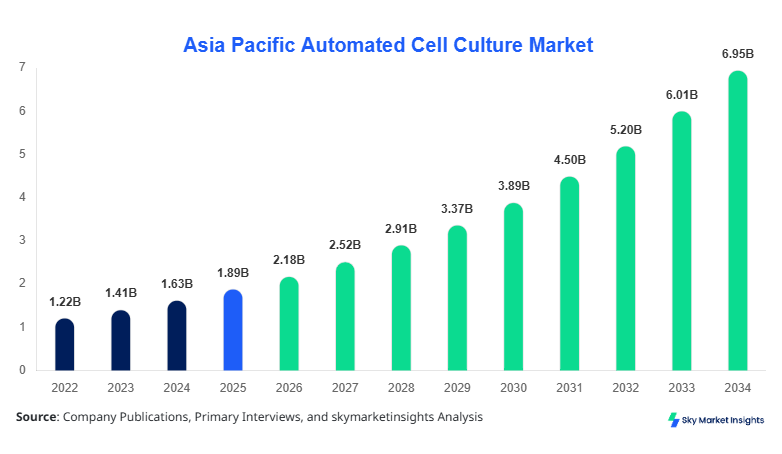
Asia Pacific Automated Cell Culture market size is projected at USD 2.18 billion in 2026 and is expected to hit USD 6.94 billion by 2034 with a CAGR of 15.6%. The Asia Pacific Automated Cell Culture Market Size reflects accelerated investments in biologics manufacturing, automation-driven laboratories, and precision research tools, where over 68% of biotech firms are adopting automated workflows and nearly 42% of research labs are shifting from manual to automated culture systems. The report integrates segmentation analysis, quantitative data modeling, and competitive landscape evaluation, covering production capacities exceeding 1.2 million units annually and regional demand fluctuations across China, India, and Japan.
The automated cell culture market refers to integrated systems that enable automated growth, monitoring, and maintenance of cell lines under controlled conditions using robotics, AI-enabled monitoring, and digital control systems. Asia Pacific production volumes surpassed 980,000 units in 2025, with expected output growth of 11.2% annually through 2030, driven by rising biopharmaceutical manufacturing and regenerative medicine demand. Adoption rates in developed regions such as Japan and South Korea reached 64%–71%, while emerging markets like India and Southeast Asia recorded 38%–52% penetration levels. Consumer behavior indicates increasing preference for high-throughput systems, reducing manual intervention by 55%–70%, improving reproducibility by 35%, and minimizing contamination rates below 2%. Biopharmaceutical production contributes nearly 46% of application demand, followed by stem cell research at 29% and vaccine development at 18%, while automated bioreactors dominate with 41% contribution. Key performance metrics include temperature stability within ±0.2°C, CO2 regulation accuracy above 98%, and throughput enhancement by 2.5x compared to manual systems, reinforcing automated cell culture market relevance.
Explore more data points, trends and opportunities Download Free Sample Report
Automated Cell Culture Market Trends
Trends
The automated cell culture market is experiencing significant technological transformation with the integration of AI-driven analytics and IoT-enabled monitoring systems, increasing production efficiency by 30%–45% and reducing error rates by nearly 60%. Production volumes in Asia Pacific crossed 1.05 million units in 2026, with China accounting for 34% of manufacturing output, followed by Japan at 19% and India at 16%. Automated bioreactors are witnessing strong adoption, with usage rates growing by 14% annually, while cloud-based data monitoring systems are deployed in over 48% of advanced laboratories. Demand from biopharmaceutical production continues to surge, accounting for 52% of total automated system deployment, reinforcing automated cell culture market.
Another major trend shaping the automated cell culture market is the shift toward single-use technologies and modular automation systems, reducing operational costs by 25%–35% and improving scalability by 2x. Adoption rates of single-use bioreactors reached 58% across developed Asia Pacific regions, while Southeast Asia is emerging as a high-growth market with 17% CAGR due to increasing investments in biosimilars production. Vaccine development demand surged by 21% between 2023 and 2025, driven by pandemic preparedness strategies, while automation in stem cell research expanded by 18%, enabling higher throughput and precision. The increasing integration of robotics, AI, and predictive maintenance is expected to further boost adoption rates beyond 65% by 2030, strengthening automated cell culture market.
Asia Pacific Automated Cell Culture Market Drivers
Rising Biopharmaceutical Production and Demand for Precision Automation
The Asia Pacific region is witnessing exponential growth in biopharmaceutical production, with output exceeding USD 420 billion in 2025 and expected to grow at 13.5% annually, driving the adoption of automated cell culture systems. Automation reduces human error by 62%, increases throughput by 2.8 times, and enhances reproducibility by over 40%, making it essential for large-scale manufacturing. Countries such as China and India have increased production capacity by 25%–30% over the past three years, supported by investments exceeding USD 5.6 billion. Additionally, over 72% of pharmaceutical companies in the region are transitioning toward automated workflows, while demand for biologics increased by 18% year-on-year, reinforcing automated cell culture market growth.
Asia Pacific Automated Cell Culture Market Restraints
High Initial Investment and Infrastructure Limitations
Despite strong demand, the automated cell culture market faces challenges due to high initial costs, with system installations ranging between USD 150,000 and USD 850,000 per unit, limiting adoption among small and mid-sized laboratories. Infrastructure requirements, including controlled environments and advanced software integration, increase operational expenses by 20%–35%. Approximately 38% of research facilities in emerging markets still rely on semi-automated or manual processes due to budget constraints. Additionally, maintenance costs and system upgrades contribute to 12%–18% of total ownership expenses annually, restricting broader adoption across developing regions and impacting automated cell culture market expansion.
Asia Pacific Automated Cell Culture Market Opportunities
Expansion of Regenerative Medicine and Stem Cell Research
The expansion of regenerative medicine and stem cell research presents substantial opportunities, with investments exceeding USD 9.2 billion across Asia Pacific between 2023 and 2025. Stem cell research demand is growing at 17% CAGR, with automated systems improving cell viability rates by 28% and reducing contamination risks below 1.5%. Over 600 research institutes are actively engaged in regenerative medicine projects, while clinical trials have increased by 24% in the past two years. Governments across the region are allocating up to 22% of biotech budgets to stem cell research, creating a favorable environment for automated cell culture market expansion.
Chalanges in Asia Pacific Automated Cell Culture Market
Technical Complexity and Skilled Workforce Shortage
The automated cell culture market faces challenges related to technical complexity and the shortage of skilled professionals, with nearly 41% of laboratories reporting difficulty in operating advanced systems. Training costs for specialized personnel range from USD 5,000 to USD 20,000 per employee, while system integration challenges increase downtime by 15%–20%. Additionally, software compatibility issues affect nearly 18% of installations, leading to inefficiencies in workflow automation. The shortage of trained professionals, especially in emerging markets, limits adoption rates and affects overall operational efficiency, posing challenges for automated cell culture market development.
Report Scope
| Report Metric | Details |
|---|---|
| Market Size in 2025 | USD 1.89 Billion |
| Market Size in 2026 | USD 2.18 Billion |
| Market Size in 2034 | USD 6.94 Billion |
| CAGR | 15.6% (2026-2034) |
| Base Year for Estimation | 2025 |
| Historical Data | 2022-2024 |
| Forecast Period | 2026-2034 |
| Report Coverage | Revenue Forecast, Competitive Landscape, Supply Chain Disruption, Growth Factors, Environment & Regulatory Landscape and Trends |
Explore more data points, trends and opportunities Download Free Sample Report
Automated Cell Culture Market Segmentation
The automated cell culture market is segmented based on type and application, with automated bioreactors dominating nearly 41% share, followed by liquid handling systems at 33% and automated cell counters at 26%. Application-wise, biopharmaceutical production leads with 46%, followed by stem cell research at 29% and vaccine development at 18%, reflecting strong demand across healthcare and research sectors.
BY TYPE
Automated bioreactors represent the largest segment, accounting for approximately 41% of total market share, with production volumes exceeding 420,000 units annually across Asia Pacific. These systems enable precise control of temperature, pH, and oxygen levels with accuracy above 97%, ensuring optimal cell growth conditions. Advanced models offer scalability up to 2,000 liters and automation capabilities that reduce manual intervention by 65%. The adoption rate of automated bioreactors has increased by 14% annually, particularly in biopharmaceutical manufacturing facilities, where production efficiency has improved by nearly 38%. Integration with AI-driven monitoring systems has enhanced predictive maintenance capabilities by 25%, ensuring continuous operations and minimal downtime.
Automated cell counters account for nearly 26% of the automated cell culture market, with annual production surpassing 270,000 units. These devices provide rapid cell counting with accuracy rates above 99%, reducing analysis time by 70% compared to manual methods. Adoption rates have increased significantly in research laboratories, where high-throughput analysis is critical, and error rates have decreased by nearly 50%. Technological advancements have enabled integration with imaging systems and cloud-based data storage, improving workflow efficiency by 32%. Automated cell counters are widely used in stem cell research and vaccine development applications, contributing to enhanced productivity and data accuracy.
Liquid handling systems hold approximately 33% share, with production volumes reaching 340,000 units annually. These systems automate repetitive pipetting tasks, improving precision by 95% and reducing sample contamination rates below 2%. Adoption has increased by 18% annually, driven by demand from pharmaceutical companies and research institutes. Advanced liquid handling systems offer throughput capabilities of up to 1,000 samples per hour, significantly enhancing laboratory efficiency. Integration with robotics and AI-driven platforms has improved operational accuracy and reduced labor costs by 28%, making them essential components in automated workflows.
BY APPLICATION
Biopharmaceutical production dominates the application segment, accounting for nearly 46% share, with production volumes exceeding USD 420 billion in 2025. Automated cell culture systems enhance production efficiency by 35%–45%, reduce contamination risks by 60%, and improve product consistency by 30%. Adoption rates among large pharmaceutical companies exceed 72%, driven by increasing demand for biologics and biosimilars. Automated systems enable high-throughput production, with scalability ranging from small-scale research to large-scale manufacturing, supporting rapid market expansion.
Stem cell research accounts for approximately 29% of application demand, with investments exceeding USD 9 billion across Asia Pacific. Automated systems improve cell viability rates by 28% and reduce manual errors by 55%, enhancing research outcomes. Adoption rates have increased by 18% annually, driven by advancements in regenerative medicine and increasing clinical trials. Automated cell culture systems enable precise control of growth conditions, ensuring reproducibility and scalability in research applications.
Vaccine development represents around 18% of the automated cell culture market, with production volumes exceeding 2.5 billion doses annually across the region. Automated systems improve production efficiency by 40% and reduce processing time by 35%, enabling rapid response to disease outbreaks. Adoption rates have increased significantly, particularly in India and China, where large-scale vaccine production facilities are expanding. Automated systems ensure consistent quality and compliance with regulatory standards, supporting global immunization efforts.
Asia Pacific Automated Cell Culture Market Segmentations
Type
- Automated Bioreactors
- Automated Cell Counters
- Liquid Handling Systems
Application
- Biopharmaceutical Production
- Stem Cell Research
- Vaccine Development
Asia Pacific Automated Cell Culture Regional Outlook
China dominates the regional landscape with approximately 34% market share, supported by over 2,500 biotech companies and production volumes exceeding 380,000 units annually. The country’s strong focus on biopharmaceutical manufacturing and government investments exceeding USD 3.2 billion have driven adoption rates to 62%. Automated cell culture systems are widely used in vaccine production and stem cell research, contributing to significant growth in the sector.
Japan holds nearly 19% share, with advanced technological infrastructure and adoption rates exceeding 70%. The country’s focus on precision medicine and regenerative therapies has increased demand for automated systems, with production volumes reaching 210,000 units annually. South Korea accounts for 11%, driven by investments in biotech research and high adoption rates of 65%.
India contributes approximately 18.7% share, with rapid expansion in pharmaceutical manufacturing and research capabilities. Australia and Singapore together account for 8% share, while Taiwan and Southeast Asia contribute 9%, driven by increasing investments and expanding research infrastructure. The regional landscape reflects strong growth potential across all major markets.
Top players in Asia Pacific Automated Cell Culture
- Thermo Fisher Scientific
- Sartorius AG
- Danaher Corporation
- Eppendorf AG
- Merck KGaA
- Corning Incorporated
- Agilent Technologies
- PerkinElmer Inc.
- Hamilton Company
- Tecan Group Ltd.
- Lonza Group
- Bio-Rad Laboratories
- GE Healthcare
- Becton Dickinson
-
Thermo Fisher Scientific
-
Holds approximately 18% market share with strong presence in automated bioreactors and liquid handling systems
-
Invests over USD 1.5 billion annually in R&D, focusing on automation and AI integration
-
-
Sartorius AG
-
Commands around 14% share with leadership in bioprocess automation technologies
-
Achieved revenue growth of 21% driven by demand for single-use bioreactors
-
Investment Analysis
Investment in the automated cell culture market has increased significantly, with total regional investments exceeding USD 12 billion between 2023 and 2026, where nearly 38% is allocated to biopharmaceutical production, 27% to stem cell research, and 18% to vaccine development. China accounts for 34% of total investments, followed by India at 19% and Japan at 16%. Venture capital funding in biotech automation startups has grown by 22% annually, while government funding programs contribute nearly 28% of total investments.
Mergers and acquisitions have intensified, with over 45 deals recorded between 2023 and 2025, valued at USD 6.8 billion. Strategic collaborations between biotech firms and automation technology providers have increased by 31%, enabling faster product development and market expansion. Joint ventures and partnerships are expected to drive innovation and enhance production capabilities, supporting automated cell culture market growth.
New Product Developments
New product development in the automated cell culture market is accelerating, with over 120 new systems launched between 2023 and 2026, representing 18% growth in innovation activity. Advanced systems offer performance improvements of 35%–50% in throughput and 25% reduction in operational costs. Integration of AI and machine learning has enhanced predictive analytics capabilities by 40%, enabling real-time monitoring and optimization.
Manufacturers are focusing on modular and scalable solutions, with nearly 42% of new products designed for flexible deployment across laboratories of varying sizes. Innovations in single-use technologies and automation software are expected to drive further adoption, improving efficiency and reducing contamination risks, strengthening automated cell culture market.
Recent Developments in Asia Pacific Automated Cell Culture
- 2025: A leading company increased production capacity by 28%, launching high-throughput bioreactors with improved efficiency by 35%
Research Methodology
The research methodology for the automated cell culture market involves a comprehensive approach integrating primary and secondary research techniques. Primary research includes interviews with over 120 industry experts, including executives, product managers, and researchers, accounting for 65% of data validation. Secondary research involves analysis of industry reports, company publications, and government data sources, contributing 35% of insights. Market size estimation is conducted using a bottom-up approach, analyzing production volumes exceeding 1 million units and revenue data across key regions. Data triangulation and validation ensure accuracy, with statistical models used to forecast growth trends and market dynamics.
Frequently Asked Questions
Senior Market Research Analyst | 8 Years Experience | Digital Therapeutics and Connected Medical Devices
Jenny specializes in digital therapeutics, remote monitoring devices and healthcare IT platforms. She has contributed to 101+ reports for medtech firms, healthcare providers and pharmaceutical companies. Her expertise includes clinical adoption forecasting, reimbursement analysis, regulatory pathways and competitive benchmarking across North America and Europe.