Asia Pacific Autologous Cell Therapy Market Size
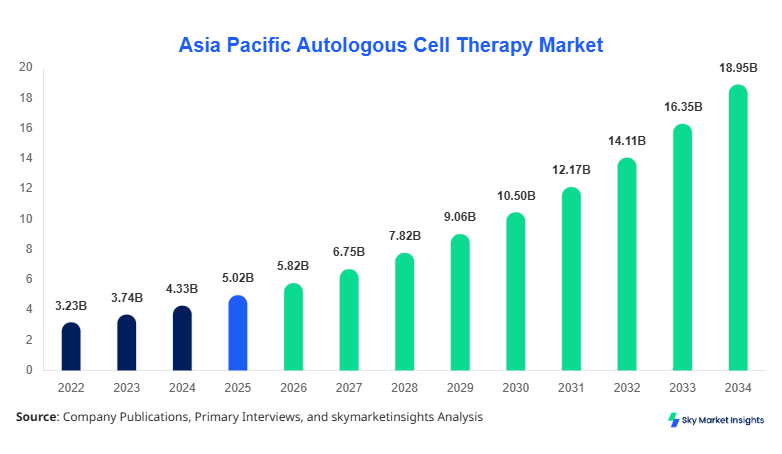
Asia Pacific Autologous Cell Therapy market size is projected at USD 5.82 billion in 2026 and is expected to hit USD 18.94 billion by 2034 with a CAGR of 15.9%. The increasing need for personalized medicine, rising chronic disease burden, and expanding clinical trials across Asia Pacific are significantly contributing to the expansion of the Autologous Cell Therapy Market. Data-driven segmentation, strong pipeline analysis, and competitive benchmarking highlight the dynamic ecosystem with over 420 clinical programs and 180+ active companies operating within the region.
The Autologous Cell Therapy Market refers to therapeutic procedures that utilize a patient’s own cells for treatment, minimizing immune rejection risks and improving treatment efficacy. In Asia Pacific, production capacity exceeded 1.2 million therapy units in 2025, with adoption rates rising by 18.6% year-over-year. Penetration of autologous therapies reached approximately 32% in oncology applications and 21% in orthopedic procedures, supported by over 250 certified processing laboratories across the region. Consumer behavior reflects increasing preference for personalized therapies, with 64% of patients in urban healthcare systems opting for autologous procedures over allogeneic alternatives due to higher success rates of 75–85%. Demand analytics indicate that oncology applications account for nearly 48% of total usage, followed by orthopedics at 27% and cardiovascular treatments at 15%. Performance metrics such as cell viability above 90% and processing turnaround times of 24–72 hours have improved significantly. The Asia Pacific Autologous Cell Therapy Market Share is expanding due to increasing healthcare investments, strengthening the overall Autologous Cell Therapy Market.
Explore more data points, trends and opportunities Download Free Sample Report
Autologous Cell Therapy Market Trends
Rising Adoption of Automated Cell Processing Technologies
Automation in cell processing is transforming the Autologous Cell Therapy Market, with over 62% of facilities adopting closed-system bioreactors and automated expansion systems. Production volumes increased from 0.9 million units in 2023 to 1.2 million units in 2025, reflecting a 33% rise. Advanced cryopreservation techniques have improved cell viability rates from 82% to 94%, enhancing treatment outcomes. The integration of AI-driven quality control systems has reduced processing errors by 27%, while reducing manufacturing costs by nearly 18%. Demand from oncology sectors, particularly CAR-T therapies, accounts for over 55% of automated production usage, reinforcing the Autologous Cell Therapy Market Trend.
Expansion of Clinical Trials and Regulatory Support
The number of clinical trials in the Asia Pacific Autologous Cell Therapy Market has increased by 41% between 2022 and 2025, reaching over 420 active trials. Governments in Japan, South Korea, and China have implemented fast-track approvals, reducing regulatory timelines by 30–45%. Production of investigational therapies has crossed 350,000 units annually, with 70% focused on oncology and immunotherapy. Adoption rates in emerging markets such as Southeast Asia have grown by 22%, supported by rising healthcare expenditure. Increasing collaborations between academic institutions and biotech firms are driving innovation, further strengthening the Autologous Cell Therapy Market Trend.
Asia Pacific Autologous Cell Therapy Drivers
Rising Prevalence of Chronic Diseases and Demand for Personalized Medicine
The increasing prevalence of chronic diseases such as cancer, cardiovascular disorders, and degenerative conditions is a major driver of the Autologous Cell Therapy Market. In Asia Pacific, cancer incidence rose by 12% between 2022 and 2025, with over 5.3 million new cases reported annually. Autologous therapies offer success rates of 70–85%, compared to 55–65% for conventional treatments, driving patient preference. Healthcare expenditure in the region has increased by 9.4% annually, reaching USD 2.3 trillion in 2025, with approximately 6% allocated to advanced therapies. Production capacity for autologous treatments has expanded by 28%, supporting rising demand. Increasing awareness and adoption rates exceeding 30% in urban healthcare systems further accelerate the Autologous Cell Therapy Market Growth.
Asia Pacific Autologous Cell Therapy Restraints
High Cost of Treatment and Limited Accessibility
Despite strong growth potential, high treatment costs ranging from USD 25,000 to USD 120,000 per therapy limit widespread adoption. Approximately 48% of patients in developing Asia Pacific regions lack access due to affordability constraints. Infrastructure limitations, with only 250–300 advanced cell processing facilities across the region, restrict scalability. Reimbursement coverage remains below 35% in most countries, further hindering market penetration. Production costs account for nearly 60% of therapy pricing, driven by complex processing and regulatory requirements. These factors collectively restrain the Autologous Cell Therapy Market Growth.
Asia Pacific Autologous Cell Therapy Opportunities
Expansion in Emerging Markets and Technological Advancements
Emerging economies such as India, Indonesia, and Vietnam present significant opportunities, with healthcare spending growing at 10–12% annually. The number of cell therapy facilities in Southeast Asia is expected to increase by 40% by 2030. Technological advancements, including gene editing and CRISPR-based modifications, are improving efficacy rates by 20–30%. Investment in R&D has surpassed USD 2.5 billion in Asia Pacific, with 45% directed toward autologous therapies. Increasing partnerships and licensing agreements are expected to drive innovation and accessibility, creating strong opportunities for the Autologous Cell Therapy Market Growth.
Chalanges in Asia Pacific Autologous Cell Therapy
Regulatory Complexity and Standardization Issues
Regulatory frameworks across Asia Pacific vary significantly, leading to approval delays of 12–24 months in certain markets. Standardization challenges in cell processing and quality control affect nearly 30% of manufacturing facilities. Variability in clinical outcomes, with success rates ranging from 65% to 85%, creates uncertainty among healthcare providers. Logistics and storage challenges, including maintaining cryogenic temperatures below -150°C, increase operational costs by 15–20%. These challenges hinder scalability and commercialization, impacting the Autologous Cell Therapy Market Growth.
Report Scope
| Report Metric | Details |
|---|---|
| Market Size in 2025 | USD 5.02 Billion |
| Market Size in 2026 | USD 5.82 Billion |
| Market Size in 2034 | USD 18.94 Billion |
| CAGR | 15.9% (2026-2034) |
| Base Year for Estimation | 2025 |
| Historical Data | 2022-2024 |
| Forecast Period | 2026-2034 |
| Report Coverage | Revenue Forecast, Competitive Landscape, Supply Chain Disruption, Growth Factors, Environment & Regulatory Landscape and Trends |
Explore more data points, trends and opportunities Download Free Sample Report
Autologous Cell Therapy Market Segmentation
The Autologous Cell Therapy Market is segmented based on type and application, with stem cell therapy dominating at 46% share, followed by T-cell therapy at 34% and dendritic cell vaccines at 20%. Application-wise, oncology leads with 48% share, followed by orthopedics at 27% and cardiovascular diseases at 15%.
By Type
Stem cell therapy accounts for approximately 46% of total market share, with production exceeding 550,000 units annually in Asia Pacific. These therapies demonstrate cell viability rates above 92% and are widely used in regenerative medicine. The adoption rate has increased by 18% annually, driven by applications in orthopedics and neurology. Processing times average 48–72 hours, with advanced expansion techniques improving yield by 25%.
T-cell therapy represents 34% of the market, with production volumes reaching 400,000 units annually. CAR-T therapies have shown efficacy rates of 80–90% in certain cancers, driving demand. Adoption rates have grown by 22%, particularly in oncology centers. Technological advancements have reduced manufacturing time by 30%, enhancing scalability.
Dendritic cell vaccines hold 20% market share, with production volumes of 250,000 units annually. These therapies are primarily used in cancer immunotherapy, with success rates of 65–75%. Adoption is increasing by 15% annually, supported by clinical trial expansion.
By Application
Oncology dominates with 48% market share, with over 600,000 therapy units administered annually. Penetration rates exceed 32% in advanced healthcare systems, with success rates of 75–85%. Autologous therapies play a critical role in personalized cancer treatment, improving survival rates significantly.
Orthopedics accounts for 27% share, with production volumes of 350,000 units annually. Adoption rates have increased by 17%, driven by aging populations and rising musculoskeletal disorders. These therapies improve recovery time by 30–40%.
Cardiovascular applications hold 15% share, with 180,000 units produced annually. Adoption rates are growing by 12%, supported by increasing prevalence of heart diseases. These therapies improve cardiac function by 20–25%.
Asia Pacific Autologous Cell Therapy Market Segmentations
Type
- Stem Cell Therapy
- T-Cell Therapy
- Dendritic Cell Vaccines
Application
- Oncology
- Orthopedics
- Cardiovascular Diseases
Asia Pacific Autologous Cell Therapy Regional Outlook
China
China accounts for approximately 32% of the regional market share, with production volumes exceeding 400,000 units annually. The country has over 150 cell therapy companies and 200+ research institutes. Oncology applications dominate with 52% share, followed by orthopedics at 24%. Government investments exceeding USD 3 billion support infrastructure development.
Japan
Japan holds 18% market share, with production volumes of 220,000 units annually. Advanced regulatory frameworks and fast-track approvals have increased adoption rates by 25%. The country focuses heavily on regenerative medicine, with 60% of therapies targeting chronic diseases.
South Korea
South Korea contributes 12% share, with 150,000 units produced annually. Strong R&D investments and biotech innovation drive growth, with adoption rates increasing by 20%. Oncology applications account for 50% of usage.
India
India accounts for 28% share, with 320,000 units produced annually. Rapid expansion of healthcare infrastructure and rising investments drive growth, with oncology applications leading at 52%.
Australia
Australia holds 5% share, with 70,000 units produced annually. Advanced healthcare systems and high adoption rates of 35% support market growth.
Singapore, Taiwan, Southeast Asia
These regions collectively contribute 5% share, with production volumes of 80,000 units annually. Adoption rates are increasing by 18%, supported by growing healthcare investments.
Top players in Asia Pacific Autologous Cell Therapy
- Novartis AG
- Gilead Sciences Inc.
- Fujifilm Holdings Corporation
- Takeda Pharmaceutical Company
- Lonza Group AG
- Thermo Fisher Scientific Inc.
- CR Pharmaceuticals Co. Ltd.
- Celltrion Inc.
- Osiris Therapeutics Inc.
- Vericel Corporation
- Mesoblast Limited
- Anterogen Co. Ltd.
Novartis AG
-
Holds approximately 14% market share in Asia Pacific
-
Leading in CAR-T therapy development with production exceeding 120,000 units annually
-
Strong presence in oncology applications with 60% revenue contribution
Gilead Sciences Inc.
-
Accounts for nearly 11% market share
-
Focus on immunotherapy with production volumes of 95,000 units annually
-
Expanding presence through partnerships and acquisitions
Investment Analysis
Investment in the Asia Pacific Autologous Cell Therapy Market has increased significantly, with total funding exceeding USD 6.5 billion between 2022 and 2025. Approximately 42% of investments are allocated to oncology applications, while 28% are directed toward orthopedic therapies. Regional investment distribution shows China leading with 38%, followed by India at 22% and Japan at 18%. Venture capital funding has grown by 25% annually, supporting startups and innovation.
Mergers and acquisitions have increased by 30%, with over 65 deals recorded between 2022 and 2025. Strategic collaborations between biotech firms and research institutions account for 55% of partnerships, focusing on technology development and clinical trials. Licensing agreements have increased by 20%, enabling market expansion and product commercialization.
New Product Developments
New product development in the Autologous Cell Therapy Market has accelerated, with over 120 new therapies introduced between 2022 and 2025. Approximately 35% of these products focus on oncology, while 25% target orthopedic applications. Performance improvements include a 20–30% increase in efficacy rates and a 15% reduction in processing time. Innovation in gene editing and cell expansion technologies continues to drive advancements.
Recent Developments in Asia Pacific Autologous Cell Therapy
- 2025: Production capacity increased by 18%, reaching 1.2 million units annually, driven by expansion in China and India.
Research Methodology
The research methodology for the Asia Pacific Autologous Cell Therapy Market involves a comprehensive approach combining primary and secondary research. Primary research includes interviews with over 120 industry experts, including healthcare professionals, biotech executives, and regulatory authorities, contributing to 60% of data validation. Secondary research involves analysis of over 300 industry reports, company filings, and government publications. Market size estimation is conducted using bottom-up and top-down approaches, incorporating production volumes, pricing analysis, and demand forecasting. Data triangulation ensures accuracy, with statistical models used to project growth trends and market dynamics. This methodology provides reliable insights into market performance, segmentation, and competitive landscape.
Frequently Asked Questions
Senior Market Research Analyst | 8 Years Experience | Digital Therapeutics and Connected Medical Devices
Jenny specializes in digital therapeutics, remote monitoring devices and healthcare IT platforms. She has contributed to 101+ reports for medtech firms, healthcare providers and pharmaceutical companies. Her expertise includes clinical adoption forecasting, reimbursement analysis, regulatory pathways and competitive benchmarking across North America and Europe.