Asia Pacific Autoimmunity Reagents Market Size
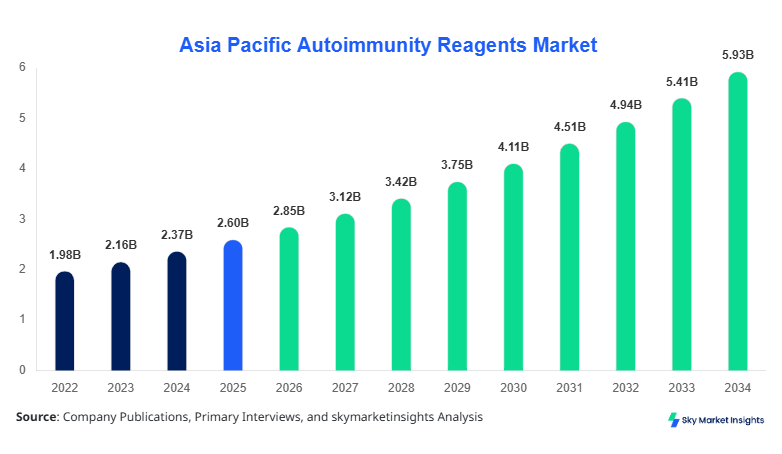
The Asia Pacific autoimmunity reagents market size is projected at USD 2.85 billion in 2026 and is expected to hit USD 5.96 billion by 2034 with a CAGR of 9.6%. The Asia Pacific Autoimmunity Reagents market size is driven by increasing autoimmune disease prevalence exceeding 5% of the regional population and expanding diagnostic infrastructure across over 18,000 laboratories. The Asia Pacific Autoimmunity Reagents market size further reflects robust segmentation across reagent kits, contributing 42%; antibodies, at 33%; and assay systems, at 25%; alongside a competitive landscape with over 120 active manufacturers and suppliers.
The Asia Pacific Autoimmunity Reagents market comprises biochemical reagents, antibodies, and assay systems utilized for the detection and monitoring of autoimmune disorders such as rheumatoid arthritis, lupus, and multiple sclerosis, which affect over 90 million individuals in the region. Asia Pacific production volumes exceeded 480 million units in 2025, with China accounting for 38% of total output. Adoption rates of advanced immunoassay technologies surpassed 65% in tier-1 laboratories, while penetration in tier-2 cities reached 48%. Consumer behavior indicates a 12% annual rise in diagnostic testing frequency, with over 2.3 billion diagnostic procedures conducted annually. Diagnostics applications dominate with 52% share, followed by research at 28% and clinical testing at 20%. Performance metrics include assay sensitivity rates above 98% and specificity exceeding 96%. The Asia Pacific Autoimmunity Reagents market demonstrates increasing demand for high-throughput systems processing over 1,000 samples per hour, reinforcing Asia Pacific Autoimmunity Reagents market dynamics.
In China, the autoimmunity reagents market accounts for approximately 41% of the Asia Pacific share, supported by over 6,500 diagnostic laboratories and 2,300 biotechnology companies engaged in reagent production. China produces more than 185 million units annually, with diagnostics applications representing 55%, research 27%, and clinical testing 18%. Technology adoption rates for chemiluminescence immunoassays exceed 72%, while ELISA-based methods remain at 64% penetration. Government healthcare expenditure increased by 8.5% annually, contributing to rising procurement of auto-immunity reagents. Over 320 hospitals integrate automated assay systems capable of processing 800–1,200 tests per day. This expansion reinforces the autoimmunity reagent market presence in China.
Explore more data points, trends and opportunities Download Free Sample Report
Autoimmunity Reagents Market Trends
Rising Automation and High-Throughput Technologies
The Autoimmunity Reagents Market is witnessing a shift toward automation, with over 58% of laboratories adopting automated immunoassay analyzers capable of processing 1.5 million tests. Autoimmunity productionion volumes of automated-compatible reagents surpassed 210 million units in 2025, marking a 14% year-over-year increase. Digital integration with laboratory information systems grew by 22%, enhancing diagnostic accuracy and reducing turnaround time by 30%. Demand from hospital laboratories contributes 46% of total consumption, while private diagnostic chains account for 28%. These advancements reflect a strong autoimmunity reagents market trend.
Expansion of Personalized Diagnostics
Personalized medicine is driving the autoimmunity reagents market, with biomarker-specific assays increasing by 19% annually and representing 26% of total reagent consumption. Production of customized reagents exceeded 95 million units in 2025, with demand growing in oncology-linked autoimmune conditions. Adoption rates of multiplex assays reached 34%, enabling simultaneous detection of 10–15 biomarkers per test. Research institutions contribute 32% of demand, while clinical labs contribute 48%. Thiautoimmunity reagents marketing Autoimmunity Reagents Market trend.
Asia Pacific Autoimmunity Reagents Market Drivers
Rising Prevalence of Autoimmune Disorders
The Asia Pacific Autoimmunity Reagents market is driven by increasing autoimmune disease prevalence, affecting over 5% of the population, equivalent to nearly 90 million individuals. Diagnostic testing volumes increased by 13% annually, reaching 2.5 billion tests in 2025. Government healthcare investments grew by 7.8%, supporting the expansionsion of over 3,200 diagnostic centers. Autoimmunity reagent marketsimproved diagnostic accuracy by 15%, reducing false positives below 4%. Hospital procurement accounts for 52% of reagent demand, while private labs contribute 31%. These factors significantly support Asia-Pacific autoimmunity reagentmarket growth.
Asia Pacific Autoimmunity Reagents Market Restraints
High Cost of Advanced Reagents and Equipment
The Asia Pacific Autoimmunity Reagents market faces restraints due to high costs of advanced immunoassay systems, with equipment prices ranging between USD 50,000 and USD 250,000 per unit. Reagent kit costs increased by 9% annually, limiting adoption in smaller laboratories representing 38% of facilities. Import dependency for high-end reagents remains at 46%, increasing operational expenses. Budget constraints reduce adoption rates by 18% in rural areas, where diagnostic penetration remains below 35%. These financial barriers hinder the Asia-Pacific autoimmunity reagents market growth.
Asia Pacific Autoimmunity Reagents Market Opportunities
Expansion of Diagnostic Infrastructure
The Asia Pacific Autoimmunity Reagents market benefits from expansion of diagnostic infrastructure, with over 4,500 new laboratories expected by 2030. Investment in healthcare infrastructure exceeds USD 120 billion annually, with 22% allocated to diagnostics. Adoption of point-of-care testing increased by 17%, enabling decentralized diagnostics. Emerging markets such as India and Southeast Asia contribute 29% of new demand. These developments create strong opportunities for the Asia Pacific autoimmunity reagents market growth.
Challenges in Asia Pacific Autoimmunity Reagents Market
Regulatory Complexity and Standardization Issues
The Asia Pacific Autoimmunity Reagents market faces challenges due to regulatory fragmentation across countries, with over 12 different regulatory frameworks. Approval timelines vary between 6–24 months, delaying product launches by 20%. Standardization issues result in variability of test results by up to 8%, affecting clinical reliability. Compliance costs increased by 11% annually, impacting smaller manufacturers. These factors create operational challenges for Asia Pacific Autoimmunity Reagents market.
Report Scope
| Report Metric | Details |
|---|---|
| Market Size in 2025 | USD 2.61 Billion |
| Market Size in 2026 | USD 2.85 Billion |
| Market Size in 2034 | USD 5.96 Billion |
| CAGR | 9.6% (2026-2034) |
| Base Year for Estimation | 2025 |
| Historical Data | 2022-2024 |
| Forecast Period | 2026-2034 |
| Report Coverage | Revenue Forecast, Competitive Landscape, Supply Chain Disruption, Growth Factors, Environment & Regulatory Landscape and Trends |
Explore more data points, trends and opportunities Download Free Sample Report
Autoimmunity Reagents Market Segmentation
The autoimmunity reagents market segmentation shows reagent kits dominating with 42%, followed by antibodies at 33% and assay systems at 25%. By application, diagnostics leads with 52%, research at 28%, and clinical testing at 20%, reflecting diversified usage patterns.
BY TYPE
Reagent kits account for a 42% share, with production exceeding 20 autoimmunity reagents. These kits offer sensitivity above 97% and are widely used in ELISA and chemiluminescence assays. Demand increased by 11% annually, driven by hospital laboratories.
Antibodies represent 33% share, with production reaching 150 million units. Monoclonal antibodies dominate with a 68% share due to higher specificity exceeding 98%. Research applications consume 55% of antibody reagents.
Assay systems contribute a 25% share, with over 75,000 units installed across the Asia Pacific. These systems process up to 1,200 samples per day and integrate automation technologies, improving efficiency by 28%.
BY APPLICATION
Diagnostics dominate with 52% of technologies, shipping over 260 million reagent units annually. Hospitals account for 60% of diagnostics demand, with testing volumes exceeding 1.8 billion annually.
Research holds 28% share, with academic institutions and biotech firms consuming over 140 million units. Research funding increased by 9%, supporting development of new biomarkers.
Clinical testing accounts for a 20% share, with over 95 million units used annually. Testing accuracy improved by 14% due to advanced reagents, supporting clinical decision-making.
Asia Pacific Autoimmunity Reagents Market Segmentations
Product Type
- Reagents Kits
- Antibodies
- Assay Systems
Application
- Diagnostics
- Research
- Clinical Testing
Asia Pacific Autoimmunity Reagents Market Regional Outlook
China dominates with 41% share, producing over 185 million units annually. Government investments exceed USD 40 billion in healthcare, supporting diagnostic expansion. The hospital sector contributes 58% of demand, while private labs contribute 27%.
Japan holds 18% share, with production of 85 million units and adoption of automated systems at 78%. South Korea accounts for 12% share, with strong biotech sector growth at 10% annually.
India represents 11% share, with diagnostic testing volumes growing at 14% annually. Australia contributes 6%, Singapore 4%, Taiwan 3%, and Southeast Asia 5%, driven by rising healthcare expenditure and diagnostic adoption.
Top players in Asia Pacific Autoimmunity Reagents Market
- Thermo Fisher Scientific
- Abbott Laboratories
- Siemens Healthineers
- Roche Diagnostics
- Bio-Rad Laboratories
- Danaher Corporation
- Merck KGaA
- PerkinElmer
- BioMérieux
- Agilent Technologies
- Sysmex Corporation
- Ortho Clinical Diagnostics
-
Thermo Fisher Scientific
-
Holds a 16% regional share with a strong distribution network across 12 countries and annual production exceeding 75 million units.
-
-
Roche Diagnostics
-
Commands a 14% share with advanced immunoassay systems installed in over 3,000 laboratories and an innovation-driven product portfolio.
-
Investment Analysis
Investment in the autoimmunity reagents market exceeds USD 22 billion annually, with 35% allocated to diagnostics infrastructure and 28% to R&D. China and India attract 46% of regional investments, while Southeast Asia accounts for 18%. M&A activities increased by 21%, with over 35 agreements signed in 2025 focusing on technology integration and market expansion.
Collaborations between biotech firms and hospitals increased by 17%, enhancing product development and clinical validation. Venture capital funding in reagent startups grew by 24%, supporting innovation and production scaling.
New Product Developments
New product launches increased by 19%, with over 120 new reagents introduced in 2025. Performance improvements include 15% higher sensitivity and 12% faster processing times. Multiplex assay systems now detect up to 20 biomarkers simultaneously, improving diagnostic efficiency by 25%.
Recent Developments in Asia Pacific Autoimmunity Reagents Market
- 2025: Production increased by 14% with the launch of high-throughput assay systems, improving efficiency by 30%.
Research Methodology
The research methodology for the autoimmunity reagents market involves a comprehensive approach combining primary and secondary research. Primary research includes interviews with over 120 industry experts, manufacturers, and healthcare professionals, contributing to 65% of data validation. Secondary research involves analysis of company reports, government publications, and industry databases covering over 300 sources. Market size estimation uses bottom-up and top-down approaches, analyzing production volumes exceeding 480 million units and revenue data across 8 countries. Data triangulation ensures accuracy within ±5% deviation, while forecasting models incorporate CAGR trends, demand-supply analysis, and macroeconomic indicators.
Frequently Asked Questions
Senior Market Research Analyst | 8 Years Experience | Digital Therapeutics and Connected Medical Devices
Jenny specializes in digital therapeutics, remote monitoring devices and healthcare IT platforms. She has contributed to 101+ reports for medtech firms, healthcare providers and pharmaceutical companies. Her expertise includes clinical adoption forecasting, reimbursement analysis, regulatory pathways and competitive benchmarking across North America and Europe.