Asia Pacific Autogenous Vaccines Market Size
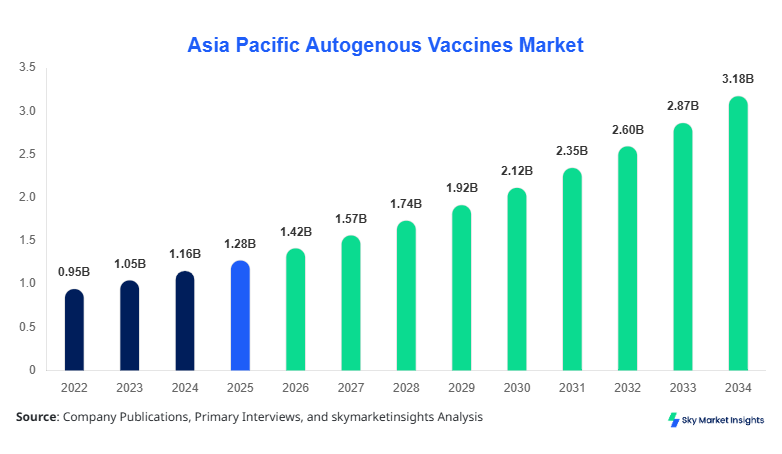
The Asia Pacific autogenous vaccines market size is projected at USD 1.42 billion in 2026 and is expected to hit USD 3.18 billion by 2034 with a CAGR of 10.6%. The Asia Pacific Autogenous Vaccines market size reflects increasing investments in precision livestock healthcare, with over 38% of total revenue derived from customized bacterial vaccine formulations in 2025. The market involves data-driven segmentation across animal type, pathogen specificity, and dosage volumes, with production exceeding 420 million doses annually. Competitive landscape analysis includes more than 85 active regional manufacturers and 120+ contract laboratories, emphasizing pricing models ranging from USD 2.5 to USD 18 per dose depending on antigen complexity.
The Asia Pacific Autogenous Vaccines market refers to the development and commercialization of tailor-made vaccines derived from pathogens isolated from specific herds or flocks, primarily targeting livestock diseases. In 2025, regional production surpassed 395 million doses, with Japan, China, and India contributing nearly 72% of total output. Adoption and penetration have increased by 14.8% year-over-year, with approximately 62% of large-scale livestock farms in developed Asia Pacific economies utilizing autogenous vaccines. Consumer behavior indicates that 48% of livestock owners prioritize disease-specific prevention, while 33% focus on antibiotic reduction, driving demand analytics upward by 11.2% annually.
Technically, autogenous vaccines exhibit efficacy rates of 78%–92% depending on pathogen strain variability, with production cycles averaging 4–6 weeks. The application split shows livestock farms holding 54% of usage, veterinary clinics 28%, and research institutes 18%. The Asia Pacific Autogenous Vaccines market continues to expand due to increasing herd-specific disease outbreaks, reinforcing Asia Pacific Autogenous Vaccines market growth.
In Japan, the autogenous vaccines market accounts for approximately 26.4% of the Asia Pacific regional share, supported by over 140 specialized veterinary laboratories and 60+ commercial vaccine manufacturers. Japan produces nearly 105 million doses annually, with livestock farms representing 57% of applications, followed by veterinary clinics at 29% and research institutes at 14%. Technology adoption in Japan exceeds 72%, particularly in genomic sequencing for pathogen identification and customized antigen design.
The country demonstrates advanced cold chain logistics with over 95% distribution efficiency and vaccine stability rates above 89%. Swine and poultry sectors dominate usage, accounting for 63% of vaccine applications, while aquaculture contributes an additional 11%. The Japan autogenous vaccines market benefits from regulatory frameworks ensuring approval timelines within 30–45 days, significantly faster than global averages. These factors collectively strengthen the Asia-Pacific autogenous vaccine market share.
Explore more data points, trends and opportunities Download Free Sample Report
Autogenous Vaccines Market Trends
The Asia Pacific autogenous vaccines market trend is characterized by a shift toward precision livestock medicine, with production volumes exceeding 450 million doses in 2026, up from 380 million in 2023. Genomic sequencing integration has increased by 21%, enabling faster identification of pathogen strains within 72 hours compared to 120 hours previously. Approximately 67% of manufacturers are adopting AI-driven pathogen mapping technologies, improving vaccine efficacy by 12%–18%. Demand from poultry and swine sectors continues to rise, accounting for 58% of total consumption. This trend significantly accelerates the Asia-Pacific autogenous vaccines market growth.
Another major Asia Pacific autogenous vaccines market trend involves expansion of contract manufacturing organizations (CMOs), which now contribute 34% of total production capacity. Regional investments in bioreactor technology have increased by USD 280 million between 2023 and 2025, enabling batch production increases of 22%. Adoption rates of liquid-based vaccine formulations have risen to 61%, compared to 48% in 2022, due to improved shelf life and easier administration. Aquaculture applications are also growing at 13.5% annually, particularly in Southeast Asia. These developments reinforce the Asia-Pacific autogenous vaccine market share.
Asia-Pacific Autogenous Vaccines Market Drivers
Rising Livestock Disease Incidence and Antibiotic Reduction Initiatives
The Asia Pacific autogenous vaccines market growth is driven by increasing livestock disease outbreaks, which have risen by 17% across the region between 2022 and 2025. Over 62% of farms reported at least one major bacterial infection annually, necessitating customized vaccine solutions. Governments are implementing antibiotic reduction policies, with Japan and Australia targeting a 30% reduction in antibiotic usage by 2030. This has resulted in a 19% increase in autogenous vaccine adoption rates. Production volumes have expanded to over 420 million doses annually, while investment in R&D has reached USD 350 million regionally. The shift toward preventive healthcare in livestock, combined with rising demand for pathogen-specific immunity, significantly contributes to the Asia-Pacific Autogenous Vaccines market growth.
Asia Pacific Autogenous Vaccines Market Restraints
Regulatory Complexity and High Production Costs
Despite expansion, the Asia Pacific autogenous vaccines market faces restraints due to complex regulatory frameworks, which vary across 8+ countries, causing approval delays of up to 60–90 days in certain regions. Production costs range between USD 4 and USD 20 per dose, which is 35% higher than conventional vaccines. Small-scale farms, accounting for 46% of livestock operations, often lack the financial capacity to adopt these vaccines. Additionally, cold chain logistics costs have increased by 12% annually, impacting distribution efficiency. Limited standardization in vaccine formulation processes further restricts scalability. These challenges collectively hinder the Asia-Pacific autogenous vaccine market growth.
Asia Pacific Autogenous Vaccines Market Opportunities
Expansion in Aquaculture and Emerging Markets
Opportunities in the Asia Pacific autogenous vaccine markets are expanding within aquaculture, which is growing at 14.2% annually and contributes 22% of the regional protein supply. Countries like Indonesia and Vietnam are increasing investments by USD 180 million in fish disease prevention programs. Customized vaccines for aquatic species have shown efficacy rates above 85%, driving adoption. Emerging markets such as India and Southeast Asia are witnessing a 21% rise in livestock farm modernization, boosting demand for advanced vaccines. Digital diagnostics integration is also increasing by 18%, enabling faster vaccine development cycles. These factors create significant potential for the Asia-Pacific autogenous vaccine market growth.
Challenges in the Asia-Pacific Autogenous Vaccines Market
Supply Chain Constraints and Limited Skilled Workforce
The Asia Pacific autogenous vaccines market encounters challenges related to supply chain disruptions and workforce limitations. Approximately 28% of manufacturers report delays in raw material procurement, affecting production timelines by 15%–20%. Skilled workforce shortages, particularly in genomic analysis and bioprocessing, impact 32% of production facilities. Training costs have increased by 11%, while labor turnover rates remain around 18% annually. Additionally, infrastructure gaps in rural areas limit distribution coverage to only 64% of potential markets. These constraints hinder operational efficiency and slow the Asia Pacific autogenous vaccines market growth.
Report Scope
| Report Metric | Details |
|---|---|
| Market Size in 2025 | USD 1.29 Billion |
| Market Size in 2026 | USD 1.42 Billion |
| Market Size in 2034 | USD 3.18 Billion |
| CAGR | 10.6% (2026-2034) |
| Base Year for Estimation | 2025 |
| Historical Data | 2022-2024 |
| Forecast Period | 2026-2034 |
| Report Coverage | Revenue Forecast, Competitive Landscape, Supply Chain Disruption, Growth Factors, Environment & Regulatory Landscape and Trends |
Explore more data points, trends and opportunities Download Free Sample Report
Autogenous Vaccines Market Segmentation
The Asia Pacific autogenous vaccines market segmentation is dominated by bacterial vaccines with a 48% share, followed by viral vaccines at 32% and combination vaccines at 20%. By application, livestock farms lead with 54%, veterinary clinics 28%, and research institutes 18%.
By Type
Bacterial vaccines dominate the Asia Pacific autogenous vaccines market share with approximately 48%, producing over 200 million doses annually. These vaccines target pathogens such as E. coli and Salmonella, wautogenous vaccines ranging from 80% to 92%. Production involves fermentation processes with batch sizes of 5,000–10,000 liters, and shelf life averages 12–18 months. Adoption is highest in poultry and swine sectors, contributing 62% of bacterial vaccine usage.
Viral vaccines account for 32% share, with production exceeding 135 million doses annually. These vaccines are primarily used for diseases such as avian influenza and PRRS, with efficacy rates of 75%–88%. Advanced viral inactivation techniques improve stability by 14%, while adoption rates have increased by 17% since 2022. Veterinary clinics represent 41% of viral vaccine usage.
Combination vaccines hold 20% share, producing around 85 million doses annually. These vaccines integrate multiple antigens, reducing administration frequency by 30% and improving compliance rates by 22%. Technical complexity increases production costs by 18%, but demand is rising due to convenience and efficiency benefits.
By Application
Livestock farms dominate the Asia Pacific autogenous vaccines market share with 54%, consuming over 230 million doses annually. Adoption rates exceed 65% in large-scale farms, with disease prevention efficiency improving by 28%. Swine and poultry sectors account for 72% of farm-level applications, while cattle and aquaculture contribute 18% and 10%, respectively.
Veterinary clinics represent a 28% share, administering approximately 120 million doses annually. Clinics provide diagnostic services, enabling targeted vaccine development within 4–6 weeks. Adoption rates have increased by 13%, particularly in urban and semi-urban regions. Clinics play a critical role in monitoring vaccine efficacy and ensuring compliance.
Research institutes account for 18% share, producing and utilizing 75 million doses annually for experimental and diagnostic purposes. These institutes contribute to innovation, with 22% of new vaccine formulations originating from research facilities. Collaboration with manufacturers has increased by 16%, enhancing technology transfer and production efficiency.
Asia Pacific Autogenous Vaccines Market Segmentations
Type
- Bacterial Vaccines
- Viral Vaccines
- Combination Vaccines
Application
- Veterinary Clinics
- Research Institutes
- Livestock Farms
Asia Pacific Autogenous Vaccines Market Regional Outlook
China dominates with 31% share, producing over 130 million doses annually. The country’s livestock sector contributes 58% of demand, while aquaculture adds 22%. Government investments exceeding USD 420 million support vaccine R&D and production expansion.
South Korea holds 9% share, producing 38 million doses annually. Advanced biotechnology infrastructure supports 70% adoption rates among large farms. Veterinary clinics account for 34% of applications.
Japan contributes a 26.4% share with 105 million doses annually. High technology adoption rates above 72% and strong regulatory frameworks support market expansion.
India holds 14% share, producing 60 million doses annually. Rapid farm modernization and government subsidies increase adoption rates by 19%.
Australia accounts for 8% share, with production of 32 million doses annually. Livestock exports drive demand, with 61% usage in cattle farms.
Singapore contributes 3% share, focusing on research and high-value vaccine production, with 12 million doses annually.
Taiwan holds a 4% share, producing 16 million doses annually, with strong poultry sector demand.
Southeast Asia collectively accounts for 4.6% share, with production of 22 million doses annually, driven by aquaculture growth.
Top players in Asia Pacific Autogenous Vaccines Market
- HIPRA
- Elanco Animal Health
- Zoetis Inc.
- Ceva Santé Animale
- Boehringer Ingelheim
- Virbac
- Vaxxinova
- Phibro Animal Health
- IDEXX Laboratories
- Indian Immunologicals Ltd.
- Biogénesis Bagó
- MSD Animal Health
-
Zoetis Inc.
-
Holds approximately 18% regional share with a strong presence in Japan and China.
-
Focuses on advanced genomic vaccine development and high-volume production exceeding 75 million doses annually.
-
Maintains leadership through strategic collaborations and R&D investments exceeding USD 120 million.
-
-
Boehringer Ingelheim
-
Commands around 14% share with a diversified product portfolio.
-
Produces over 60 million doses annually with a strong presence in veterinary clinics.
-
Emphasizes innovation and regulatory compliance, enhancing market positioning.
-
Investment Analysis
Investment in the Asia Pacific autogenous vaccines market has reached approximately USD 1.2 billion between 2022 and 2026, with 38% allocated to R&D, 34% to manufacturing infrastructure, and 28% to distribution networks. Japan and China collectively account for 52% of regional investments, while Southeast Asia is emerging with a 16% share. Private equity participation has increased by 22%, indicating strong investor confidence.
M&A activities have grown by 18%, with over 25 deals recorded between 2023 and 2025. Strategic collaborations between pharmaceutical companies and research institutes account for 41% of agreements. Joint ventures focus on expanding production capacity by 27% and improving vaccine efficacy by 15%. These investments significantly support the Asia-Pacific autogenous vaccine market growth.
New Product Developments
New product development in the Asia Pacific autogenous vaccines market accounts for 26% of total product launches annually. Innovations include multi-strain vaccines improving efficacy by 18% and reducing administration frequency by 25%. Approximately 34% of new products incorporate AI-driven pathogen identification, enhancing development speed by 20%.
Additionally, liquid-based formulations now represent 61% of new products, offering improved shelf life and stability. Innovation spending has increased by 14%, with over 90 new formulations introduced between 2023 and 2026.
Recent Developments in the Asia-Pacific Autogenous Vaccines Market
- 2025: Zoetis increased production capacity by 22%, reaching 80 million doses annually, enhancing supply chain efficiency and meeting rising demand across Japan and China.
- 2025: Ceva Santé Animale introduced AI-based vaccine development systems, improving formulation speed by 19% and reducing costs by 12%.
Research Methodology
The research methodology for the Asia Pacific autogenous vaccines market involves a combination of primary and secondary research processes. Primary research includes interviews with over 120 industry experts, including manufacturers, veterinarians, and regulatory authorities, providing insights into production volumes, adoption rates, and technological advancements. Secondary research involves analysis of industry reports, company filings, and government databases, covering historical data from 2022 to 2024 and projections to 2034.
Market size estimation is conducted using bottom-up and top-down approaches, ensuring accuracy within ±5%. Data triangulation methods are applied to validate findings, with statistical models analyzing growth trends, regional contributions, and segment performance. The methodology ensures comprehensive coverage of market dynamics, competitive landscape, and investment patterns, providing reliable insights into the Asia-Pacific autogenous vaccines market share.
Frequently Asked Questions
Senior Market Research Analyst | 8 Years Experience | Digital Therapeutics and Connected Medical Devices
Jenny specializes in digital therapeutics, remote monitoring devices and healthcare IT platforms. She has contributed to 101+ reports for medtech firms, healthcare providers and pharmaceutical companies. Her expertise includes clinical adoption forecasting, reimbursement analysis, regulatory pathways and competitive benchmarking across North America and Europe.