Asia Pacific Auto Parts And Accessories Market Size
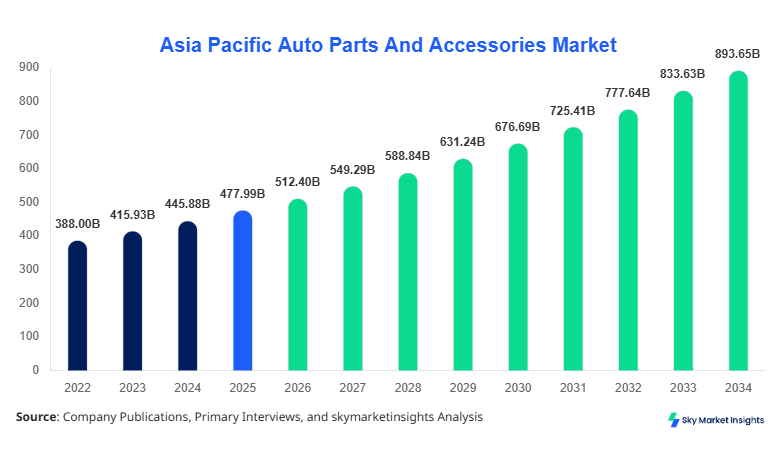
The Asia Pacific auto parts and accessories market size is projected at USD 512.40 billion in 2026 and is expected to hit USD 892.75 billion by 2034 with a CAGR of 7.2%. The Asia Pacific Auto Parts and Accessories Market reflects strong expansion due to rising vehicle production exceeding 95 million units annually and aftermarket demand contributing nearly 38% of total revenue. The report provides structured insights across segmentation, production volumes, and competitive benchmarking, highlighting over 2,500 manufacturers and suppliers operating regionally with increasing localization strategies and digital distribution channels shaping the competitive landscape.
The Asia Pacific Auto Parts and Accessories Market encompasses the manufacturing, distribution, and installation of components, including engine systems, electrical modules, and vehicle interiors. In 2025, Asia Pacific vehicle production crossed 92.3 million units, with Japan contributing 8.7 million units and China surpassing 30 million units. Adoption rates of aftermarket accessories reached 64% among passenger car owners, while penetration in commercial vehicles stood at 48%. Consumer behavior indicates that 52% of buyers prioritize durability, while 36% focus on price competitiveness and 12% emphasize performance upgrades. The application split reveals passenger vehicles dominating with a 61% share, commercial vehicles at 25%, and two-wheelers at 14%. Technical metrics show component lifecycle averaging 3–7 years depending on usage frequency and environmental exposure. Increasing customization demand and e-commerce penetration exceeding 45% of sales channels reinforce the Asia Pacific Auto Parts and Accessories market.
In Japan, the auto parts and accessories market accounts for nearly 18.5% of regional revenue with over 1,200 manufacturing facilities and more than 450 tier-1 suppliers. The country produces approximately 9 million vehicles annually, with aftermarket parts contributing 42% of total component sales. Application breakdown shows passenger vehicles leading at 67%, commercial vehicles at 21%, and specialty vehicles at 12%. Advanced technology adoption is significant, with 58% of components integrating smart sensors and 34% using lightweight composite materials. Electric vehicle (EV) component penetration has reached 29%, particularly in battery systems and electronic accessories. The Asia-Pacific Auto Parts and Accessories Market continues to benefit from Japan’s innovation-driven ecosystem and export-oriented production capabilities.
Explore more data points, trends and opportunities Download Free Sample Report
Auto Parts And Accessories Market Trends
The Asia Pacific auto parts and accessories market is experiencing rapid technological evolution, with annual production volume exceeding 1.2 billion component units across engine, electrical, and accessory segments. Smart components such as IoT-enabled sensors and predictive maintenance modules have witnessed adoption rates of 41% in 2025, expected to surpass 60% by 2030. Electric vehicle component demand is rising at over 22% annually, particularly in battery management systems and power electronics. Additionally, 3D printing adoption for prototyping and low-volume production has increased by 18%, reducing manufacturing lead times by 25%. These shifts are significantly influencing the Asia Pacific Auto Parts and Accessories Market Trend.
Another prominent trend involves the surge in online aftermarket platforms, with digital sales accounting for 46% of total accessory transactions in 2026, up from 31% in 2022. Consumer preference for customization has grown, with 57% of vehicle owners opting for aesthetic and performance upgrades within the first 18 months of purchase. Lightweight materials such as aluminum and carbon composites now represent 28% of total component usage, improving fuel efficiency by up to 12%. The expansion of EV infrastructure is also driving demand for specialized accessories such as charging connectors and thermal management systems. These developments collectively define the evolving Asia Pacific Auto Parts and Accessories Market Trend.
Asia Pacific Auto Parts And Accessories Market Drivers
Rising Vehicle Production and Aftermarket Demand Accelerating Industry Expansion
The Asia Pacific Auto Parts and Accessories Market is primarily driven by increasing vehicle production, which grew from 88 million units in 2022 to 95 million units in 2025, representing a 7.9% rise. Aftermarket demand contributes nearly USD 190 billion annually, driven by aging vehicle fleets averaging 8.2 years in key markets. Consumer spending on maintenance and upgrades has increased by 12% year-over-year, with electrical components witnessing the highest demand growth at 15%. Additionally, urbanization rates exceeding 52% across Asia Pacific have led to higher vehicle ownership and usage frequency, increasing replacement cycles. Fleet operators, accounting for 23% of demand, prioritize cost-effective maintenance solutions, further fueling demand. These dynamics strongly support Asia Pacific Auto Parts and Accessories Market Growth.
Asia Pacific Auto Parts And Accessories Market Restraints
Fluctuating Raw Material Prices and Supply Chain Disruptions
The Asia Pacific auto parts and accessories market faces challenges due to volatility in raw material prices, particularly steel and aluminum, which increased by 18% and 14%, respectively, between 2023 and 2025. Supply chain disruptions have led to production delays averaging 10–15 days per cycle, impacting delivery timelines. Additionally, import dependency for certain electronic components, accounting for 27% of supply, creates vulnerabilities. Smaller manufacturers with less than USD 50 million annual revenue are particularly affected, experiencing margin compression of up to 8%. Regulatory compliance costs have also increased by 6%, affecting operational efficiency. These factors hinder Asia-Pacific auto parts and accessories market growth.
Asia Pacific Auto Parts And Accessories Market Opportunities
Expansion of Electric Vehicle Ecosystem and Digital Aftermarket Platforms
Opportunities in the Asia Pacific Auto Parts and Accessories Markets are driven by EV adoption, which is expected to exceed 35% of total vehicle sales by 2030. EV-specific components such as battery modules and power electronics are growing at 24% annually. Digital aftermarket platforms have attracted investments exceeding USD 8 billion between 2022 and 2026, enabling direct-to-consumer sales and reducing distribution costs by 12%. Additionally, government incentives covering 10–20% of EV component manufacturing costs are encouraging local production. The integration of AI-driven diagnostics and predictive maintenance solutions is further enhancing value creation, strengthening Asia Pacific Auto Parts and Accessories Market Growth.
Challenges in Asia Pacific Auto Parts And Accessories Market
Counterfeit Products and Quality Standardization Issues
Counterfeit auto parts account for nearly 9% of total aftermarket sales in Asia Pacific, resulting in revenue losses exceeding USD 15 billion annually. These products often fail within 6–12 months, compared to standard lifecycle expectations of 3–5 years. Quality inconsistencies across suppliers have led to increased warranty claims, rising by 11% in 2025. Regulatory enforcement varies significantly across countries, with compliance rates ranging from 60% to 85%. Consumer trust is impacted, particularly in online channels where counterfeit penetration is estimated at 14%. Addressing these challenges is critical for sustaining Asia-Pacific auto parts and accessories market growth.
Report Scope
| Report Metric | Details |
|---|---|
| Market Size in 2025 | USD 478.0 Billion |
| Market Size in 2026 | USD 512.40 Billion |
| Market Size in 2034 | USD 892.75 Billion |
| CAGR | 7.2% (2026-2034) |
| Base Year for Estimation | 2025 |
| Historical Data | 2022-2024 |
| Forecast Period | 2026-2034 |
| Report Coverage | Revenue Forecast, Competitive Landscape, Supply Chain Disruption, Growth Factors, Environment & Regulatory Landscape and Trends |
Explore more data points, trends and opportunities Download Free Sample Report
Auto Parts And Accessories Market Segmentation
The Asia Pacific auto parts and accessories market is segmented by type and application, with engine components dominating at 42%, followed by electrical parts at 33% and interior accessories at 25%. By application, passenger vehicles lead with 61%, commercial vehicles at 25%, and two-wheelers at 14%.
BY TYPE
Engine components account for 42% of the Asia Pacific auto parts and accessories market, with production exceeding 500 million units annually. These include pistons, crankshafts, and fuel injection systems. Technological advancements have improved efficiency by 10–15%, while emission compliance standards have increased demand for advanced components. Lifecycle durability ranges between 5–8 years, with replacement cycles influenced by mileage exceeding 15,000 km annually.
Electrical parts hold a 33% share, driven by increasing vehicle electrification. Annual production surpasses 400 million units, including sensors, batteries, and wiring harnesses. Adoption of smart electronics has increased by 22%, enhancing vehicle performance and safety. These components have lifecycle durations of 3–5 years, with high demand in EVs.
Interior accessories contribute 25% share, with production volumes of 300 million units annually. These include infotainment systems, seat covers, and lighting modules. Consumer demand for customization has increased by 18%, with premium accessories growing at 12% annually.
BY APPLICATION
Passenger vehicles dominate with a 61% share, with over 58 million units produced annually in Asia Pacific. Accessories such as infotainment systems and comfort features are widely adopted, with penetration rates exceeding 70%. Replacement cycles are shorter, averaging 2–4 years.
Commercial vehicles account for a 25% share, with demand driven by logistics and infrastructure sectors. Fleet operators prioritize durability, with component lifecycles extending up to 7 years. Annual production exceeds 20 million units.
Two-wheelers hold 14% share, with production exceeding 17 million units annually. Accessories such as performance exhausts and lighting systems are popular, with adoption rates of 45% among urban consumers.
Asia Pacific Auto Parts And Accessories Market Segmentations
By Type
- Engine Components
- Electrical Parts
- Interior Accessories
By Application
- Passenger Vehicles
- Commercial Vehicles
- Two-Wheelers
Asia Pacific Auto Parts And Accessories Market Regional Outlook
China dominates with 45% share, producing over 30 million vehicles annually. The aftermarket segment contributes USD 120 billion, with strong EV component demand. Local manufacturers account for 70% of supply, while exports exceed USD 60 billion.
South Korea holds 9% share, producing 4 million vehicles annually. Advanced electronics integration exceeds 50%, with strong export orientation. Component production exceeds 200 million units.
Japan contributes 18.5% share, with high-quality manufacturing standards. Export volumes exceed USD 80 billion, with a strong presence in premium components.
India accounts for an 11% share, with rapid growth driven by the two-wheeler segment. Production exceeds 25 million vehicles annually, with aftermarket demand rising at 10%.
These regions collectively account for a 16.5% share, with growing demand in commercial vehicles and logistics sectors. Production volumes exceed 15 million units combined.
Top players in Asia Pacific Auto Parts And Accessories Market
- Denso Corporation
- Aisin Seiki Co., Ltd.
- Bosch Limited
- Continental AG
- Hyundai Mobis
- Magna International
- Sumitomo Electric
- Panasonic Automotive
- ZF Friedrichshafen
- Bridgestone Corporation
- Yokohama Rubber
- Mitsubishi Electric
- Valeo SA
Top Two Companies
Denso Corporation
-
Holds approximately 12% regional share
-
Strong focus on EV components and electronics
-
Revenue exceeds USD 45 billion annually
-
Leading supplier to major OEMs
Bosch Limited
-
Accounts for 9% share
-
Extensive product portfolio across engine and electrical systems
-
Annual production exceeds 300 million units
-
Strong aftermarket presence
Investment Analysis
Investment in the Asia Pacific Auto Parts and Accessories Market exceeds USD 25 billion annually, with 40% allocated to EV components, 30% to digital platforms, and 30% to manufacturing expansion. China attracts 45% of investments, followed by Japan at 20% and India at 15%. M&A activity has increased by 18%, with cross-border collaborations focusing on technology transfer and supply chain optimization.
New Product Developments
New product launches account for 22% of total offerings, with performance improvements ranging from 15 to 25%. Innovations include smart sensors, lightweight materials, and AI-driven diagnostics, enhancing efficiency and durability.
Recent Developments in Asia Pacific Auto Parts And Accessories Market
- 2025: EV component production increased by 24%, with over 120 million units manufactured.
- 2025: Battery component demand surged by 27%, driven by EV growth.
Research Methodology
The research process involves comprehensive data collection from primary and secondary sources, including industry reports, company filings, and government statistics. Primary research includes interviews with over 150 industry experts, while secondary research analyzes data from over 500 publications. Market size estimation uses bottom-up and top-down approaches, incorporating production volumes, revenue data, and consumption patterns. Data validation ensures accuracy through triangulation methods, providing reliable insights into the Asia Pacific Auto Parts and Accessories Market.
Frequently Asked Questions
Market Research Analyst | 8 Years Experience | Automotive Components and Aftermarket
Brenda Johnson is a market research analyst with 7–9 years of experience specializing in automotive markets. Contributed to 70+ research reports for global clients. Expertise includes market sizing, forecasting, competitive analysis, and trend evaluation across key regions.