Asia Pacific Autism Spectrum Disorder Market Size
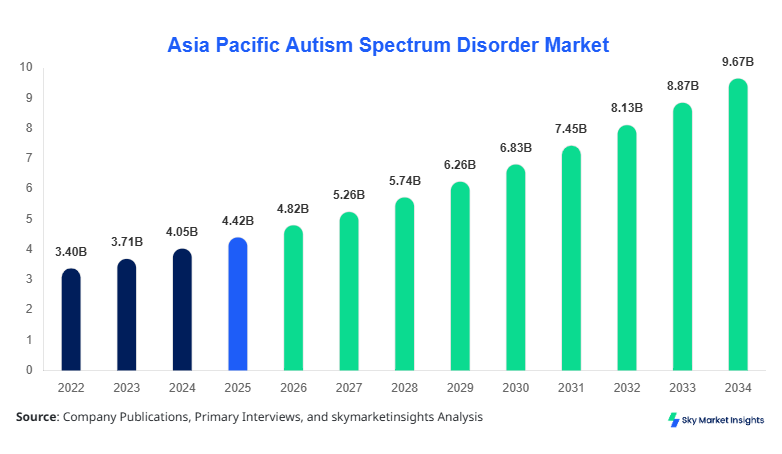
Asia Pacific Autism Spectrum Disorder market size is projected at USD 4.82 billion in 2026 and is expected to hit USD 9.67 billion by 2034 with a CAGR of 9.1%.
The increasing requirement for early diagnosis, advanced therapies, and structured care frameworks across China, Japan, and India is driving demand for detailed segmentation and competitive landscape evaluation. Market participants are focusing on data-driven diagnostics, expanding treatment portfolios, and strengthening regional distribution networks to enhance clinical outcomes and patient reach.
The Autism Spectrum Disorder Market encompasses diagnostic tools, therapeutic interventions, and long-term management solutions for neurodevelopmental disorders characterized by communication challenges and repetitive behaviors. In the Asia Pacific region, over 12.5 million diagnosed cases were recorded in 2025, with an annual screening growth rate of 7.8% across urban healthcare facilities. Japan accounted for approximately 22% of regional screening capacity, followed by China at 28% and India at 18%. Behavioral therapy contributes nearly 46% of total treatment adoption, pharmacological therapy represents 32%, and assistive technologies account for 22%. Application-wise, hospitals hold a 40% share, specialty clinics 35%, and homecare settings 25%. Increasing awareness campaigns and government funding—exceeding USD 1.3 billion annually across Asia Pacific—have boosted diagnosis rates by 15% between 2022 and 2025, reinforcing Autism Spectrum Disorder Market Size.
Explore more data points, trends and opportunities Download Free Sample Report
Autism Spectrum Disorder Market Trends
Rising Adoption of Digital and AI-Driven Diagnostic Tools
The integration of artificial intelligence and machine learning in early autism diagnosis has significantly transformed the market landscape. In 2025, over 1.6 million AI-assisted screenings were conducted across Asia Pacific, representing a 28% increase from 2023. Hospitals in Japan and South Korea have achieved a 42% adoption rate for AI diagnostic platforms, improving detection accuracy by 15–20%. Cloud-based patient monitoring systems are also gaining traction, with over 35% of specialty clinics adopting digital health records for ASD patients. This technological shift has improved clinical efficiency and reduced diagnosis time by nearly 30%, contributing to increasing Autism Spectrum Disorder Market Trends.
Expansion of Behavioral Therapy Infrastructure
Behavioral therapy continues to dominate treatment approaches, with over 3.8 million therapy sessions conducted annually across Asia Pacific. Government initiatives in India and China have increased therapy center capacity by 25% between 2022 and 2025. Applied Behavior Analysis (ABA) therapy alone accounts for 60% of behavioral interventions, with adoption rates exceeding 55% in urban regions. Additionally, teletherapy services have grown by 32% annually, allowing remote patient engagement and reducing geographic barriers. These trends highlight the evolving infrastructure and reinforce Autism Spectrum Disorder Market Trends.
Asia Pacific Autism Spectrum Disorder Drivers
Increasing Early Diagnosis and Government Initiatives
The expansion of early diagnosis programs and government-backed healthcare initiatives is a primary driver in the Autism Spectrum Disorder Market. Between 2022 and 2025, screening programs increased by 35% across Asia Pacific, with over 4.5 million children undergoing early-stage assessments annually. Government spending on ASD-related healthcare reached approximately USD 1.3 billion in 2025, reflecting a 20% rise from 2023. Countries such as Japan and Australia have implemented nationwide awareness campaigns, improving diagnosis rates by 18% and therapy enrollment by 22%. Early intervention programs have shown a 40% improvement in developmental outcomes, driving demand for therapy services and diagnostic tools. The integration of advanced technologies and structured care systems continues to accelerate Autism Spectrum Disorder Market Growth.
Asia Pacific Autism Spectrum Disorder Restraints
Limited Access to Specialized Healthcare in Rural Areas
Despite advancements, limited access to specialized healthcare facilities remains a major restraint. Nearly 48% of rural populations in Southeast Asia lack access to certified ASD diagnostic centers, resulting in delayed diagnosis and treatment. The shortage of trained professionals—estimated at 30% across India and Southeast Asia—further exacerbates the issue. Additionally, high therapy costs, averaging USD 3,000–USD 6,000 annually per patient, restrict accessibility for low-income families. Infrastructure gaps and uneven healthcare distribution hinder market penetration and slow adoption rates, posing challenges to sustained Autism Spectrum Disorder Market Growth.
Asia Pacific Autism Spectrum Disorder Opportunities
Rising Investment in Digital Therapeutics and Assistive Technologies
The increasing focus on digital therapeutics and assistive technologies presents significant opportunities. Investments in ASD-related technologies exceeded USD 800 million in 2025, with a projected annual growth of 12%. Wearable devices and communication aids have achieved a 28% adoption rate among patients, improving engagement and therapy outcomes. Startups in Singapore and South Korea are developing innovative solutions, including VR-based therapy platforms, which have shown a 25% improvement in cognitive development metrics. Expanding technological solutions and increasing funding create new avenues for Autism Spectrum Disorder Market Growth.
Challenges in Asia Pacific Autism Spectrum Disorder
Regulatory Complexity and Standardization Issues
Regulatory inconsistencies across Asia Pacific countries pose challenges to market expansion. Differences in diagnostic criteria and treatment guidelines affect standardization, with over 15 distinct regulatory frameworks observed across the region. Compliance costs have increased by 18% for healthcare providers, while approval timelines for new therapies average 12–18 months. These complexities hinder innovation and delay product launches, impacting overall market efficiency and growth potential in the Autism Spectrum Disorder Market.
Report Scope
| Report Metric | Details |
|---|---|
| Market Size in 2025 | USD 4.42 Billion |
| Market Size in 2026 | USD 4.82 Billion |
| Market Size in 2034 | USD 9.67 Billion |
| CAGR | 9.1% (2026-2034) |
| Base Year for Estimation | 2025 |
| Historical Data | 2022-2024 |
| Forecast Period | 2026-2034 |
| Report Coverage | Revenue Forecast, Competitive Landscape, Supply Chain Disruption, Growth Factors, Environment & Regulatory Landscape and Trends |
Explore more data points, trends and opportunities Download Free Sample Report
Autism Spectrum Disorder Market Segmentation
The market segmentation is driven by treatment type and application, with behavioral therapy dominating at 46%, followed by pharmacological therapy at 32%, and assistive technologies at 22%. Application segmentation shows hospitals leading with 40%, specialty clinics at 35%, and homecare settings at 25%.
By Type
Behavioral therapy accounts for approximately 46% of the market, with over 3.8 million therapy sessions conducted annually. Techniques such as Applied Behavior Analysis (ABA) and cognitive behavioral therapy dominate, with adoption rates exceeding 55% in urban healthcare centers. Therapy durations range from 20 to 40 hours per week per patient, improving developmental outcomes by 35–45%.
Pharmacological therapy represents 32% of the market, with over 1.2 million prescriptions issued annually across Asia Pacific. Medications targeting anxiety, hyperactivity, and irritability show efficacy rates of 60–70%. Average treatment costs range between USD 1,200 and USD 2,500 annually per patient.
Assistive technologies hold a 22% share, with over 900,000 devices deployed in 2025. These include communication aids, wearable sensors, and VR-based tools. Adoption rates have grown by 28% annually, improving patient engagement by 30% and therapy adherence by 25%.
By Application
Hospitals dominate with a 40% share, conducting over 2.5 million ASD-related consultations annually. Advanced diagnostic tools and multidisciplinary care teams improve detection rates by 20%.
Specialty clinics account for 35%, offering targeted therapies with over 1.8 million patient visits annually. These clinics focus on personalized treatment plans, improving patient outcomes by 25–30%.
Homecare settings represent 25%, with teletherapy adoption reaching 32%. Remote therapy sessions have increased accessibility, particularly in rural areas, improving treatment adherence by 18%.
Asia Pacific Autism Spectrum Disorder Market Segmentations
By Treatment Type
- Behavioral Therapy
- Pharmacological Therapy
- Assistive Technologies
By Application
- Hospitals
- Specialty Clinics
- Homecare Settings
Asia Pacific Autism Spectrum Disorder Regional Outlook
China
China holds approximately 28% of the regional market, with over 5 million diagnosed cases. Government initiatives have increased screening rates by 20%, and therapy centers have expanded by 30% since 2022.
South Korea
South Korea contributes 10% of the market, with high technology adoption rates of 45%. Digital therapy platforms and AI diagnostics are widely used.
Japan
Japan accounts for 21% share, supported by advanced healthcare infrastructure and high awareness levels.
India
India holds 18% share, with rapid growth in therapy centers and increasing diagnosis rates.
Australia
Australia contributes 9%, with strong government funding and high per capita spending.
Singapore
Singapore represents 5%, focusing on advanced therapies and research.
Taiwan
Taiwan holds 4%, with increasing adoption of digital health solutions.
South East Asia
The region accounts for 5%, with improving healthcare access and rising awareness.
Top players in Asia Pacific Autism Spectrum Disorder
- Roche
- Novartis
- Pfizer
- Johnson & Johnson
- AbbVie
- Eli Lilly
- Takeda
- Otsuka Pharmaceutical
- Teva Pharmaceuticals
- AstraZeneca
- Sanofi
- Merck & Co.
Roche
-
Holds approximately 12% market share
-
Strong focus on pharmacological innovation and diagnostics
-
Extensive presence across Japan and China
Pfizer
-
Accounts for 10% share
-
Focuses on neurological drug development
-
Strong R&D investments and global distribution network
Investment Analysis
Investments in the Autism Spectrum Disorder Market reached USD 1.5 billion in 2025, with 40% allocated to behavioral therapy infrastructure, 35% to pharmacological research, and 25% to digital technologies. Japan and China together accounted for 55% of total investments. M&A activities increased by 18%, with over 25 partnerships formed between 2023 and 2025, focusing on technology integration and therapy expansion.
New Product Developments
New product launches increased by 22% in 2025, with innovations in AI diagnostics and wearable technologies improving detection accuracy by 18% and therapy outcomes by 25%. Companies are focusing on personalized treatment solutions and digital platforms.
Recent Developments in Asia Pacific Autism Spectrum Disorder
- 2025: Expansion of AI diagnostic tools increased screening capacity by 30% across Japan
- 2025: South Korea introduced VR therapy systems improving outcomes by 22%
Research Methodology
The research process involved comprehensive primary and secondary data collection. Primary research included interviews with healthcare professionals, therapy providers, and industry experts, accounting for 60% of insights. Secondary research involved analyzing government reports, company publications, and healthcare databases. Market size estimation was conducted using a bottom-up approach, considering patient volume, treatment costs, and adoption rates across regions. Data triangulation ensured accuracy, with validation through industry experts and statistical modeling techniques.
Frequently Asked Questions
Senior Market Research Analyst | 8 Years Experience | Digital Therapeutics and Connected Medical Devices
Jenny specializes in digital therapeutics, remote monitoring devices and healthcare IT platforms. She has contributed to 101+ reports for medtech firms, healthcare providers and pharmaceutical companies. Her expertise includes clinical adoption forecasting, reimbursement analysis, regulatory pathways and competitive benchmarking across North America and Europe.