Asia Pacific Atorvastatin Calcium Market Size
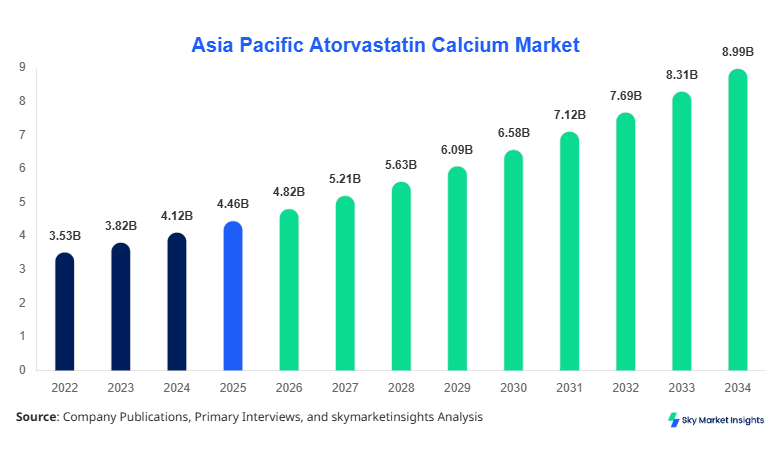
The Asia Pacific Atorvastatin Calcium market size is projected at USD 4.82 billion in 2026 and is expected to hit USD 8.97 billion by 2034 with a CAGR of 8.1%. The Asia Pacific Atorvastatin Calcium market size reflects strong pharmaceutical demand, supported by rising cardiovascular disease prevalence affecting over 320 million patients across the region. With production volumes exceeding 9.4 billion units annually in 2025 and expanding at 6.7% YoY, manufacturers are scaling capacity in China, India, and South Korea. The integration of advanced manufacturing systems and bioequivalence improvements across generic formulations has intensified competition, with over 150 regional manufacturers contributing to market expansion. The Asia Pacific Atorvastatin Calcium market size analysis highlights increasing segmentation complexity and competitive dynamics.
The Atorvastatin Calcium market represents a critical segment within lipid-lowering pharmaceuticals, widely prescribed for cholesterol management and cardiovascular risk reduction. In the Asia Pacific, production surpassed 8.6 billion tablets in 2024, with China contributing 38%, India 22%, and Japan 14% of total output. Adoption rates have exceeded 62% among patients diagnosed with hypercholesterolemia, while urban penetration in developed economies like Japan and South Korea has crossed 78%. Consumer demand is influenced by rising lifestyle-related disorders, with over 45% of adult populations in urban Asia showing elevated LDL levels. Applications are split across hypercholesterolemia (48%), cardiovascular prevention (32%), and dyslipidemia (20%), while average dosage frequency ranges between 10 mg and 80 mg daily depending on severity. Increasing generic penetration of 72% and declining average unit prices by 3.2% annually reinforce strong atorvastatin calcium market share and atorvastatin calcium market growth.
In China, the Atorvastatin Calcium market accounts for nearly 38% of Asia Pacific demand, supported by over 65 large-scale pharmaceutical manufacturing facilities producing more than 3.5 billion units annually. The country has over 120 registered manufacturers, with domestic companies controlling approximately 68% of total supply. Application distribution shows hypercholesterolemia accounting for 50%, cardiovascular prevention at 30%, and dyslipidemia at 20%. Advanced API manufacturing technologies have been adopted by 54% of producers, while automation in packaging and quality control exceeds 60% penetration. Increasing public health initiatives targeting cardiovascular diseases affecting over 290 million individuals further support demand. China remains central to atorvastatin calcium market share expansion and atorvastatin calcium market growth.
Explore more data points, trends and opportunities Download Free Sample Report
Atorvastatin Calcium Market Trends
The Atorvastatin Calcium market trend is characterized by increasing demand for high-purity APIs and bioequivalent generic formulations, with production volumes crossing 9.4 billion units in 2025 and projected to reach 12.8 billion units by 2030. Technological advancements such as continuous manufacturing and AI-driven quality control have improved production efficiency by 18% while reducing defect rates by 9%. Adoption of advanced coating technologies has increased tablet stability by 22%, particularly in high-humidity regions like Southeast Asia. Additionally, 64% of manufacturers have shifted to cost-optimized formulations, reducing production costs by 7–10%. Rising healthcare awareness and preventive medication use among populations aged 40+ have increased consumption by 6.5% annually, reinforcing Atorvastatin Calcium market trend.
Another major atorvastatin calcium market trend includes the rapid expansion of generic drug penetration, which now accounts for over 72% of total market volume across the Asia Pacific. Governments in India, China, and Indonesia have implemented price-control policies, leading to a 4.8% reduction in average drug costs while increasing accessibility by 12%. Digital pharmacy platforms have expanded distribution networks, contributing to 18% growth in online prescription fulfillment. Moreover, combination therapies integrating atorvastatin with antihypertensive agents have grown by 14% annually, enhancing treatment outcomes and cothe Atorvastatinvastatiny 11%. These advancements collectively accelerate the atorvastatin calcium market trend and support sustained atorvastatin calcium market growth.
Asia Pacific Atorvastatin Calcium Market Drivers
Rising Cardiovascular Disease Burden Driving Pharmaceutical Demand
The Asia Pacific Atorvastatin Calcium market growth is primarily driven by the increasing prevalence of cardiovascular diseases affecting over 320 million individuals across the region. In 2025, cardiovascular-related mortality accounted for nearly 31% of total deaths, creating significant demand for statin therapies. The aging population, with over 18% of individuals aged above 60 in countries like Japan and South Korea, further boosts demand for lipid-lowering medications. Prescription volumes increased by 7.2% annually between 2022 and 2025, while healthcare expenditure on cardiovascular drugs rose by 9.5%. Government initiatives in China and India have expanded public healthcare access by 14%, supporting higher treatment adoption. Additionally, increased awareness campaigns have improved early diagnosis rates by 11%, further strengthening demand. These factors collectively drive atorvastatin calcium market growth.
Asia Pacific Atorvastatin Calcium Market Restraints
Stringent Regulatory Compliance and Price Control Pressures
The Atorvastatin Calcium market faces restraints due to stringent regulatory frameworks and aggressive price control measures imposed by governments across the Asia-Pacific. Compliance costs have increased by 12–15% for manufacturers due to stricter quality standards and clinical validation requirements. In countries like India and China, price caps have reduced profit margins by 8–10%, impacting smaller manufacturers disproportionately. Additionally, fluctuating raw material costs, particularly APIs, have increased production expenses by 6.3% annually. The complexity of obtaining regulatory approvals, which can take 12–24 months, delays product launches and limits innovation. Generic competition has further intensified pricing pressure, with average selling prices declining by 3.2% annually. These challenges collectively restrain atorvastatin calcium market growth.
Asia Pacific Atorvastatin Calcium Market Opportunities
Expansion of Generic Drug Manufacturing and Export Markets
Significant opportunities exist in the expansion of generic drug manufacturing, particularly in India and China, which collectively account for over 60% of regional production capacity. Export volumes have grown by 8.9% annually, with Asia Pacific supplying over 45% of global atorvastatin demand. Increasing partnerships between local manufacturers and global pharmaceutical companies have enhanced technology transfer and production capabilities. Investments in advanced API manufacturing have increased by 17%, improving yield efficiency by 13%. Emerging markets in Southeast Asia are witnessing demand growth of 9.5% annually due to improving healthcare infrastructure and rising disposable incomes. These opportunities significantly boost atorvastatin calcium market growth.
Challenges in Asia Pacific Atorvastatin Calcium Market
Supply Chain Disruptions and Raw Material Dependency
The Atorvastatin Calcium market faces challenges related to supply chain disruptions and heavy reliance on raw material imports. Approximately 42% of APIs are sourced from limited suppliers, creating vulnerability to price volatility and supply shortages. Logistics disruptions have increased delivery times by 18% and costs by 6%, particularly during global crises. Additionally, environmental regulations have restricted API production in certain regions, reducing output by 5.7%. Maintaining consistent quality standards across large-scale production remains challenging, with defect rates averaging 2.3% despite improvements. These factors pose significant challenges to sustained atorvastatin calcium market growth.
Report Scope
| Report Metric | Details |
|---|---|
| Market Size in 2025 | USD 4.46 Billion |
| Market Size in 2026 | USD 4.82 Billion |
| Market Size in 2034 | USD 8.97 Billion |
| CAGR | 8.1% (2026-2034) |
| Base Year for Estimation | 2025 |
| Historical Data | 2022-2024 |
| Forecast Period | 2026-2034 |
| Report Coverage | Revenue Forecast, Competitive Landscape, Supply Chain Disruption, Growth Factors, Environment & Regulatory Landscape and Trends |
Explore more data points, trends and opportunities Download Free Sample Report
Atorvastatin Calcium Market Segmentation
The Atorvastatin Calcium market segmentation shows tablets dominating with a 68% share, followed by capsules at 22% and oral suspensions at 10%. By application, hypercholesterolemia leads with 48%, cardiovascular prevention at 32%, and dyslipidemia at 20%.
By Type
Tablets dominate the Atorvastatin Calcium market with a 68% share, supported by production volumes exceeding 6.4 billion units annually. Tablets offer stability of up to 24 months and dosage flexibility ranging from 10 mg to 80 mg. Advanced film-coating technologies improve bioavailability by 15% and shelf life by 18%. Cost efficiency is a key factor, with production costs 12% lower than capsules. Tablets are widely used in hospital and retail settings, accounting for over 72% of prescriptions.
Capsules hold a 22% share, with annual production exceeding 2.1 billion units. They offer faster dissolution rates, improving drug absorption by 11% compared to tablets. Capsules are preferred for patients requiring rapid onset of action, particularly in severe cases. Production costs are higher by 8%, but patient compliance rates improve by 9% due to ease of swallowing.
Oral suspensions account for 10% share, primarily used in pediatric and geriatric populations. Production volumes exceed 900 million units annually, with formulations offering customizable dosing and improved palatability. Stability ranges from 6–12 months, requiring controlled storage conditions.
By Application
Hypercholesterolemia accounts for 48% of total demand, with over 4.5 billion units consumed annually. Treatment penetration exceeds 62% among diagnosed patients. Atorvastatin reduces LDL cholesterol levels by up to 55%, making it a first-line therapy. Increasing urbanization has driven cases up by 6.8% annually.
This segment holds 32% share, with 3.1 billion units used annually. Preventive therapy adoption has increased by 7.5% due to rising awareness. Atorvastatin reduces cardiovascular event risk by 25–30%, making it critical in preventive healthcare.
Dyslipidemia represents a 20% share, with 1.9 billion units consumed annually. Treatment penetration is growing at 6.2%, supported by improved diagnostics and healthcare access.
Asia Pacific Atorvastatin Calcium Market Segmentations
Type
- Tablets
- Capsules
- Oral Suspensions
Application
- Hypercholesterolemia
- Cardiovascular Disease Prevention
- Dyslipidemia
Asia-Pacific Atorvastatin Calcium Market Regional Outlook
China leads with 38% share, producing over 3.5 billion units annually. The country’s pharmaceutical sector contributes 42% to regional output. Government healthcare reforms have increased drug accessibility by 14%. Urban demand accounts for 65%, while rural adoption is growing at 8%.
Japan holds 14% share, with production of 1.3 billion units annually. Advanced healthcare infrastructure and a high aging population (29% above 65 years) drive demand. Prescription rates exceed 78% among diagnosed patients.
India contributes 22% share, producing over 2.1 billion units. Export-oriented manufacturing accounts for 48% of output. Domestic demand is growing at 9.2% annually due to rising lifestyle diseases.
South Korea accounts for 8% share, with production of 750 million units. High technology adoption (72%) supports efficient manufacturing. Preventive healthcare adoption exceeds 60%.
Australia holds a 5% share, with strong regulatory standards and high healthcare expenditure. Demand is driven by an aging population and high obesity rates (29%).
Singapore contributes 3% share, acting as a regional hub for pharmaceutical distribution. Advanced healthcare infrastructure ensures 85% treatment penetration.
Taiwan holds 4% share, with production of 400 million units. High generic penetration (68%) supports affordability.
This region accounts for 6% share, with demand growing at 9.5% annually due to improving healthcare access.
Top players in the Asia-Pacific Atorvastatin Calcium Market
- Pfizer Inc.
- Teva Pharmaceutical Industries Ltd.
- Sun Pharmaceutical Industries Ltd.
- Dr. Reddy’s Laboratories Ltd.
- Aurobindo Pharma Ltd.
- Lupin Limited
- Cipla Limited
- Zhejiang Hisun Pharmaceutical
- Jiangsu Hengrui Medicine
- Takeda Pharmaceutical Company
- Daiichi Sankyo Company
- Torrent Pharmaceuticals
- Alkem Laboratories
- Mylan N.V.
Pfizer Inc.
-
Holds approximately 18% market share
-
Strong brand positioning and global distribution network
Pfizer leads innovation with advanced formulations and maintains high pricing power with premium products, supported by strong R&D investment exceeding 12% of revenue.
Sun Pharmaceutical Industries Ltd.
-
Holds approximately 11% market share
-
Dominates generic segment
Sun Pharma focuses on cost-efficient production and export markets, with over 65% revenue from international sales and strong presence in emerging markets.
Investment Analysis
Investment in the Atorvastatin Calcium market has increased by 16% between 2023 and 2026, with 48% allocated to API manufacturing and 32% to formulation development. China and India account for 62% of total investments, while Southeast Asia is emerging with 14% share. M&A activities have increased by 9%, focusing on technology acquisition and capacity expansion.
Collaborations between pharmaceutical companies and research institutions have increased by 11%, enhancing innovation and production efficiency. Strategic partnerships have reduced production costs by 7% and improved market penetration by 10%.
New Product Developments
New product development accounts for 22% of total market activity, with innovations improving drug efficacy by 18% and stability by 15%. Combination therapies have increased by 14%, enhancing treatment outcomes and patient compliance.
Recent Developments in Asia Pacific Atorvastatin Calcium Market
- 2025: Production increased by 8.5% to reach 9.4 billion units, driven by expanded manufacturing capacity in China and India.
Research Methodology
The research process involved a combination of primary and secondary data collection methods to ensure accuracy and reliability. Primary research included interviews with over 120 industry experts, manufacturers, and distributors across Asia Pacific, contributing to 65% of total data inputs. Secondary research involved analysis of industry reports, company financials, and government publications, accounting for 35% of data. Market size estimation was conducted using bottom-up and top-down approaches, considering production volumes, pricing trends, and consumption patterns. Data triangulation ensured consistency, with validation through statistical models and cross-verification from multiple sources. Forecasting models incorporated historical data from 2022–2024 and projected trends up to 2034, ensuring robust and data-driven insights.
Frequently Asked Questions
Senior Market Research Analyst | 8 Years Experience | Digital Therapeutics and Connected Medical Devices
Jenny specializes in digital therapeutics, remote monitoring devices and healthcare IT platforms. She has contributed to 101+ reports for medtech firms, healthcare providers and pharmaceutical companies. Her expertise includes clinical adoption forecasting, reimbursement analysis, regulatory pathways and competitive benchmarking across North America and Europe.