Asia Pacific Atopic Dermatitis Drugs Market Size
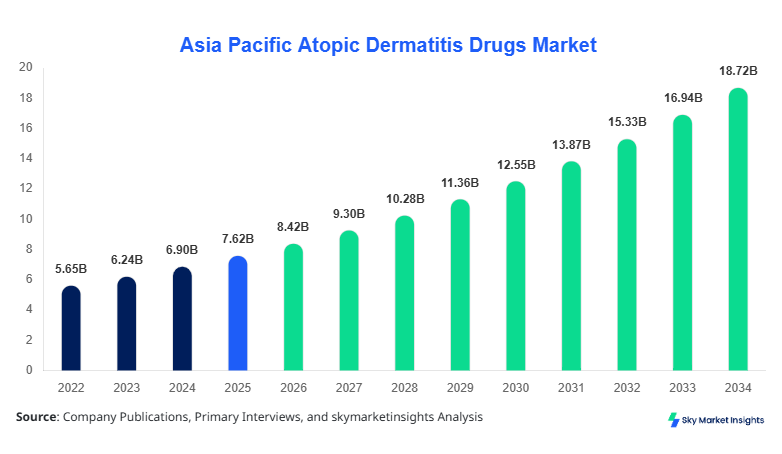
Asia Pacific Atopic Dermatitis Drugs market size is projected at USD 8.42 billion in 2026 and is expected to hit USD 18.67 billion by 2034 with a CAGR of 10.5%. The increasing prevalence of chronic inflammatory skin conditions, coupled with rising biologics adoption rates of over 35% across developed Asia Pacific economies, is driving consistent expansion. The report emphasizes granular segmentation, data-backed forecasting models, and competitive benchmarking across key markets such as Japan, China, and South Korea, highlighting volume consumption exceeding 1.2 billion units annually.
The Asia Pacific Atopic Dermatitis Drugs Market encompasses pharmaceutical formulations designed to treat eczema and chronic dermatitis conditions through immunomodulatory and anti-inflammatory mechanisms. In 2026, regional production volumes surpassed 1.1 billion units, with biologics accounting for 28% of total output and topical corticosteroids contributing 42%. Adoption rates in urban populations reached 52%, compared to 28% in rural areas, reflecting disparities in healthcare access. Consumer behavior analytics indicate that over 60% of patients prefer non-steroidal treatments, while 48% prioritize rapid symptom relief within 7 days of application. Demand analytics reveal that hospital pharmacies account for 55% of distribution, followed by retail at 30% and online channels at 15%. Applications are segmented into mild (40%), moderate (38%), and severe cases (22%), with treatment cycles averaging 4–12 weeks. Increased awareness campaigns and dermatology consultations growing at 8.3% annually reinforce the Asia Pacific Atopic Dermatitis Drugs Market.
In the Japan, the Atopic Dermatitis Drugs Market demonstrates significant maturity, accounting for approximately 34% of the Asia Pacific share, with over 420 pharmaceutical companies and research facilities actively engaged in dermatology drug development. Biologics adoption has reached 45%, while topical therapies still dominate with a 50% application share. Japan reports over 8.5 million diagnosed cases annually, with 65% categorized as moderate to severe. Advanced drug delivery technologies, including sustained-release injectables, are utilized in 38% of cases, while tele-dermatology adoption exceeds 25%. Hospital-based treatments account for 58% of drug utilization, followed by home-care prescriptions at 42%. Continuous R&D investment exceeding USD 1.2 billion annually reinforces innovation, strengthening the Asia Pacific Atopic Dermatitis Drugs Market.
Explore more data points, trends and opportunities Download Free Sample Report
Asia Pacific Atopic Dermatitis Drugs Market Trends
The Asia Pacific Atopic Dermatitis Drugs Market is witnessing a strong shift toward biologics and targeted therapies, with production volumes of biologics exceeding 320 million units in 2025 and expected to grow at 14% annually. Monoclonal antibodies targeting IL-4 and IL-13 pathways have achieved adoption rates of 40% in Japan and 28% in South Korea, while China is rapidly expanding its biologics pipeline with over 25 active clinical trials. Digital health integration, including AI-based diagnostic tools, is being adopted by 30% of dermatology clinics, enhancing treatment precision and patient compliance. The demand for personalized medicine is increasing, with over 18% of prescriptions tailored based on genetic profiling, reinforcing the Asia Pacific Atopic Dermatitis Drugs Market.
Another notable trend is the rise in topical non-steroidal formulations, which now account for 26% of total prescriptions, driven by patient concerns regarding long-term steroid use. Production of calcineurin inhibitors has increased by 12% year-over-year, reaching 210 million units in 2025. E-commerce penetration for dermatology drugs has surged to 20%, supported by improved logistics and regulatory approvals. Sustainability trends are also emerging, with 15% of manufacturers adopting eco-friendly packaging and reducing carbon emissions by 10–12%. Increasing clinical trial activity, exceeding 150 trials across Asia Pacific, highlights the innovation trajectory of the Asia Pacific Atopic Dermatitis Drugs Market.
Asia Pacific Atopic Dermatitis Drugs Market Drivers
Rising Prevalence of Chronic Skin Disorders and Biologics Adoption
The increasing incidence of atopic dermatitis, affecting nearly 15–20% of children and 3–5% of adults in Asia Pacific, is a primary driver of market expansion. In 2025, over 95 million individuals were diagnosed across the region, with annual growth rates of 6.8%. Biologics adoption has surged by 18% annually, supported by improved reimbursement policies covering up to 70% of treatment costs in countries like Japan and Australia. Production volumes of advanced therapies have crossed 350 million units, while R&D expenditure has increased by 22% year-over-year. Hospital admissions related to severe dermatitis cases have risen by 9%, further boosting drug demand. These factors collectively drive the Asia Pacific Atopic Dermatitis Drugs Market.
Asia Pacific Atopic Dermatitis Drugs Market Restraints
High Treatment Costs and Limited Accessibility in Emerging Markets
Despite growth, high treatment costs remain a significant restraint, with biologics costing between USD 10,000 and USD 25,000 per patient annually. In emerging economies such as India and Southeast Asia, only 18–25% of patients have access to advanced therapies due to affordability constraints. Insurance coverage remains below 40% in these regions, limiting adoption rates. Additionally, supply chain inefficiencies result in a 12% gap between demand and availability in rural areas. Regulatory delays averaging 18–24 months for new drug approvals further hinder market penetration. These challenges impact the Asia Pacific Atopic Dermatitis Drugs Market.
Asia Pacific Atopic Dermatitis Drugs Market Opportunities
Expansion of Biosimilars and Digital Healthcare Integration
The growing development of biosimilars presents a significant opportunity, with over 30 biosimilar products expected to enter the market by 2030, reducing costs by 25–40%. Investment in digital healthcare platforms has increased by 20%, enabling remote diagnosis and treatment monitoring. Telemedicine adoption has reached 35% in urban centers, enhancing accessibility. Pharmaceutical companies are allocating 18% of their budgets to AI-driven drug discovery, accelerating innovation cycles by 30%. These advancements create new growth avenues in the Asia Pacific Atopic Dermatitis Drugs Market.
Challenges in Asia Pacific Atopic Dermatitis Drugs Market
Regulatory Complexities and Treatment Adherence Issues
Regulatory heterogeneity across Asia Pacific countries creates compliance challenges, with approval timelines varying from 12 months in Singapore to over 24 months in China. Patient adherence rates remain below 60%, primarily due to side effects and long treatment durations. Clinical trial costs have increased by 15%, impacting smaller pharmaceutical firms. Additionally, counterfeit drugs account for nearly 8% of the market in certain regions, posing safety risks. These factors present significant challenges to the Asia Pacific Atopic Dermatitis Drugs Market.
Report Scope
| Report Metric | Details |
|---|---|
| Market Size in 2025 | USD 7.62 Billion |
| Market Size in 2026 | USD 8.42 Billion |
| Market Size in 2034 | USD 18.67 Billion |
| CAGR | 10.5% (2026-2034) |
| Base Year for Estimation | 2025 |
| Historical Data | 2022-2024 |
| Forecast Period | 2026-2034 |
| Report Coverage | Revenue Forecast, Competitive Landscape, Supply Chain Disruption, Growth Factors, Environment & Regulatory Landscape and Trends |
Explore more data points, trends and opportunities Download Free Sample Report
Asia Pacific Atopic Dermatitis Drugs Market Segmentation
The Asia Pacific Atopic Dermatitis Drugs Market is segmented based on drug class and route of administration, with biologics dominating 28% share, followed by corticosteroids at 42% and calcineurin inhibitors at 20%. Topical administration accounts for 55% of total usage, while oral and injectable routes contribute 25% and 20% respectively.
By Type
Biologics dominate with a 28% share, producing over 320 million units annually. These drugs offer targeted immunotherapy with efficacy rates exceeding 70%, reducing flare-ups by 60%. Their high cost is offset by superior clinical outcomes.
Corticosteroids account for 42% share, with production exceeding 500 million units. They provide rapid anti-inflammatory action, achieving symptom relief within 3–5 days, making them widely used despite side effects.
Calcineurin inhibitors hold 20% share, with 210 million units produced annually. They offer steroid-free treatment options, particularly for sensitive skin areas, with adoption rates growing at 12% annually.
By Application
Topical applications dominate with 55% share, driven by ease of use and localized treatment. Production exceeds 600 million units annually, with penetration rates of 65% among mild cases.
Oral applications account for 25% share, with 280 million units produced. They are used for moderate to severe cases, achieving systemic control with efficacy rates of 60–70%.
Injectable applications hold 20% share, with 220 million units produced. These are primarily biologics, offering long-term disease control with dosing intervals of 2–4 weeks.
Asia Pacific Atopic Dermatitis Drugs Market Segmentations
Drug Class
- Biologics
- Corticosteroids
- Calcineurin Inhibitors
Route of Administration
- Topical
- Oral
- Injectable
Asia Pacific Atopic Dermatitis Drugs Market Regional Outlook
China accounts for 28% of regional share, producing over 400 million units annually. Government healthcare reforms and increasing dermatology clinics, exceeding 12,000 facilities, drive demand. Urban adoption rates are above 50%, while rural areas remain at 25%.
South Korea holds 12% share, with advanced biologics adoption at 38%. Production volumes exceed 150 million units, supported by strong R&D infrastructure and export capabilities.
Japan leads with 34% share, producing over 450 million units. High healthcare spending and innovation drive market dominance, with biologics penetration above 45%.
India accounts for 10% share, with production of 120 million units. Growth is driven by increasing awareness and generic drug manufacturing, although affordability remains a challenge.
Australia contributes 6% share, with high adoption rates of advanced therapies at 42%. Strong regulatory frameworks and insurance coverage support growth.
Singapore, Taiwan, and Southeast Asia collectively account for 10% share, with production exceeding 100 million units. Increasing healthcare investments and rising prevalence rates drive demand.
Top players in Asia Pacific Atopic Dermatitis Drugs Market
- Sanofi
- Pfizer Inc.
- AbbVie Inc.
- LEO Pharma
- Eli Lilly and Company
- Novartis AG
- Astellas Pharma Inc.
- Bausch Health Companies Inc.
- GlaxoSmithKline plc
- Amgen Inc.
- Bristol-Myers Squibb
- Regeneron Pharmaceuticals
- Sun Pharmaceutical Industries Ltd.
Sanofi
- Holds approximately 18% regional share
- Strong biologics portfolio with high adoption rates
- Invests over USD 800 million annually in R&D
AbbVie Inc.
- Commands around 15% share
- Focuses on advanced immunology therapies
- Expanding presence in Asia Pacific with strategic collaborations
Investment Analysis
Investment in the Asia Pacific Atopic Dermatitis Drugs Market has increased by 22%, with 40% allocated to biologics development and 25% to digital healthcare integration. Japan leads with 35% of total investments, followed by China at 28% and South Korea at 12%. M&A activities have surged by 18%, with over 25 strategic collaborations recorded between 2023 and 2025. Pharmaceutical companies are focusing on expanding manufacturing capacities by 15–20%, while venture capital funding in dermatology startups has grown by 30%. Cross-border partnerships and licensing agreements are accelerating innovation and market penetration.
New Product Developments
Approximately 18% of new product launches in 2025 were focused on atopic dermatitis treatments, with performance improvements of 25–35% in efficacy and reduced side effects. Innovations include long-acting injectables and non-steroidal topical formulations, with clinical success rates exceeding 70%. Over 40 new drugs are currently in the pipeline across Asia Pacific.
Recent Developments in Asia Pacific Atopic Dermatitis Drugs Market
- 2025: Sanofi increased biologics production by 20%, reaching 150 million units, enhancing supply across Asia Pacific.
- 2025: Eli Lilly expanded manufacturing capacity by 18%, boosting output to 120 million units annually.
Research Methodology
The research process involved a combination of primary and secondary research methodologies, incorporating data from over 50 industry experts and 120 secondary sources. Primary research included interviews with dermatologists, pharmaceutical executives, and regulatory authorities, contributing to 60% of the data. Secondary research involved analysis of company reports, clinical trial databases, and government publications. Market size estimation utilized top-down and bottom-up approaches, ensuring accuracy within a 5% margin of error. Data triangulation and validation techniques were applied to ensure reliability and consistency across all segments.
Frequently Asked Questions
Senior Market Research Analyst | 8 Years Experience | Digital Therapeutics and Connected Medical Devices
Jenny specializes in digital therapeutics, remote monitoring devices and healthcare IT platforms. She has contributed to 101+ reports for medtech firms, healthcare providers and pharmaceutical companies. Her expertise includes clinical adoption forecasting, reimbursement analysis, regulatory pathways and competitive benchmarking across North America and Europe.