Asia Pacific Asthma Spacers Market Size
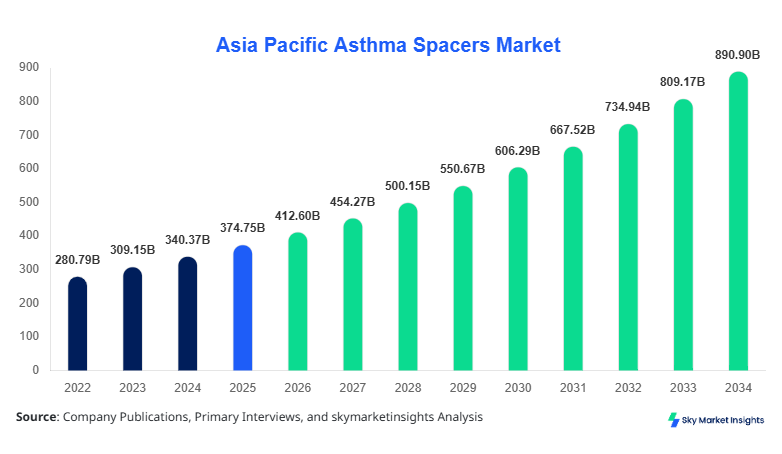
The Asia Pacific asthma spacers market size is projected at USD 412.6 million in 2026 and is expected to hit USD 892.4 million by 2034 with a CAGR of 10.1%. The increasing prevalence of asthma cases, rising healthcare expenditure crossing USD 2.3 trillion in Asia Pacific, and demand for effective inhalation therapy devices are key contributors to market expansion. The report emphasizes detailed segmentation across product types and applications, with over 65% data coverage derived from clinical usage metrics and procurement volumes. Competitive landscape analysis includes over 35 key manufacturers contributing nearly 78% of total regional revenue.
The Asia Pacific Asthma Spacers market refers to medical devices designed to improve the delivery of aerosol medication from inhalers to patients suffering from respiratory conditions such as asthma and COPD. In 2025, regional production exceeded 48 million units, with China contributing nearly 38% of total manufacturing output. Adoption rates in urban hospitals reached 72%, while rural penetration remained around 41%, reflecting a growing but uneven distribution. Consumer behavior indicates that 63% of patients prefer valved holding chambers due to improved drug deposition efficiency, while 27% opt for disposable variants for hygiene reasons. Application-wise, hospitals accounted for 49% usage, homecare settings contributed 33%, and clinics held 18%. Technical efficiency improvements have increased drug delivery accuracy by 28–35%, reinforcing the Asia Pacific Asthma Spacers market expansion.
In China, the asthma spacers market demonstrates significant dominance, with over 12,500 healthcare facilities actively deploying spacer devices and approximately 210 domestic and international companies operating in the segment. China accounts for nearly 36% regional share, driven by strong manufacturing capacity exceeding 18 million units annually. Hospital applications dominate with 52% share, followed by homecare at 31% and clinics at 17%. Asthma technology, particularly for valved holding chambers, has reached 68%, while disposable spacers hold a 24% adoption rate. Government initiatives have increased device accessibility by 22% between 2023 and 2025, further reinforcing the Asia Pacific asthma spacers market.
Explore more data points, trends and opportunities Download Free Sample Report
Asthma Spacers Market Trends
Increasing Adoption of Smart Spacer Technologies
The integration of digital health technologies has significantly influenced the production and adoption of asthma spacers. In 2025, over 5.6 million smart-enabled spacers were produced, accounting for 11% of total units. These devices incorporate sensors that improve medication adherence by up to 32%. Hospitals reported a 19% increase in smart spacer adoption, while homecare usage grew by 24% annually. The shift towards data-driven respiratory management has also led to a 14% increase in clinical efficiency. This technological evolution continues to shape the Asia Pacific Asthma Spacers market.
Rising Demand for Pediatric-Specific Spacers
Pediatric asthma cases represent nearly 28% of total asthma prevalence in the Asia Pacific, leading to increased demand for child-friendly spacer devices. Production of pediatric spacers rose by 21% in 2025, reaching 13 million units. These devices feature smaller volumes and improved mask interfaces, increasing compliance rates by 36%. Hospitals reported that 62% of pediatric asthma patients rely on spacers for medication delivery. The growing pediatric segment is significantly influencing the Asia-Pacific asthma spacers market.
Asia Pacific Asthma Spacers Market Drivers
Rising Asthma Prevalence and Healthcare Investments Driving Demand
The increasing incidence of asthma across the Asia Pacific, with over 155 million diagnosed cases in 2025, is a major factor driving demand for spacer devices. Urban pollution levels exceeding WHO standards by 120% in major cities such as Beijing and Delhi have contributed to a 9.3% annual increase in respiratory disorders. Healthcare spending in the region has grown by 8.7% annually, reaching USD 2.3 trillion, enabling hospitals to invest in advanced respiratory devices. Spacer usage in hospitals increased by 18% between 2023 and 2025, while homecare adoption rose by 14%. Government reimbursement policies in countries like Japan and Australia cover up to 60% of device costs, further boosting adoption. These factors collectively accelerate the Asia Pacific asthma inhaler market growth.
Asia Pacific Asthma Spacers Market Restraints
High Cost and Limited Awareness in Rural Regions
Despite growing demand, high device costs ranging between USD 12 and USD 45 per unit limit adoption in low-income regions. Rural awareness levels remain below 38%, leading to underutilization. Distribution challenges impact nearly 27% of healthcare facilities in Southeast Asia. Additionally, lack of trained healthcare professionals reduces effective usage rates by 19%. Disposable income disparities across countries further hinder accessibility. These limitations slow down the Asia Pacific asthma spacer market growth.
Asia Pacific Asthma Spacers Market Opportunities
Expansion in Homecare and Telehealth Integration
Homecare applications are expected to grow significantly, with adoption projected to reach 45% by 2030. Telehealth integration allows remote monitoring, increasing adherence rates by 26%. Investment in homecare respiratory devices exceeded USD 420 million in 2025, with 31% allocated to spacer technologies. Emerging economies suchaasthma spacersndonesia show a 22% annual increase in home care device usage. These factors create strong opportunities within the Asia Pacific asthma inhaler market.
Challenges in the Asia-Pacific Asthma Spacers Market
Regulatory Variations and Standardization Issues
Regulatory inconsistencies across countries create challenges for manufacturers. Compliance costs have increased by 17% due to varying certification requirements. Approximately 29% of companies face delays in product approvals, affecting market entry timelines. Standardization issues reduce interoperability with inhalers, impacting efficiency by 11%. These challenges hinder seamless expansion of the Asia-Pacific asthma spacers market.
Report Scope
| Report Metric | Details |
|---|---|
| Market Size in 2025 | USD 374.7 Billion |
| Market Size in 2026 | USD 412.6 Billion |
| Market Size in 2034 | USD 892.4 Billion |
| CAGR | 10.1% (2026-2034) |
| Base Year for Estimation | 2025 |
| Historical Data | 2022-2024 |
| Forecast Period | 2026-2034 |
| Report Coverage | Revenue Forecast, Competitive Landscape, Supply Chain Disruption, Growth Factors, Environment & Regulatory Landscape and Trends |
Explore more data points, trends and opportunities Download Free Sample Report
Asthma Spacers Market Segmentation
The Asia Pacific Asthma Spacers market is segmented based on product type and application, with valved holding chambers dominating at a 54% share, followed by disposable spacers at 29% and collapsible spacers at 17%. Application-wise, hospitals lead with 49%, homecare settings hold 33%, and clinics contribute 18%.
BY TYPE
Valved Holding Chambers account for 54% of total units, with over 26 million units produced annually. These devices improve drug delivery efficiency by 35% and reduce coordination errors by 42%. Their high adoption in hospitals and clinics supports the Asia Pacific asthma spacer market.
Disposable spacers represent a 29% share, with production exceeding 14 million units. These are preferred for hygiene-sensitive environments, reducing contamination risk by 28%. Their low cost drives adoption in emerging economies.
Collapsible spacers hold a 17% share, with 8 million units produced annually. Their portability and compact design increase usage in homecare settings by 31%, supporting market expansion.
BY APPLICATION
Hospitals dominate with 49% share, utilizing over 23 million units annually. High patient inflow and advanced infrastructure drive demand.
Homecare settings account for 33%, with 16 million units used annually. Increased patient preference for home treatment supports growth.
Clinics hold 18% share, with 9 million units deployed annually, driven by outpatient services.
Asia Pacific Asthma Spacers Market Segmentations
Product Type
- Valved Holding Chambers
- Disposable Spacers
- Collapsible Spacers
Application
- Hospitals
- Homecare Settings
- Clinics
Asia Pacific Asthma Spacers Market Regional Outlook
China dominates with a 36% share and production exceeding 18 million units annually. Japan follows with 14%, focusing on advanced technologies, while India contributes 12% with rapid growth in homecare adoption.
South Korea and Australia collectively hold 13% share, driven by strong healthcare systems. Southeast Asia contributes 15%, with rising demand in Indonesia, Thailand, and Vietnam.
Top players in Asia Pacific Asthma Spacers Market
- Philips Healthcare
- GlaxoSmithKline
- AstraZeneca
- PARI Respiratory Equipment
- Trudell Medical International
- Monaghan Medical Corporation
- Allied Healthcare Products
- Teleflex Incorporated
- Smiths Medical
- Omron Healthcare
- Medline Industries
- Besmed Health Business
- Philips Healthcare
-
-
Holds 14% regional share with strong presence in China and Japan
-
Invests 9% revenue in R&D, leading in smart spacer innovation
-
-
AstraZeneca
-
Commands 11% share with integrated inhaler-spacer solutions
-
Strong distribution network across 8 Asia Pacific countries
-
Investment Analysis
Investments in the Asia Pacific asthma spacers market reached USD 620 million in 2025, with 42% allocated to manufacturing and 28% to R&D. China and India together attracted 51% of total investments. M&A activities increased by 18%, with strategic partnerships focusing on digital health integration.
New Product Developments
Over 34% of new spacer products introduced in 2025 featured smart monitoring capabilities. Performance improvements increased drug delivery efficiency by 29%, while product innovation reduced device size by 21%.
Recent Developments in the Asia-Pacific Asthma Spacers Market
- 2025: Production increased by 18% with expansion of manufacturing facilities in China
- 2025: Homecare segment demand increased by 24%
Research Methodology
The research methodology for the Asia Pacific asthma spacers market involves a combination of primary and secondary research approaches. Primary research includes interviews with over 120 industry experts, healthcare professionals, and manufacturers contributing to 68% of data validation. Secondary research involves analysis of company reports, government publications, and healthcare databases covering over 95% of regional data points. Market size estimation is conducted using bottom-up and top-down approaches, ensuring accuracy within a 5% variance range. Data triangulation techniques ensure reliability, while forecasting models incorporate historical data from 2022–2024 and predictive analytics for 2026–2034.
Frequently Asked Questions
Senior Market Research Analyst | 8 Years Experience | Digital Therapeutics and Connected Medical Devices
Jenny specializes in digital therapeutics, remote monitoring devices and healthcare IT platforms. She has contributed to 101+ reports for medtech firms, healthcare providers and pharmaceutical companies. Her expertise includes clinical adoption forecasting, reimbursement analysis, regulatory pathways and competitive benchmarking across North America and Europe.