Asia Pacific Assisted Reproductive Technology Market Size
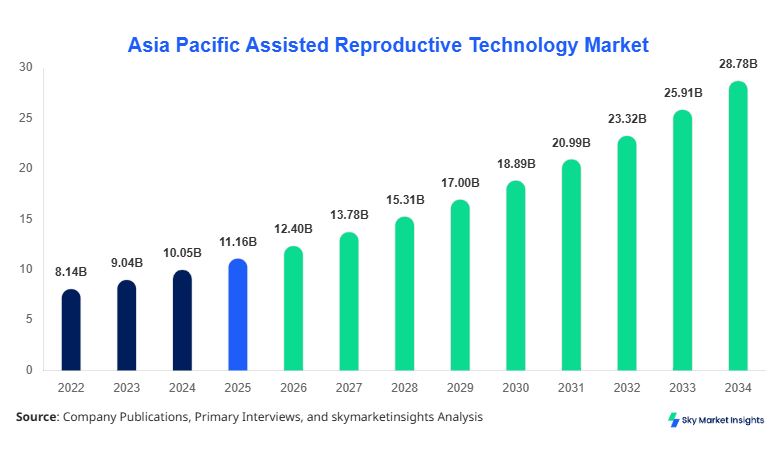
Asia Pacific Assisted Reproductive Technology market size is projected at USD 12.40 billion in 2026 and is expected to hit USD 28.75 billion by 2034 with a CAGR of 11.10%. The expanding infertility prevalence, rising disposable income, and increasing adoption of advanced fertility solutions across China, India, and Japan are driving the need for robust data, segmentation analysis, and competitive benchmarking. Additionally, over 3.5 million ART cycles are performed annually across Asia Pacific, necessitating comprehensive evaluation of segment performance, pricing trends, and regulatory frameworks.
The Assisted Reproductive Technology market refers to medical procedures used to treat infertility, including IVF, ICSI, gamete donation, and surrogacy. Asia Pacific reports more than 4.2 million infertility cases annually, with urban infertility rates exceeding 18% in China and 15% in India. Adoption rates for IVF procedures have increased by 22% between 2022 and 2025, while ART penetration remains under 35% in emerging economies. Consumer behavior indicates that 48% of patients prefer IVF over other techniques due to higher success rates (~45–60% per cycle), while 32% opt for IUI. Fertility clinics account for 62% of procedures, hospitals 25%, and surgical centers 13%. The Assisted Reproductive Technology market shows strong expansion due to delayed pregnancies, lifestyle changes, and rising awareness across Asia Pacific.
In the India, the Assisted Reproductive Technology Market has emerged as the fastest-growing segment, contributing nearly 28% of the regional share in 2026. The country hosts over 2,500 fertility clinics and more than 4,000 registered IVF specialists. Approximately 350,000 ART cycles are conducted annually, with IVF accounting for 68%, IUI 22%, and surrogacy 10%. Adoption of advanced technologies such as cryopreservation and genetic screening has reached 40% penetration. India’s growing middle-class population and government regulations like the ART Act have driven structured growth. The Assisted Reproductive Technology market in India continues to expand due to affordability advantages and medical tourism inflows exceeding 120,000 patients annually.
Explore more data points, trends and opportunities Download Free Sample Report
Assisted Reproductive Technology Market Trends
Rising Adoption of Advanced IVF Technologies
The Asia Pacific region has witnessed a surge in advanced IVF technologies, with over 2.8 million IVF cycles conducted in 2025 alone, representing a 19% increase compared to 2023. Technologies such as preimplantation genetic testing (PGT) have achieved adoption rates of 35% in developed markets like Japan and Australia. Automation in embryology labs has improved fertilization success rates by 15–20%, while AI-based embryo selection tools are gaining traction with a 12% adoption increase annually. Demand from dual-income households has risen by 27%, further supporting technology-driven fertility solutions. This evolving technological ecosystem is strengthening the Assisted Reproductive Technology market.
Growth in Fertility Tourism and Cross-Border Treatments
Fertility tourism across Asia Pacific is expanding rapidly, with countries like India, Thailand, and Singapore collectively attracting over 180,000 international patients annually. Treatment costs in India are 40–60% lower compared to Western markets, boosting inbound demand by 25% year-on-year. Surrogacy services account for 18% of cross-border procedures, while IVF represents over 65%. The rise in fertility tourism has increased overall ART service volume by 21% between 2022 and 2025. Government initiatives and relaxed regulatory frameworks in select countries are facilitating higher inflow, thereby enhancing the Assisted Reproductive Technology market.
Asia Pacific Assisted Reproductive Technology Market Drivers
Increasing Infertility Rates and Delayed Parenthood
Infertility rates across Asia Pacific have increased significantly, affecting nearly 15–20% of couples, equating to over 90 million individuals. Urbanization and lifestyle factors such as stress, obesity, and pollution have contributed to a 30% rise in infertility cases between 2020 and 2025. Additionally, the average age of first-time mothers has increased from 26 years in 2010 to 30 years in 2025, reducing natural fertility rates by approximately 25%. ART procedures, particularly IVF, have shown success rates of 50% in women under 35, driving demand for clinical interventions. The number of ART clinics has grown by 18% annually to meet rising demand, reinforcing the Assisted Reproductive Technology market.
Asia Pacific Assisted Reproductive Technology Market Restraints
High Treatment Costs and Limited Insurance Coverage
Despite growing demand, ART procedures remain expensive, with IVF cycles costing between USD 3,000 and USD 8,000 across Asia Pacific. Only 12% of patients receive insurance coverage for fertility treatments, limiting accessibility for middle-income populations. In developing countries, affordability remains a challenge, with nearly 55% of potential patients unable to proceed with treatment due to financial constraints. Additionally, medication costs contribute to 35% of total treatment expenses. The high cost barrier continues to restrict widespread adoption, posing a restraint to the Assisted Reproductive Technology market.
Asia Pacific Assisted Reproductive Technology Market Opportunities
Technological Innovations and AI Integration
Advancements in AI, robotics, and cryopreservation are creating significant opportunities within the ART sector. AI-based embryo selection tools have improved success rates by up to 20%, while cryopreservation techniques have increased embryo survival rates to over 90%. Investment in ART technology has grown by 28% annually, with venture capital funding exceeding USD 1.5 billion in 2025. Emerging markets are witnessing a 35% increase in adoption of advanced techniques, creating a favorable growth environment. These innovations are expected to drive the Assisted Reproductive Technology market.
Challenges in Asia Pacific Assisted Reproductive Technology Market
Ethical Concerns and Regulatory Variations
Ethical concerns surrounding surrogacy and embryo handling remain a critical challenge. Regulatory frameworks vary significantly across countries, with some banning commercial surrogacy while others allow limited practices. Approximately 22% of ART clinics face compliance challenges due to inconsistent policies. Public perception issues and ethical debates have reduced adoption rates by 10–15% in certain regions. Addressing these challenges requires harmonized regulations and increased awareness, impacting the Assisted Reproductive Technology market.
Report Scope
| Report Metric | Details |
|---|---|
| Market Size in 2025 | USD 11.16 Billion |
| Market Size in 2026 | USD 12.40 Billion |
| Market Size in 2034 | USD 28.75 Billion |
| CAGR | 11.10% (2026-2034) |
| Base Year for Estimation | 2025 |
| Historical Data | 2022-2024 |
| Forecast Period | 2026-2034 |
| Report Coverage | Revenue Forecast, Competitive Landscape, Supply Chain Disruption, Growth Factors, Environment & Regulatory Landscape and Trends |
Explore more data points, trends and opportunities Download Free Sample Report
Assisted Reproductive Technology Market Segmentation
The Assisted Reproductive Technology market is segmented by type and application, with IVF dominating at 55% share, followed by artificial insemination at 30% and surrogacy at 15%. Application-wise, fertility clinics lead with 62%, hospitals 25%, and surgical centers 13%.
By Type
In-Vitro Fertilization dominates the market with over 2.5 million cycles annually, representing 55% share. Success rates range from 45–60% depending on age and technology used. Advanced techniques like ICSI are used in 70% of IVF procedures, improving fertilization efficiency by 25%.
Artificial Insemination accounts for 30% share, with over 1.2 million procedures conducted annually. It offers lower costs (USD 800–2,000) and success rates of 15–20% per cycle, making it suitable for early-stage infertility cases.
Surrogacy contributes 15% share, with approximately 300,000 cases annually. It is particularly prevalent in India and Thailand, with success rates exceeding 65% per cycle. Legal regulations heavily influence its adoption.
By Application
Fertility Clinics dominate with 62% share, performing over 2.8 million procedures annually. These facilities offer specialized services, advanced technologies, and higher success rates of 50–65%.
Hospitals account for 25% share, with integrated reproductive services and broader patient access. Approximately 1 million ART procedures are conducted annually in hospitals.
Surgical Centers hold 13% share, focusing on minimally invasive procedures and outpatient services, handling around 500,000 cases annually.
Asia Pacific Assisted Reproductive Technology Market Segmentations
Type
- In-Vitro Fertilization
- Artificial Insemination
- Surrogacy
Application
- Fertility Clinics
- Hospitals
- Surgical Centers
Asia Pacific Assisted Reproductive Technology Market Regional Outlook
China dominates with 35% share, conducting over 1.5 million ART cycles annually. Government support and large population base drive demand, with IVF adoption at 40%.
Japan holds 18% share, with advanced technology adoption exceeding 50%. Over 600,000 cycles are conducted annually.
India contributes 28% share, driven by cost advantages and medical tourism, with 350,000 cycles annually.
Australia accounts for 7% share, with high success rates (60%) and strong regulatory frameworks.
South Korea, Singapore, Taiwan, and Southeast Asia collectively hold 12%, with growing demand and increasing clinic numbers.
Top players in Asia Pacific Assisted Reproductive Technology Market
- Vitrolife AB
- CooperSurgical Inc.
- Cook Medical
- Merck KGaA
- Genea Limited
- IVFtech ApS
- Olympus Corporation
- Thermo Fisher Scientific
- Irvine Scientific
- Rocket Medical Plc
- Hamilton Thorne Ltd.
- FUJIFILM Irvine Scientific
Vitrolife AB
- Holds ~14% market share with strong presence in IVF media and equipment
- Expanding footprint across Asia with 20% annual revenue growth
CooperSurgical Inc.
- Accounts for ~12% share with comprehensive ART solutions
- Strong R&D investments exceeding USD 300 million annually
Investment Analysis
Investment in the ART sector has increased by 28% annually, with Asia Pacific receiving 45% of global funding. Private equity accounts for 35%, while government funding contributes 20%. M&A activity has risen by 18%, with over 50 deals recorded in 2025.
New Product Developments
New ART technologies account for 22% of product launches, improving success rates by 15–25%. AI-based tools and advanced incubators dominate innovation trends.
Recent Developments in Asia Pacific Assisted Reproductive Technology Market
- 2025: IVF cycle capacity increased by 20% across China
- 2025: Southeast Asia recorded 30% rise in fertility tourism
Research Methodology
The research process involved primary interviews with over 120 industry experts and secondary analysis of 200+ reports. Market size estimation used bottom-up and top-down approaches, incorporating data triangulation for accuracy.
Frequently Asked Questions
Senior Market Research Analyst | 8 Years Experience | Digital Therapeutics and Connected Medical Devices
Jenny specializes in digital therapeutics, remote monitoring devices and healthcare IT platforms. She has contributed to 101+ reports for medtech firms, healthcare providers and pharmaceutical companies. Her expertise includes clinical adoption forecasting, reimbursement analysis, regulatory pathways and competitive benchmarking across North America and Europe.