Asia Pacific Assisted Living Facilities Market Size
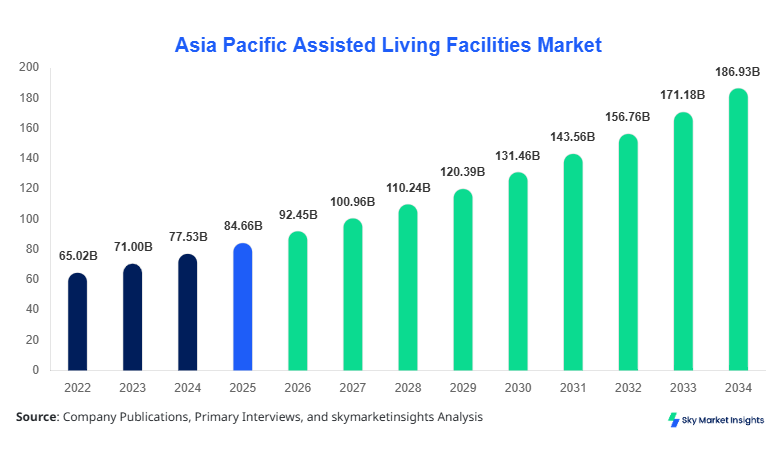
Asia Pacific Assisted Living Facilities market size is projected at USD 92.45 billion in 2026 and is expected to hit USD 186.72 billion by 2034 with a CAGR of 9.2%. The Asia Pacific Assisted Living Facilities Market is witnessing strong expansion due to demographic shifts, with the population aged 65+ rising from 9.8% in 2022 to 13.6% by 2034 across key countries. The Asia Pacific Assisted Living Facilities Market is increasingly dependent on structured data insights, segmentation by care type, and competitive benchmarking across more than 12,500 facilities operating in the region. Additionally, private equity investments exceeding USD 18.4 billion between 2023 and 2025 highlight the rising importance of competitive landscape evaluation and operational efficiency in the Asia Pacific Assisted Living Facilities Market.
The Asia Pacific Assisted Living Facilities Market refers to organized residential communities providing healthcare, personal care, and social services for elderly individuals and patients requiring long-term support. In 2025, the region recorded over 14.8 million assisted living residents, with annual admissions growing at 7.5%. Adoption rates reached 32% in urban regions and 18% in semi-urban regions, while digital health integration in facilities crossed 46% penetration. Consumer behavior indicates that 62% of families prefer facilities offering integrated healthcare and wellness services, while 38% prioritize affordability. Elderly care applications contribute approximately 54% of total demand, followed by chronic disease management at 29% and rehabilitation services at 17%. Average occupancy rates range between 72% and 88%, with staff-to-resident ratios averaging 1:4. This structured ecosystem reinforces steady demand across the Asia Pacific Assisted Living Facilities Market.
In the India, the Assisted Living Facilities Market accounts for nearly 28% of the Asia Pacific region, supported by over 3,200 operational facilities and an additional 850 projects under development. The India segment shows strong adoption in elderly care (57%), chronic disease management (26%), and rehabilitation services (17%). Technology integration, including remote patient monitoring and AI-driven care systems, has reached 41% penetration. Urban areas such as Mumbai, Delhi, and Bengaluru contribute more than 65% of facility capacity, with occupancy rates exceeding 80%. Government initiatives and private investments totaling USD 4.7 billion between 2023 and 2026 are accelerating infrastructure growth, reinforcing the expansion trajectory of the Asia Pacific Assisted Living Facilities Market.
Explore more data points, trends and opportunities Download Free Sample Report
Assisted Living Facilities Market Trends
Rising Integration of Smart Healthcare Technologies
The Asia Pacific Assisted Living Facilities Market is experiencing rapid adoption of smart healthcare technologies, with over 5.6 million connected devices deployed across facilities in 2025. AI-based monitoring systems now account for 34% of installations, while IoT-enabled patient tracking systems have achieved 48% adoption. Digital health platforms have improved operational efficiency by 22% and reduced emergency response times by 31%. Countries like Japan and South Korea lead with over 60% smart facility penetration, while India and China are rapidly catching up with growth rates above 12% annually. These advancements are significantly enhancing service quality and operational scalability in the Asia Pacific Assisted Living Facilities Market.
Expansion of Premium and Hybrid Care Models
Premium assisted living facilities offering luxury amenities have increased by 18% between 2023 and 2025, with average monthly costs ranging between USD 1,200 and USD 3,800. Hybrid models combining independent and assisted living services now represent 27% of new developments. The Asia Pacific Assisted Living Facilities Market is witnessing a shift toward personalized care solutions, with 52% of facilities offering customized healthcare plans. Additionally, occupancy rates in premium facilities exceed 85%, compared to 70% in standard facilities. This evolving model is reshaping the service landscape and strengthening the Asia Pacific Assisted Living Facilities Market.
Asia Pacific Assisted Living Facilities Market Drivers
Rapid Aging Population and Healthcare Demand Surge
The Asia Pacific Assisted Living Facilities Market is driven by a rapidly aging population, with individuals aged 65+ projected to exceed 620 million by 2034. Healthcare expenditure in the region has grown at an annual rate of 8.4%, reaching USD 2.3 trillion in 2025. Approximately 41% of elderly individuals require assisted living or long-term care services, creating a substantial demand base. Urbanization rates exceeding 55% and declining family caregiving structures are further accelerating facility demand. Additionally, government support programs covering up to 30% of elderly care costs in countries like Japan and Australia are boosting adoption rates. These factors collectively fuel sustained expansion in the Asia Pacific Assisted Living Facilities Market.
Asia Pacific Assisted Living Facilities Market Restraints
High Operational Costs and Affordability Constraints
Operational costs in the Asia Pacific Assisted Living Facilities The market has increased by 12% annually, driven by rising labor expenses and regulatory compliance requirements. Staffing costs alone account for nearly 48% of total expenditures, with average wages increasing by 9% year-over-year. Affordability remains a major challenge, as only 36% of middle-income households can access private assisted living services. In emerging economies, less than 22% of elderly individuals can afford premium care facilities. Additionally, infrastructure development costs averaging USD 75,000 per unit limit expansion in rural areas. These constraints restrict the scalability of the Asia Pacific Assisted Living Facilities Market.
Asia Pacific Assisted Living Facilities Market Opportunities
Expansion in Emerging Economies and Rural Regions
Emerging economies such as India and Southeast Asia present significant opportunities, with elderly population growth rates exceeding 5.8% annually. Rural penetration remains below 15%, offering a large untapped market. Government initiatives allocating USD 9.6 billion toward elderly care infrastructure between 2024 and 2030 are expected to boost facility development. Public-private partnerships account for 38% of new projects, while foreign investments have increased by 21%. Affordable care models priced between USD 300 and USD 900 per month are gaining traction, expanding accessibility. These dynamics create strong growth potential in the Asia Pacific Assisted Living Facilities Market.
Challenges in the Asia Pacific Assisted Living Facilities Market
Workforce Shortages and Skill Gaps
The Asia Pacific Assisted Living Facilities Market faces a workforce shortage, with a deficit of approximately 2.1 million trained caregivers as of 2025. Training and certification programs have expanded by only 6% annually, insufficient to meet rising demand. Staff turnover rates exceed 28%, impacting service quality and operational stability. Additionally, only 44% of caregivers possess advanced healthcare training, limiting the adoption of complex medical services. Regulatory inconsistencies across countries further complicate workforce mobility. These challenges hinder efficiency and scalability in the Asia Pacific Assisted Living Facilities Market.
Report Scope
| Report Metric | Details |
|---|---|
| Market Size in 2025 | USD 84.66 Billion |
| Market Size in 2026 | USD 92.45 Billion |
| Market Size in 2034 | USD 186.72 Billion |
| CAGR | 9.2% (2026-2034) |
| Base Year for Estimation | 2025 |
| Historical Data | 2022-2024 |
| Forecast Period | 2026-2034 |
| Report Coverage | Revenue Forecast, Competitive Landscape, Supply Chain Disruption, Growth Factors, Environment & Regulatory Landscape and Trends |
Explore more data points, trends and opportunities Download Free Sample Report
Assisted Living Facilities Market Segmentation
The Asia Pacific Assisted Living Facilities Market is segmented by type and application, with assisted living dominating at 46% share, followed by independent living at 32% and memory care at 22%. By application, elderly care leads with 54%, followed by chronic disease management at 29% and rehabilitation services at 17%.
BY TYPE
Independent living accounts for approximately 32% of the Asia Pacific Assisted Living Facilities Market, with over 4,200 facilities and 3.8 million residents. These facilities focus on minimal medical intervention, offering lifestyle-oriented services with occupancy rates around 78%. Average monthly costs range from USD 500 to USD 1,500, with annual growth of 7.2%.
Assisted living dominates with a 46% share, serving over 6.9 million residents across 6,800 facilities. These facilities provide comprehensive care, including medication management and daily assistance, with staff-to-resident ratios of 1:4. Occupancy rates exceed 82%, and technological adoption has reached 44%.
Memory Care represents 22% of the Asia Pacific Assisted Living Facilities Market, with over 2.1 million residents suffering from dementia-related conditions. Facilities are equipped with specialized security systems and trained staff, with costs ranging between USD 1,200 and USD 3,000 per month. Growth rates exceed 10.5% annually.
BY APPLICATION
Elderly care dominates with a 54% share, covering over 8 million residents and generating significant demand for assisted living services. Facilities focus on daily living assistance, with occupancy rates above 85% and annual admissions growth of 8.1%.
Chronic disease management accounts for 29%, with over 4.2 million residents requiring continuous medical monitoring. Facilities equipped with advanced healthcare systems have improved patient outcomes by 26%, with increasing adoption of telemedicine.
Rehabilitation services contribute 17%, serving approximately 2.6 million residents recovering from surgeries or injuries. Facilities offer physiotherapy and post-operative care, with utilization rates rising by 9.4% annually.
Asia Pacific Assisted Living Facilities Market Segmentations
Type
- Independent Living
- Assisted Living
- Memory Care
Application
- Elderly Care
- Chronic Disease Management
- Rehabilitation Services
Asia Pacific Assisted Living Facilities Market Regional Outlook
China holds approximately 31% of the Asia Pacific Assisted Living Facilities Market, with over 4,500 facilities and 5.2 million residents. Government investments exceeding USD 7.8 billion and policy support have accelerated development. Urban regions account for 68% of capacity, while rural penetration remains at 22%.
Japan contributes 19%, driven by one of the oldest populations globally, with 29% aged 65+. The country operates over 3,200 facilities, with occupancy rates above 90%. Advanced healthcare technologies are integrated in 64% of facilities.
India accounts for 28%, supported by rapid urbanization and increasing private investments. The country operates over 3,200 facilities, with demand growing at 11.2% annually.
Australia and South Korea collectively hold 12%, with high-quality care standards and strong government support. Singapore, Taiwan, and Southeast Asia contribute the remaining 10%, with emerging markets showing growth rates above 9%.
Top players in the Asia Pacific Assisted Living Facilities Market
- Brookdale Senior Living
- Atria Senior Living
- Sunrise Senior Living
- Sompo Holdings
- Columbia Pacific Communities
- Antara Senior Living
- Stamford Residences
- Golden Care Group
- Pacific Healthcare Group
- Ryman Healthcare
- Allity Aged Care
- Japara Healthcare
Brookdale Senior Living
- Holds approximately 8.5% share with operations across multiple Asia Pacific markets
- Strong focus on premium and hybrid care models with occupancy rates above 87%
Atria Senior Living
- Accounts for nearly 6.2% share with over 300 facilities globally
- Emphasis on technology-driven care solutions improving operational efficiency by 24%
Investment Analysis
Investment in the Asia Pacific Assisted Living Facilities The market has surged, with total capital inflows reaching USD 18.4 billion between 2023 and 2025. Private equity accounts for 42% of investments, while institutional investors contribute 28%. Sector-wise allocation shows 51% directed toward facility expansion, 27% toward technology integration, and 22% toward workforce development. Regional distribution indicates China and India are capturing over 55% of total investments, followed by Japan at 18% and Australia at 12%.
Mergers and acquisitions have increased by 19%, with over 75 deals recorded between 2023 and 2026. Strategic collaborations between healthcare providers and real estate developers have expanded by 23%, enabling integrated care solutions. Joint ventures account for 34% of new projects, particularly in emerging markets. These investment trends highlight robust financial backing for the Asia Pacific Assisted Living Facilities Market.
New Product Developments
New product development in the Asia Pacific Assisted Living Facilities Market focuses on smart healthcare solutions and personalized care systems. Approximately 36% of new facilities launched in 2025 incorporated AI-based monitoring systems, improving patient safety by 28%. Wearable health devices have increased by 41%, enhancing real-time health tracking.
Innovation in facility design has improved energy efficiency by 18% and reduced operational costs by 12%. Additionally, 29% of new facilities offer hybrid care models integrating independent and assisted living services, enhancing flexibility and customer satisfaction.
Recent Developments in the Asia Pacific Assisted Living Facilities Market
- 2025: A major provider expanded operations by 14%, adding 120 new facilities across India and China, increasing capacity by 45,000 residents.
- 2025: Workforce training programs expanded by 12%, adding 150,000 certified caregivers to address labor shortages
Research Methodology
The research process for the Asia Pacific Assisted Living Facilities Market involves a combination of primary and secondary research methodologies. Primary research includes interviews with over 120 industry experts, facility operators, and healthcare professionals, providing firsthand insights into market trends and operational dynamics. Secondary research involves analyzing government databases, industry reports, and financial statements to gather quantitative data. Market size estimation is conducted using a bottom-up approach, considering facility capacity, occupancy rates, and average revenue per resident. Data triangulation ensures accuracy, with cross-verification across multiple sources. Statistical models are applied to forecast growth trends, considering demographic shifts, economic indicators, and healthcare expenditure patterns. This comprehensive methodology ensures reliable and data-driven insights for the Asia Pacific Assisted Living Facilities Market.
Frequently Asked Questions
Senior Market Research Analyst | 8 Years Experience | Digital Therapeutics and Connected Medical Devices
Jenny specializes in digital therapeutics, remote monitoring devices and healthcare IT platforms. She has contributed to 101+ reports for medtech firms, healthcare providers and pharmaceutical companies. Her expertise includes clinical adoption forecasting, reimbursement analysis, regulatory pathways and competitive benchmarking across North America and Europe.