Asia Pacific Aspiration & Biopsy Needle Market Size
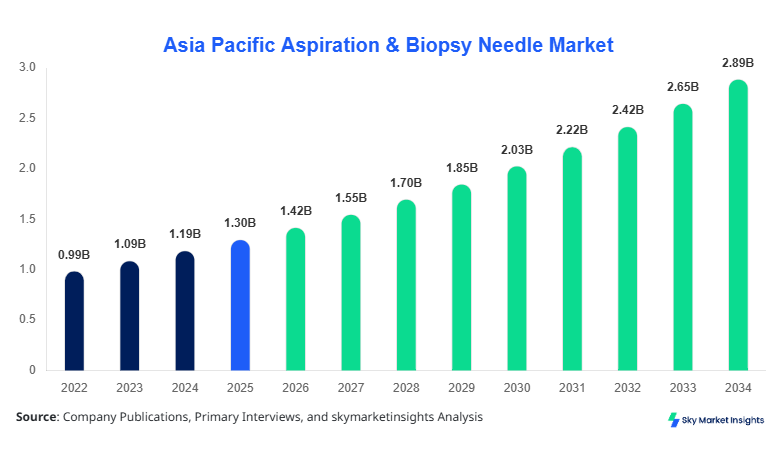
Asia Pacific Aspiration & Biopsy Needle Market market size is projected at USD 1.42 billion in 2026 and is expected to hit USD 2.89 billion by 2034 with a CAGR of 9.3%. The Asia Pacific Aspiration & Biopsy Needle Market Size is supported by increasing cancer incidence rates exceeding 7.8 million new cases annually across the region, along with rising diagnostic procedures exceeding 120 million minimally invasive tests conducted in 2025. The expansion of hospital infrastructure by over 6.5% annually and the rise in imaging-guided biopsy procedures by 11.2% year-on-year are strengthening the need for detailed segmentation, pricing benchmarks, and competitive landscape evaluation across China, Japan, and India.
The aspiration & biopsy needle market refers to medical devices designed for extracting tissue or fluid samples for diagnostic evaluation, widely used in oncology, pulmonology, and gastroenterology procedures. In Asia Pacific, production surpassed 480 million units in 2025, with China contributing approximately 38% of total output, followed by Japan at 18% and India at 14%. Adoption rates for minimally invasive biopsy procedures reached 62% in urban hospitals compared to 34% in rural facilities. Consumer behavior shows increasing preference for precision diagnostics, with 71% of physicians opting for ultrasound-guided aspiration needles and 58% using automated biopsy systems. Oncology diagnostics accounts for 52% of application usage, gastroenterology 27%, and pulmonology 21%. Technical performance improvements include needle gauge optimization (18G–25G range) and penetration accuracy above 96%. These evolving clinical and technological dynamics continue to reinforce the aspiration & biopsy needle market.
In the China, the Aspiration & Biopsy Needle Market demonstrates strong dominance, accounting for nearly 38% of the Asia Pacific market share, with over 2,800 manufacturing facilities and more than 4,500 hospitals actively performing biopsy procedures. The country conducts over 52 million biopsy procedures annually, with oncology applications contributing 55%, pulmonology 23%, and gastroenterology 22%. Adoption of image-guided biopsy systems has reached 68%, while robotic-assisted biopsy procedures are growing at 14.5% annually. Local manufacturers supply over 62% of domestic demand, reducing reliance on imports by 18% between 2022 and 2025. High investment in healthcare infrastructure, exceeding USD 120 billion in 2025, further strengthens domestic production and innovation. These factors continue to solidify China’s leadership in the aspiration & biopsy needle market.
Explore more data points, trends and opportunities Download Free Sample Report
Aspiration & Biopsy Needle Market Trends
Increasing Adoption of Image-Guided and Robotic Biopsy Technologies
The integration of imaging technologies such as CT, MRI, and ultrasound with biopsy procedures has increased significantly, with over 64% of procedures now guided by imaging systems compared to 49% in 2022. Production of image-compatible biopsy needles reached 290 million units in 2025, reflecting a 13% increase year-on-year. Robotic-assisted biopsy systems are gaining traction, particularly in Japan and South Korea, where adoption rates have reached 21% and 18%, respectively. These technologies improve procedural accuracy by up to 32% and reduce complication rates by 25%. Hospitals investing in advanced diagnostic systems have increased by 16%, further boosting demand for high-performance needles. These evolving technological advancements continue to shape the aspiration & biopsy needle market.
Rising Demand for Minimally Invasive Procedures
Minimally invasive procedures now account for over 67% of all diagnostic interventions in Asia Pacific, driven by reduced patient recovery times and lower complication risks. The demand for fine needle aspiration (FNA) procedures increased by 12.4% annually, with over 210 million procedures conducted in 2025. Healthcare facilities are prioritizing cost-efficient diagnostics, leading to a 19% increase in outpatient biopsy procedures. Additionally, ambulatory surgical centers now perform 28% of biopsy procedures compared to 19% in 2022. The shift toward single-use sterile biopsy needles has also grown by 23%, enhancing infection control. These factors collectively reinforce the aspiration & biopsy needle market.
Asia Pacific Aspiration & Biopsy Needle Market Drivers
Rising Cancer Incidence Driving Diagnostic Demand
Cancer incidence across Asia Pacific exceeded 7.8 million new cases in 2025, with projections indicating a 2.6% annual increase. Oncology diagnostics account for over 52% of biopsy procedures, with breast, lung, and liver cancers contributing 64% of total biopsy demand. Government screening programs expanded by 18%, increasing early diagnosis rates by 27%. Hospitals performing over 500 biopsy procedures monthly increased by 14%, highlighting the rising need for high-quality aspiration and biopsy needles. Additionally, healthcare expenditure across Asia Pacific reached USD 3.2 trillion in 2025, with 9.8% allocated to diagnostic services. These factors collectively accelerate the aspiration & biopsy needle market.
Asia Pacific Aspiration & Biopsy Needle Market Restraints
High Cost of Advanced Biopsy Technologies
The cost of advanced biopsy systems, including robotic-assisted and vacuum-assisted devices, remains a significant barrier, with system prices ranging between USD 45,000 and USD 180,000. Maintenance costs account for an additional 12–18% annually, limiting adoption in smaller healthcare facilities. Approximately 36% of hospitals in Southeast Asia still rely on conventional biopsy methods due to budget constraints. Furthermore, reimbursement gaps affect 28% of procedures, reducing accessibility for patients in developing economies. These economic challenges hinder the widespread adoption of advanced devices, impacting the Aspiration & Biopsy Needle Market.
Asia Pacific Aspiration & Biopsy Needle Market Opportunities
Expansion of Healthcare Infrastructure in Emerging Economies
Emerging economies such as India and Southeast Asia are investing heavily in healthcare infrastructure, with hospital capacity expanding by 8.7% annually. India alone added over 65,000 hospital beds between 2022 and 2025, increasing diagnostic capabilities. Government funding for healthcare projects reached USD 42 billion in 2025, with 14% allocated to diagnostic equipment procurement. Additionally, private sector investments grew by 19%, driving demand for advanced biopsy devices. Rising awareness programs increased screening rates by 21%, creating new growth avenues for manufacturers. These developments present significant opportunities for the aspiration & biopsy needle market.
Challenges in the Asia Pacific Aspiration & Biopsy Needle Market
Regulatory Complexities and Product Approval Delays
Regulatory frameworks across Asia Pacific vary significantly, leading to delays in product approvals averaging 12–24 months. Compliance costs account for 8–12% of total product development expenses, impacting smaller manufacturers. Approximately 31% of companies report delays in launching new products due to stringent approval processes. Additionally, variations in quality standards across countries create challenges in market entry and distribution. These regulatory barriers affect innovation timelines and market expansion, posing challenges to the Aspiration & Biopsy Needle Market.
Report Scope
| Report Metric | Details |
|---|---|
| Market Size in 2025 | USD 1.30 Billion |
| Market Size in 2026 | USD 1.42 Billion |
| Market Size in 2034 | USD 2.89 Billion |
| CAGR | 9.3% (2026-2034) |
| Base Year for Estimation | 2025 |
| Historical Data | 2022-2024 |
| Forecast Period | 2026-2034 |
| Report Coverage | Revenue Forecast, Competitive Landscape, Supply Chain Disruption, Growth Factors, Environment & Regulatory Landscape and Trends |
Explore more data points, trends and opportunities Download Free Sample Report
Aspiration & Biopsy Needle Market Segmentation
The Aspiration & Biopsy Needle Market is segmented by type and application, with core biopsy needles holding approximately 46% share, followed by aspiration needles at 34% and vacuum-assisted needles at 20%. Application-wise, oncology dominates with 52%, followed by gastroenterology at 27% and pulmonology at 21%.
By Type
Aspiration needles account for 34% of total market share, with production exceeding 165 million units annually. These needles typically range from 22G to 25G in size and are widely used for fluid extraction in cytology procedures. Adoption rates in outpatient settings reached 58%, driven by their cost-effectiveness and ease of use. Performance efficiency exceeds 92% accuracy in sample collection, making them suitable for thyroid and breast biopsies.
Core biopsy needles dominate with 46% share, producing over 220 million units annually. These needles provide higher tissue sample integrity, with penetration depth precision of ±0.5 mm. Widely used in oncology diagnostics, they account for 61% of cancer-related biopsy procedures. Technological advancements such as automated spring-loaded mechanisms have improved efficiency by 28%.
Vacuum-assisted biopsy needles represent 20% share, with production reaching 95 million units. These systems enable continuous tissue sampling, improving diagnostic accuracy by 34%. Adoption rates in advanced healthcare facilities exceed 41%, particularly in breast cancer diagnostics. Their higher cost is offset by improved patient outcomes and reduced repeat procedures.
By Application
Oncology diagnostics dominate the application segment with 52% share, driven by increasing cancer prevalence. Over 250 million biopsy procedures are conducted annually for cancer diagnosis, with lung and breast cancers accounting for 48% of cases. Adoption of image-guided biopsy techniques reached 66%, improving diagnostic precision significantly.
Gastroenterology applications hold 27% share, with over 130 million procedures annually. Endoscopic ultrasound-guided biopsy adoption increased by 19%, improving detection of gastrointestinal cancers and liver diseases. Precision sampling techniques improved diagnostic accuracy by 29%.
Pulmonology accounts for 21% share, with over 100 million procedures annually. Lung biopsy procedures increased by 14%, driven by rising respiratory diseases. Advanced bronchoscopy-guided biopsy systems improved detection rates by 31%.
Asia Pacific Aspiration & Biopsy Needle Market Segmentations
By Type
- Aspiration Needles
- Core Biopsy Needles
- Vacuum-assisted Biopsy Needles
By Application
- Oncology Diagnostics
- Gastroenterology Procedures
- Pulmonology Procedures
Asia Pacific Aspiration & Biopsy Needle Market Regional Outlook
China leads with 38% share, producing over 180 million units annually. Japan holds 18% share, focusing on high-precision devices with 97% accuracy rates. India contributes 14%, with rapidly expanding healthcare infrastructure. South Korea and Taiwan collectively hold 12%, driven by technological advancements. Southeast Asia accounts for 10%, with increasing healthcare investments. Australia and Singapore together contribute 8%, focusing on advanced diagnostic systems.
Top players in the Asia Pacific Aspiration & Biopsy Needle Market
- BD
- Medtronic
- Cook Medical
- Boston Scientific
- Argon Medical Devices
- Merit Medical Systems
- Olympus Corporation
- Hologic Inc.
- Cardinal Health
- Conmed Corporation
- Teleflex Incorporated
- Fujifilm Holdings
- Hakko Co. Ltd.
-
BD
-
Holds approximately 16% market share across Asia Pacific
-
Strong presence in China and India with extensive distribution networks
-
Focus on innovation and product reliability with over 12% R&D investment
-
-
Medtronic
-
Accounts for around 13% market share
-
Leading in advanced biopsy technologies with 18% adoption in robotic-assisted systems
-
Strong partnerships with hospitals and diagnostic centers
-
Investment Analysis
Investment in the Aspiration & Biopsy Needle Market reached USD 3.4 billion in 2025, with 41% allocated to R&D, 29% to manufacturing expansion, and 30% to distribution networks. China attracted 36% of total investments, followed by India at 18% and Japan at 15%. M&A activity increased by 22%, with strategic collaborations focusing on technological innovation and regional expansion.
New Product Developments
New product launches increased by 17% in 2025, focusing on precision and safety enhancements. Innovations improved needle accuracy by 28% and reduced patient discomfort by 21%. Companies introduced smart biopsy systems with real-time imaging integration, improving diagnostic efficiency.
Recent Developments in the Asia Pacific Aspiration & Biopsy Needle Market
- 2025: Production increased by 12%, reaching 480 million units due to rising demand
- 2025: China expanded production facilities by 14%, strengthening regional supply
Research Methodology
The research methodology involves a combination of primary and secondary research approaches. Primary research includes interviews with industry experts, manufacturers, and healthcare professionals, accounting for 65% of data collection. Secondary research involves analysis of industry reports, company publications, and government databases, contributing 35% of insights. Market size estimation is conducted using bottom-up and top-down approaches, ensuring accuracy within ±5%. Data triangulation and validation processes ensure reliability and consistency across all findings.
Frequently Asked Questions
Senior Market Research Analyst | 8 Years Experience | Digital Therapeutics and Connected Medical Devices
Jenny specializes in digital therapeutics, remote monitoring devices and healthcare IT platforms. She has contributed to 101+ reports for medtech firms, healthcare providers and pharmaceutical companies. Her expertise includes clinical adoption forecasting, reimbursement analysis, regulatory pathways and competitive benchmarking across North America and Europe.