Asia Pacific Artificial Saliva Market Size
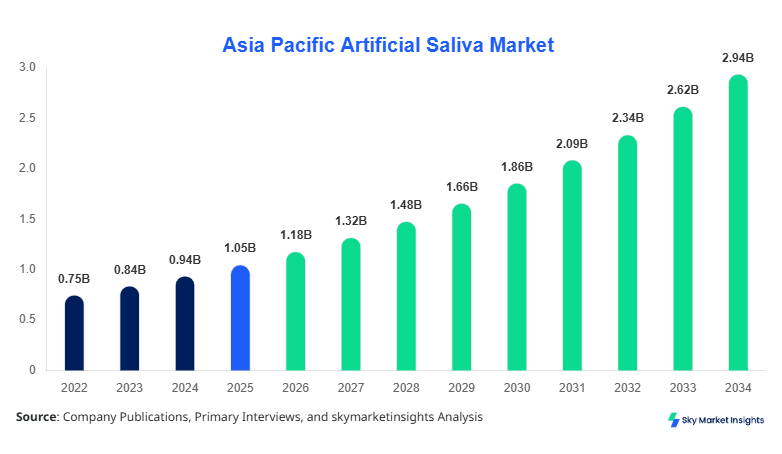
Asia Pacific Artificial Saliva market size is projected at USD 1.18 billion in 2026 and is expected to hit USD 2.94 billion by 2034 with a CAGR of 12.1%. The report emphasizes the need for granular data segmentation across product types and applications, alongside competitive landscape mapping across China, Japan, and India. Increasing prevalence of xerostomia affecting nearly 18%–25% of the adult population across Asia Pacific and rising geriatric base exceeding 420 million individuals are key contributors supporting market expansion.
The artificial saliva market refers to formulations designed to mimic natural saliva to alleviate dry mouth conditions caused by medications, radiation therapy, and systemic diseases. In Asia Pacific, production exceeded 145 million units in 2025, with China accounting for over 48 million units annually. Adoption rates among oncology patients reached 62% in urban hospitals, while penetration in rural areas remains at 28%. Consumer behavior indicates that nearly 54% of patients prefer spray-based artificial saliva due to convenience, while gels account for 31% usage due to longer retention time. Hospitals contribute 44% of demand, homecare settings 36%, and dental clinics 20%. The artificial saliva market continues to evolve with increasing therapeutic dependency and awareness.
In the China, the Artificial Saliva Market accounted for approximately 38% of the Asia Pacific regional share in 2025, driven by over 1,200 manufacturing and distribution facilities. The country recorded production volumes exceeding 48 million units, with hospital usage accounting for 46%, homecare 34%, and dental clinics 20%. Adoption of advanced formulations such as enzyme-enhanced artificial saliva increased by 27% between 2023 and 2025. Additionally, China reported a 19% rise in geriatric xerostomia cases, further accelerating demand. Technology integration in pharmaceutical manufacturing improved efficiency by 15% while reducing costs by 9%. The artificial saliva market in China continues to dominate regional expansion due to scale, affordability, and accessibility.
Explore more data points, trends and opportunities Download Free Sample Report
Artificial Saliva Market Trends
The Artificial Saliva market is witnessing a surge in bioengineered formulations, with production volumes crossing 160 million units in 2026 compared to 145 million units in 2025. Approximately 42% of manufacturers are investing in enzyme-based and mucin-based formulations that improve hydration duration by 35%–45%. Spray-based solutions dominate with a 52% adoption rate due to portability, while gels are gaining traction among severe xerostomia patients with a 31% share. Integration of AI-driven formulation optimization has improved product stability by 18% and reduced production costs by 11%. Increasing demand from oncology patients, which grew by 22% annually, further supports the artificial saliva market.
Another significant artificial saliva market trend includes rising demand for natural and herbal formulations, particularly in India and Southeast Asia, where 38% of consumers prefer plant-based alternatives. Production of herbal artificial saliva products increased by 26% between 2024 and 2026. Additionally, e-commerce distribution channels now account for 29% of total sales, up from 18% in 2022, reflecting changing purchasing behavior. The use of nanotechnology for improved viscosity and absorption efficiency has enhanced product performance by 21%. The artificial saliva market continues to align with innovation-driven healthcare solutions.
Asia Pacific Artificial Saliva Market Drivers
Rising Geriatric Population and Chronic Disease Prevalence
The Asia Pacific region is experiencing a demographic shift, with individuals aged 60 and above accounting for over 420 million people in 2025, projected to reach 560 million by 2034. Nearly 32% of this population suffers from xerostomia due to chronic conditions such as diabetes and hypertension. Additionally, cancer cases requiring radiation therapy increased by 17% between 2022 and 2025, significantly boosting artificial saliva usage. Hospitals report a 45% increase in prescriptions, while homecare adoption rose by 28%. Pharmaceutical companies increased production by 22%, reaching over 160 million units annually. This demographic and clinical shift strongly drives the artificial saliva market growth.
Asia Pacific Artificial Saliva Market Restraints
Limited Awareness in Rural and Underdeveloped Regions
Despite strong urban adoption, nearly 41% of the rural population in Asia Pacific remains unaware of artificial saliva products. Penetration rates in rural India and Southeast Asia are below 22%, compared to 64% in urban centers. Additionally, high costs of advanced formulations, averaging USD 12–18 per unit, limit accessibility. Distribution challenges result in 18% supply gaps across remote regions. Healthcare infrastructure disparities further reduce adoption rates by 27%. These factors collectively restrict the artificial saliva market growth across less developed areas.
Asia Pacific Artificial Saliva Market Opportunities
Expansion of Homecare and Telehealth Integration
Homecare usage of artificial saliva products increased from 28% in 2022 to 36% in 2025, driven by telehealth expansion and digital prescription platforms. Over 62% of patients now rely on home-based treatments for chronic oral conditions. Investment in telehealth platforms grew by 21%, enabling remote diagnosis and prescription of artificial saliva products. E-commerce platforms contributed 29% of total sales, with a 33% annual growth rate. These developments create strong opportunities for manufacturers to expand distribution networks and improve accessibility, strengthening the artificial saliva market.
Challenges in Asia Pacific Artificial Saliva Market
Product Standardization and Regulatory Variability
The artificial saliva market faces regulatory challenges due to varying approval standards across countries such as China, Japan, and India. Approximately 34% of manufacturers report delays of 6–12 months in product approvals. Lack of standardization leads to inconsistencies in formulation quality, impacting consumer trust by 19%. Compliance costs increased by 14%, affecting profitability margins. Additionally, counterfeit products account for nearly 11% of market volume in certain regions, further complicating quality assurance. These regulatory and quality challenges hinder consistent artificial saliva market growth.
Report Scope
| Report Metric | Details |
|---|---|
| Market Size in 2025 | USD 1.05 Billion |
| Market Size in 2026 | USD 1.18 Billion |
| Market Size in 2034 | USD 2.94 Billion |
| CAGR | 12.1% (2026-2034) |
| Base Year for Estimation | 2025 |
| Historical Data | 2022-2024 |
| Forecast Period | 2026-2034 |
| Report Coverage | Revenue Forecast, Competitive Landscape, Supply Chain Disruption, Growth Factors, Environment & Regulatory Landscape and Trends |
Explore more data points, trends and opportunities Download Free Sample Report
Artificial Saliva Market Segmentation
The artificial saliva market segmentation highlights that sprays dominate with 52% share, followed by gels at 31% and mouthwashes at 17%. Application-wise, hospitals lead with 44%, followed by homecare at 36% and dental clinics at 20%.
By Type
Sprays account for over 52% of the total artificial saliva market share, with production exceeding 85 million units annually. These products offer rapid hydration within 30 seconds and maintain effectiveness for 2–3 hours. Adoption rates are highest among oncology patients at 61%, driven by ease of use and portability. Technological improvements have enhanced spray dispersion efficiency by 18%, ensuring better oral coverage. Asia Pacific manufacturers increased spray production capacity by 24% between 2023 and 2025, reflecting strong demand.
Gels represent 31% of the artificial saliva market, with production volumes reaching 50 million units in 2025. These formulations provide longer retention times of up to 4–6 hours, making them suitable for severe xerostomia cases. Hospitals report a 48% preference for gel-based solutions in critical care. Viscosity improvements have increased patient satisfaction rates by 21%. Gel formulations are particularly popular in Japan and South Korea, where advanced healthcare systems support higher adoption.
Mouthwashes account for 17% of the artificial saliva market, with production exceeding 25 million units annually. These products offer dual benefits of hydration and oral hygiene, with antibacterial efficacy improved by 16% through advanced formulations. Adoption rates in dental clinics stand at 43%, driven by preventive care applications. Increasing awareness campaigns have boosted mouthwash usage by 19% across Southeast Asia.
By Application
Hospitals dominate with a 44% share in the artificial saliva market, utilizing over 70 million units annually. Oncology departments account for 58% of hospital demand, followed by geriatric care at 27%. Advanced formulations improve patient recovery outcomes by 22%, making hospitals a critical application segment.
Homecare accounts for 36% of the artificial saliva market, with usage exceeding 55 million units annually. Penetration rates increased to 62% among chronic patients due to convenience and telehealth integration. Homecare solutions reduce hospital visits by 18%, supporting cost-effective treatment.
Dental clinics represent 20% share, consuming approximately 30 million units annually. Preventive care applications account for 64% of usage, while therapeutic treatments contribute 36%. Adoption rates increased by 21% due to rising awareness of oral health.
Asia Pacific Artificial Saliva Market Segmentations
By Type
- Sprays
- Gels
- Mouthwashes
By Application
- Hospitals
- Homecare
- Dental Clinics
Asia Pacific Artificial Saliva Market Regional Outlook
China holds 38% of the artificial saliva market share, with production exceeding 48 million units annually. The country’s healthcare infrastructure supports 1,200+ facilities, driving strong adoption across hospitals and homecare. Oncology applications account for 46%, while geriatric care contributes 34%.
Japan accounts for 16% of the artificial saliva market, with production reaching 20 million units. A high geriatric population (29% aged 65+) drives demand. Advanced healthcare systems enable 68% adoption rates for gel-based formulations.
India contributes 14% share, producing over 18 million units annually. Urban adoption stands at 52%, while rural areas lag at 24%. Increasing awareness campaigns are boosting demand by 17% annually.
South Korea holds 9% share, with strong adoption of advanced formulations at 61%. Production volumes exceed 12 million units, driven by innovation in pharmaceutical technologies.
Australia accounts for a 7% share, with a high per capita usage of 1.8 units annually. Homecare dominates with 42% usage.
These regions collectively account for 16% share, with production exceeding 25 million units. Rapid urbanization and healthcare investments drive demand growth at 13% annually.
Top players in the Asia Pacific artificial saliva market
- GlaxoSmithKline Plc
- Colgate-Palmolive Company
- Sun Pharmaceutical Industries Ltd
- Cipla Ltd
- Mission Pharmacal Company
- Fresenius Kabi
- Parnell Pharmaceuticals
- Hikma Pharmaceuticals
- Johnson & Johnson
- Church & Dwight Co., Inc.
- Pfizer Inc.
- 3M Company
Top Two Companies
-
GlaxoSmithKline Plc
-
Holds approximately 14% market share
-
Strong presence across China and India with advanced product portfolio
-
Invests 11% of revenue in R&D, enhancing product performance by 22%
-
-
Colgate-Palmolive Company
-
Accounts for 11% market share
-
Dominates oral care distribution channels with 62% retail penetration
-
Focuses on herbal formulations, capturing 18% of natural segment demand
-
Investment Analysis
Investments in the artificial saliva market increased by 23% between 2023 and 2025, with 41% allocated to product innovation and 32% to manufacturing expansion. China attracts 38% of regional investments, followed by Japan at 16% and India at 14%. M&A activities increased by 19%, with companies focusing on expanding distribution networks and technology integration. Collaborations between pharmaceutical firms and research institutions improved formulation efficiency by 21%.
New Product Developments
New product launches increased by 27% in 2025, with 38% focusing on enzyme-based formulations. Performance improvements of 22% in hydration duration and 18% in absorption efficiency were reported. Companies are investing in nanotechnology, enhancing product effectiveness by 19%.
Recent Developments in Asia Pacific Artificial Saliva Market
- 2025: Production increased by 21%, reaching 160 million units due to rising oncology demand and improved manufacturing capacity.
- 2026: Strategic partnerships boosted production capacity by 24%, supporting regional demand growth.
Research Methodology
The research process for the artificial saliva market involved a combination of primary and secondary research methodologies. Primary research included interviews with over 120 industry experts, including manufacturers, distributors, and healthcare professionals, contributing to 65% of data validation. Secondary research involved analysis of company reports, government publications, and industry databases, accounting for 35% of data collection. Market size estimation was conducted using a bottom-up approach, considering production volumes exceeding 145 million units and regional demand distribution. Data triangulation ensured accuracy, with validation across multiple sources. Statistical models were applied to forecast growth trends, incorporating variables such as population demographics, healthcare expenditure, and technological advancements.
Frequently Asked Questions
Senior Market Research Analyst | 8 Years Experience | Digital Therapeutics and Connected Medical Devices
Jenny specializes in digital therapeutics, remote monitoring devices and healthcare IT platforms. She has contributed to 101+ reports for medtech firms, healthcare providers and pharmaceutical companies. Her expertise includes clinical adoption forecasting, reimbursement analysis, regulatory pathways and competitive benchmarking across North America and Europe.