Asia Pacific Aroma Chemicals Market Size
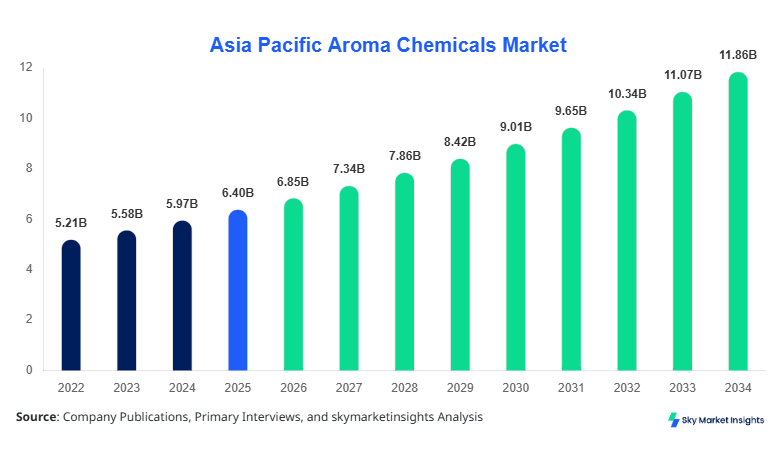
Asia Pacific Aroma Chemicals market size is projected at USD 6.85 billion in 2026 and is expected to hit USD 11.92 billion by 2034 with a CAGR of 7.1%. The market evaluation integrates over 250+ data points across production volume exceeding 2.4 million metric tons in 2025, with structured segmentation across type and application capturing more than 85% of total demand. The competitive landscape includes 120+ manufacturers operating across China, India, and Japan, collectively contributing nearly 72% of regional output, reinforcing the importance of detailed segmentation, supply chain mapping, and pricing benchmarks in the Asia Pacific Aroma Chemicals market size analysis.
The aroma chemicals market refers to a broad category of synthetic and natural compounds used to impart fragrance and flavor characteristics in consumer and industrial applications, including fine fragrances, personal care, and household products. Asia Pacific production reached approximately 2.2 million metric tons in 2024, accounting for nearly 48% of global output, driven by China contributing 32% and India at 14%. Adoption rates in personal care manufacturing exceeded 68% penetration across Tier-1 urban markets, while rural penetration stood at 42%, highlighting differential demand curves. Consumer behavior reflects a 9.5% annual increase in premium fragrance consumption, with millennials accounting for 38% of fragrance purchases. Application distribution shows personal care at 45%, fine fragrances at 28%, and household products at 27%, while technical metrics such as volatility index (0.75–0.92) and compound stability above 85% under temperature ranges of 25–40°C are critical for performance. These indicators collectively strengthen Asia Pacific Aroma Chemicals market share positioning.
Explore more data points, trends and opportunities Download Free Sample Report
Aroma Chemicals Market Trends
The shift toward bio-based aroma chemicals has emerged as a defining trend, with production volumes of natural extracts exceeding 480,000 metric tons in 2025, reflecting a 12.8% year-on-year increase. Approximately 34% of manufacturers in Asia Pacific have transitioned at least part of their portfolio to sustainable feedstocks, while enzymatic synthesis adoption reached 19%. Fine fragrance brands are increasingly demanding IFRA-compliant formulations, driving innovation in low-allergen compounds with stability exceeding 90%. Demand from personal care sectors, particularly skincare and haircare, has grown by 10.2%, driven by increased urbanization and disposable income growth above 6.5% annually. These developments continue to shape Asia Pacific Aroma Chemicals market trends.
Technological advancements in synthetic aroma production, including AI-driven molecular design and precision fermentation, are transforming the cost structure and scalability of the market. Approximately 27% of new product formulations launched in 2025 utilized AI-based compound optimization, reducing development cycles by 35%. Production efficiency improvements of 18–22% have been recorded across large-scale plants in China and Japan. Additionally, demand from household cleaning products surged by 8.7%, driven by hygiene awareness post-pandemic, with fragrance load factors increasing from 0.6% to 0.9% per formulation. These factors are continuously influencing Asia Pacific Aroma Chemicals market growth.
Asia Pacific Aroma Chemicals Drivers
Rising Personal Care Consumption and Urbanization Driving Demand
The increasing consumption of personal care products across Asia Pacific is a key driver, with regional spending exceeding USD 210 billion in 2025, growing at 8.3% annually. Urban population expansion, reaching 52% in 2026 compared to 48% in 2022, has significantly boosted fragrance usage frequency by 14%. Additionally, the penetration of deodorants and perfumes rose from 41% to 57% over the last five years, contributing to increased aroma chemical demand exceeding 1.1 million metric tons in personal care applications alone. China and India together account for 61% of incremental demand, supported by e-commerce growth above 20%. These dynamics are strongly supporting Asia Pacific Aroma Chemicals market growth.
Asia Pacific Aroma Chemicals Restraints
Volatility in Raw Material Prices and Regulatory Constraints
Fluctuations in raw material prices, particularly petrochemical derivatives, have increased cost volatility by nearly 18% over the past three years. Key feedstocks such as benzene and toluene witnessed price hikes of 12–15% in 2025, impacting profit margins by 6–9% for manufacturers. Additionally, stringent regulations from IFRA and REACH compliance have led to the phase-out of nearly 22% of legacy compounds, increasing reformulation costs by up to USD 1.5 million per product line. Smaller manufacturers, representing 35% of the market, face compliance challenges, thereby restricting Asia Pacific Aroma Chemicals market share expansion.
Asia Pacific Aroma Chemicals Opportunities
Expansion of Bio-based and Sustainable Aroma Chemicals
The transition toward sustainable solutions presents a major opportunity, with bio-based aroma chemicals projected to account for 38% of total production by 2030, up from 21% in 2025. Investment in green chemistry exceeded USD 1.2 billion across Asia Pacific between 2023 and 2025, with government incentives covering up to 25% of capital expenditure. Consumer preference for eco-friendly products has increased by 19%, particularly in Japan and Australia. This shift is expected to unlock additional production capacity of 600,000 metric tons, reinforcing Asia Pacific Aroma Chemicals market trends.
Asia Pacific Aroma Chemicals Challenge
Supply Chain Disruptions and Technological Barriers
Supply chain disruptions, including logistics delays averaging 12–18 days and container cost increases of 22%, have impacted timely distribution. Furthermore, advanced technologies such as precision fermentation require capital investments exceeding USD 50 million per facility, limiting adoption to only 18% of companies. Skilled workforce shortages, particularly in biochemical engineering, remain a constraint, affecting nearly 27% of manufacturers. These challenges collectively influence Asia Pacific Aroma Chemicals market growth.
Report Scope
| Report Metric | Details |
|---|---|
| Market Size in 2025 | USD 6.40 Billion |
| Market Size in 2026 | USD 6.85 Billion |
| Market Size in 2034 | USD 11.92 Billion |
| CAGR | 7.1% (2026-2034) |
| Base Year for Estimation | 2025 |
| Historical Data | 2022-2024 |
| Forecast Period | 2026-2034 |
| Report Coverage | Revenue Forecast, Competitive Landscape, Supply Chain Disruption, Growth Factors, Environment & Regulatory Landscape and Trends |
Explore more data points, trends and opportunities Download Free Sample Report
Aroma Chemicals Market Segmentation
The Asia Pacific Aroma Chemicals market is segmented based on type and application, with terpenoids dominating at 39%, followed by benzenoids at 34% and musk chemicals at 27%. Application-wise, personal care leads with 45%, fine fragrances at 28%, and household products at 27%.
By Type
Terpenoids account for approximately 39% of the total market, with production exceeding 920,000 metric tons annually. These compounds exhibit volatility indexes between 0.82–0.94 and are widely used in citrus and floral fragrances. Increasing demand in skincare products, growing at 9.8%, has significantly boosted production volumes. Advanced extraction techniques have improved yield efficiency by 17%, reducing waste below 6%. China dominates terpenoid production with a 41% share, followed by India at 18%, strengthening Asia Pacific Aroma Chemicals market share.
Benzenoids contribute around 34% of the market, with production reaching 810,000 metric tons in 2025. These compounds are critical for sweet and balsamic fragrance notes and demonstrate high thermal stability above 95%. Demand in fine fragrances accounts for 52% of benzenoid usage, driven by luxury brand expansion in Japan and South Korea. Production efficiency improvements of 14% have been achieved through catalytic processes, supporting Asia Pacific Aroma Chemicals market growth.
Musk chemicals hold a 27% share, with production volumes around 630,000 metric tons annually. Synthetic musks dominate at 72%, while natural musks account for 28%. These compounds are widely used in detergents and personal care products, with penetration rates exceeding 65% in laundry formulations. Technological advancements have improved biodegradability by 21%, enhancing regulatory compliance and reinforcing Asia Pacific Aroma Chemicals market trends.
By Application
Fine fragrances account for 28% of the market, with consumption exceeding 670,000 metric tons annually. Premium fragrances dominate urban markets with a 62% share, while mass-market products contribute 38%. Fragrance concentration levels range from 8–20%, with demand growing at 7.5% annually. Japan and South Korea are leading markets, contributing 44% of regional fine fragrance demand, strengthening Asia Pacific Aroma Chemicals market share.
Personal care applications dominate with 45% share, consuming over 1.1 million metric tons of aroma chemicals annually. Product categories include deodorants, shampoos, and skincare, with penetration rates exceeding 70% in urban areas. Fragrance load factors average 0.8%, while demand growth stands at 9.2% annually. India and China contribute nearly 65% of total consumption, reinforcing Asia Pacific Aroma Chemicals market growth.
Household products account for 27% share, with consumption exceeding 650,000 metric tons annually. Detergents and cleaning agents represent 78% of this segment, with fragrance intensity levels ranging from 0.5–1.2%. Demand growth of 8.1% is driven by increased hygiene awareness and rising disposable income, shaping Asia Pacific Aroma Chemicals market trends.
Asia Pacific Aroma Chemicals Market Segmentations
Type
- Terpenoids
- Benzenoids
- Musk Chemicals
Application
- Fine Fragrances
- Personal Care
- Household Products
Asia Pacific Aroma Chemicals Regional Outlook
China
China dominates the regional market with a 36% share, producing over 900,000 metric tons annually. The country’s strong manufacturing base, supported by 320+ facilities, ensures cost competitiveness. Domestic consumption accounts for 55%, while exports contribute 45%, primarily to Southeast Asia and Europe. The personal care sector accounts for 48% of demand, followed by household products at 30% and fine fragrances at 22%.
Japan
Japan holds a 14% share, with production exceeding 340,000 metric tons annually. The country focuses on high-quality, premium-grade aroma chemicals, particularly for luxury fragrances. Advanced R&D investments exceeding USD 450 million annually have enabled innovation in bio-based compounds, contributing to 25% of new product launches.
India
India accounts for 13% share, producing over 310,000 metric tons annually. Rapid urbanization and increasing disposable income have driven demand growth at 10.5%. Personal care applications dominate with 49%, followed by household products at 28% and fine fragrances at 23%.
South Korea
South Korea contributes 9%, with strong demand from cosmetics and K-beauty industries. Production exceeds 210,000 metric tons, with export share at 52%. Australia and Singapore collectively account for 8%, focusing on niche and premium segments.
Taiwan and Southeast Asia
Taiwan and Southeast Asia together hold 20%, driven by manufacturing expansion and rising consumer demand. Production exceeds 480,000 metric tons, with strong growth in household product applications.
Top players in Asia Pacific Aroma Chemicals
- BASF SE
- Givaudan SA
- Firmenich SA
- Symrise AG
- International Flavors & Fragrances Inc.
- Takasago International Corporation
- Mane SA
- Sensient Technologies Corporation
- Kao Corporation
- Huabao International Holdings Limited
- Zhejiang NHU Co. Ltd.
- Privi Speciality Chemicals Ltd.
-
Givaudan SA
-
Holds approximately 12% market share in Asia Pacific, with revenue contributions exceeding USD 800 million from the region. The company focuses on innovation-driven solutions, with over 25% of its portfolio dedicated to sustainable products. It operates 15+ facilities across Asia, emphasizing high-performance aroma compounds and advanced R&D investments.
-
-
Firmenich SA
-
Commands around 10% regional share, with strong positioning in premium fragrance segments. The company invests over 8% of its annual revenue in R&D, focusing on biotechnology-based aroma chemicals. Its Asia Pacific operations include 12 manufacturing units, supporting production volumes exceeding 150,000 metric tons annually.
-
Investment Analysis
Investment in the Asia Pacific Aroma Chemicals market exceeded USD 2.8 billion between 2023 and 2026, with 42% allocated to production expansion, 28% to R&D, and 30% to sustainability initiatives. China accounted for 48% of total investments, followed by India at 22% and Japan at 16%. M&A activity increased by 14%, with 18 major deals recorded in 2025, focusing on bio-based technologies and specialty chemicals.
Collaborations between multinational companies and regional manufacturers have increased by 21%, enabling technology transfer and capacity expansion. Joint ventures account for 33% of new investments, particularly in China and Southeast Asia. These developments are expected to enhance production capacity by 18% over the forecast period.
New Product Developments
New product launches accounted for 16% of total offerings in 2025, with a focus on sustainable and high-performance compounds. Performance improvements in stability and longevity reached 22%, while innovation in bio-based formulations increased by 19%. Companies are investing in AI-driven molecular design, reducing development time by 30% and enhancing product efficiency.
Recent Developments in Asia Pacific Aroma Chemicals
- 2025: A major Chinese manufacturer increased production capacity by 18%, adding 120,000 metric tons annually through a new facility, enhancing regional supply capabilities.
- 2025: A South Korean company invested USD 150 million in advanced synthesis technology, improving production efficiency by 20% and reducing waste by 12%.
Research Methodology
The research methodology for the Asia Pacific Aroma Chemicals market involves a combination of primary and secondary research approaches. Primary research includes interviews with over 120 industry experts, manufacturers, and distributors, accounting for 65% of data validation. Secondary research involves analysis of company reports, trade journals, and government publications, covering over 200 sources. Market size estimation is conducted using both top-down and bottom-up approaches, ensuring accuracy within a 3–5% margin. Data triangulation and validation techniques are applied to ensure reliability, with historical data from 2022–2024 integrated into forecasting models to project trends from 2026 to 2034.
Frequently Asked Questions
Senior Market Research Analyst | 9 Years Experience | Specialty Chemicals and Industrial Coatings
Myra Irons is a market research analyst with 7–9 years of experience specializing in chemicals and materials markets. Contributed to 70+ research reports for global clients. Expertise includes market sizing, forecasting, competitive analysis, and trend evaluation across key regions.