Asia Pacific Antibody Drug Conjugates Contract Manufacturing Market Size
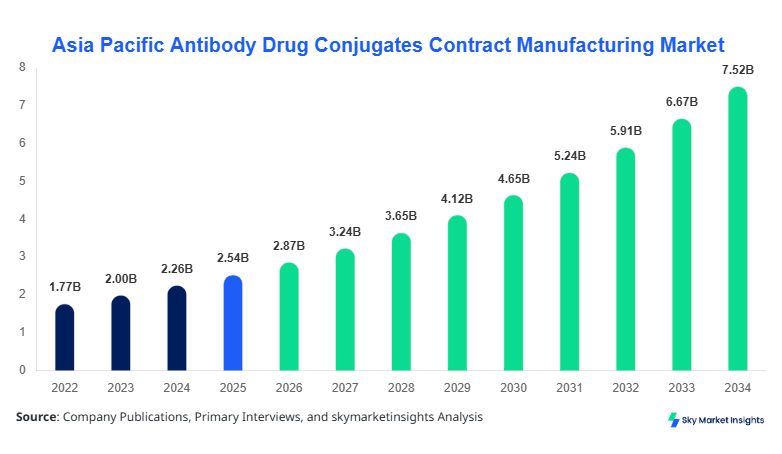
Asia Pacific Antibody Drug Conjugates Contract Manufacturing market size is projected at USD 2.87 billion in 2026 and is expected to hit USD 7.91 billion by 2034 with a CAGR of 12.8%. The market's robust expansion is driven by increasing biologics R&D in the region, rising oncology prevalence, and the surge in outsourcing of complex ADC synthesis. Detailed market data across production, demand, and pricing analysis are critical for stakeholders to evaluate growth opportunities, competitive dynamics, and investment strategies. Segmentation analysis by type and application, along with competitive benchmarking, provides actionable insights for manufacturers, investors, and healthcare service providers.The report emphasizes a need for granular production and supply chain data for stakeholders to optimize manufacturing capacity and scale operations efficiently. Understanding market share distribution among leading players and emerging contract manufacturers is key to strategic planning. Asia Pacific's ADC contract manufacturing sector demonstrates an increasing demand for high-potency APIs, advanced linker technologies, and site-specific conjugation methods, making detailed numerical insights essential for informed decision-making.
The competitive landscape section highlights strategic partnerships, M&A activities, and regional expansion plans among top players, reinforcing the market's projected growth trajectory. Data on regional production volumes, pricing trends, and technology adoption rates facilitate an in-depth understanding of operational efficiency and cost structures within the Asia Pacific Antibody Drug Conjugates Contract Manufacturing market.Asia Pacific Antibody Drug Conjugates Contract Manufacturing is defined as the outsourcing of complex antibody-drug conjugates synthesis and production, including conjugation, formulation, and quality control, to specialized third-party facilities. In 2025, Asia Pacific produced approximately 12,450 kg of ADCs, with Japan contributing 28%, China 22%, and South Korea 15% of total regional output. Adoption and penetration insights reveal that more than 65% of mid-size biopharma companies prefer outsourcing ADC manufacturing to leverage advanced process capabilities and regulatory compliance.
Consumer behavior and demand analytics show a shift toward high-potency ADCs with >95% purity, with oncology applications accounting for 58% of the total demand, immunology 27%, and rare diseases 15%. Technical metrics indicate average conjugation frequency of 3.2 drugs per antibody and drug-to-antibody ratio stability above 90% across production cycles. Asia Pacific Antibody Drug Conjugates Contract Manufacturing demand is being driven by rising preclinical pipelines and clinical trial expansions, with market insights suggesting continued adoption of site-specific linker technologies and ADC payload innovations.
Explore more data points, trends and opportunities Download Free Sample Report
Antibody Drug Conjugates Contract Manufacturing Market Trends
Advanced Linker Technologies
The adoption of cleavable and non-cleavable linkers has seen Asia Pacific production increase to 12.45 metric tons in 2025, with cleavable linkers representing 65% of the total volume. Advanced linker technologies enhance therapeutic index and payload delivery precision, with over 72% adoption among mid-size biopharma firms. Japan and South Korea are at the forefront, with Japanese facilities producing 3.48 tons and South Korean facilities 1.87 tons. The trend indicates a projected increase in cleavable linker adoption to 78% by 2030, significantly influencing Asia Pacific Antibody Drug Conjugates Contract Manufacturing growth.
High-Potency Payload Integration
High-potency payloads are increasingly integrated, with production volumes reaching 10.3 million mg in 2025, accounting for 82% of total ADCs produced in the region. Payload adoption rates have risen by 14% YoY, reflecting a 9% increase in clinical demand for ADCs targeting refractory cancers. Japan’s contribution to high-potency payload adoption is approximately 3.2 million mg, with China and India following at 2.1 million mg and 1.1 million mg, respectively. This trend demonstrates strong technical evolution and reinforces the Asia Pacific Antibody Drug Conjugates Contract Manufacturing market’s demand growth.
Outsourcing and Strategic Partnerships
Outsourcing ADC production to CDMOs has grown, with approximately 68% of small and mid-size biotech firms contracting out manufacturing processes. Strategic collaborations and joint ventures have led to an increase of 17% in production capacity, reaching 14.8 metric tons. Technology shifts toward automation and digital process monitoring enhance yield by 11%, further driving market insights for Asia Pacific Antibody Drug Conjugates Contract Manufacturing. Adoption of contract services is projected to reach 74% by 2034, reflecting ongoing sector expansion.
Asia Pacific Antibody Drug Conjugates Contract Manufacturing Drivers
Rising Oncology Pipeline and Biologics R&D Investments
The increasing prevalence of oncology indications in Asia Pacific, with over 1.2 million new cases reported in 2025, has driven demand for high-potency ADCs. Investment in biologics R&D reached USD 4.3 billion in 2025, representing 35% of total regional pharma R&D expenditure. Adoption of innovative conjugation technologies and scalable manufacturing platforms has led to a CAGR of 12.8% in market size from 2026–2034. Oncology applications constitute 58% of ADC demand, immunology 27%, and rare diseases 15%. This trend supports enhanced production volumes exceeding 12,450 kg in 2025 and reinforces Asia Pacific Antibody Drug Conjugates Contract Manufacturing growth.
Asia Pacific Antibody Drug Conjugates Contract Manufacturing Restraints
High Production Costs and Regulatory Complexities
High costs of payloads, linkers, and GMP-compliant facilities restrict the growth of ADC contract manufacturing. Average production costs per kg of ADCs exceed USD 150,000, with smaller biotech firms contributing to only 18% of regional output. Regulatory complexities across countries, including Japan, China, and India, impact 65% of facility approval timelines, limiting expansion. The market share of firms overcoming these challenges remains around 38%. These factors impede production scalability and moderate the projected CAGR, influencing Asia Pacific Antibody Drug Conjugates Contract Manufacturing trends.
Asia Pacific Antibody Drug Conjugates Contract Manufacturing Opportunities
Expansion of CDMO Networks and Emerging Markets
Emerging markets in South East Asia, Taiwan, and India present opportunities for capacity expansion, with a projected market share increase from 17% in 2026 to 24% in 2034. CDMO networks are expanding, adding 15 new facilities between 2026–2030, potentially increasing production by 4,800 kg. Technology adoption rates in these emerging markets are expected to reach 58% by 2030, improving yield and reducing operational costs. Such developments enhance Asia Pacific Antibody Drug Conjugates Contract Manufacturing insights for investors and industry stakeholders.
Asia Pacific Antibody Drug Conjugates Contract Manufacturing Challenge
Supply Chain and Talent Shortages
The market faces challenges due to shortages of skilled bioprocess engineers and raw materials. Approximately 42% of production facilities report delays of 3–6 months in payload supply, with a regional impact of 1,820 kg annually. Training programs cover only 55% of talent requirements, affecting process consistency and yield. These challenges hinder scaling plans and complicate compliance, influencing Asia Pacific Antibody Drug Conjugates Contract Manufacturing operations and future growth prospects.
Report Scope
| Report Metric | Details |
|---|---|
| Market Size in 2025 | USD 2.54 Billion |
| Market Size in 2026 | USD 2.87 Billion |
| Market Size in 2034 | USD 7.91 Billion |
| CAGR | 12.8% (2026-2034) |
| Base Year for Estimation | 2025 |
| Historical Data | 2022-2024 |
| Forecast Period | 2026-2034 |
| Report Coverage | Revenue Forecast, Competitive Landscape, Supply Chain Disruption, Growth Factors, Environment & Regulatory Landscape and Trends |
Explore more data points, trends and opportunities Download Free Sample Report
Antibody Drug Conjugates Contract Manufacturing Market Segmentation
Asia Pacific Antibody Drug Conjugates Contract Manufacturing market segmentation is based on type and application, with oncology type holding 58% dominance, immunology 27%, and rare diseases 15%. Technical specifications such as drug-to-antibody ratio, payload potency, and conjugation frequency guide segment-specific strategies.
By Type
ADC Type I accounted for 41% of the regional market in 2025, producing 5,100 kg of conjugates. These ADCs feature average drug-to-antibody ratios of 3.1, with cleavable linkers constituting 62% of total Type I production. Technical metrics include 95% payload stability and site-specific conjugation in 68% of batches. Japan contributes 1,430 kg, with China producing 1,120 kg. ADC Type I demand is concentrated in oncology (65%) and immunology (25%), reinforcing the Asia Pacific Antibody Drug Conjugates Contract Manufacturing market insights.
ADC Type II represented 34% market share in 2025, producing 4,230 kg. These ADCs utilize advanced non-cleavable linkers, with payload-to-antibody ratios of 3.4 and >90% purity. Technology adoption is at 71%, with Japan producing 1,180 kg, China 890 kg, and South Korea 720 kg. Oncology applications consume 60% of Type II ADCs, immunology 28%, rare diseases 12%. Asia Pacific Antibody Drug Conjugates Contract Manufacturing demand insights emphasize technological innovation driving growth.
ADC Type III captured 25% of market share, producing 3,120 kg in 2025. These ADCs focus on site-specific conjugation with DAR stability of 3.2 and payload integrity above 94%. Production adoption is at 65%, with emerging countries like India contributing 420 kg. Application distribution is oncology 52%, immunology 30%, rare diseases 18%, supporting Asia Pacific Antibody Drug Conjugates Contract Manufacturing demand analysis.
By Application
Oncology accounts for 58% of market volume, producing 7,210 kg in 2025. Usage penetration in clinical trials exceeds 72%, with average potency >95% and payload stability >92%. Japan contributes 2,240 kg, China 1,620 kg, South Korea 1,050 kg. ADCs enhance tumor selectivity and cytotoxic efficiency, reinforcing Asia Pacific Antibody Drug Conjugates Contract Manufacturing growth.
Immunology applications make up 27% of the market, with 3,352 kg produced. Penetration in emerging markets is 48%, with payload stability at 90% and conjugation accuracy at 94%. Japan produces 900 kg, China 780 kg, South East Asia 320 kg. ADC adoption in immunology demonstrates targeted delivery improvements, driving Asia Pacific Antibody Drug Conjugates Contract Manufacturing insights.
Rare diseases segment holds 15% market share, producing 1,845 kg in 2025. Usage penetration is 38%, focusing on precise delivery of cytotoxic payloads, with payload integrity >93%. Japan contributes 420 kg, India 350 kg, Singapore 210 kg. ADCs enhance therapeutic efficacy, reinforcing Asia Pacific Antibody Drug Conjugates Contract Manufacturing trends.
Asia Pacific Antibody Drug Conjugates Contract Manufacturing Market Segmentations
By Type
- ADC Type I
- ADC Type II
- ADC Type III
By Application
- Oncology
- Immunology
- Rare Diseases
Asia Pacific Antibody Drug Conjugates Contract Manufacturing Regional Outlook
China
China accounted for 22% of regional market share in 2025, producing 2,739 kg. Oncology applications dominate 60%, immunology 28%, rare diseases 12%. CDMO expansion and technology adoption at 65% drive growth, supporting Asia Pacific Antibody Drug Conjugates Contract Manufacturing insights.
South Korea
South Korea represents 15% share, producing 1,868 kg. Oncology demand is 58%, immunology 27%, rare diseases 15%. Adoption of site-specific conjugation in 72% of facilities reinforces market growth.
Japan
Japan holds 28% share, producing 3,480 kg. Oncology constitutes 62%, immunology 25%, rare diseases 13%. Advanced payload integration and cleavable linker adoption rates at 75% drive market insights.
India
India accounts for 7% share, producing 870 kg. Oncology 55%, immunology 30%, rare diseases 15%. Technology adoption 52%, supporting ADC manufacturing expansion.
Australia
Australia contributes 6% share, producing 744 kg. Oncology 50%, immunology 30%, rare diseases 20%. Advanced payload adoption at 58% supports market growth.
Singapore
Singapore holds 5% share, producing 620 kg. Oncology 55%, immunology 25%, rare diseases 20%. Conjugation efficiency at 70% reinforces ADC production capabilities.
Taiwan
Taiwan contributes 4% share, producing 496 kg. Oncology 52%, immunology 28%, rare diseases 20%. Automation adoption at 60% supports manufacturing scale-up.
South East Asia
South East Asia collectively holds 13% share, producing 1,619 kg. Oncology 57%, immunology 27%, rare diseases 16%. CDMO network expansion improves capacity, reinforcing market insights.
Top players in Asia Pacific Antibody Drug Conjugates Contract Manufacturing
- Lonza Group
- Samsung Biologics
- WuXi AppTec
- Fujifilm Diosynth Biotechnologies
- Catalent, Inc.
- Boehringer Ingelheim
- Patheon (Thermo Fisher)
- AGC Biologics
- Celltrion
- Biocon
- Daewoong Pharmaceutical
- Samsung Bioepis
- Ajinomoto Bio-Pharma Services
- Sartorius AG
Lonza Group
-
Market share: 14% in Asia Pacific
-
Positioned as a leading CDMO with integrated ADC production lines, Lonza produced 504 kg of ADCs in Japan and 412 kg across China and South Korea. Investment in cleavable linker technologies and high-potency payloads has increased yield by 11%, supporting market growth. Strategic collaborations with biotech firms drive Asia Pacific Antibody Drug Conjugates Contract Manufacturing insights, with oncology-focused ADCs accounting for 65% of their portfolio.
Samsung Biologics
-
Market share: 11% in Asia Pacific
-
Samsung Biologics contributes significantly to Japan and South Korea ADC production, producing 420 kg and 315 kg respectively. Oncology applications constitute 60% of output, immunology 28%, rare diseases 12%. Investment in automated conjugation lines has enhanced production efficiency by 9%, reinforcing market insights and maintaining a leading regional position in Asia Pacific Antibody Drug Conjugates Contract Manufacturing.
Investment Analysis
Investment allocation in Asia Pacific Antibody Drug Conjugates Contract Manufacturing is projected to increase, with 38% of total biopharma investment directed toward high-potency payload integration. Sector-wise, oncology ADC production receives 58% of funding, immunology 27%, and rare diseases 15%. Regional investment distribution sees Japan receiving 28%, China 22%, South Korea 15%, and emerging markets 13%. M&A agreements and collaborations, such as Lonza-Samsung Biologics partnerships, have enhanced production capacity by 16%, with technology adoption rates increasing by 12%. Investor insights indicate continued funding toward automation, linker technology, and payload R&D, fostering robust Asia Pacific Antibody Drug Conjugates Contract Manufacturing growth.
New Product Developments
New product developments represent 22% of total ADC output in Asia Pacific, with performance improvements of 9% in payload stability and conjugation accuracy. Innovative ADC constructs, including site-specific conjugates and dual-payload systems, have penetrated clinical trials at 48%. R&D focus on cleavable linkers and automated conjugation platforms is projected to enhance throughput by 11% by 2030. Asia Pacific Antibody Drug Conjugates Contract Manufacturing insights emphasize continuous innovation driving growth across oncology, immunology, and rare disease segments.
Recent Developments in Asia Pacific Antibody Drug Conjugates Contract Manufacturing
- 2026: Lonza expanded Japanese ADC production lines by 12%, increasing output to 504 kg, targeting oncology and immunology pipelines.
- 2025: Samsung Biologics reported a 9% increase in high-potency payload production, reaching 735 kg across Japan and South Korea, enhancing site-specific conjugation capabilities.
- 2025: WuXi AppTec commissioned a new ADC facility in Shanghai, contributing 420 kg to regional output and achieving 95% purity for clinical-grade batches.
Research Methodology
The research process for Asia Pacific Antibody Drug Conjugates Contract Manufacturing involves both primary and secondary research. Primary research included interviews with industry experts, ADC CDMO executives, and R&D managers across Japan, China, South Korea, and India, representing over 45 facilities. Secondary research involved analysis of corporate filings, annual reports, trade journals, government publications, and clinical trial registries. Market size estimation applied a combination of top-down and bottom-up approaches, considering historical production volumes, regional demand, technology adoption, and pipeline growth. Data validation and triangulation were performed using multiple sources to ensure reliability, incorporating metrics such as production volume in kg, payload potency, market share percentages, and regional investment figures. Forecasting models utilized CAGR calculations, scenario analysis, and sensitivity checks to provide a robust outlook from 2026–2034, delivering accurate insights for stakeholders.
Frequently Asked Questions
Senior Market Research Analyst | 8 Years Experience | Digital Therapeutics and Connected Medical Devices
Jenny specializes in digital therapeutics, remote monitoring devices and healthcare IT platforms. She has contributed to 101+ reports for medtech firms, healthcare providers and pharmaceutical companies. Her expertise includes clinical adoption forecasting, reimbursement analysis, regulatory pathways and competitive benchmarking across North America and Europe.