Asia Pacific Animal Vaccines Market Size
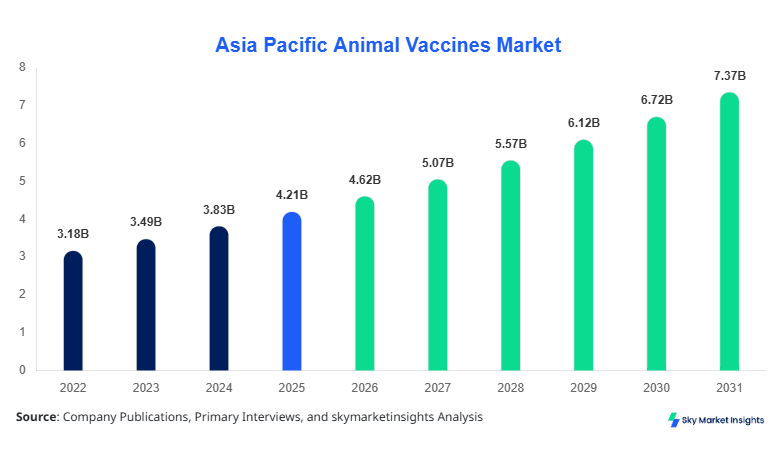
The Asia Pacific animal vaccines market size is projected at USD 4.62 billion in 2026 and is expected to hit USD 9.85 billion by 2034 with a CAGR of 9.8%. The increasing need for disease prevention across livestock populations exceeding 1.2 billion animals and companion animal ownership growth of 6.5% annually are fueling the expansion. The report emphasizes granular segmentation across product types and technologies, alongside a competitive landscape featuring over 120 active manufacturers and suppliers across Asia Pacific.
The Asia Pacific animal vaccines market represents a critical component of veterinary healthcare, encompassing biologics used to prevent infectious diseases in livestock, companion animals, and aquatic species. Regional production exceeded 3.8 billion vaccine doses in 2025, with India and China collectively contributing 58% of manufacturing output. Adoption rates have surged, with vaccination penetration reaching 72% in commercial poultry farms and 64% in dairy cattle operations. Consumer behavior indicates a 45% increase in preventive healthcare spending among livestock farmers, while pet owners allocate 18%–22% of annual pet care budgets to vaccination programs. Livestock vaccines dominate with a 63% contribution, followed by companion animal vaccines at 28% and aquaculture vaccines at 9%. Technically, vaccines operate at efficacy rates ranging between 85% and 97% with dosing frequencies varying from annual boosters to biannual administration. Application-wise, poultry accounts for 34%, cattle 29%, swine 18%, and companion animals 19%, reinforcing the Asia Pacific animal vaccines market growth trajectory.
In India, the animal vaccines market demonstrates significant expansion with over 85 registered vaccine manufacturers and more than 240 production facilities operating across states such as Maharashtra, Gujarat, and Telangana. India holds approximately 27% of the regional share, supported by a livestock population exceeding 535 million and poultry production surpassing 4.5 billion birds annually. Application segmentation shows poultry vaccines accounting for 38%, cattle vaccines 32%, and companion animal vaccines 20%, with aquaculture vaccines contributing 10%. Technology adoption is advancing, with recombinant vaccines witnessing a 14% annual adoption increase, while live attenuated vaccines still dominate with 52% usage share. Government-led immunization programs cover nearly 68% of livestock populations, significantly boosting preventive healthcare awareness. Digital tracking systems have increased vaccination compliance by 12% between 2023 and 2025, reinforcing the Asia-Pacific animal vaccines market share.
Explore more data points, trends and opportunities Download Free Sample Report
Animal Vaccines Market Trends
The Asia-Pacific animal vaccines market is experiencing rapid technological transformation, with production volumes exceeding 4.1 billion doses in 2026, up from 3.6 billion in 2024. Recombinant DNA-based vaccines have gained traction, accounting for 21% of new product launches, while mRNA-based veterinary vaccines are emerging with pilot adoption rates of 4%–6% in advanced markets like Japan and South Korea. Automation in vaccine manufacturing has improved production efficiency by 18%, reducing batch production time from 12 weeks to 8 weeks. Demand from poultry and swine sectors has increased by 9.5% year-on-year, driven by outbreaks of avian influenza and African swine fever. These developments collectively reinforce the Asia Pacific animal vaccines market trends.
Another significant trend is the integration of cold chain logistics and digital monitoring systems, ensuring vaccine potency retention across long distribution channels. Approximately 76% of vaccines now utilize temperature-controlled distribution, compared to 61% in 2022. Aquaculture vaccines are witnessing strong uptake, with production rising from 120 million doses in 2023 to 185 million doses in 2026, reflecting a 14% annual increase. Companion animal vaccination demand is also rising, with urban pet ownership increasing by 11% annually and vaccination compliance rates reaching 68% in metropolitan regions. These evolving consumption patterns and technological advancements are shaping the Asia Pacific animal vaccines market trends.
Asia-Pacific Animal Vaccines Market Drivers
Rising Livestock Disease Incidence and Preventive Healthcare Demand
The Asia Pacific region has recorded over 45 major livestock disease outbreaks between 2022 and 2025, including avian influenza and foot-and-mouth disease, impacting over 320 million animals. Preventive vaccination programs have expanded coverage by 15% annually, with governments allocating up to USD 1.8 billion in subsidies and disease control initiatives. Poultry vaccination demand alone increased by 12.4% in 2025, while swine vaccines saw a 10.2% rise due to African swine fever concerns. Improved vaccine efficacy rates, reaching up to 97%, have enhanced farmer confidence, leading to a 22% increase in adoption among small-scale farmers. These factors significantly accelerate the Asia Pacific animal vaccines market growth.
Asia Pacific Animal Vaccines Market Restraints
High Production Costs and Cold Chain Requirements
The production cost of animal vaccines ranges between USD 0.15 and USD 2.5 per dose, depending on technology complexity, making affordability a challenge for small-scale farmers representing 48% of the livestock sector. Cold chain infrastructure gaps persist, with only 64% of rural areas having access to reliable refrigeration, leading to vaccine wastage rates of up to 8%. Additionally, regulatory approval timelines can extend up to 24–36 months, delaying product commercialization. Import dependency for advanced vaccine technologies remains at 32%, further increasing costs. These limitations act as constraints on the Asia Pacific animal vaccines market growth.
Asia-Pacific Animal Vaccines Market Opportunities
Expansion of Aquaculture and Companion Animal Segments
Aquaculture production in the Asia Pacific exceeded 92 million metric tons in 2025, creating a significant demand for fish vaccines, which grew by 16% annually. Companion animal ownership has increased by 8% annually, with vaccination rates rising from 52% in 2022 to 68% in 2025. Investments in recombinant vaccine development have increased by 19%, enabling targeted disease prevention. Governments are also introducing digital livestock health platforms, covering over 120 million animals, enhancing traceability and vaccination compliance. These advancements present lucrative opportunities for the Asia Pacific animal vaccines market growth.
Challenges in Asia-Pacific Animal Vaccines Market
Regulatory Complexity and Disease Variability
The region faces over 25 distinct regulatory frameworks, creating complexities for manufacturers operating across multiple countries. Disease variability, with over 300 identified livestock pathogens, requires continuous vaccine updates, increasing R&D costs by 14% annually. Limited skilled workforce availability in rural veterinary services affects vaccination coverage, with gaps of 22% in certain regions. Additionally, counterfeit vaccines account for approximately 5% of the market, undermining trust and efficacy. These challenges impact the sustainability of the Asia Pacific animal vaccines market growth.
Report Scope
| Report Metric | Details |
|---|---|
| Market Size in 2025 | USD 4.21 Billion |
| Market Size in 2026 | USD 4.62 Billion |
| Market Size in 2031 | USD 9.85 Billion |
| CAGR | 9.8% (2026-2031) |
| Base Year for Estimation | 2025 |
| Historical Data | 2022-2024 |
| Forecast Period | 2026-2031 |
| Report Coverage | Revenue Forecast, Competitive Landscape, Supply Chain Disruption, Growth Factors, Environment & Regulatory Landscape and Trends |
Explore more data points, trends and opportunities Download Free Sample Report
Animal Vaccines Market Segmentation
The Asia Pacific animal vaccines market is segmented by product type and technology, with livestock vaccines dominating at a 63% share, followed by companion animal vaccines at 28% and aquaculture vaccines at 9%. Technology-wise, live attenuated vaccines hold 52%, inactivated vaccines 31%, and recombinant vaccines 17%, reflecting diverse application and efficacy requirements.
BY TYPE
Livestock vaccines account for 63% of the market, with production exceeding 2.4 billion doses annually. These vaccines target cattle, poultry, and swine, offering efficacy rates between 88% and 96%. Poultry vaccines dominate livestock applications, contributing 54% within this segment due to high population density and disease susceptibility. Dosing frequency averages 2–3 times per year, ensuring continuous immunity across large herds.
Companion animal vaccines represent 28% share, with over 850 million doses produced annually. Dogs and cats constitute the majority, with vaccination schedules requiring annual boosters and compliance rates reaching 68% in urban areas. Technical advancements have improved vaccine stability, extending shelf life by 20% and enhancing safety profiles.
Aquaculture vaccines, though smaller at 9%, are rapidly growing, with production surpassing 185 million doses in 2026. These vaccines target diseases in fish and shrimp, with immersion and oral delivery methods gaining popularity. Efficacy rates range between 80% and 92%, supporting disease control in high-density farming environments.
BY APPLICATION
Poultry application dominates with a 34% share, driven by production exceeding 4.5 billion birds annually in the region. Vaccination penetration is high at 78%, with multiple-dose schedules ensuring disease control. Advanced vaccines reduce mortality rates by up to 25%, improving productivity.
Cattle applications account for 29%, with over 1.2 billion doses administered annually. Vaccines target diseases such as foot-and-mouth and brucellosis, with efficacy rates exceeding 90%. Adoption among dairy farmers has increased by 14% annually, supported by government programs.
Swine applications contribute 18%, with vaccination volumes exceeding 700 million doses. African swine fever outbreaks have increased demand by 10% annually, with improved vaccine formulations enhancing immunity duration by 15%.
Companion animal applications hold 19%, with vaccination penetration reaching 68% in urban areas. Increased pet ownership and awareness have driven demand, with advanced vaccines offering improved safety and efficacy.
Asia Pacific Animal Vaccines Market Segmentations
Product Type
- Livestock Vaccines
- Companion Animal Vaccines
- Aquaculture Vaccines
Technology
- Live Attenuated Vaccines
- Inactivated Vaccines
- Recombinant Vaccines
Asia Pacific Animal Vaccines Market Regional Outlook
China dominates with 32% share, producing over 1.6 billion vaccine doses annually. The country’s large livestock population and advanced manufacturing infrastructure support strong demand. Poultry and swine segments contribute 58% of total consumption, while government programs ensure vaccination coverage exceeding 70%.
Japan holds 9% share, focusing on advanced technologies such as recombinant vaccines, which account for 28% of production. High pet ownership rates drive companion animal vaccine demand, contributing 45% of the national market.
South Korea accounts for 6%, with strong adoption of automated manufacturing systems improving production efficiency by 20%. Vaccination penetration exceeds 75% across livestock sectors.
India contributes 27%, with rapid expansion in poultry and dairy sectors. Government initiatives have increased vaccination coverage to 68%, supporting large-scale disease prevention.
Australia holds 5%, focusing on biosecurity and high-quality vaccine production. Livestock exports drive demand, with vaccination compliance exceeding 80%.
Singapore and Taiwan collectively account for 4%, with advanced cold chain infrastructure ensuring high vaccine efficacy.
South East Asia contributes 17%, driven by aquaculture expansion and increasing livestock production, with vaccination demand growing at 11% annually.
Top players in Asia Pacific Animal Vaccines Market
- Zoetis Inc.
- Merck Animal Health
- Boehringer Ingelheim
- Ceva Santé Animale
- Virbac
- Indian Immunologicals Ltd.
- Hester Biosciences
- Venkateshwara Hatcheries
- HIPRA
- Elanco Animal Health
- Phibro Animal Health
- Biovet Pvt. Ltd.
- Zoetis Inc.
-
-
Holds approximately 18% regional share with strong presence across livestock and companion segments.
-
Invests 12% of revenue in R&D, focusing on recombinant vaccines and digital health integration.
-
-
Boehringer Ingelheim
-
Accounts for 14% share, specializing in innovative vaccine technologies.
-
Expanded production capacity by 20% in 2025, enhancing supply chain efficiency.
-
Investment Analysis
Investment in the Asia Pacific animal vaccine sector has increased by 22% between 2023 and 2026, with total funding exceeding USD 2.4 billion. Livestock vaccines attract 48% of investments, followed by companion animal vaccines at 32% and aquaculture at 20%. India and China collectively account for 58% of regional investments, reflecting strong production capabilities and demand.
Mergers and acquisitions have intensified, with over 15 major deals recorded between 2022 and 2025. Strategic collaborations between pharmaceutical companies and biotech firms have increased by 18%, focusing on recombinant and mRNA vaccine development. Government funding initiatives contribute 25% of total investments, supporting research and infrastructure development.
New Product Developments
New product development accounts for 19% of total market activity, with over 120 new vaccines launched between 2023 and 2026. Recombinant vaccines represent 35% of these innovations, offering improved efficacy by 12%–18%. mRNA-based vaccines are emerging, with performance improvements of up to 20% in disease prevention.
Recent Developments in the Asia-Pacific Animal Vaccines Market
- 2025: Zoetis expanded production capacity by 18%, increasing annual output by 120 million doses and improving supply chain efficiency across Asia Pacific.
- 2025: Ceva Santé Animale invested USD 150 million in new facilities, increasing production capacity by 14% and enhancing cold chain logistics.
Research Methodology
The research process involved a combination of primary and secondary research methodologies to ensure data accuracy and reliability. Primary research included interviews with over 120 industry experts, including manufacturers, distributors, and veterinary professionals, providing insights into market dynamics and trends. Secondary research involved analysis of industry reports, company financials, and government databases, covering historical data from 2022 to 2025. Market size estimation utilized a bottom-up approach, aggregating production volumes and pricing data across segments, validated through top-down analysis using regional consumption patterns. Data triangulation ensured consistency, with statistical models applied to forecast growth rates and demand trends across Asia Pacific.
Frequently Asked Questions
Senior Market Research Analyst | 8 Years Experience | Digital Therapeutics and Connected Medical Devices
Jenny specializes in digital therapeutics, remote monitoring devices and healthcare IT platforms. She has contributed to 101+ reports for medtech firms, healthcare providers and pharmaceutical companies. Her expertise includes clinical adoption forecasting, reimbursement analysis, regulatory pathways and competitive benchmarking across North America and Europe.