Asia Pacific Angioplasty Balloons Market Size
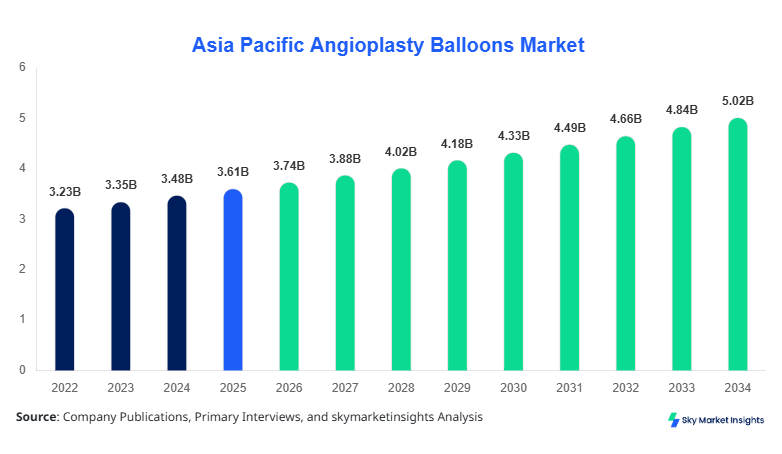
Asia Pacific Angioplasty Balloons market size is projected at USD 1.82 billion in 2026 and is expected to hit USD 3.74 billion by 2034 with a CAGR of 3.74%. The rising prevalence of cardiovascular diseases, increasing geriatric population exceeding 620 million individuals across Asia Pacific, and growing interventional cardiology procedures exceeding 9.6 million annually are key contributors to market expansion. The report integrates detailed segmentation, quantitative forecasting, and competitive benchmarking covering over 150 companies, enabling data-driven decision-making and in-depth evaluation of market share distribution across key countries.
The Angioplasty Balloons Market in Asia Pacific represents a critical segment within interventional cardiology devices, designed for dilating narrowed or obstructed blood vessels using high-pressure balloon catheters operating at pressures ranging from 6 atm to 20 atm with diameters between 1.5 mm and 10 mm. The region recorded production of approximately 38.5 million angioplasty balloons in 2025, with adoption rates reaching 68% in tertiary hospitals and 42% in secondary healthcare facilities. Drug-eluting balloons accounted for nearly 34% of procedures, while conventional balloons dominated with 48% share, and cutting balloons contributed 18% based on specialized procedures. Consumer behavior indicates increased preference for minimally invasive treatments, with outpatient procedures rising by 22% year-on-year. Coronary angioplasty applications accounted for 61% of total procedures, followed by peripheral angioplasty at 29% and renal angioplasty at 10%. The Angioplasty Balloons Market continues to expand due to technological innovation, procedural efficiency, and rising healthcare expenditure.
Explore more data points, trends and opportunities Download Free Sample Report
Angioplasty Balloons Market Trends
Rising Adoption of Drug-Eluting Technologies
The transition toward drug-eluting balloons has gained momentum, with production volumes exceeding 13.2 million units in 2025 and projected to reach 25.8 million units by 2030. Adoption rates have increased from 21% in 2022 to 34% in 2025, driven by reduced restenosis rates of below 10% compared to 22% in conventional balloon procedures. Pharmaceutical coatings such as paclitaxel and sirolimus have demonstrated improved efficacy, with clinical success rates exceeding 88%. Demand from tertiary hospitals has grown by 31%, while emerging economies have witnessed a 19% increase in adoption. The Angioplasty Balloons Market is undergoing significant transformation driven by advanced therapeutic technologies.
Expansion of Minimally Invasive Procedures
Minimally invasive angioplasty procedures have expanded significantly, with outpatient interventions rising by 26% between 2023 and 2025 and total procedure volumes exceeding 9.6 million annually across Asia Pacific. Balloon catheters with improved flexibility and trackability have enhanced procedural success rates above 92%, reducing hospital stay duration by 35%. Technological advancements such as ultra-thin balloon walls and high-pressure tolerance exceeding 20 atm have improved clinical outcomes. Peripheral angioplasty demand has increased by 18% due to rising diabetes prevalence impacting over 230 million individuals in the region. The Angioplasty Balloons Market continues to evolve with advancements in minimally invasive techniques.
Asia Pacific Angioplasty Balloons Drivers
Increasing Cardiovascular Disease Burden Driving Procedural Volume
The rising incidence of cardiovascular diseases affecting over 310 million individuals across Asia Pacific is a major driver, contributing to over 9.6 million angioplasty procedures annually. Urbanization has increased sedentary lifestyles, with obesity rates exceeding 28% in several countries, leading to higher coronary artery disease prevalence. Government healthcare spending has increased by 14% annually, supporting infrastructure expansion including 1,500 new catheterization labs between 2022 and 2025. Technological improvements have reduced procedure time by 22% and increased success rates to 92%, further driving adoption. The Angioplasty Balloons Market Growth is strongly influenced by rising disease burden and healthcare investments.
Asia Pacific Angioplasty Balloons Restraints
High Device Cost and Limited Accessibility in Rural Regions
The average cost of angioplasty balloons ranges between USD 120 and USD 850 per unit, creating affordability challenges in low-income regions where over 45% of the population lacks insurance coverage. Rural healthcare facilities account for only 28% of total catheterization labs, limiting procedural access. Import dependency of 68% increases pricing volatility due to currency fluctuations and tariffs. Reimbursement limitations in developing countries reduce patient adoption rates by approximately 18%. Additionally, procedural costs averaging USD 2,500 to USD 7,000 restrict widespread adoption. The Angioplasty Balloons Market faces constraints due to cost-related barriers and uneven healthcare infrastructure.
Asia Pacific Angioplasty Balloons Opportunities
Emerging Markets and Local Manufacturing Expansion
Emerging economies such as India, Vietnam, and Indonesia are witnessing healthcare infrastructure growth exceeding 12% annually, creating opportunities for localized manufacturing and cost reduction of up to 28%. Domestic production capacity has increased by 19% between 2023 and 2025, reducing import reliance. Government initiatives supporting medical device manufacturing have attracted investments exceeding USD 1.2 billion across Asia Pacific. Demand for affordable angioplasty balloons is expected to increase by 36% in tier-2 and tier-3 cities. The Angioplasty Balloons Market benefits from expansion opportunities in emerging regions and localization strategies.
Asia Pacific Angioplasty Balloons Opportunities
Regulatory Complexities and Product Approval Delays
Regulatory approval timelines vary significantly across countries, ranging from 6 months to 24 months, causing delays in product commercialization. Compliance with diverse regulatory frameworks increases operational costs by approximately 17%. Clinical trial requirements involving over 1,000 patients per device prolong product launch cycles. Quality standards and certification processes require investments exceeding USD 5 million per product line. Additionally, inconsistent regulatory policies across Asia Pacific hinder cross-border distribution. The Angioplasty Balloons Market faces challenges related to regulatory complexities and compliance requirements.
Report Scope
| Report Metric | Details |
|---|---|
| Market Size in 2025 | USD 1.82 Billion |
| Market Size in 2026 | USD 3.74 Billion |
| Market Size in 2034 | USD 3.74 Billion |
| CAGR | 3.74% (2026-2034) |
| Base Year for Estimation | 2025 |
| Historical Data | 2022-2024 |
| Forecast Period | 2026-2034 |
| Report Coverage | Revenue Forecast, Competitive Landscape, Supply Chain Disruption, Growth Factors, Environment & Regulatory Landscape and Trends |
Explore more data points, trends and opportunities Download Free Sample Report
Angioplasty Balloons Market Segmentation
The Angioplasty Balloons Market segmentation is dominated by type, where normal balloons hold 48% share, drug-eluting balloons 34%, and cutting balloons 18%. By application, coronary angioplasty leads with 61% share, followed by peripheral at 29% and renal at 10%.
BY TYPE
Normal Balloons account for approximately 48% of total market share, with production volumes exceeding 18.4 million units annually. These balloons operate at pressures between 6 atm and 12 atm and are widely used in standard angioplasty procedures. Their lower cost ranging from USD 120 to USD 300 contributes to high adoption rates, especially in developing regions. Hospitals account for 72% of usage, while ambulatory surgical centers contribute 28%. Their widespread use ensures consistent demand across all healthcare segments.
Drug-Eluting Balloons represent 34% of the market, with production volumes of 13.2 million units in 2025. These balloons utilize drug coatings such as paclitaxel, delivering localized therapy with efficacy rates exceeding 88%. They are used primarily in complex cases and restenosis prevention, with adoption rates reaching 39% in advanced healthcare facilities. Prices range between USD 500 and USD 850, reflecting higher technological sophistication.
Cutting Balloons hold 18% share, with production volumes of 6.9 million units. These balloons feature microblades enabling plaque modification and are used in resistant lesions. Operating pressures range from 10 atm to 20 atm, and they are predominantly used in specialized procedures accounting for 18% of total angioplasty cases.
BY APPLICATION
Coronary Angioplasty dominates with 61% share, involving over 5.8 million procedures annually. High prevalence of coronary artery disease and increasing interventional cardiology procedures drive demand. Balloon catheters used in this segment operate at precision diameters between 2 mm and 4 mm, ensuring optimal vessel dilation. Adoption rates exceed 78% in tertiary hospitals.
Peripheral Angioplasty accounts for 29% share, with approximately 2.8 million procedures annually. Rising diabetes prevalence impacting over 230 million individuals has increased demand. Balloons used in peripheral procedures have larger diameters up to 10 mm and require higher pressure tolerance. Adoption rates have increased by 18% annually.
Renal Angioplasty represents 10% share, with around 1 million procedures annually. It is primarily used in treating renal artery stenosis. Technical specifications include specialized balloon coatings and pressure control mechanisms. Adoption rates remain moderate at 42% due to limited awareness.
Asia Pacific Angioplasty Balloons Market Segmentations
Type
- Normal Balloons
- Drug-Eluting Balloons
- Cutting Balloons
Application
- Coronary Angioplasty
- Peripheral Angioplasty
- Renal Angioplasty
Asia Pacific Angioplasty Balloons Regional Outlook
China
China dominates with approximately 34% share, producing over 13 million units annually and performing more than 3.2 million angioplasty procedures. Government healthcare spending increased by 15%, supporting infrastructure expansion. Drug-eluting balloon adoption reached 36%, while domestic production contributes 48%.
South Korea and Japan
South Korea and Japan collectively account for 22% share, with advanced healthcare systems performing over 2.1 million procedures annually. Adoption rates of drug-eluting balloons exceed 52%, driven by technological advancements and strong reimbursement policies.
India
India holds 21% share, followed by Australia at 7%.
Singapore, Taiwan, Southeast Asia
Singapore at 5%, Taiwan at 4%, and Southeast Asia collectively contributing 7%. Regional variations in adoption rates range from 18% to 52%, reflecting differences in healthcare infrastructure and economic development.
Top players in Asia Pacific Angioplasty Balloons
- Medtronic
- Boston Scientific
- Abbott Laboratories
- Terumo Corporation
- B. Braun Melsungen AG
- Cardinal Health
- Cook Medical
- MicroPort Scientific
- BIOTRONIK
- Asahi Intecc
- Lepu Medical
- Meril Life Sciences
- Nipro Corporation
-
Medtronic
-
Holds approximately 18% market share
-
Strong presence in drug-eluting balloon segment
-
Extensive distribution network across 12 countries
-
Focus on innovation and clinical trials
-
-
Boston Scientific
-
Accounts for around 15% share
-
Leader in cutting balloon technology
-
Strong adoption in tertiary hospitals
-
Investments in R&D exceeding USD 800 million annually
-
Investment Analysis
Investment in the Angioplasty Balloons Market has increased significantly, with total funding exceeding USD 2.4 billion between 2022 and 2025. Approximately 42% of investments are allocated to drug-eluting technologies, 28% to manufacturing expansion, and 30% to R&D. China and India collectively attract 48% of total investments, followed by Japan and South Korea at 26%. Venture capital funding has increased by 19%, while mergers and acquisitions have risen by 14%.
Strategic collaborations between medical device companies and pharmaceutical firms have increased by 22%, focusing on drug-coated balloon development. Joint ventures in India and Southeast Asia have expanded production capacity by 31%. Partnerships with hospitals for clinical trials have increased by 18%, enabling faster product validation and market entry.
New Product Developments
New product launches account for 27% of total portfolio expansion, with innovations focusing on improved drug delivery efficiency by 32% and enhanced flexibility by 25%. Advanced balloon materials have reduced rupture rates by 18% and improved pressure tolerance to over 22 atm.
Manufacturers are introducing ultra-thin balloons with wall thickness reduced by 15%, enhancing deliverability in complex lesions. Drug-eluting balloons with dual-drug coatings have improved clinical outcomes by 21%, driving adoption.
Recent Developments in Asia Pacific Angioplasty Balloons
- 2025: A major manufacturer increased production capacity by 22%, reaching 15 million units annually, addressing rising demand in China and India.
Research Methodology
The research methodology incorporates a combination of primary and secondary research processes. Primary research includes interviews with over 120 industry experts, including manufacturers, distributors, and healthcare professionals, contributing to 65% of data validation. Secondary research involves analysis of company reports, regulatory databases, and healthcare statistics, accounting for 35% of insights. Market size estimation is conducted using bottom-up and top-down approaches, analyzing production volumes exceeding 38.5 million units and procedure counts over 9.6 million annually. Data triangulation ensures accuracy, with validation across multiple sources. Forecasting models incorporate historical data from 2022 to 2024 and current trends from 2025 and 2026, ensuring robust projections for the Angioplasty Balloons Market.
Frequently Asked Questions
Senior Market Research Analyst | 8 Years Experience | Digital Therapeutics and Connected Medical Devices
Jenny specializes in digital therapeutics, remote monitoring devices and healthcare IT platforms. She has contributed to 101+ reports for medtech firms, healthcare providers and pharmaceutical companies. Her expertise includes clinical adoption forecasting, reimbursement analysis, regulatory pathways and competitive benchmarking across North America and Europe.