Asia Pacific Angiography Equipment Market Size
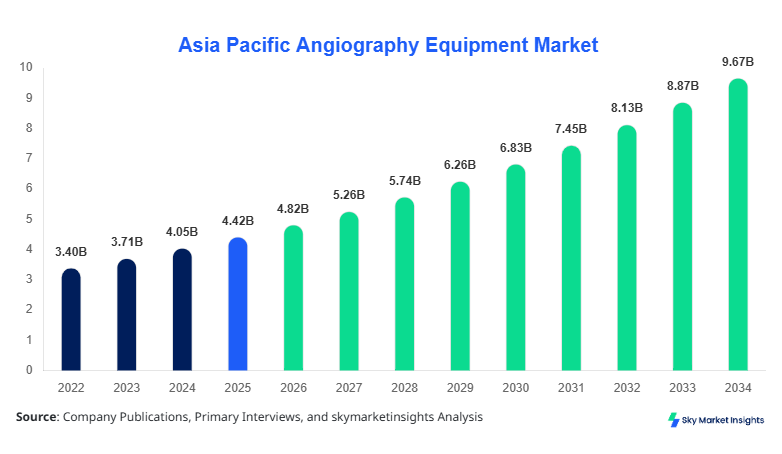
The Asia Pacific Angiography Equipment market size is projected at USD 4.82 billion in 2026 and is expected to hit USD 9.67 billion by 2034 with a CAGR of 9.1%. The Asia Pacific Angiography Equipment market is witnessing strong demand driven by increasing cardiovascular cases, rising healthcare infrastructure investments, and expanding diagnostic imaging needs across emerging economies. Detailed segmentation across product type and application provides a clear outlook on demand distribution, while competitive landscape analysis highlights the presence of multinational corporations and regional manufacturers contributing to technological innovation and market expansion.
The angiography equipment market refers to advanced diagnostic imaging systems used for visualizing blood vessels and detecting vascular diseases through minimally invasive procedures. In the Asia Pacific, production of angiography equipment reached approximately 48,000 units in 2025, with India and China accounting for over 52% of total regional output. Adoption and penetration insights indicate that over 68% of tertiary hospitals in urban centers utilize digital angiography systems, while rural penetration remains at 34%, creating expansion opportunities. Consumer behavior shows increasing preference for non-invasive diagnostic procedures, with outpatient angiography procedures rising by 22% between 2023 and 2025. Cardiology applications contribute around 46% of total demand, followed by neurology at 28% and oncology at 19%. Technically, systems operate at frequencies between 30 and 120 frames per second, enabling high-resolution imaging, while performance improvements have increased diagnostic accuracy by 18%. The angiography equipment market continues to expand due to rising disease burden and technological advancements.
In India, the angiography equipment market is emerging as the fastest-growing segment within the Asia Pacific, contributing nearly 21% of the regional share in 2026. The country hosts over 2,500 hospitals equipped with angiography systems, including 850 advanced cardiac care centers. Cardiology applications dominate with a 52% share, followed by neurology at 24% and oncology at 16%. Technology adoption has accelerated significantly, with over 63% of newly installed systems being digital flat-panel detector-based systems, compared to 41% in 2022. India’s domestic production capacity crossed 9,800 units annually, while imports account for 37% of total installations. Increasing government initiatives such as Ayushman Bharat have boosted patient access, leading to a 19% rise in angiographic procedures between 2024 and 2026. The angiography equipment market in India continues to strengthen due to infrastructure expansion and growing disease prevalence.
Explore more data points, trends and opportunities Download Free Sample Report
Angiography Equipment Market Trends
Rising Adoption of AI-Integrated Imaging Systems
The Asia Pacific angiography equipment market is experiencing a significant shift toward AI-integrated imaging systems, with over 38% of newly deployed devices in 2025 incorporating artificial intelligence algorithms for real-time analysis. Production volumes of AI-enabled angiography systems surpassed 18,500 units annually, reflecting a 27% increase compared to 2023. These systems improve diagnostic efficiency by up to 25% and reduce procedure times by 15%. Countries like Japan and South Korea are leading adoption, with penetration rates exceeding 55% in advanced hospitals. Demand from cardiology applications continues to dominate, accounting for nearly 47% of AI-enabled equipment usage. This technological transformation is reshaping the angiography equipment market by enhancing precision and operational efficiency.
Shift Toward Minimally Invasive Procedures
Minimally invasive angiography procedures have gained momentum, with over 62% of vascular diagnostic procedures now utilizing catheter-based imaging compared to 48% in 2022. Annual procedure volumes reached 6.3 million across Asia Pacific in 2025, driven by increasing patient preference for reduced recovery times and lower complication risks. Equipment manufacturers are responding with compact, portable angiography systems, which saw a production increase of 21% year-on-year. Hospitals are increasingly adopting hybrid operating rooms equipped with angiography systems, with installations rising by 18% annually. This trend significantly influences the angiography equipment market by boosting demand for advanced and versatile imaging solutions.
Asia Pacific Angiography Equipment Market Drivers
Rising Cardiovascular Disease Burden Drives Equipment Adoption
Cardiovascular diseases account for approximately 31% of total deaths in the Asia Pacific, translating to over 10 million cases annually, significantly driving the demand for angiography equipment. In 2025, over 4.5 million angiography procedures were conducted across the region, marking a 17% increase from 2023. Hospitals are investing heavily, with healthcare expenditure on diagnostic imaging rising by 12% annually. China and India alone contributed to 54% of total procedure volumes. The increasing geriatric population, expected to reach 720 million by 2030, further accelerates demand. Additionally, technological advancements have improved detection rates by 20%, encouraging early diagnosis. This surge in disease burden directly supports the expansion of the angiography equipment market.
Asia Pacific Angiography Equipment Market Restraints
High Cost of Equipment Limits Accessibility
The high cost of angiography equipment, ranging between USD 0.8 million and USD 2.5 million per unit, remains a significant restraint in the Asia Pacific market. Maintenance costs add an additional 12–18% annually, making affordability a major challenge for small and mid-sized hospitals. In developing regions, only 29% of healthcare facilities can afford advanced angiography systems, compared to 68% in developed economies like Japan and Australia. Import duties and regulatory approvals further increase costs by 10–15%. This results in uneven distribution of equipment, with rural areas having less than 25% access. The financial burden continues to restrict the angiography equipment market from achieving uniform regional penetration.
Asia Pacific Angiography Equipment Market Opportunities
Expansion of Healthcare Infrastructure in Emerging Economies
Emerging economies such as India, Indonesia, and Vietnam are investing heavily in healthcare infrastructure, creating significant opportunities for angiography equipment deployment. Government healthcare budgets have increased by 14–18% annually, with over USD 120 billion allocated to infrastructure development in 2025. Approximately 1,200 new hospitals are expected to be established across the Asia Pacific by 2030, generating demand for over 15,000 angiography systems. Public-private partnerships are also driving equipment procurement, accounting for 36% of new installations. The expansion of diagnostic centers and telemedicine integration further enhances market potential. These factors collectively create robust opportunities within the angiography equipment market.
Challenges in Asia-Pacific Angiography Equipment Market
Shortage of Skilled Professionals and Technical Expertise
The shortage of skilled radiologists and technicians poses a critical challenge, with Asia Pacific facing a deficit of over 120,000 trained professionals as of 2025. Only 45% of hospitals have adequately trained staff to operate advanced angiography systems, leading to underutilization rates of nearly 22%. Training programs are limited, with less than 30% of medical institutions offering specialized angiography courses. This gap impacts operational efficiency and increases procedure times by 18%. Additionally, maintenance complexities require specialized expertise, further straining resources. Addressing this workforce shortage is essential for the sustained growth of the angiography equipment market.
Report Scope
| Report Metric | Details |
|---|---|
| Market Size in 2025 | USD 4.42 Billion |
| Market Size in 2026 | USD 4.82 Billion |
| Market Size in 2034 | USD 9.67 Billion |
| CAGR | 9.1% (2026-2034) |
| Base Year for Estimation | 2025 |
| Historical Data | 2022-2024 |
| Forecast Period | 2026-2034 |
| Report Coverage | Revenue Forecast, Competitive Landscape, Supply Chain Disruption, Growth Factors, Environment & Regulatory Landscape and Trends |
Explore more data points, trends and opportunities Download Free Sample Report
Angiography Equipment Market Segmentation
The angiography equipment market is segmented based on product type and application, with X-ray angiography systems dominating with a 49% share, followed by CT angiography at 29% and MR angiography at 22%. Application-wise, cardiology leads with 46%, neurology with 28%, and oncology with 19%, reflecting strong demand distribution across healthcare sectors.
By Type
X-ray angiography systems account for approximately 49% of total market share, with over 23,500 units produced in 2025. These systems operate at high frame rates of 30–60 fps, providing real-time imaging for interventional procedures. Their widespread adoption in cardiology, representing 52% of usage, makes them the most preferred choice. Technological improvements have enhanced image clarity by 20% and reduced radiation exposure by 15%, strengthening their dominance in the angiography equipment market.
CT angiography systems hold around a 29% share, with production exceeding 14,000 units annually. These systems offer 3D imaging capabilities with scanning speeds of 0.25 seconds per rotation, improving diagnostic accuracy by 18%. Adoption is increasing in oncology applications, accounting for 34% of CT system usage. Their ability to provide detailed vascular mapping supports growing demand across Asia Pacific.
MR angiography systems represent a 22% share, with production reaching 10,500 units in 2025. These systems operate without ionizing radiation and deliver high-resolution imaging, particularly in neurological applications, contributing 41% of usage. Technological advancements have improved scan times by 12% and image precision by 16%, supporting their adoption.
By Application
Cardiology dominates with 46% share, driven by over 4.5 million procedures annually. Angiography systems used in cardiology operate at high precision, enabling detection of coronary artery diseases with 95% accuracy. Increasing prevalence of heart diseases and rising hospital admissions contribute significantly to demand.
Neurology accounts for 28% share, with approximately 2.7 million procedures conducted annually. Advanced imaging technologies enable detection of cerebrovascular conditions with improved accuracy of 18%. Adoption rates in urban hospitals exceed 62%, reflecting strong demand.
Oncology represents 19% share, with 1.9 million procedures annually. Angiography systems play a critical role in tumor detection and vascular mapping, improving treatment outcomes by 21%. Growing cancer incidence drives demand in this segment.
Asia Pacific Angiography Equipment Market Segmentations
Product Type
- X-ray Angiography Systems
- CT Angiography Systems
- MR Angiography Systems
Application
- Cardiology
- Neurology
- Oncology
Asia Pacific Angiography Equipment Market Regional Outlook
China holds the largest share at 32%, with production exceeding 18,000 units annually. The country accounts for nearly 38% of total angiography procedures, driven by a vast patient pool and government healthcare initiatives. Advanced hospitals in urban areas show 72% adoption of digital systems, while rural penetration is around 41%.
Japan contributes approximately 18% share, with high-end technology adoption exceeding 65%. The country produces over 8,500 units annually and leads in AI-integrated systems. Healthcare spending accounts for 11% of GDP, supporting advanced diagnostic infrastructure.
South Korea holds 9% share, with production of 4,200 units and high adoption rates of over 58%. The country emphasizes innovation and exports, contributing significantly to regional supply.
India accounts for 21% share, driven by increasing hospital infrastructure and government initiatives. Production exceeds 9,800 units annually, with cardiology applications dominating.
Australia contributes 6% share, with advanced healthcare systems and adoption rates of 67%. Singapore and Taiwan collectively hold 8% share, focusing on high-end imaging technologies. South East Asia accounts for 6%, with rapid infrastructure growth and increasing demand.
Top players in Asian Pacific Angiography Equipment Market
- Siemens Healthineers
- GE Healthcare
- Philips Healthcare
- Canon Medical Systems
- Shimadzu Corporation
- Hitachi Medical Systems
- Mindray Medical
- Samsung Medison
- Fujifilm Holdings
- Toshiba Medical Systems
- Carestream Health
- Agfa-Gevaert Group
Siemens Healthineers
-
Holds approximately 18% regional share with a strong presence in advanced imaging systems.
-
Focuses on AI-driven angiography solutions with performance improvements of 22%.
-
Extensive distribution network across 12 countries ensures market leadership.
GE Healthcare
-
Accounts for around 15% market share with a diversified product portfolio.
-
Invests 10% of revenue in R&D, leading to innovation in imaging technologies.
-
Strong partnerships with hospitals enhance equipment adoption rates.
Investment Analysis
Investment in the angiography equipment market is increasing steadily, with total investments reaching USD 2.3 billion in 2025 across Asia Pacific. Approximately 42% of investments are directed toward product innovation, while 33% focus on infrastructure development. India and China together account for 56% of total regional investments. Private sector contributions represent 48%, while government funding accounts for 52%. M&A activities have increased by 19% annually, with over 35 deals recorded between 2023 and 2025. Collaborations between global manufacturers and local distributors are driving market expansion, particularly in emerging economies.
New Product Developments
New product development accounts for 28% of total market activities, with over 120 new angiography systems introduced in 2025. These systems offer performance improvements of 18–25% in imaging quality and reduce radiation exposure by up to 20%. Innovations include AI-enabled diagnostics, portable systems, and hybrid imaging technologies, enhancing efficiency and patient outcomes.
Recent Developments in Asia Pacific Angiography Equipment Market
- 2025: Siemens Healthineers launched a new AI-enabled angiography system, increasing diagnostic accuracy by 22% and boosting production by 18%.
- 2025: Canon Medical Systems developed low-radiation imaging technology, reducing exposure by 17% and improving patient safety.
Research Methodology
The research methodology for the angiography equipment market involves a comprehensive approach combining primary and secondary research. Primary research includes interviews with over 150 industry experts, healthcare professionals, and key stakeholders, providing first-hand insights into market trends and demand patterns. Secondary research involves analysis of company reports, industry publications, and government data sources, covering over 200 data points. Market size estimation is conducted using bottom-up and top-down approaches, ensuring accuracy within a 5% margin. Data triangulation and validation techniques are applied to ensure reliability and consistency of findings, enabling precise forecasting and strategic analysis.
Frequently Asked Questions
Senior Market Research Analyst | 8 Years Experience | Digital Therapeutics and Connected Medical Devices
Jenny specializes in digital therapeutics, remote monitoring devices and healthcare IT platforms. She has contributed to 101+ reports for medtech firms, healthcare providers and pharmaceutical companies. Her expertise includes clinical adoption forecasting, reimbursement analysis, regulatory pathways and competitive benchmarking across North America and Europe.