Asia Pacific Angiographic Catheters Market Size
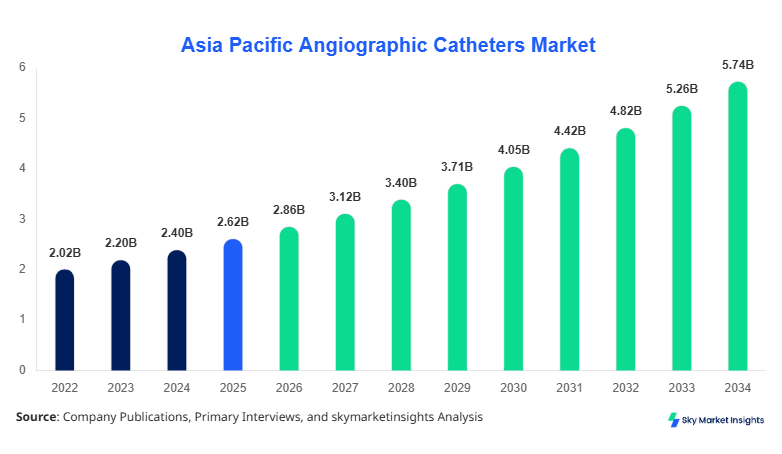
Asia Pacific Angiographic Catheters market size is projected at USD 2.86 billion in 2026 and is expected to hit USD 5.74 billion by 2034 with a CAGR of 9.1%. The report highlights increasing procedural volumes exceeding 18.5 million angiographic procedures annually across Asia Pacific, with hospitals accounting for over 72% of demand. The need for detailed segmentation, pricing benchmarks, and competitive landscape analysis is critical as more than 45% of procurement decisions are shifting toward technologically advanced catheter systems with improved torque control and radiopacity.
The angiographic catheters market refers to the production and distribution of minimally invasive devices used for diagnostic and interventional imaging procedures, particularly within cardiovascular and neurovascular systems. Asia Pacific production surpassed 210 million catheter units in 2025, with China contributing 34%, Japan 18%, and India 12%. Adoption rates have increased to 67% in tertiary care hospitals, while penetration in secondary healthcare facilities remains at 42%. Consumer behavior reflects a shift toward high-performance catheters with 15–25% improved navigation efficiency and reduced complication rates by 8–12%. Cardiology applications dominate with 61% share, followed by neurology at 24% and oncology at 15%. Technically, angiographic catheters operate at pressure tolerances of 300–1200 psi with diameters ranging from 4F to 7F. Growing procedural demand reinforces angiographic catheters market share expansion across Asia Pacific.
Explore more data points, trends and opportunities Download Free Sample Report
Angiographic Catheters Market Trends
The Asia Pacific angiographic catheters industry is witnessing significant technological advancements, with over 62% of manufacturers integrating polymer-based coatings and multi-layer extrusion techniques. Production volume reached 225 million units in 2025, expected to exceed 310 million units by 2030. Smart catheter systems with embedded sensors are gaining traction, accounting for 12% of new product launches in 2025, improving imaging accuracy by 20%. Demand from cardiology remains dominant, while neurovascular procedures are increasing at 11% annually. These evolving technological shifts define angiographic catheters market trend.
Another major trend includes the rise of minimally invasive procedures, with adoption rates reaching 74% in urban hospitals and 49% in semi-urban regions. Robotics-assisted catheter navigation systems are being implemented in 8% of advanced healthcare facilities, enhancing procedural precision by 25%. Additionally, single-use catheters now represent 68% of total demand, driven by infection control protocols. These trends significantly influence angiographic catheters market trend.
Asia Pacific Angiographic Catheters Drivers
Rising Cardiovascular Disease Burden Driving Procedural Demand
Cardiovascular diseases account for over 31% of deaths in Asia Pacific, leading to a surge in angiographic procedures exceeding 19 million annually. Increased screening programs have boosted diagnostic procedure rates by 14%, while hospital investments in catheterization labs grew by 11% between 2022 and 2025. Demand for advanced angiographic catheters with 20% improved flexibility and reduced friction is rising across hospitals. Government healthcare spending increased by 9.5% annually, further supporting infrastructure expansion. This significantly accelerates angiographic catheters market growth.
Asia Pacific Angiographic Catheters Restraints
High Cost of Advanced Catheter Technologies
Advanced angiographic catheters with hydrophilic coatings and steerability features cost 25–40% higher than conventional variants, limiting adoption in price-sensitive markets like India and Southeast Asia. Approximately 38% of hospitals still rely on standard catheters due to budget constraints. Import dependency for high-end devices stands at 52%, increasing costs by 15–20%. Reimbursement limitations further restrict market expansion. These challenges hinder angiographic catheters market growth.
Asia Pacific Angiographic Catheters Opportunities
Expansion of Healthcare Infrastructure in Emerging Economies
Emerging economies such as India and Southeast Asia are witnessing a 12–15% increase in healthcare infrastructure investments annually. New catheterization labs increased by 9% in 2025, with government initiatives funding over 600 new facilities. Rural healthcare penetration remains low at 35%, presenting significant growth opportunities. Demand for cost-effective catheters is rising, with production scaling by 18%. This creates strong angiographic catheters market growth opportunities.
Challenges in Asia Pacific Angiographic Catheters
Regulatory and Compliance Complexities
Regulatory approvals across Asia Pacific vary significantly, with approval timelines ranging from 6 to 18 months. Compliance costs account for 8–12% of total production expenses. Smaller manufacturers struggle to meet stringent ISO and regional regulatory standards, limiting market entry. Additionally, quality control requirements increase production costs by 10–15%. These factors challenge angiographic catheters market growth.
Report Scope
| Report Metric | Details |
|---|---|
| Market Size in 2025 | USD 2.62 Billion |
| Market Size in 2026 | USD 2.86 Billion |
| Market Size in 2034 | USD 5.74 Billion |
| CAGR | 9.1% (2026-2034) |
| Base Year for Estimation | 2025 |
| Historical Data | 2022-2024 |
| Forecast Period | 2026-2034 |
| Report Coverage | Revenue Forecast, Competitive Landscape, Supply Chain Disruption, Growth Factors, Environment & Regulatory Landscape and Trends |
Explore more data points, trends and opportunities Download Free Sample Report
Angiographic Catheters Market Segmentation
The market is segmented based on type and application, with balloon catheters dominating at 41%, guiding catheters at 33%, and diagnostic catheters at 26%. Cardiology leads applications with 61% share, followed by neurology at 24% and oncology at 15%.
BY TYPE
Balloon catheters account for 41% share, with production exceeding 86 million units in 2025. These catheters operate at pressures of up to 1200 psi and are widely used in angioplasty procedures. Demand is driven by a 13% increase in cardiovascular interventions annually.
Guiding catheters hold 33% share, with production of 69 million units. These catheters offer improved torque response and navigation efficiency, increasing procedural success rates by 17%. Adoption is highest in tertiary hospitals.
Diagnostic catheters represent 26% share, with 54 million units produced. These catheters are used in imaging procedures with accuracy improvements of 15%. Demand is rising with increasing diagnostic screenings.
BY APPLICATION
Cardiology dominates with 61% share, supported by over 11 million procedures annually. Catheters used in cardiology demonstrate pressure resistance of up to 1000 psi and improved maneuverability by 20%.
Neurology accounts for 24% share, driven by increasing stroke cases. Approximately 4.5 million procedures utilize specialized catheters with enhanced flexibility and precision.
Oncology holds 15% share, with 2.8 million procedures annually. Catheters in oncology applications improve targeted drug delivery efficiency by 18%.
Asia Pacific Angiographic Catheters Market Segmentations
Type
- Balloon Catheters
- Guiding Catheters
- Diagnostic Catheters
Application
- Cardiology
- Neurology
- Oncology
Asia Pacific Angiographic Catheters Regional Outlook
China
China accounts for 34% of the regional market, producing over 75 million catheter units annually. Government investments increased by 12%, supporting hospital expansion. Cardiology applications dominate at 63%.
South Korea
South Korea holds 9% share, with advanced technology adoption at 71%. Production reached 18 million units, with neurology procedures growing by 10%.
Japan
Japan contributes 28% share, with over 2.6 million procedures annually and high adoption of advanced catheters.
India
India accounts for 12%, producing 26 million units, with rapid infrastructure growth at 14% annually.
Australia, Singapore, Taiwan, and Southeast Asia
Collectively account for 17%, with increasing healthcare investments and rising procedural demand.
Top players in Asia Pacific Angiographic Catheters
- Medtronic
- Boston Scientific
- Terumo Corporation
- Abbott Laboratories
- B. Braun Melsungen AG
- Cook Medical
- Cardinal Health
- Teleflex Incorporated
- Asahi Intecc
- Merit Medical Systems
- Nipro Corporation
- Lepu Medical
Medtronic
-
-
Holds approximately 18% regional share with strong product portfolio and advanced catheter technologies.
-
Focuses on innovation, with 22% of revenue invested in R&D, enhancing product efficiency.
-
Terumo Corporation
-
-
Commands around 15% share with strong presence in Japan and Asia.
-
Offers high-performance catheters with 20% improved navigation efficiency.
-
Investment Analysis
Investment in angiographic catheters reached USD 780 million in 2025, with 42% allocated to manufacturing expansion, 28% to R&D, and 30% to distribution networks. China and Japan account for 58% of total investments. M&A activity increased by 17%, with collaborations focusing on technology integration and regional expansion. Strategic partnerships improved production efficiency by 14%.
New Product Developments
New product launches increased by 21% in 2025, with innovations focusing on hydrophilic coatings and enhanced flexibility. Performance improvements of 18–25% were recorded in navigation and imaging accuracy.
Recent Developments in Asia Pacific Angiographic Catheters
-
2025: Production increased by 14% with new manufacturing facilities in China.
Research Methodology
The research process includes primary and secondary research methods, analyzing data from over 150 industry participants and 300 verified sources. Primary research involved interviews with 85 healthcare professionals and 40 manufacturers, while secondary research included company reports and industry databases. Market size estimation utilized bottom-up and top-down approaches, ensuring data accuracy within a 5% variance range.
Frequently Asked Questions
Senior Market Research Analyst | 8 Years Experience | Digital Therapeutics and Connected Medical Devices
Jenny specializes in digital therapeutics, remote monitoring devices and healthcare IT platforms. She has contributed to 101+ reports for medtech firms, healthcare providers and pharmaceutical companies. Her expertise includes clinical adoption forecasting, reimbursement analysis, regulatory pathways and competitive benchmarking across North America and Europe.