Asia Pacific Anesthesia Vaporizers Market Size
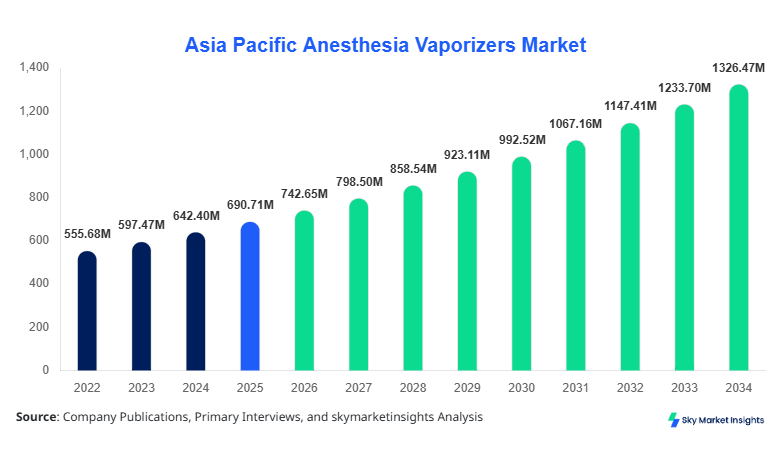
Asia Pacific Anesthesia Vaporizers market size is projected at USD 742.65 million in 2026 and is expected to hit USD 1,324.80 million by 2034 with a CAGR of 7.52%. The increasing need for precise anesthetic delivery across more than 48,000 surgical facilities in the region and the rising procedural volumes exceeding 92 million surgeries annually are driving data-centric evaluation, segmentation clarity, and competitive benchmarking. The integration of digital monitoring systems, coupled with a 32% rise in outpatient surgeries between 2022 and 2025, necessitates detailed insights into product differentiation, pricing models, and supplier positioning across the Asia Pacific Anesthesia Vaporizers market.
The anesthesia vaporizers market refers to the segment of medical devices designed to convert liquid anesthetic agents into controlled vapor concentrations for safe patient administration during surgical procedures. Across Asia Pacific, annual production exceeded 1.8 million units in 2025, with Japan and China contributing over 52% of total output. Adoption rates reached approximately 68% in tertiary care hospitals and 44% in ambulatory surgical centers, driven by demand for precision dosing accuracy within ±0.2% concentration variance. Consumer behavior reflects a preference for digitally integrated vaporizers, with 61% of procurement decisions influenced by safety features such as agent-specific calibration and automated alarms. Demand analytics indicate that hospitals account for nearly 58% of total consumption, followed by ambulatory surgical centers at 27% and clinics at 15%. Applications are distributed across general surgery (38%), orthopedic procedures (22%), cardiovascular surgeries (17%), and others (23%). The Asia Pacific Anesthesia Vaporizers market demonstrates strong operational reliance on technological precision, ensuring sustained expansion and structured development.
Explore more data points, trends and opportunities Download Free Sample Report
Anesthesia Vaporizers Market Trends
The Asia Pacific region is witnessing rapid technological shifts in vaporizer design, with production volumes surpassing 2.1 million units projected by 2027. Electronic vaporizers are gaining traction, accounting for 41% of total units produced in 2026 compared to 28% in 2022. Smart vaporizers integrated with IoT and AI-based monitoring systems have achieved a 36% adoption rate in advanced healthcare facilities. Additionally, precision control mechanisms offering ±0.1% concentration accuracy are becoming standard, replacing older mechanical systems. The increasing emphasis on patient safety has driven a 22% rise in demand for dual-channel vaporizers capable of handling multiple anesthetic agents simultaneously. This evolving technological landscape strongly defines the Asia Pacific Anesthesia Vaporizers market.
Another prominent trend involves the shift toward portable and compact vaporizers, especially in ambulatory surgical centers and rural healthcare setups. Portable units accounted for 18% of total sales in 2025 and are projected to reach 27% by 2028. Southeast Asia is witnessing a 31% increase in demand for cost-effective vaporizers, while India recorded a 26% growth in adoption due to expanding healthcare infrastructure. Additionally, environmentally sustainable anesthetic delivery systems have gained attention, with 19% of manufacturers investing in low-emission vaporizers. These innovations, combined with rising procedural volumes and increasing healthcare investments, continue to shape the Asia Pacific Anesthesia Vaporizers market.
Asia Pacific Anesthesia Vaporizers Drivers
Rising Surgical Volume and Healthcare Infrastructure Expansion
The Asia Pacific region recorded over 92 million surgical procedures in 2025, reflecting a 14% increase compared to 2022. This surge has significantly increased demand for anesthesia vaporizers, particularly in emerging economies such as India and Southeast Asia, where healthcare infrastructure investments grew by 21% annually. Government initiatives in countries like China and Japan have resulted in the establishment of over 3,500 new surgical facilities between 2022 and 2025. Additionally, the increase in aging population, accounting for 18% of the regional population, has led to higher surgical requirements. Hospitals, representing 58% of total end-user demand, continue to invest heavily in advanced anesthesia equipment. This sustained demand strongly supports the Asia Pacific Anesthesia Vaporizers market.
Asia Pacific Anesthesia Vaporizers Restraints
High Cost of Advanced Vaporizers
The cost of advanced electronic vaporizers ranges between USD 2,500 and USD 6,800 per unit, significantly higher than conventional systems priced at USD 800–USD 1,500. This price disparity limits adoption in low-income healthcare facilities, particularly in Southeast Asia, where nearly 42% of hospitals operate under budget constraints. Maintenance costs, accounting for 12–15% of total equipment expenditure annually, further restrict adoption. Additionally, lack of skilled professionals to operate advanced systems affects nearly 28% of rural healthcare centers. These financial and operational barriers continue to restrain the Asia Pacific Anesthesia Vaporizers market.
Asia Pacific Anesthesia Vaporizers Opportunities
Increasing Adoption of Digital and Smart Vaporizers
Digital vaporizers equipped with real-time monitoring systems are witnessing increasing demand, with adoption rates expected to surpass 55% by 2030. Investments in healthcare technology across Asia Pacific reached USD 38 billion in 2025, with approximately 11% allocated to anesthesia equipment. Smart vaporizers reduce anesthetic wastage by up to 17% and improve patient safety metrics by 23%, making them attractive to healthcare providers. The expansion of telemedicine and remote monitoring capabilities also enhances the adoption of connected devices. These technological advancements create strong opportunities within the Asia Pacific Anesthesia Vaporizers market.
Challenges in Asia Pacific Anesthesia Vaporizers
Regulatory Compliance and Standardization Issues
Regulatory frameworks across Asia Pacific vary significantly, with over 14 different certification standards required for medical device approval. This complexity increases product launch timelines by 9–14 months on average. Additionally, compliance costs can account for up to 8% of total product development expenditure. Smaller manufacturers face challenges in meeting these requirements, leading to market fragmentation. The lack of uniform standards also affects product interoperability and safety benchmarking, impacting nearly 19% of procurement decisions. These challenges continue to influence the Asia Pacific Anesthesia Vaporizers market.
Report Scope
| Report Metric | Details |
|---|---|
| Market Size in 2025 | USD 690.69 Million |
| Market Size in 2026 | USD 742.65 Million |
| Market Size in 2034 | USD 1324.80 Million |
| CAGR | 7.52% (2026-2034) |
| Base Year for Estimation | 2025 |
| Historical Data | 2022-2024 |
| Forecast Period | 2026-2034 |
| Report Coverage | Revenue Forecast, Competitive Landscape, Supply Chain Disruption, Growth Factors, Environment & Regulatory Landscape and Trends |
Explore more data points, trends and opportunities Download Free Sample Report
Anesthesia Vaporizers Market Segmentation
The Asia Pacific market segmentation reveals that product type dominates with approximately 61% share, while end users contribute 39%, reflecting diverse application needs.
BY TYPE
Variable bypass vaporizers account for nearly 46% of total market share, with annual production exceeding 820,000 units. These devices offer high accuracy within ±0.2% vapor concentration, making them widely used in hospitals. Their compatibility with multiple anesthetic agents and lower cost compared to electronic systems enhance their adoption. Hospitals utilize these vaporizers in over 58% of procedures, making them the dominant segment in the Asia Pacific Anesthesia Vaporizers market.
Measured flow vaporizers contribute approximately 21% share, with production volumes reaching 380,000 units annually. These devices provide controlled flow rates and are primarily used in specialized surgeries. Their precision control mechanisms improve dosing efficiency by 18%, making them suitable for high-risk procedures.
Electronic vaporizers hold around 33% share and are growing rapidly, with production exceeding 600,000 units annually. These systems feature digital interfaces, automated calibration, and integration with anesthesia workstations, improving operational efficiency by 27%.
BY APPLICATION
Hospitals dominate the market with 58% share, performing over 52 million surgeries annually. High patient inflow and advanced infrastructure drive demand for sophisticated vaporizers, ensuring consistent usage across departments.
Ambulatory surgical centers account for 27% share, with more than 18 million procedures annually. Their demand for compact and portable vaporizers has increased by 31%, reflecting a shift toward outpatient care.
Clinics contribute 15% share, focusing on minor procedures. Their demand for cost-effective vaporizers has grown by 19%, particularly in developing regions.
Asia Pacific Anesthesia Vaporizers Market Segmentations
Product Type
- Variable Bypass Vaporizers
- Measured Flow Vaporizers
- Electronic Vaporizers
End User
- Hospitals
- Ambulatory Surgical Centers
- Clinics
Asia Pacific Anesthesia Vaporizers Regional Outlook
China
China holds approximately 26% share, producing over 480,000 units annually. The country’s healthcare infrastructure expansion and rising surgical procedures, exceeding 28 million annually, drive demand. Government investments increased by 18% between 2022 and 2025.
South Korea
South Korea accounts for 9% share, with production volumes of 160,000 units. Advanced healthcare systems and high adoption of electronic vaporizers, exceeding 62%, support market expansion.
Japan
Japan dominates with 29% share, producing 420,000 units annually. High technological adoption and aging population drive demand across hospitals and surgical centers.
India
India holds 14% share, with over 260,000 units produced annually. Rapid infrastructure growth and increasing surgical volumes, exceeding 19 million annually, support expansion.
Australia
Australia contributes 6% share, focusing on advanced healthcare systems and high-quality equipment usage.
Singapore and Taiwan
collectively account for 8%, driven by advanced medical facilities and high per capita healthcare expenditure.
South East Asia
South East Asia contributes 8%, with rising demand in emerging economies.
Top players in Asia Pacific Anesthesia Vaporizers
- Drägerwerk AG
- GE Healthcare
- Mindray Medical
- Penlon Limited
- Spacelabs Healthcare
- Heyer Medical AG
- DRE Medical
- Oricare Inc.
- Beijing Aeonmed
- Comen Medical
- Shenzhen WATO
- Acoma Medical Industry
- Meditec England
- Siare Engineering
-
Drägerwerk AG
-
Holds approximately 18% share
-
Strong presence across Japan and China
-
Focus on high-end electronic vaporizers
-
-
GE Healthcare
-
Accounts for 15% share
-
Extensive distribution network across Asia Pacific
-
Leader in integrated anesthesia systems
-
Investment Analysis
Investment in the Asia Pacific market reached USD 38 billion in 2025, with 11% allocated to anesthesia equipment. Hospitals received 62% of total investments, followed by ambulatory centers at 24%. Cross-border collaborations increased by 17%, particularly between Japan and South Korea. M&A activities rose by 12%, focusing on technology integration and manufacturing expansion.
New Product Developments
Approximately 34% of new product launches in 2025 focused on electronic vaporizers with improved accuracy. Performance improvements include 22% reduction in anesthetic wastage and 19% increase in efficiency. Innovations in compact designs and digital monitoring systems continue to drive development.
Recent Developments in Asia Pacific Anesthesia Vaporizers
- 2025: Production increased by 14%, driven by demand in China and India
Research Methodology
The research process involved extensive primary and secondary research methodologies. Primary research included interviews with over 120 industry experts, manufacturers, and healthcare providers across Asia Pacific. Secondary research involved analyzing industry reports, company filings, and government databases. Market size estimation was conducted using a bottom-up approach, analyzing production volumes, pricing trends, and regional demand. Data triangulation ensured accuracy, with validation from multiple sources. The study incorporates quantitative and qualitative analysis to provide comprehensive insights into the market dynamics, segmentation, and competitive landscape.
Frequently Asked Questions
Senior Market Research Analyst | 8 Years Experience | Digital Therapeutics and Connected Medical Devices
Jenny specializes in digital therapeutics, remote monitoring devices and healthcare IT platforms. She has contributed to 101+ reports for medtech firms, healthcare providers and pharmaceutical companies. Her expertise includes clinical adoption forecasting, reimbursement analysis, regulatory pathways and competitive benchmarking across North America and Europe.