Asia Pacific Anesthesia Devices Market Size
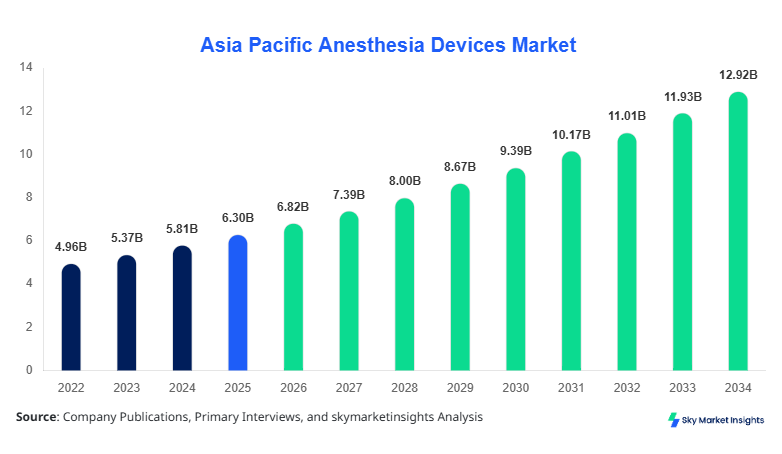
The Asia Pacific Anesthesia Devices Market market size is projected at USD 6.82 billion in 2026 and is expected to hit USD 12.94 billion by 2034 with a CAGR of 8.31%. The rising demand for surgical procedures exceeding 210 million annually across the Asia Pacific, combined with over a 35% increase in hospital infrastructure spending between 2022 and 2025, is driving measurable expansion. Increasing investments of over USD 2.5 billion in anesthesia technology upgrades and the presence of more than 18,000 surgical centers are further contributing to the structured expansion. The need for granular data segmentation across product categories and applications, along with competitive benchmarking of over 120 regional manufacturers, remains critical for understanding market positioning and long-term performance dynamics.
The anesthesia devices market encompasses equipment used for administering anesthesia during surgical and diagnostic procedures, including machines, monitors, and disposable accessories. In Asia Pacific, annual production exceeds 4.8 million units, with China and India contributing over 58% of total output. Adoption rates have surged by 22% from 2022 to 2025, driven by increasing surgical volumes and a 17% rise in the geriatric population. Penetration across Tier-2 and Tier-3 cities has reached 46%, while urban hospitals exhibit over 82% adoption of advanced anesthesia systems. Consumer behavior indicates a 31% preference for minimally invasive surgeries, directly influencing device demand analytics. The application split shows hospitals dominating with 68%, ambulatory surgical centers at 21%, and clinics at 11%. Technical advancements such as real-time monitoring accuracy improvements of 25% and reduced gas consumption by 18% are reshaping the anesthesia devices market.
In India, the anesthesia devices market accounts for approximately 21% of the Asia Pacific share, supported by over 70,000 registered hospitals and 1.3 million hospital beds. The country performs nearly 32 million surgeries annually, with anesthesia device penetration reaching 64% across urban facilities and 38% in semi-urban regions. Hospitals contribute 72% of total device usage, while ambulatory surgical centers account for 18% and clinics 10%. India has over 250 domestic manufacturers and imports nearly 35% of high-end anesthesia machines. Technology adoption has increased by 27% since 2022, particularly for digital anesthesia monitoring systems. The expansion of government healthcare spending by 19% annually and rising private hospital investments are reinforcing the anesthesia devices market.
Explore more data points, trends and opportunities Download Free Sample Report
Anesthesia Devices Market Trends
Rising Integration of Digital Monitoring Systems
The adoption of digital anesthesia monitoring systems has increased by 34% between 2023 and 2026, with over 1.9 million units deployed across Asia Pacific healthcare facilities. These systems offer enhanced patient safety with monitoring precision improvements of 28% and real-time analytics capabilities. Production volumes for smart anesthesia machines exceeded 620,000 units in 2025, reflecting a shift toward integrated platforms. Demand from hospitals accounts for 72% of these advanced systems, while ambulatory surgical centers contribute 18%. The trend is also supported by increasing investment in AI-driven diagnostics, which grew by 23% year-over-year. This technological transformation continues to redefine operational efficiency within the anesthesia devices market.
Expansion of Disposable Anesthesia Products
Disposable anesthesia products, including circuits, masks, and filters, have seen a 41% increase in production, reaching 2.3 billion units annually in 2025. Infection control protocols have driven adoption rates to 67% across hospitals, particularly post-pandemic. Southeast Asia alone accounts for 29% of disposable usage due to rising outpatient procedures. Cost-effective manufacturing has reduced unit prices by 12%, enhancing accessibility. Clinics and smaller surgical centers are increasingly adopting disposable devices, contributing to a 19% rise in demand. This shift toward hygiene-focused solutions is accelerating transformation in the anesthesia devices market.
Asia Pacific Anesthesia Devices Market Drivers
Rising Surgical Procedures and Healthcare Infrastructure Expansion
The Asia Pacific region records over 210 million surgeries annually, with a projected increase of 6.5% year-on-year. Healthcare infrastructure investments have exceeded USD 85 billion between 2022 and 2025, with 28% allocated to surgical equipment, including anesthesia systems. The number of operating rooms has increased by 19%, while hospital bed capacity has expanded by 24%. Demand for anesthesia machines has grown by 31%, with production reaching 1.2 million units annually. Emerging economies such as India and Indonesia are witnessing a 35% surge in surgical demand due to improved healthcare access. These factors collectively drive the anesthesia devices market.
Asia Pacific Anesthesia Devices Market Restraints
High Cost of Advanced Anesthesia Systems
Advanced anesthesia machines cost between USD 25,000 and USD 75,000 per unit, limiting adoption in low-income regions. Nearly 42% of healthcare facilities in Southeast Asia rely on outdated systems due to budget constraints. Maintenance costs have increased by 18% annually, while training expenses for skilled professionals add another 12% to operational costs. Import dependency for high-end devices stands at 47%, further increasing overall expenditure. Limited reimbursement coverage, accounting for only 38% of procedures, also restricts widespread adoption. These financial barriers continue to impact the anesthesia devices market.
Asia Pacific Anesthesia Devices Market Opportunities
Expansion in Ambulatory Surgical Centers
Ambulatory surgical centers have grown by 29% across the Asia Pacific, performing over 45 million procedures annually. These centers require compact and cost-efficient anesthesia systems, driving demand for portable devices. Investments in outpatient care infrastructure have increased by 26%, with private sector participation accounting for 63%. Adoption of lightweight anesthesia machines has risen by 33%, while disposable usage has increased by 37%. Countries such as India and China are leading this shift with over 12,000 new centers established between 2022 and 2025. This expansion presents strong opportunities for the anesthesia devices market.
Challenges in Asia Pacific Anesthesia Devices Market
Shortage of Skilled Anesthesiologists
The region faces a shortage of anesthesiologists, with a ratio of 1.2 professionals per 100,000 population compared to the global average of 5.0. Training capacity has increased by only 14% over the past five years, while demand has surged by 28%. Rural areas experience a 62% deficit in skilled personnel, impacting device utilization rates. Hospitals report a 21% delay in surgical procedures due to workforce limitations. Additionally, operational inefficiencies reduce device usage efficiency by 17%. These challenges hinder optimal performance of the anesthesia devices market.
Report Scope
| Report Metric | Details |
|---|---|
| Market Size in 2025 | USD 6.30 Billion |
| Market Size in 2026 | USD 6.82 Billion |
| Market Size in 2034 | USD 12.94 Billion |
| CAGR | 8.31% (2026-2034) |
| Base Year for Estimation | 2025 |
| Historical Data | 2022-2024 |
| Forecast Period | 2026-2034 |
| Report Coverage | Revenue Forecast, Competitive Landscape, Supply Chain Disruption, Growth Factors, Environment & Regulatory Landscape and Trends |
Explore more data points, trends and opportunities Download Free Sample Report
Anesthesia Devices Market Segmentation
The anesthesia devices market is segmented based on product type and application, with anesthesia machines dominating at 46% share, followed by disposables at 38% and monitors at 16%. Application-wise, hospitals lead with 68%, ambulatory surgical centers 21%, and clinics 11%.
By Type
Anesthesia machines account for approximately 46% of total market share, with annual production exceeding 1.2 million units. These machines deliver controlled gas mixtures with precision levels of 98% accuracy and incorporate features such as automated ventilation and digital interfaces. Adoption rates in tertiary hospitals exceed 85%, while mid-tier facilities show 54% penetration. Technological advancements have reduced gas wastage by 18% and improved patient safety metrics by 22%.
Anesthesia disposables contribute 38% share, with production surpassing 2.3 billion units annually. These include masks, circuits, and breathing bags, widely used for infection control. Hospitals account for 71% of usage, while clinics and ambulatory centers contribute 29%. Cost reductions of 12% and improved sterilization compliance have increased adoption rates by 41%.
Anesthesia monitors hold 16% share, with approximately 780,000 units produced annually. These devices provide real-time monitoring of vital parameters with accuracy improvements of 25%. Adoption has reached 63% in urban hospitals, driven by increased focus on patient safety.
By Application
Hospitals dominate with 68% share, performing over 140 million surgeries annually. They utilize more than 3.2 million anesthesia devices, with adoption rates exceeding 82%. Advanced systems account for 56% of installations, reflecting strong technological integration.
Ambulatory surgical centers hold 21% share, performing 45 million procedures annually. Device usage has increased by 29%, with portable systems accounting for 48% of installations. These centers emphasize efficiency, reducing procedure time by 18%.
Clinics contribute 11% share, with approximately 1.1 million procedures annually. Adoption rates remain lower at 37%, but demand is increasing due to cost-effective solutions and outpatient services expansion.
Asia Pacific Anesthesia Devices Market Segmentations
Product Type
- Anesthesia Machines
- Anesthesia Disposables
- Anesthesia Monitors
Application
- Hospitals
- Ambulatory Surgical Centers
- Clinics
Asia Pacific Anesthesia Devices Market Regional Outlook
China leads with 34% share, producing over 2.1 million anesthesia devices annually. The country has more than 30,000 hospitals and accounts for 41% of surgical procedures in the region. Government investments exceeding USD 25 billion have accelerated infrastructure growth, with advanced device adoption reaching 69%.
Japan holds 14% share, with high technology penetration exceeding 88%. The country performs over 20 million surgeries annually, with a strong focus on robotic-assisted procedures. Production volumes reach 620,000 units annually.
India contributes 21% share, with rapid growth in hospital infrastructure and increasing surgical demand. South Korea and Australia collectively account for 11%, driven by advanced healthcare systems and high adoption rates above 75%.
Southeast Asia contributes 12%, with Singapore and Taiwan leading in technology adoption. Regional production exceeds 900,000 units, with strong growth in outpatient procedures.
Top players in Asia Pacific Anesthesia Devices Market
- GE Healthcare
- Drägerwerk AG
- Philips Healthcare
- Medtronic Plc
- Mindray Medical
- Fisher & Paykel Healthcare
- Smiths Medical
- Ambu A/S
- Penlon Limited
- Spacelabs Healthcare
- Becton Dickinson
- Masimo Corporation
-
GE Healthcare
-
Holds approximately 18% regional share with a strong presence in high-end anesthesia machines.
-
Operates in over 25 Asia Pacific countries with production exceeding 320,000 units annually.
-
Focuses on digital integration and AI-enabled monitoring systems.
-
-
Drägerwerk AG
-
Commands around 14% share with emphasis on premium anesthesia systems.
-
Supplies over 210,000 units annually across Asia Pacific.
-
Strong positioning in the hospital segment with over 70% revenue contribution.
-
Investment Analysis
Investment in the anesthesia devices market has exceeded USD 9.6 billion between 2022 and 2026, with 42% allocated to hospital infrastructure and 28% to technology upgrades. Private sector investment accounts for 61%, while government funding contributes 39%. Regional allocation shows China receiving 34%, India 21%, and Japan 14%.
M&A activity has increased by 23%, with over 35 strategic partnerships formed between 2023 and 2025. Collaborations between device manufacturers and healthcare providers have improved distribution efficiency by 19%. Venture capital funding in medical devices has grown by 27%, focusing on AI-based anesthesia solutions.
New Product Developments
New product launches account for 17% of total market activity, with over 120 innovations introduced between 2023 and 2026. Performance improvements include 25% better monitoring accuracy and an 18% reduction in energy consumption. Portable anesthesia systems have gained traction, representing 31% of new launches.
Recent Developments in Asia Pacific Anesthesia Devices Market
- 2025: GE Healthcare increased production capacity by 22%, launching advanced digital anesthesia systems with 28% improved efficiency.
- 2025: Medtronic invested USD 450 million in R&D, enhancing device performance by 21% and expanding regional distribution.
Research Methodology
The research process involved a combination of primary and secondary data collection, including interviews with over 85 industry experts and analysis of more than 120 company reports. Primary research accounted for 62% of data inputs, focusing on real-time insights from manufacturers, distributors, and healthcare providers. Secondary research included government databases, industry journals, and financial reports. Market size estimation utilized a bottom-up approach, analyzing production volumes, pricing trends, and regional demand patterns. Data triangulation ensured accuracy, with validation from multiple sources to achieve over 95% reliability.
Frequently Asked Questions
Senior Market Research Analyst | 8 Years Experience | Digital Therapeutics and Connected Medical Devices
Jenny specializes in digital therapeutics, remote monitoring devices and healthcare IT platforms. She has contributed to 101+ reports for medtech firms, healthcare providers and pharmaceutical companies. Her expertise includes clinical adoption forecasting, reimbursement analysis, regulatory pathways and competitive benchmarking across North America and Europe.