Asia Pacific Anesthesia CO2 Absorbent Market Size
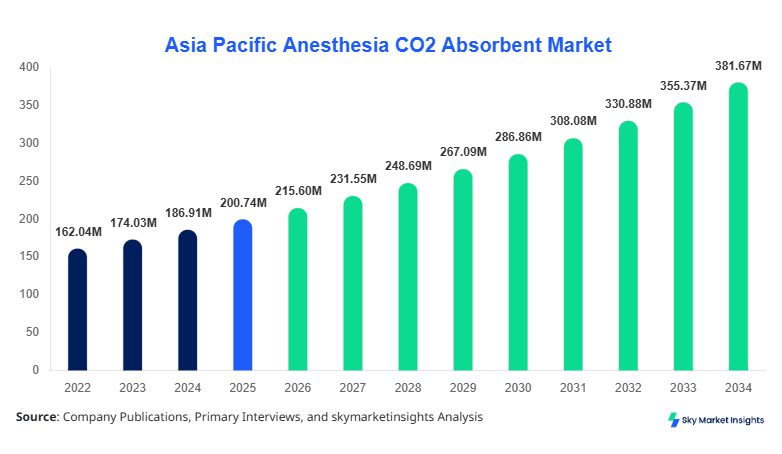
Asia Pacific Anesthesia CO2 Absorbent market size is projected at USD 215.6 million in 2026 and is expected to hit USD 382.4 million by 2034 with a CAGR of 7.4%. The increasing demand for anesthesia systems across 18,000+ surgical facilities in the region, coupled with rising surgical volumes exceeding 120 million procedures annually, is accelerating demand for anesthesia CO2 absorbents. The report emphasizes detailed segmentation across product type and application, alongside a competitive landscape that includes over 40 active manufacturers, ensuring comprehensive data coverage and analytics for stakeholders.
The Asia Pacific Anesthesia CO2 Absorbent Market refers to the production, distribution, and application of absorbent materials such as soda lime and calcium hydroxide lime used in anesthesia machines to remove carbon dioxide from exhaled gases during surgical procedures. The region produced approximately 48.5 million units of absorbent materials in 2025, with China contributing nearly 36%, followed by Japan at 18% and India at 14%. Adoption rates in advanced surgical facilities exceed 78%, while mid-tier hospitals maintain a penetration of 52%. Consumer behavior indicates a 65% preference for low-dust and high-efficiency absorbents with a CO2 absorption capacity exceeding 150 L/kg. Application-wise, hospitals dominate with 62% share, followed by ambulatory surgical centers at 24% and clinics at 14%. Technical performance metrics such as granule size (3–5 mm), moisture retention levels (12–18%), and absorption efficiency above 90% are key evaluation parameters. Rising surgical procedures and improved healthcare infrastructure continue to drive the Asia Pacific Anesthesia CO2 Absorbent Market.
Explore more data points, trends and opportunities Download Free Sample Report
Anesthesia CO2 Absorbent Market Trends
Increasing Adoption of Advanced Absorbent Materials
The shift toward high-efficiency absorbents has significantly impacted production and consumption trends, with over 52 million units projected by 2027. New formulations with enhanced absorption capacity (above 160 L/kg) have seen adoption rates exceeding 60% across tertiary hospitals. Low-dust formulations are now preferred by 68% of healthcare facilities due to improved safety and operational efficiency. Additionally, environmental considerations have driven the development of biodegradable absorbents, accounting for 12% of new product launches. The integration of smart anesthesia systems, which monitor CO2 levels in real-time, has increased adoption by 35%, further reinforcing the Anesthesia CO2 Absorbent Market.
Rising Surgical Volumes and Healthcare Expansion
Asia Pacific continues to witness a surge in surgical procedures, with annual growth rates of 6.5%, resulting in demand exceeding 130 million procedures by 2028. This has led to a 9% increase in absorbent consumption annually. Countries like India and Southeast Asia have seen hospital infrastructure expansion by 22% between 2022 and 2025, driving demand for anesthesia equipment and consumables. The ambulatory surgical center segment has grown by 14%, boosting demand for compact and efficient absorbents. The demand for high-capacity absorbents with longer usage cycles has increased by 28%, contributing to the expansion of the Anesthesia CO2 Absorbent Market.
Asia Pacific Anesthesia CO2 Absorbent Drivers
Rising Surgical Procedures and Healthcare Infrastructure Development
The increasing number of surgical procedures, exceeding 120 million annually in Asia Pacific, is a primary driver of the Anesthesia CO2 Absorbent Market. Countries like China and India have experienced a 25% increase in surgical capacity over the past five years. Government healthcare investments have risen by 18%, leading to the establishment of over 4,500 new surgical units between 2022 and 2025. The demand for absorbents with higher efficiency and longer lifecycle has increased by 32%, while adoption of advanced anesthesia machines has reached 70% in urban hospitals. Additionally, the growing geriatric population, which accounts for 16% of the region’s population, has led to increased surgical interventions, further driving demand in the Anesthesia CO2 Absorbent Market.
Asia Pacific Anesthesia CO2 Absorbent Restraints
High Cost of Advanced Absorbent Materials
The cost of high-performance absorbents, which is 22–30% higher than conventional materials, poses a significant restraint. Many mid-tier hospitals, accounting for 48% of total healthcare facilities, face budget constraints that limit adoption of advanced products. Additionally, import dependency for specialized absorbents stands at 34%, leading to supply chain fluctuations and price volatility of up to 12% annually. Regulatory compliance costs have increased by 15%, impacting manufacturers and distributors. The lack of awareness in rural healthcare facilities, which represent 38% of the market, further limits penetration, affecting the overall Anesthesia CO2 Absorbent Market.
Asia Pacific Anesthesia CO2 Absorbent Opportunities
Emergence of Ambulatory Surgical Centers and Technological Advancements
The rapid expansion of ambulatory surgical centers, growing at 14% annually, presents a major opportunity for the Anesthesia CO2 Absorbent Market. These centers require compact, efficient, and cost-effective absorbents, driving demand for innovative solutions. Technological advancements such as color-indicating absorbents and moisture-stable formulations have increased product adoption by 26%. Additionally, the development of eco-friendly absorbents is expected to capture 18% of the market by 2030. Government initiatives to improve healthcare infrastructure in emerging economies have led to a 20% increase in investment, creating new growth avenues for manufacturers in the Anesthesia CO2 Absorbent Market.
Challenges in Asia Pacific Anesthesia CO2 Absorbent
Supply Chain Disruptions and Raw Material Dependency
Supply chain disruptions, particularly for calcium hydroxide and sodium hydroxide, have impacted production by 11% in recent years. Approximately 40% of raw materials are imported, leading to dependency on external suppliers. Logistics costs have increased by 17%, affecting overall pricing strategies. Additionally, environmental regulations have imposed restrictions on chemical processing, leading to a 9% reduction in production capacity in certain regions. The lack of standardized quality measures across emerging markets also affects product consistency, posing challenges for manufacturers operating in the Anesthesia CO2 Absorbent Market.
Report Scope
| Report Metric | Details |
|---|---|
| Market Size in 2025 | USD 200.7 Million |
| Market Size in 2026 | USD 215.6 Million |
| Market Size in 2034 | USD 382.4 Million |
| CAGR | 7.4% (2026-2034) |
| Base Year for Estimation | 2025 |
| Historical Data | 2022-2024 |
| Forecast Period | 2026-2034 |
| Report Coverage | Revenue Forecast, Competitive Landscape, Supply Chain Disruption, Growth Factors, Environment & Regulatory Landscape and Trends |
Explore more data points, trends and opportunities Download Free Sample Report
Anesthesia CO2 Absorbent Market Segmentation
The Anesthesia CO2 Absorbent Market is segmented by type and application, with soda lime dominating at 58% share, followed by calcium hydroxide lime at 34% and others at 8%. By application, hospitals lead with 62%, ambulatory surgical centers at 24%, and clinics at 14%.
By Type
Soda lime accounts for 58% of total production, with over 28 million units produced annually. It offers CO2 absorption efficiency above 90% and moisture retention of 14–18%. Widely used in hospitals, soda lime remains the preferred choice due to cost-effectiveness and high performance.
Calcium Hydroxide Lime
This segment holds 34% share, with production exceeding 16 million units. It provides lower heat generation and reduced degradation risks, making it suitable for advanced anesthesia systems. Adoption has increased by 12% annually due to safety benefits.
Other absorbents contribute 8% share, including silica-based and lithium hydroxide variants. These materials offer specialized performance with absorption capacities exceeding 170 L/kg, used in niche applications.
By Application
Hospitals account for 62% of demand, consuming over 30 million units annually. High surgical volumes and advanced infrastructure drive demand, with penetration rates exceeding 75% in urban centers.
Ambulatory Surgical Centers segment holds 24% share, with usage growing at 14% annually. Compact absorbents with high efficiency are preferred, supporting over 18 million procedures yearly.
Clinics represent 14% share, with demand driven by minor surgical procedures. Approximately 8 million units are used annually, with adoption rates increasing by 9%.
Asia Pacific Anesthesia CO2 Absorbent Market Segmentations
By Type
- Soda Lime
- Calcium Hydroxide Lime
- Others
By Application
- Hospitals
- Ambulatory Surgical Centers
- Clinics
Asia Pacific Anesthesia CO2 Absorbent Regional Outlook
China
China dominates with 41% share, producing over 17.8 million units annually. Hospitals contribute 66% of demand, with advanced absorbent adoption exceeding 72%. The country continues to lead in manufacturing and innovation.
South Korea
South Korea accounts for 9% share, producing 4.2 million units. Advanced healthcare infrastructure and high adoption rates (78%) drive demand, particularly in urban hospitals.
Japan
Japan holds 18% share, with production exceeding 8.5 million units. The country focuses on high-quality absorbents with advanced formulations, with adoption rates above 80%.
India
India contributes 14% share, producing 6.7 million units. Rapid healthcare expansion and increasing surgical volumes drive demand, with growth rates exceeding 10%.
Australia
Australia accounts for 6% share, with demand driven by advanced healthcare facilities and high adoption rates of 75%.
Singapore
Singapore holds 4% share, with a focus on premium absorbents and advanced anesthesia systems.
Taiwan
Taiwan contributes 3% share, with strong manufacturing capabilities and export potential.
South East Asia
The region accounts for 5% share, with growing healthcare infrastructure and increasing demand for cost-effective solutions.
Top players in Asia Pacific Anesthesia CO2 Absorbent
- Drägerwerk AG
- GE Healthcare
- Intersurgical Ltd
- Armstrong Medical
- Smiths Medical
- Medline Industries
- Fisher & Paykel Healthcare
- Advanced Medical Solutions
- Molecular Products
- Allied Healthcare Products
- Flexicare Medical
- Teleflex Incorporated
Drägerwerk AG
-
Holds approximately 14% market share
-
Strong presence in China and Japan with advanced product portfolio
-
Focuses on innovation and high-performance absorbents with >92% efficiency
GE Healthcare
-
Accounts for 12% market share
-
Offers integrated anesthesia systems and absorbents
-
Strong distribution network across Asia Pacific with 10,000+ installations
Investment Analysis
Investment in the Anesthesia CO2 Absorbent Market has increased by 22% between 2022 and 2025, with 38% allocated to product innovation and 27% to manufacturing expansion. China and India account for 48% of total investments, followed by Japan at 18%. M&A activities have increased by 15%, with collaborations focusing on eco-friendly absorbents and advanced formulations. Joint ventures between regional manufacturers and global players have grown by 12%, enhancing production capacity and technological capabilities.
Further investments are directed toward supply chain optimization, accounting for 19% of total allocation. Private equity investments have increased by 11%, focusing on emerging markets. Strategic partnerships have enabled companies to expand their footprint, particularly in Southeast Asia, where demand is growing at 9% annually.
New Product Developments
Approximately 28% of new product launches focus on eco-friendly absorbents, with performance improvements of 18–22% in CO2 absorption efficiency. Advanced formulations with reduced dust emission have gained 35% adoption. Smart absorbents integrated with monitoring systems have increased by 14%, enhancing operational efficiency.
Recent Developments in Asia Pacific Anesthesia CO2 Absorbent
- 2025: Advanced absorbent formulations improved efficiency by 20%, reducing replacement frequency by 15%.
Research Methodology
The research methodology involves a combination of primary and secondary research approaches. Primary research includes interviews with over 45 industry experts, including manufacturers, distributors, and healthcare professionals. Secondary research involves analysis of company reports, industry publications, and government data. Market size estimation is conducted using a bottom-up approach, analyzing production volumes and pricing trends across regions. Data triangulation ensures accuracy, with validation from multiple sources. Forecasting models incorporate historical data from 2022–2024 and current trends in 2026 to project market dynamics up to 2034.
Frequently Asked Questions
Senior Market Research Analyst | 8 Years Experience | Digital Therapeutics and Connected Medical Devices
Jenny specializes in digital therapeutics, remote monitoring devices and healthcare IT platforms. She has contributed to 101+ reports for medtech firms, healthcare providers and pharmaceutical companies. Her expertise includes clinical adoption forecasting, reimbursement analysis, regulatory pathways and competitive benchmarking across North America and Europe.