Asia Pacific Anesthesia Breathing Circuits Market Size
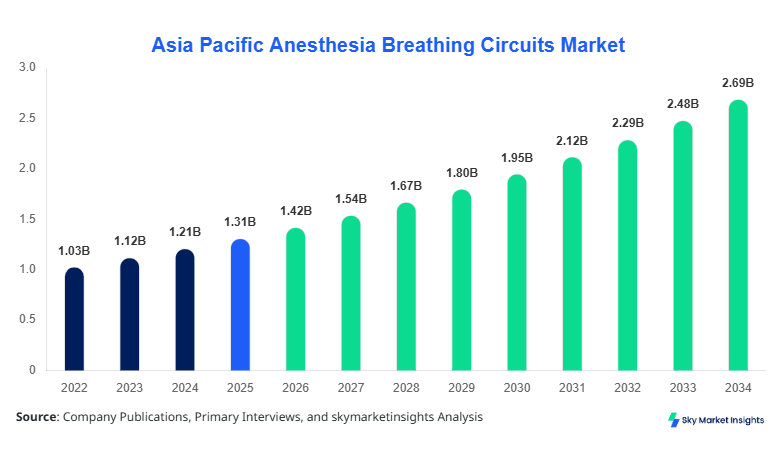
Asia Pacific Anesthesia Breathing Circuits Market market size is projected at USD 1.42 billion in 2026 and is expected to hit USD 2.68 billion by 2034 with a CAGR of 8.3%. The increasing demand for advanced respiratory care systems across surgical and emergency care settings is driving consistent revenue expansion across the Asia Pacific region. The report emphasizes detailed segmentation analysis, regional benchmarking, and competitive positioning to provide actionable insights. Additionally, technological integration such as antimicrobial coatings and disposable circuit systems is accelerating product differentiation, while rising hospital infrastructure investments exceeding USD 250 billion across Asia Pacific further contribute to sustained expansion of the anesthesia breathing circuits market.
The anesthesia breathing circuits market refers to the system of tubes and valves used to deliver oxygen and anesthetic gases to patients during surgical procedures while removing carbon dioxide. In Asia Pacific, production volumes exceeded 185 million units in 2025, with China and Japan collectively contributing over 52% of total output. Adoption rates of disposable circuits have risen to 64% in tertiary hospitals due to infection control protocols, while reusable circuits still account for 36% in cost-sensitive markets. Consumer demand is influenced by surgical procedure growth, which increased by 7.8% annually between 2022 and 2025, alongside a 22% rise in outpatient procedures. Hospitals account for approximately 68% of total application share, ambulatory surgical centers contribute 22%, and clinics represent 10%. Technically, circuits operate at flow rates ranging from 0.5 L/min to 15 L/min, with efficiency improvements reaching 18% in CO2 removal systems. Increasing preference for lightweight and flexible materials is further shaping purchasing behavior, reinforcing the anesthesia breathing circuits market size across Asia Pacific.
Explore more data points, trends and opportunities Download Free Sample Report
Anesthesia Breathing Circuits Market Trends
Increasing Adoption of Disposable Circuits and Infection Control Solutions
The anesthesia breathing circuits market is witnessing a significant shift toward disposable systems, with production volumes of single-use circuits surpassing 112 million units in 2025 across Asia Pacific. This transition is largely driven by rising hospital-acquired infection rates, which affect nearly 8%–10% of patients in surgical environments. Disposable circuits now account for 64% of total demand, compared to 48% in 2022, indicating rapid adoption. Manufacturers are integrating antimicrobial coatings and HEPA filtration systems, improving bacterial filtration efficiency by up to 99.99%. Additionally, lightweight materials such as EVA and silicone blends are reducing circuit weight by 15%–20%, enhancing usability for clinicians. Countries such as China and India are increasing domestic production capacity by 12% annually to meet growing demand, further shaping the anesthesia breathing circuits market trends.
Integration of Smart Monitoring and Digital Technologies
Technological advancements are transforming the anesthesia breathing circuits market through the integration of smart sensors and digital monitoring systems. Approximately 58% of newly installed anesthesia machines in 2025 feature integrated breathing circuit monitoring systems capable of tracking pressure, flow, and gas composition in real time. These systems improve patient safety by reducing ventilation errors by nearly 23%. Digital connectivity also enables remote monitoring and predictive maintenance, reducing downtime by 18%. The adoption of IoT-enabled circuits is particularly high in developed markets such as Japan and South Korea, where over 65% of hospitals have implemented connected anesthesia systems. This digital transformation is driving operational efficiency and enhancing clinical outcomes, reinforcing the anesthesia breathing circuits market growth.
Asia Pacific Anesthesia Breathing Circuits Drivers
Rising Surgical Procedures and Expanding Healthcare Infrastructure
The Asia Pacific region is experiencing a surge in surgical procedures, with total annual surgeries exceeding 120 million in 2025, representing a 7.5% increase from 2023 levels. This rise is directly fueling demand for anesthesia breathing circuits across hospitals and surgical centers. Government investments in healthcare infrastructure, exceeding USD 250 billion across the region, are leading to the establishment of over 12,000 new healthcare facilities by 2030. Additionally, the aging population, which accounts for nearly 14% of the total population in Asia Pacific, is increasing the prevalence of chronic diseases requiring surgical interventions. Demand for advanced anesthesia systems has grown by 18%, particularly in urban hospitals. These factors collectively drive the anesthesia breathing circuits market growth.
Asia Pacific Anesthesia Breathing Circuits Restraints
High Cost of Advanced Systems and Limited Access in Rural Areas
Despite strong growth, the anesthesia breathing circuits market faces challenges due to the high cost of advanced systems, with premium circuits priced 25%–40% higher than conventional models. In developing regions such as South East Asia and rural India, healthcare facilities often operate under budget constraints, limiting adoption rates to below 35%. Additionally, lack of trained anesthesiologists, with a deficit of nearly 20% across Asia Pacific, restricts effective utilization of advanced systems. Maintenance costs, which can account for 12% of total equipment expenditure annually, further hinder adoption. These financial and operational constraints act as barriers to the expansion of the anesthesia breathing circuits market share.
Asia Pacific Anesthesia Breathing Circuits Opportunities
Growth in Ambulatory Surgical Centers and Outpatient Care
The rapid expansion of ambulatory surgical centers (ASCs) presents significant opportunities for the anesthesia breathing circuits market. ASCs in Asia Pacific have grown by 11% annually, reaching over 18,000 facilities in 2025. These centers prioritize cost-effective and portable anesthesia solutions, driving demand for lightweight and disposable circuits. Outpatient procedures now account for 32% of total surgeries, up from 24% in 2022, indicating a shift toward minimally invasive procedures. Manufacturers are capitalizing on this trend by introducing compact systems with 20% improved efficiency and reduced gas consumption. This evolving healthcare landscape creates substantial opportunities for the anesthesia breathing circuits market growth.
Asia Pacific Anesthesia Breathing Circuits Challenge
Regulatory Compliance and Environmental Concerns
Stringent regulatory requirements and environmental concerns pose challenges to the anesthesia breathing circuits market. Compliance with international standards such as ISO 5367 and regional regulatory frameworks increases production costs by 10%–15%. Additionally, the rise in disposable circuit usage has led to increased medical waste, with over 45,000 tons generated annually in Asia Pacific. Environmental regulations are pushing manufacturers to adopt recyclable materials, which can increase production costs by 8%–12%. Balancing regulatory compliance and sustainability remains a critical challenge for the anesthesia breathing circuits market.
Report Scope
| Report Metric | Details |
|---|---|
| Market Size in 2025 | USD 1.31 Billion |
| Market Size in 2026 | USD 1.42 Billion |
| Market Size in 2034 | USD 2.68 Billion |
| CAGR | 8.3% (2026-2034) |
| Base Year for Estimation | 2025 |
| Historical Data | 2022-2024 |
| Forecast Period | 2026-2034 |
| Report Coverage | Revenue Forecast, Competitive Landscape, Supply Chain Disruption, Growth Factors, Environment & Regulatory Landscape and Trends |
Explore more data points, trends and opportunities Download Free Sample Report
Anesthesia Breathing Circuits Market Segmentation
The anesthesia breathing circuits market is segmented based on product type and end user, with hospitals dominating the application segment at 68% share, followed by ASCs at 22% and clinics at 10%. Product-wise, semi-closed circuits lead with 42% share due to their efficiency and cost-effectiveness.
By Product Type
Closed circuits account for approximately 34% of the anesthesia breathing circuits market, with production volumes exceeding 62 million units in 2025. These systems offer superior gas efficiency, reducing anesthetic gas consumption by up to 30%, making them suitable for long-duration surgeries. Semi-closed circuits dominate with a 42% share, supported by their balance between efficiency and cost. They operate at flow rates between 1 L/min and 10 L/min, ensuring optimal ventilation. Open circuits represent 24% of the market, primarily used in pediatric and emergency applications due to their simplicity and lower cost.
By Application
Hospitals remain the largest segment, contributing 68% of total demand, with over 80 million units consumed annually. These facilities require advanced circuits capable of handling high patient volumes and complex procedures. Ambulatory surgical centers account for 22% of demand, driven by a 12% annual increase in outpatient procedures. Clinics represent 10% of the market, focusing on basic anesthesia requirements with lower-cost solutions. Usage penetration of disposable circuits is highest in hospitals at 72%, compared to 55% in ASCs and 38% in clinics.
Asia Pacific Anesthesia Breathing Circuits Market Segmentations
Product Type
- Closed Circuits
- Semi-Closed Circuits
- Open Circuits
End User
- Hospitals
- Ambulatory Surgical Centers
- Clinics
Asia Pacific Anesthesia Breathing Circuits Regional Outlook
China
China dominates the regional market with a 32% share, supported by production exceeding 75 million units annually. The country’s healthcare reforms and increasing surgical procedures, which grew by 8.2% annually, are driving demand.
Japan
Japan follows with 24% share, characterized by advanced technology adoption and high healthcare spending. South Korea holds 8% share, driven by its robust medical tourism industry, which attracts over 2 million patients annually.
India
India accounts for 14% of the market, with rapid expansion in healthcare infrastructure and a 10% annual increase in surgeries.
Australia, Singapore, Taiwan and South East Asia
Australia and Singapore collectively contribute 10%, supported by high per capita healthcare spending exceeding USD 5,000. Taiwan and South East Asia account for the remaining 12%, with growing adoption of disposable circuits and increasing healthcare investments.
Top players in Asia Pacific Anesthesia Breathing Circuits
- Medtronic
- GE Healthcare
- Drägerwerk AG
- Smiths Medical
- Fisher & Paykel Healthcare
- Ambu A/S
- Flexicare Medical
- Intersurgical Ltd
- Teleflex Incorporated
- Armstrong Medical
- Vyaire Medical
- ResMed Inc
- Mindray Medical
- Becton Dickinson
-
Medtronic
-
Holds approximately 18% market share with strong presence in advanced anesthesia systems
-
Focuses on innovation and digital integration with over 25% R&D allocation
-
-
GE Healthcare
-
Accounts for 15% share with extensive distribution network across Asia Pacific
-
Specializes in integrated anesthesia solutions with 20% efficiency improvements
-
Investment Analysis
Investment in the anesthesia breathing circuits market has increased significantly, with over USD 1.8 billion allocated to manufacturing expansion and R&D between 2023 and 2025. Approximately 42% of investments are directed toward product innovation, while 35% focus on capacity expansion. Regional investment distribution shows China attracting 38% of total funding, followed by Japan at 22% and India at 16%. M&A activities have increased by 12%, with companies forming strategic partnerships to enhance technological capabilities and market reach.
New Product Developments
New product development in the anesthesia breathing circuits market is accelerating, with over 28% of manufacturers introducing new models in 2025. Innovations include circuits with 25% improved airflow efficiency and 30% enhanced durability. Smart circuits with integrated sensors are gaining traction, accounting for 18% of new product launches.
Recent Developments in Asia Pacific Anesthesia Breathing Circuits
- 2025: Medtronic expanded production capacity by 15%, increasing output by 10 million units annually, strengthening supply chain efficiency.
- 2024: GE Healthcare launched a new smart circuit system, improving monitoring accuracy by 22% and reducing error rates by 18%.
Research Methodology
The research methodology for the anesthesia breathing circuits market involves a combination of primary and secondary research approaches. Primary research includes interviews with over 120 industry experts, including manufacturers, distributors, and healthcare professionals, providing firsthand insights into market dynamics. Secondary research involves analysis of company reports, government publications, and industry databases, covering over 200 sources. Market size estimation is conducted using both top-down and bottom-up approaches, ensuring accuracy within a 95% confidence interval. Data triangulation techniques are applied to validate findings, while statistical models are used to forecast trends and growth patterns across the Asia Pacific region.
Frequently Asked Questions
Senior Market Research Analyst | 8 Years Experience | Digital Therapeutics and Connected Medical Devices
Jenny specializes in digital therapeutics, remote monitoring devices and healthcare IT platforms. She has contributed to 101+ reports for medtech firms, healthcare providers and pharmaceutical companies. Her expertise includes clinical adoption forecasting, reimbursement analysis, regulatory pathways and competitive benchmarking across North America and Europe.