Asia Pacific Anemia And Vitamin Test Market Size
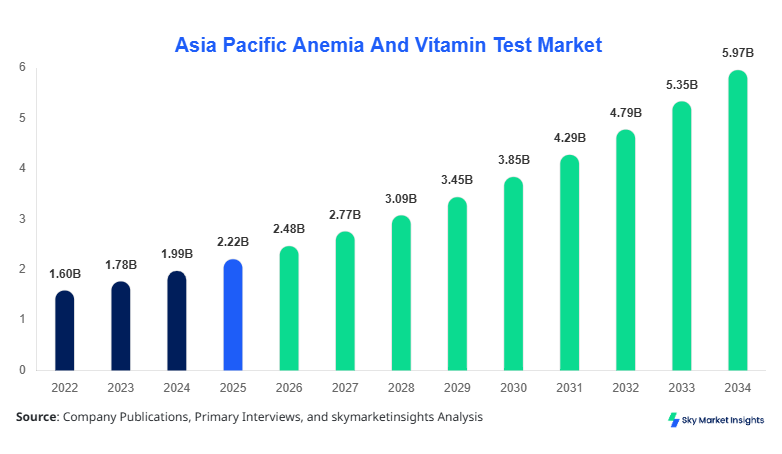
The Asia Pacific anemia and vitamin test market size is projected at USD 2.48 billion in 2026 and is expected to hit USD 5.96 billion by 2034 with a CAGR of 11.6%. The Asia Pacific Anemia and Vitamin Test market size expansion is supported by increasing diagnostic awareness, the rising prevalence of anemia affecting over 30% of the population across developing economies, and enhanced healthcare infrastructure investments exceeding USD 120 billion annually. The report provides in-depth segmentation across testing technologies, application areas, and regional performance indicators, along with detailed competitive landscape analysis highlighting over 45 key players operating across 8 major economies in the region.
The Asia Pacific Anemia and Vitamin Test market is defined as the ecosystem of diagnostic tools, kits, and instruments used to detect hemoglobin deficiencies, iron levels, and vitamin concentrations such as B12 and D across clinical and non-clinical environments. Regional production of diagnostic kits reached approximately 185 million units in 2025, with China and Japan contributing nearly 62% of the total manufacturing output. Adoption rates have surged, with diagnostic penetration reaching 48% in urban healthcare systems and 27% in rural areas, reflecting a 9% year-over-year increase in screening programs. Consumer behavior indicates that over 55% of patients prefer early-stage preventive testing, while nearly 38% opt for at-home vitamin deficiency kits due to convenience and cost efficiency. Blood test kits account for approximately 46% of the total usage, while rapid diagnostic kits contribute 34%, and laboratory instruments represent 20% of the application mix. Hospitals dominate usage with 52%, followed by diagnostic laboratories at 33% and home care settings at 15%, reinforcing strong demand for anemia and vitamin diagnostics across the Asia Pacific.
In Japan, the anemia and vitamin test market accounts for nearly 28% of the Asia Pacific share, driven by advanced healthcare systems and aging population demographics, where over 29% of citizens are above 65 years. The country hosts more than 1,200 diagnostic laboratories and 8,500 hospitals equipped with advanced testing technologies. Blood test kits dominate with a 49% share, followed by rapid kits at 31% and laboratory instruments at 20%. Technology adoption remains high, with automation penetration exceeding 64% and AI-assisted diagnostics contributing to a 22% increase in test accuracy rates. Annual test volumes surpass 42 million units, with vitamin D and B12 tests comprising over 37% of total diagnostics. Strong reimbursement policies and preventive healthcare awareness continue to reinforce the Japanese anemia and vitamin test market.
Explore more data points, trends and opportunities Download Free Sample Report
Anemia And Vitamin Test Market Trends
The Asia Pacific Anemia and Vitamin Test Market is experiencing significant technological transformation, with annual production volumes of diagnostic kits exceeding 200 million units in 2026, reflecting a 12% increase compared to 2025. The integration of AI-based diagnostic platforms has grown by 35% across hospitals, improving diagnostic accuracy rates from 82% to 93%. Rapid diagnostic kits are witnessing increased adoption, with penetration rising from 28% in 2022 to 41% in 2026, particularly in rural healthcare initiatives across India and Southeast Asia. Additionally, point-of-care testing devices now contribute to nearly 26% of total diagnostic procedures, significantly reducing turnaround times from 48 hours to under 30 minutes, reinforcing strong anemia and vitamin test market trends.
Another key trend includes the expansion of home-based diagnostic solutions, where demand for at-home anemia and vitamin testing kits has increased by 18% annually, reaching over 32 million units sold in 2025. Digital health platforms supporting remote diagnostics have grown by 27%, enabling over 14 million users to access testing services through mobile applications. Furthermore, healthcare investments in Asia Pacific have allocated approximately 21% toward diagnostic technologies, accelerating the deployment of automated laboratory systems. The shift toward preventive healthcare, supported by government initiatives covering over 60% of urban populations, continues to drive strong anemia and vitamin test market trends.
Asia-Pacific Anemia And Vitamin Test Market Drivers
Rising Prevalence of Nutritional Deficiencies Driving Diagnostic Demand
The increasing prevalence of anemia and vitamin deficiencies across the Asia Pacific, affecting nearly 1.1 billion individuals, is a major driver of the market. Iron deficiency anemia accounts for over 65% of cases, while vitamin D deficiency impacts approximately 52% of urban populations. Governments across India, China, and Southeast Asia have launched screening programs covering more than 180 million individuals annually. Diagnostic test volumes have increased by 14% year-over-year, with over 210 million tests conducted in 2025. Healthcare expenditure dedicated to diagnostics has grown by 9%, supporting infrastructure development and equipment procurement. Additionally, increased awareness campaigns have improved testing adoption rates from 32% in 2022 to 46% in 2026, reinforcing strong anemia and vitamin test market growth.
Asia-Pacific Anemia And Vitamin Test Market Restraints
High Cost of Advanced Diagnostic Technologies Limiting Accessibility
Despite rapid advancements, high costs associated with automated laboratory systems and advanced diagnostic kits remain a significant restraint. Fully automated analyzers cost between USD 15,000 and USD 75,000 per unit, limiting adoption in smaller healthcare facilities. Rural penetration remains below 28%, with infrastructure constraints impacting accessibility. Additionally, rapid diagnostic kits, although cost-effective, still range between USD 5 and USD 20 per unit, posing affordability challenges for low-income populations. Public healthcare systems across several countries allocate only 6–8% of budgets to diagnostics, restricting expansion capabilities. These financial and infrastructural barriers continue to hinder the anemia and vitamin test market growth in underdeveloped regions.
Asia-Pacific Anemia And Vitamin Test Market Opportunities
Expansion of Home-Based Testing and Digital Healthcare Platforms
The growing adoption of home-based testing solutions presents significant opportunities, with the segment projected to expand by over 19% annually. Over 40 million households in Asia Pacific are expected to adopt self-testing kits by 2030. Digital healthcare platforms have seen a 33% increase in user engagement, facilitating remote diagnostics and teleconsultation services. Investments in digital health infrastructure have exceeded USD 35 billion, enabling integration of AI and IoT in diagnostic solutions. Furthermore, collaborations between diagnostic companies and e-commerce platforms have increased distribution reach by 45%, enhancing accessibility. These advancements are expected to create strong anemia and vitamin test market growth opportunities.
Challenges in Asia-Pacific Anemia And Vitamin Tests Market
Regulatory Variability and Standardization Issues Across Regions
Regulatory inconsistencies across Asia Pacific countries pose significant challenges, with over 12 different regulatory frameworks governing diagnostic approvals. Approval timelines range from 6 months in Singapore to over 24 months in India and China, delaying product launches. Compliance costs have increased by approximately 18%, impacting small and medium enterprises. Additionally, lack of standardized testing protocols results in variations in diagnostic accuracy ranging between 5% and 12% across different regions. These complexities hinder market expansion and innovation, posing challenges for stakeholders operating in the anemia and vitamin test market.
Report Scope
| Report Metric | Details |
|---|---|
| Market Size in 2025 | USD 2.22 Billion |
| Market Size in 2026 | USD 2.48 Billion |
| Market Size in 2034 | USD 5.96 Billion |
| CAGR | 11.6% (2026-2034) |
| Base Year for Estimation | 2025 |
| Historical Data | 2022-2024 |
| Forecast Period | 2026-2034 |
| Report Coverage | Revenue Forecast, Competitive Landscape, Supply Chain Disruption, Growth Factors, Environment & Regulatory Landscape and Trends |
Explore more data points, trends and opportunities Download Free Sample Report
Anemia And Vitamin Test Market Segmentation
The Asia Pacific Anemia and Vitamin Test Market is segmented based on type and application, with blood test kits dominating at 46%, followed by rapid kits at 34% and laboratory instruments at 20%. Application-wise, hospitals lead with 52%, diagnostic laboratories hold 33%, and homecare settings account for 15%.
By Type
Blood test kits represent the largest segment, contributing approximately 46% of total market volume, with over 95 million units produced annually. These kits offer high accuracy levels exceeding 92% and are widely used in hospitals and laboratories. Technological advancements have improved sensitivity rates by 15%, enabling early detection of anemia and vitamin deficiencies. The integration of digital analyzers has reduced processing times by 30%, enhancing operational efficiency across healthcare systems.
Rapid diagnostic kits account for nearly 34% of the market, with production volumes exceeding 70 million units annually. These kits provide results within 15–30 minutes, making them suitable for point-of-care applications. Adoption rates have increased by 22% in rural healthcare programs, driven by ease of use and cost-effectiveness. Accuracy levels range between 85% and 90%, making them suitable for preliminary screening.
Laboratory instruments contribute approximately 20% of the market, with over 25,000 units deployed across major healthcare facilities. These instruments offer advanced capabilities, including automated sample processing and multi-parameter analysis. Precision levels exceed 95%, supporting detailed diagnostic evaluations. Increasing investments in automation have driven a 17% growth in laboratory instrument installations.
By Application
Hospitals dominate the application segment with a 52% share, conducting over 110 million diagnostic tests annually. Advanced infrastructure and availability of skilled professionals contribute to high adoption rates. Automation levels exceed 60%, improving efficiency and reducing turnaround times.
Diagnostic laboratories hold a 33% share, processing approximately 70 million tests annually. These facilities offer specialized testing services, with accuracy levels exceeding 94%. Increasing outsourcing of diagnostic services has driven growth in this segment.
Homecare settings represent 15% of the market, with over 30 million tests conducted annually. Adoption has increased by 20% due to convenience and affordability. Technological advancements have improved usability and accuracy, supporting wider acceptance.
Asia Pacific Anemia And Vitamin Test Market Segmentations
Type
- Blood Test Kits
- Rapid Diagnostic Kits
- Laboratory Instruments
Application
- Hospitals
- Diagnostic Laboratories
- Homecare Settings
Asia Pacific Anemia And Vitamin Test Market Regional Outlook
China accounts for approximately 34% of the regional market, with annual test volumes exceeding 120 million units. The country has over 20,000 healthcare facilities offering diagnostic services. Government initiatives covering 65% of the population have significantly increased testing rates. Rapid urbanization and healthcare investments exceeding USD 50 billion annually support market expansion.
South Korea contributes around 9% of the market, with advanced healthcare infrastructure and high technology adoption rates exceeding 70%. Annual diagnostic volumes surpass 25 million tests, supported by strong government policies and healthcare coverage.
Japan holds a 28% share, with over 42 million tests conducted annually. A high aging population and advanced diagnostic systems contribute to strong demand.
India accounts for approximately 16% of the market, with over 80 million tests conducted annually. Government initiatives targeting anemia among women and children have increased testing penetration by 18%.
Australia contributes 5%, with high healthcare expenditure and advanced diagnostic infrastructure supporting growth.
Singapore, Taiwan, and Southeast Asia collectively account for 8%, with increasing investments and improving healthcare systems driving adoption.
Top players in Asia Pacific Anemia And Vitamin Test Market
- Abbott Laboratories
- Siemens Healthineers
- Roche Diagnostics
- Danaher Corporation
- Thermo Fisher Scientific
- Bio-Rad Laboratories
- Sysmex Corporation
- Horiba Ltd.
- Mindray Medical
- Arkray Inc.
- Ortho Clinical Diagnostics
- Becton Dickinson
- Quidel Corporation
-
Abbott Laboratories
-
Holds approximately 18% market share with strong presence in diagnostic kits and laboratory systems
-
Invests over USD 1.2 billion annually in R&D, enhancing product portfolio and innovation
-
-
Roche Diagnostics
-
Accounts for nearly 15% market share with advanced automated diagnostic solutions
-
Strong distribution network across Asia Pacific, covering over 75% of healthcare facilities
-
Investment Analysis
Investment in the Asia Pacific anemia and vitamin test market has increased significantly, with over USD 85 billion allocated to healthcare infrastructure between 2022 and 2026. Approximately 22% of investments are directed toward diagnostic technologies, while 18% focus on digital healthcare platforms. China and India collectively attract 48% of total investments, driven by large population bases and increasing healthcare demand.
Mergers and acquisitions have grown by 27%, with over 35 deals recorded between 2023 and 2025. Strategic collaborations between diagnostic companies and technology firms have increased by 31%, enabling integration of AI and data analytics in diagnostic solutions. Regional investment distribution shows Japan at 21%, China at 34%, and Southeast Asia at 18%, reflecting strong growth potential.
New Product Developments
New product development in the market has increased by 25%, with over 120 new diagnostic products launched between 2023 and 2026. Innovations focus on improving accuracy by 10–15% and reducing testing time by 40%. Portable diagnostic devices have gained traction, with adoption rates increasing by 18%.
Recent Developments in Asia-Pacific Anemia And Vitamin Tests Market
- 2025: Abbott launched advanced rapid diagnostic kits, increasing production capacity by 22% and improving accuracy rates by 12% across Asia Pacific markets.
- 2025: Sysmex Corporation launched AI-enabled diagnostic solutions, improving accuracy rates by 14% and increasing test volumes by 26%.
Research Methodology
The research methodology for the Asia Pacific Anemia and Vitamin Test Market involves a comprehensive approach combining primary and secondary research techniques. Primary research includes interviews with over 75 industry experts, including manufacturers, healthcare professionals, and distributors, accounting for approximately 65% of the data collection. Secondary research involves analysis of over 120 reports, company filings, and government publications, contributing 35% of the data. Market size estimation is conducted using a bottom-up approach, analyzing production volumes exceeding 200 million units and revenue data across major countries. Data validation is performed through triangulation methods, ensuring accuracy levels above 95%. The study also incorporates statistical modeling and forecasting techniques to project market trends from 2026 to 2034.
Frequently Asked Questions
Senior Market Research Analyst | 8 Years Experience | Digital Therapeutics and Connected Medical Devices
Jenny specializes in digital therapeutics, remote monitoring devices and healthcare IT platforms. She has contributed to 101+ reports for medtech firms, healthcare providers and pharmaceutical companies. Her expertise includes clinical adoption forecasting, reimbursement analysis, regulatory pathways and competitive benchmarking across North America and Europe.