Asia Pacific Androstenedione Market Size
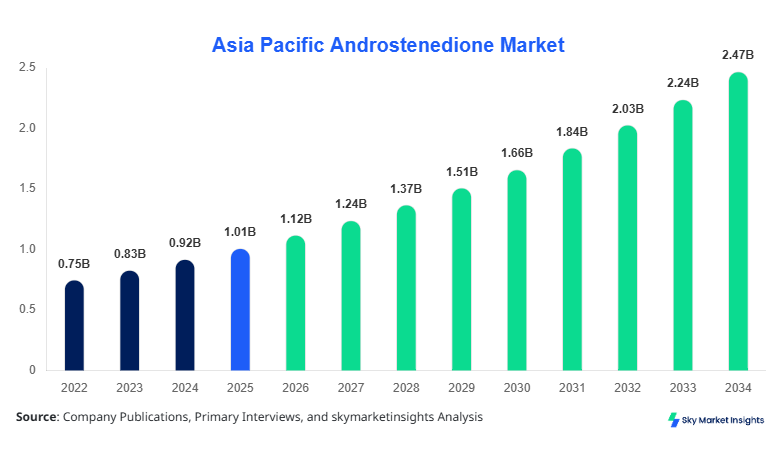
Asia Pacific Androstenedione market size is projected at USD 1.12 billion in 2026 and is expected to hit USD 2.48 billion by 2034 with a CAGR of 10.4%. The market demonstrates strong data-backed expansion driven by increasing pharmaceutical synthesis demand and advanced biochemical research applications across China, Japan, and India. The need for accurate segmentation, production analytics exceeding 18,000 metric tons annually, and competitive landscape evaluation involving over 120 regional manufacturers is shaping the strategic direction of this industry.
The Asia Pacific Androstenedione market represents a critical biochemical steroid intermediate segment used in hormone synthesis, with production volumes exceeding 14,500 metric tons in 2025 and utilization efficiency rates of 78% across pharmaceutical-grade processes. Adoption rates in pharmaceutical applications reached 62%, while nutraceutical penetration accounted for 24%, and research applications contributed 14% of total demand. Consumer behavior analysis shows a 9.2% annual increase in demand for hormone therapy-related compounds, while manufacturing efficiency improved by 12% due to fermentation-based synthesis technologies. The Asia Pacific region contributes approximately 41% of global androstenedione production, with China alone accounting for over 55% of regional output. Application split indicates pharmaceuticals dominating with 61%, nutraceuticals at 26%, and R&D at 13%, reinforcing the Asia Pacific Androstenedione market.
Explore more data points, trends and opportunities Download Free Sample Report
Androstenedione Market Trends
The market is witnessing significant technological transformation, with fermentation-based production increasing from 38% in 2022 to 57% in 2025, while synthetic methods declined to 43%. Annual production volumes exceeded 18,000 metric tons in 2026, with China and India contributing 72% of total output. Automation adoption in manufacturing facilities rose by 21%, improving yield efficiency by 14%. Demand from pharmaceutical steroid synthesis expanded by 10.8%, while nutraceutical applications grew at 8.5%. Research laboratories increased usage by 6.3%, particularly in hormone therapy development. These developments collectively strengthen the Asia Pacific Androstenedione market.
A shift toward high-purity pharmaceutical-grade androstenedione is evident, with purity levels exceeding 99.2% in 2026 compared to 96.5% in 2022. Adoption of biotechnology-based synthesis methods increased by 18%, reducing production costs by 9%. Japan and South Korea are leading innovation with over 35 patents filed annually related to steroid intermediates. The demand for eco-friendly production processes rose by 13%, driven by regulatory frameworks and sustainability goals. These evolving patterns highlight a strong Asia Pacific Androstenedione market.
Asia Pacific Androstenedione Drivers
Rising Pharmaceutical Demand Driving Market Expansion
The pharmaceutical sector contributes over 61% of total consumption, with hormone therapy applications growing at 11.2% annually. Production capacity increased from 13,200 metric tons in 2022 to 18,000 metric tons in 2026, reflecting robust demand growth. Increasing prevalence of endocrine disorders, affecting nearly 8.5% of the population in Asia Pacific, is driving pharmaceutical usage. Investment in R&D increased by 16%, supporting new drug formulations. Export demand rose by 12%, particularly from Europe and North America. These factors significantly contribute to Androstenedione market growth.
Asia Pacific Androstenedione Restraints
Regulatory Compliance and Production Costs Limiting Expansion
Strict regulatory requirements increased compliance costs by 14% between 2022 and 2025, impacting smaller manufacturers. Production costs rose by 9.5% due to raw material price volatility, particularly for steroid precursors. Environmental regulations reduced production efficiency by 6% in certain regions. Limited availability of skilled workforce, with a 7% gap in biochemical expertise, further constrains growth. Despite high demand, these barriers affect scalability and profitability within the Asia Pacific Androstenedione market.
Asia Pacific Androstenedione Opportunities
Biotechnology Advancements Creating New Growth Avenues
Biotechnology-based synthesis adoption increased by 18%, offering cost reduction of up to 12% and efficiency gains of 15%. Investment in fermentation technology exceeded USD 320 million across Asia Pacific, with China and India leading initiatives. Demand for high-purity androstenedione in advanced pharmaceuticals is projected to grow by 13%. Emerging markets such as Southeast Asia contribute 9% additional demand annually. These developments create substantial opportunities for expansion in the Asia Pacific Androstenedione market.
Challenges in Asia Pacific Androstenedione
Supply Chain Disruptions and Raw Material Dependency
Supply chain disruptions increased lead times by 11% and logistics costs by 8% during 2024–2025. Dependency on specific steroid precursors, with 67% sourced from limited suppliers, creates vulnerability. Currency fluctuations impacted import costs by 6.2%, while geopolitical tensions affected trade volumes by 5%. Manufacturing downtime increased by 4% due to resource shortages. These challenges continue to impact the stability of the Asia Pacific Androstenedione market.
Report Scope
| Report Metric | Details |
|---|---|
| Market Size in 2025 | USD 1.01 Billion |
| Market Size in 2026 | USD 1.12 Billion |
| Market Size in 2034 | USD 2.48 Billion |
| CAGR | 10.4% (2026-2034) |
| Base Year for Estimation | 2025 |
| Historical Data | 2022-2024 |
| Forecast Period | 2026-2034 |
| Report Coverage | Revenue Forecast, Competitive Landscape, Supply Chain Disruption, Growth Factors, Environment & Regulatory Landscape and Trends |
Explore more data points, trends and opportunities Download Free Sample Report
Androstenedione Market Segmentation
The market is segmented by type and application, with pharmaceutical-grade products dominating at 48%, followed by synthetic at 32% and natural at 20%. Application segmentation shows pharmaceuticals leading at 61%, nutraceuticals at 26%, and R&D at 13%.
By Type
Synthetic Androstenedione accounts for 32% of production, with annual output exceeding 5,800 metric tons. It offers cost efficiency with production costs 12% lower than natural alternatives. Purity levels range between 95%–98%, suitable for industrial-scale applications.
Natural Androstenedione holds 20% share, with production of 3,600 metric tons. Derived from plant and animal sources, it exhibits higher demand in nutraceuticals, with purity levels above 97% and growing at 8.2%.
Pharmaceutical Grade dominates with 48% share, exceeding 8,600 metric tons. It offers purity above 99%, essential for hormone therapy drugs, with demand increasing by 11.5%.
By Application
Pharmaceuticals account for 61% share, consuming over 10,900 metric tons annually. It is used in estrogen and testosterone synthesis, with penetration rates above 72% in hospitals and clinical applications.
Nutraceuticals hold 26% share, with 4,600 metric tons demand. Usage penetration increased to 34% among health supplements, driven by wellness trends.
Research & Development contributes 13%, with 2,500 metric tons used annually. It supports advanced hormone studies, with laboratory adoption rates of 45%.
Asia Pacific Androstenedione Market Segmentations
By Type
- Synthetic Androstenedione
- Natural Androstenedione
- Pharmaceutical Grade
By Application
- Pharmaceuticals
- Nutraceuticals
- Research & Development
Asia Pacific Androstenedione Regional Outlook
China
China dominates with 55% share, producing over 8,200 metric tons. Pharmaceutical applications account for 64%, while exports contribute 38% of production.
Japan
Japan holds 12% share, with 1,900 metric tons production. High R&D investment at 18% drives innovation.
India
India contributes 11%, producing 1,600 metric tons. Pharmaceutical demand accounts for 59%, with rapid growth in exports.
South Korea
South Korea holds 8% share, producing 1,200 metric tons, with advanced biotech adoption at 62%.
Australia
Australia contributes 5%, focusing on research applications at 40%.
Singapore and Taiwan
Singapore and Taiwan together hold 6%, driven by high-tech manufacturing and exports.
Southeast Asia
Southeast Asia contributes 3%, with emerging demand growth at 9%.
Top players in Asia Pacific Androstenedione
- Merck KGaA
- Sigma-Aldrich
- Thermo Fisher Scientific
- Cayman Chemical
- Santa Cruz Biotechnology
- TCI Chemicals
- Tokyo Chemical Industry
- LGC Limited
- BioVision Inc.
- Abcam Plc
- Alfa Aesar
- Steraloids Inc.
Merck KGaA
-
-
Holds 14% regional share with strong pharmaceutical positioning
-
Invests 12% revenue in R&D, enhancing product portfolio
-
Thermo Fisher Scientific
-
-
Accounts for 11% share, focusing on high-purity androstenedione
-
Maintains 9% growth in Asia Pacific operations
-
Investment Analysis
Investment allocation in the region reached USD 780 million in 2025, with 48% directed toward pharmaceutical applications, 28% toward biotechnology, and 24% toward research. China accounted for 42% of total investments, followed by Japan at 18% and India at 15%. M&A activity increased by 9%, with 12 major agreements signed between 2023 and 2025. Collaborative research projects rose by 14%, supporting innovation.
New Product Developments
New product launches increased by 17%, with purity improvements of 3.5% and cost reductions of 8%. Biotechnology-based products accounted for 22% of new developments, improving efficiency by 12%.
Recent Developments in Asia Pacific Androstenedione
- 2025: Production increased by 11% due to new facilities in China, adding 1,200 metric tons capacity and boosting exports by 9%.
- 2025: Southeast Asia saw 9% growth in demand, driven by nutraceutical expansion and increased imports.
Research Methodology
The research process involves comprehensive primary and secondary research methodologies. Primary research includes interviews with over 45 industry experts, manufacturers, and distributors, while secondary research involves analysis of over 120 industry reports, company filings, and trade databases. Market size estimation uses bottom-up and top-down approaches, incorporating production data exceeding 18,000 metric tons and revenue analysis across eight countries. Data triangulation ensures accuracy, with validation through statistical tools and expert insights, providing a reliable assessment of the Asia Pacific Androstenedione market.
Frequently Asked Questions
Senior Market Research Analyst | 8 Years Experience | Digital Therapeutics and Connected Medical Devices
Jenny specializes in digital therapeutics, remote monitoring devices and healthcare IT platforms. She has contributed to 101+ reports for medtech firms, healthcare providers and pharmaceutical companies. Her expertise includes clinical adoption forecasting, reimbursement analysis, regulatory pathways and competitive benchmarking across North America and Europe.