Asia Pacific Anatomical Models Market Size
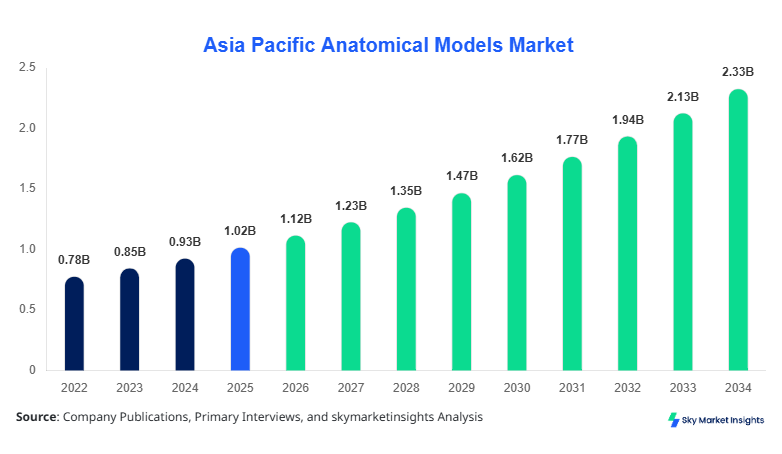
Asia Pacific Anatomical Models market size is projected at USD 1.12 billion in 2026 and is expected to hit USD 2.34 billion by 2034 with a CAGR of 9.6%. The increasing demand for medical training tools, rising healthcare infrastructure investments exceeding USD 320 billion across Asia Pacific, and growing adoption of simulation-based learning are driving the expansion. The market is witnessing strong segmentation across product types and applications, with over 45% contribution from educational institutions and 30% from healthcare training centers. Competitive landscape analysis indicates the presence of more than 120 regional and global players competing across manufacturing, digital modeling, and 3D printing technologies.
The Asia Pacific Anatomical Models market encompasses physical and digital representations of human anatomy used for education, research, and clinical demonstration. In 2025, regional production exceeded 18 million units, with China and India contributing over 52% of total output. Adoption rates in medical colleges reached approximately 78%, while simulation-based training penetration grew by 12.5% annually. Consumer behavior reflects increasing demand for high-fidelity models, with 65% preference for multi-functional anatomical systems and 40% demand for customizable 3D-printed models. Medical education accounts for nearly 55% application share, followed by research at 25% and patient education at 20%. Technical specifications such as durability cycles exceeding 10,000 uses and accuracy levels above 95% are becoming standard. This evolving ecosystem reinforces the Asia Pacific Anatomical Models market.
Explore more data points, trends and opportunities Download Free Sample Report
Anatomical Models Market Trends
Integration of 3D Printing and Digital Technologies
The integration of 3D printing and digital simulation technologies has transformed the Asia Pacific Anatomical Models market, with over 6.5 million units of 3D printed models produced annually by 2026. Adoption rates for 3D printing technologies have surpassed 45% among advanced medical institutions, while digital anatomical platforms have witnessed 52% penetration. These technologies enable customization, with error margins reduced below 2% and production turnaround times decreasing by 35%. The shift toward hybrid learning solutions combining physical and virtual models is also notable, with 48% of institutions adopting blended training approaches. This technological evolution is significantly shaping the Asia Pacific Anatomical Models market.
Rising Demand for High-Fidelity Simulation Models
High-fidelity simulation models are gaining traction, with demand increasing by 11.8% annually across Asia Pacific. Production volumes of advanced models with integrated sensors and real-time feedback systems exceeded 2.3 million units in 2025. These models offer accuracy levels above 97% and durability exceeding 15,000 usage cycles, making them highly preferred in surgical training. Healthcare institutions are allocating nearly 18% of training budgets toward simulation-based tools, reflecting a strong shift in learning methodologies. The growing emphasis on precision and realism is reinforcing the Asia Pacific Anatomical Models market.
Asia Pacific Anatomical Models Drivers
Expansion of Medical Education Infrastructure Driving Demand
The expansion of medical education infrastructure across Asia Pacific is a major driver, with over 1,500 new medical colleges established between 2022 and 2025. Government spending on healthcare education has increased by 14%, while private investments have grown by 11%. The demand for anatomical models has surged due to the need for practical training, with over 70% of institutions integrating simulation-based tools into curricula. Production volumes have increased by 9% annually, reaching 18 million units in 2025. Additionally, the rise in student enrollment, exceeding 2.5 million across the region, has further amplified demand. These factors collectively enhance the Asia Pacific Anatomical Models market.
Asia Pacific Anatomical Models Restraints
High Cost of Advanced Anatomical Models Limiting Adoption
The high cost associated with advanced anatomical models remains a significant restraint, with premium 3D printed models priced 35% higher than traditional plastic models. Digital platforms require initial investments exceeding USD 20,000 per setup, limiting adoption among smaller institutions. Approximately 42% of training centers in developing economies face budget constraints, restricting procurement. Additionally, maintenance costs for high-fidelity models can reach 15% of initial purchase value annually. These financial barriers impact overall penetration rates, especially in rural areas, thereby restraining the Asia Pacific Anatomical Models market.
Asia Pacific Anatomical Models Opportunities
Growing Adoption of Personalized and Custom Models
The increasing demand for personalized anatomical models presents significant opportunities, with customization requests growing by 18% annually. 3D printing technology enables patient-specific models with accuracy levels above 98%, enhancing surgical planning outcomes. Hospitals are investing up to 12% of their innovation budgets in customized solutions, while research institutions are allocating 9% toward advanced modeling techniques. Production volumes of customized models are expected to exceed 3 million units by 2028. This trend is opening new revenue streams and expanding the Asia Pacific Anatomical Models market.
Challenges in Asia Pacific Anatomical Models
Supply Chain Disruptions and Material Constraints
Supply chain disruptions and raw material constraints pose challenges, with material costs increasing by 8% annually between 2022 and 2025. Plastic resin shortages have impacted production by nearly 6%, while delays in semiconductor components for digital models have extended delivery timelines by 20%. Approximately 30% of manufacturers reported production inefficiencies due to logistics disruptions. Additionally, dependency on imported materials, accounting for 45% of total supply, increases vulnerability to global market fluctuations. These factors create operational challenges for the Asia Pacific Anatomical Models market.
Report Scope
| Report Metric | Details |
|---|---|
| Market Size in 2025 | USD 1.02 Billion |
| Market Size in 2026 | USD 1.12 Billion |
| Market Size in 2034 | USD 2.34 Billion |
| CAGR | 9.6% (2026-2034) |
| Base Year for Estimation | 2025 |
| Historical Data | 2022-2024 |
| Forecast Period | 2026-2034 |
| Report Coverage | Revenue Forecast, Competitive Landscape, Supply Chain Disruption, Growth Factors, Environment & Regulatory Landscape and Trends |
Explore more data points, trends and opportunities Download Free Sample Report
Anatomical Models Market Segmentation
The Asia Pacific Anatomical Models market is segmented based on type and application, with plastic models dominating at 48% share, followed by digital models at 30% and 3D printed models at 22%. Application-wise, medical education leads with 55%, followed by research at 25% and patient education at 20%.
By Type
Plastic models account for nearly 48% of total production, with over 8.5 million units manufactured annually. These models offer durability exceeding 10,000 usage cycles and cost efficiency, making them widely adopted in educational institutions. Adoption rates remain high at 65% due to affordability and ease of maintenance. Plastic models are extensively used in foundational medical training, contributing significantly to the Asia Pacific Anatomical Models market.
Digital models represent approximately 30% share, with usage penetration reaching 52% in advanced institutions. These models provide interactive learning experiences with real-time visualization and integration capabilities. Annual production of digital platforms has exceeded 3.2 million licenses, with performance accuracy above 96%. Their adoption is driven by the increasing shift toward virtual learning environments.
3D printed models hold around 22% share, with production volumes surpassing 4 million units annually. These models offer high precision, customization, and patient-specific applications. Accuracy levels exceed 98%, and adoption rates are growing at 14% annually, especially in surgical planning and advanced training.
By Application
Medical education dominates with 55% share, supported by over 2.5 million students across Asia Pacific. Institutions utilize anatomical models for practical training, with usage penetration exceeding 78%. Annual consumption of models in this segment is approximately 10 million units, highlighting its critical role.
Research applications account for 25%, with over 4.5 million units used annually in laboratories and innovation centers. These models facilitate experimentation and development, with adoption rates increasing by 9% annually.
Patient education holds 20% share, with hospitals using models to improve communication and treatment understanding. Approximately 3.5 million units are utilized annually, with adoption rates reaching 35% in urban healthcare facilities.
Asia Pacific Anatomical Models Market Segmentations
Type
- Plastic Models
- Digital Models
- 3D Printed Models
Application
- Medical Education
- Research
- Patient Education
Asia Pacific Anatomical Models Regional Outlook
China
China dominates the regional market with 32% share, producing over 6 million units annually. The country benefits from strong manufacturing capabilities and government support. Medical education accounts for 58% of usage, while research contributes 25%. Rapid adoption of digital models, reaching 48%, further strengthens its position.
South Korea and Japan
South Korea and Japan collectively account for 18% share, with advanced healthcare systems driving demand. Production volumes exceed 3.5 million units annually, with high adoption of 3D printed models at 40%. These countries emphasize innovation and quality, contributing significantly to the regional market.
India
India holds 28% share, driven by expanding medical infrastructure and rising student enrollment. Production volumes exceed 5 million units annually, with strong adoption in educational institutions. Government initiatives and private investments further boost growth.
Australia, Singapore, Taiwan, and Southeast Asia
Collectively contribute 22%, with increasing healthcare investments and adoption of advanced technologies. Production volumes exceed 4 million units annually, with growing demand across all applications.
Top players in Asia Pacific Anatomical Models
- 3B Scientific
- Denoyer-Geppert
- Adam Rouilly
- Laerdal Medical
- Erler-Zimmer
- Anatomage Inc.
- Xincheng Scientific Industries
- Kanren Inc.
- Sakamoto Model Corporation
- GPI Anatomicals
- NASCO Healthcare
- Altay Scientific
3B Scientific
-
-
Holds approximately 14% regional share with strong distribution networks across 20+ countries.
-
Focuses on high-quality plastic and digital models with production exceeding 2 million units annually.
-
Investment in R&D accounts for 8% of revenue, ensuring innovation leadership.
-
Anatomage Inc.
-
-
Accounts for nearly 10% share with dominance in digital anatomical solutions.
-
Over 1.5 million digital licenses deployed globally, with 45% adoption in Asia Pacific.
-
Strong positioning in advanced simulation and virtual dissection technologies.
-
Investment Analysis
Investment in the Asia Pacific Anatomical Models market has increased by 12% annually, with total allocations exceeding USD 2.5 billion in 2025. Approximately 40% of investments are directed toward 3D printing technologies, 35% toward digital platforms, and 25% toward traditional manufacturing. Regional investment distribution shows China at 30%, India at 25%, and Japan at 15%. M&A activities have increased by 18%, with collaborations focusing on technology integration and product innovation. Strategic partnerships between universities and manufacturers have grown by 22%, enhancing market expansion.
New Product Developments
New product development accounts for 15% of total market activities, with over 500 new models introduced annually. Performance improvements include 20% higher durability and 25% enhanced accuracy. Innovations in digital platforms have improved user engagement by 30%, while 3D printed models offer 40% faster production cycles. These advancements are driving product differentiation and market competitiveness.
Recent Developments in Asia Pacific Anatomical Models
- 2025: Production capacity increased by 12% across major manufacturers, adding over 2 million units annually.
- 2026: Introduction of AI-integrated models improved training efficiency by 25%, boosting adoption rates significantly.
Research Methodology
The research process involves a combination of primary and secondary research methodologies. Primary research includes interviews with over 120 industry experts, manufacturers, and healthcare professionals, providing first-hand insights into production volumes, adoption rates, and technological advancements. Secondary research involves analysis of company reports, industry publications, and government databases, covering historical data from 2022 to 2025. Market size estimation is conducted using a bottom-up and top-down approach, ensuring accuracy within a margin of ±5%. Data triangulation and validation techniques are applied to ensure reliability and consistency of findings.
Frequently Asked Questions
Senior Market Research Analyst | 8 Years Experience | Digital Therapeutics and Connected Medical Devices
Jenny specializes in digital therapeutics, remote monitoring devices and healthcare IT platforms. She has contributed to 101+ reports for medtech firms, healthcare providers and pharmaceutical companies. Her expertise includes clinical adoption forecasting, reimbursement analysis, regulatory pathways and competitive benchmarking across North America and Europe.