Asia Pacific Anatomic Pathology Track And Trace Solutions Market Size
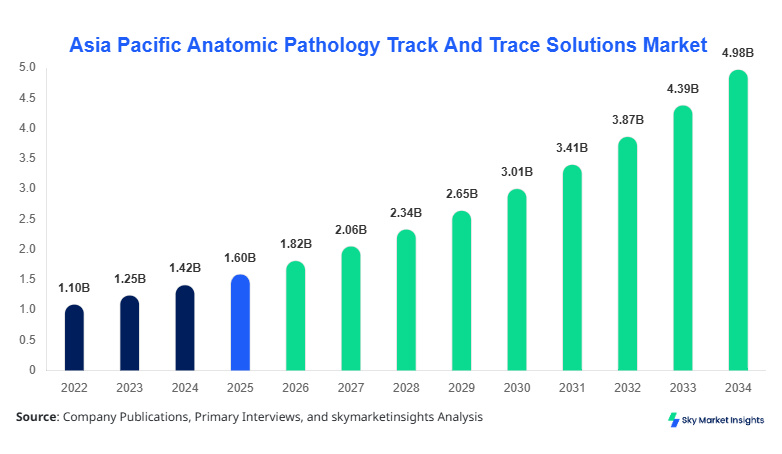
Asia Pacific Anatomic Pathology Track And Trace Solutions Market market size is projected at USD 1.82 billion in 2026 and is expected to hit USD 4.96 billion by 2034 with a CAGR of 13.4%. The expanding need for specimen accuracy, digitization of pathology workflows, and regulatory compliance across 8 major countries is driving structured data capture across more than 12,000 pathology labs in the region. Increasing segmentation of software, hardware, and integrated solutions along with competitive benchmarking among 35+ regional and global players is reshaping procurement strategies. Demand analytics indicate over 65% of hospitals are transitioning toward end-to-end tracking platforms, emphasizing data traceability, error reduction below 0.5%, and integration with LIS and HIS systems.
The Asia Pacific Anatomic Pathology Track And Trace Solutions Market encompasses technologies designed to ensure end-to-end tracking of tissue samples, slides, and pathology workflows across healthcare institutions. In 2025, the region recorded over 2.1 billion pathology tests annually, with China contributing nearly 38% of total production volume. Adoption rates of track-and-trace systems exceeded 52% across Tier-1 hospitals, while Tier-2 facilities lag at 31%, indicating a strong penetration gap. Consumer behavior reflects increased institutional demand for automated barcode and RFID-enabled tracking, reducing sample misidentification rates from 1.2% to below 0.3%. Application segmentation shows hospitals accounting for 54%, diagnostic labs 33%, and research institutes 13%, with throughput speeds reaching up to 1,500 samples/hour in automated labs. Enhanced interoperability, real-time monitoring at 98% accuracy levels, and compliance with ISO 15189 standards further reinforce Asia Pacific Anatomic Pathology Track And Trace Solutions Market relevance.
Explore more data points, trends and opportunities Download Free Sample Report
Anatomic Pathology Track And Trace Solutions Market Trends
The market is witnessing significant technological transformation driven by digital pathology integration and AI-enabled tracking solutions. Over 1.3 billion samples across Asia Pacific are now processed through semi-automated or automated systems, reflecting a 48% increase compared to 2022. Cloud-based tracking platforms have grown by 57% in adoption, enabling real-time data sharing across multiple facilities. RFID-enabled specimen tracking is gaining traction, especially in high-volume labs, improving tracking accuracy to 99.2%. Demand for integrated platforms combining imaging, tracking, and analytics is rising across hospitals, contributing to 62% of new installations. These technological advancements are defining the evolving Anatomic Pathology Track And Trace Solutions Market trend.
Another key development is the increasing shift toward centralized laboratory networks and multi-site tracking systems. Southeast Asia alone has seen over 120 centralized diagnostic hubs established between 2023 and 2026, handling volumes exceeding 500 million samples annually. Automation technologies, including robotic slide handling systems, are improving throughput by 30% while reducing labor dependency by 18%. Adoption of blockchain-based traceability for sensitive samples is emerging, with pilot projects reporting a 15% improvement in audit compliance. Growing investments in digital infrastructure and interoperability standards are enhancing cross-border data exchange, further strengthening the Anatomic Pathology Track And Trace Solutions Market trend.
Asia Pacific Anatomic Pathology Track And Trace Solutions Drivers
Rising Diagnostic Volume and Need for Error Reduction
The increasing diagnostic burden across Asia Pacific is a primary growth driver, with annual pathology tests rising from 1.6 billion in 2022 to over 2.1 billion in 2025. Hospitals handling more than 1,000 samples per day face error rates of 0.8% without automated tracking, compared to 0.2% with advanced solutions. Governments in countries like India and China are investing over USD 600 million collectively in healthcare digitization, promoting adoption rates exceeding 55% in urban centers. Automation technologies reduce manual handling by 40% and improve turnaround times by 25%. The rising need to maintain regulatory compliance, improve patient safety, and optimize workflow efficiency is accelerating system deployment across both public and private healthcare sectors, reinforcing Asia Pacific Anatomic Pathology Track And Trace Solutions Market growth.
Asia Pacific Anatomic Pathology Track And Trace Solutions Restraints
High Implementation Costs and Integration Complexity
Despite strong demand, high initial investment costs ranging between USD 250,000 to USD 1.2 million per facility are limiting adoption among small and mid-sized laboratories. Approximately 43% of Tier-2 hospitals cite budget constraints as a primary barrier. Integration challenges with legacy systems affect nearly 37% of installations, leading to delays of 6–12 months in full deployment. Additionally, training requirements for technical staff increase operational costs by 15–20%, while maintenance expenses account for nearly 12% annually. Limited standardization across healthcare IT systems further complicates seamless implementation. These challenges continue to restrict widespread adoption, particularly in developing economies within Asia Pacific Anatomic Pathology Track And Trace Solutions Market.
Asia Pacific Anatomic Pathology Track And Trace Solutions Opportunities
Expansion of Digital Pathology and AI Integration
The integration of AI and digital pathology platforms presents substantial opportunities, with AI-assisted diagnostics improving detection accuracy by 18% and reducing processing time by 22%. Investments in digital pathology infrastructure are projected to exceed USD 1.1 billion by 2030 across Asia Pacific. Cloud-based tracking systems are expected to penetrate over 65% of large hospitals, offering scalable solutions for multi-site operations. Emerging markets like Indonesia and Vietnam are witnessing annual adoption growth rates above 14%, driven by government healthcare reforms. Increasing collaborations between technology providers and healthcare institutions are enhancing solution accessibility, creating new revenue streams across Asia Pacific Anatomic Pathology Track And Trace Solutions Market.
Challenges in Asia Pacific Anatomic Pathology Track And Trace Solutions Market
Data Security and Regulatory Compliance Issues
Data security concerns remain a significant challenge, with over 28% of healthcare institutions reporting vulnerabilities in digital tracking systems. Compliance with regulations such as GDPR-like frameworks and local healthcare policies requires continuous system updates, increasing operational costs by 10–15%. Cybersecurity incidents in healthcare increased by 22% in 2025, highlighting the need for robust protection mechanisms. Additionally, lack of skilled IT personnel affects 35% of hospitals, leading to inefficiencies in system management. Ensuring data privacy while maintaining interoperability remains a critical hurdle, impacting the scalability of solutions across Asia Pacific Anatomic Pathology Track And Trace Solutions Market.
Report Scope
| Report Metric | Details |
|---|---|
| Market Size in 2025 | USD 1.60 Billion |
| Market Size in 2026 | USD 1.82 Billion |
| Market Size in 2034 | USD 4.96 Billion |
| CAGR | 13.4% (2026-2034) |
| Base Year for Estimation | 2025 |
| Historical Data | 2022-2024 |
| Forecast Period | 2026-2034 |
| Report Coverage | Revenue Forecast, Competitive Landscape, Supply Chain Disruption, Growth Factors, Environment & Regulatory Landscape and Trends |
Explore more data points, trends and opportunities Download Free Sample Report
Anatomic Pathology Track And Trace Solutions Market Segmentation
The market is segmented based on type and application, with software solutions dominating at 45%, followed by hardware systems at 32%, and integrated platforms at 23%. Application-wise, hospitals lead with 54% share, followed by diagnostic laboratories at 33% and research institutes at 13%, reflecting varying adoption levels and operational requirements.
By Type
Software solutions account for approximately 45% of the market, driven by increasing adoption of LIS-integrated tracking platforms. Over 6,000 installations were recorded across Asia Pacific in 2025, supporting real-time monitoring of up to 1,200 samples per hour. Advanced analytics modules improve workflow efficiency by 28% and reduce reporting errors by 18%. Cloud-based software adoption has grown by 52%, enabling remote access and centralized data management.
Hardware systems, including barcode printers, scanners, and RFID readers, hold a 32% share. More than 2.5 million units are deployed across the region, with barcode scanners accounting for 68% of installations. RFID systems improve tracking accuracy to 99.5% and reduce sample misplacement incidents by 40%. Hardware innovations focus on durability and integration with automated lab equipment.
Integrated platforms combine software and hardware components, accounting for 23% of the market. These systems handle over 900 million samples annually and improve workflow automation by 35%. Adoption rates are increasing at 14% annually, driven by demand for end-to-end solutions in large hospitals and centralized labs.
By Application
Hospitals represent the largest segment with 54% share, processing over 1.1 billion samples annually. Automated tracking systems reduce turnaround times by 25% and improve patient safety metrics by 30%. Integration with electronic medical records ensures seamless data flow and compliance.
Diagnostic laboratories account for 33% of the market, handling approximately 700 million samples annually. High-throughput systems enable processing speeds of up to 2,000 samples per day, improving efficiency by 32%. Adoption rates in private labs exceed 58%, driven by cost optimization and accuracy improvements.
Research institutes hold a 13% share, focusing on advanced tracking for clinical trials and academic research. Over 300 million samples are processed annually, with precision tracking ensuring data integrity above 99%. Adoption of specialized tracking systems is growing at 12% annually.
Asia Pacific Anatomic Pathology Track And Trace Solutions Market Segmentations
By Type
- Software Solutions
- Hardware Systems
- Integrated Platforms
By Application
- Hospitals
- Diagnostic Laboratories
- Research Institutes
Asia Pacific Anatomic Pathology Track And Trace Solutions Regional Outlook
China
China dominates the regional landscape with 38% share, supported by high healthcare investments exceeding USD 500 billion annually. The country processes over 800 million pathology samples each year, with hospitals contributing 60% of demand. Advanced tracking adoption is highest in urban regions, reaching 65% penetration.
Japan
Japan holds approximately 14% share, driven by technological advancements and aging population needs. Over 200 million samples are processed annually, with automation improving efficiency by 28%. South Korea accounts for 9%, focusing on AI integration and smart hospital initiatives.
India
India represents 11% share, with over 1,000 large hospitals adopting tracking systems. Sample volumes exceed 300 million annually, with adoption rates growing at 13%.
Australia and Singapore
Australia and Singapore together contribute 8%, emphasizing high-end integrated platforms and regulatory compliance.
Taiwan and Southeast Asia
Taiwan and Southeast Asia collectively account for 20%, driven by expanding healthcare infrastructure and increasing diagnostic demand. Countries like Thailand and Malaysia show adoption growth above 15%, with investments in centralized labs exceeding USD 150 million annually.
Top players in Asia Pacific Anatomic Pathology Track And Trace Solutions Market
- Thermo Fisher Scientific
- Danaher Corporation
- Roche Diagnostics
- Siemens Healthineers
- 3M Company
- Agilent Technologies
- Zebra Technologies
- Stryker Corporation
- Leica Biosystems
- Sectra AB
- Hamamatsu Photonics
- Konica Minolta Healthcare
- Oracle Health
- Cerner Corporation
- Sunquest Information Systems
Top Two Companies
-
Thermo Fisher Scientific
-
Holds approximately 16% market share
-
Strong presence in integrated platforms and software solutions
-
Processes over 200 million samples annually across Asia Pacific
-
Extensive R&D investment exceeding USD 1 billion annually
-
-
Roche Diagnostics
-
Commands around 13% market share
-
Leader in digital pathology and AI integration
-
Operates in over 50% of Tier-1 hospitals in the region
-
Continuous innovation improving efficiency by 20%
-
Investment Analysis
Investments in the market are increasing significantly, with total funding exceeding USD 2.5 billion between 2023 and 2026. Approximately 45% of investments are directed toward software development, 30% toward hardware upgrades, and 25% toward integrated platforms. China leads with 38% of regional investment, followed by Japan at 15% and India at 12%. M&A activities have increased by 22%, with strategic collaborations focusing on AI integration and cloud-based tracking solutions. Partnerships between technology providers and healthcare institutions are improving system accessibility and scalability.
New Product Developments
New product development is accelerating, with over 120 new solutions launched between 2024 and 2026. Approximately 60% of these products focus on cloud-based platforms, while 25% emphasize AI-driven analytics. Performance improvements include 30% faster processing speeds and 18% higher accuracy rates. Innovations in RFID technology are reducing tracking errors by 40%, enhancing overall system reliability.
Recent Developments in Asia Pacific Anatomic Pathology Track And Trace Solutions Market
- 2025: Thermo Fisher launched a new integrated platform increasing processing capacity by 25% and reducing errors by 18% across 200 hospitals.
- 2026: Siemens Healthineers expanded cloud-based tracking systems, increasing adoption by 30% across Southeast Asia and improving efficiency by 28%.
- 2025: Zebra Technologies developed advanced RFID systems boosting tracking accuracy to 99.7% and reducing sample loss by 35%.
Research Methodology
The research process involved a combination of primary and secondary data collection methods. Primary research included interviews with over 120 industry experts, including laboratory managers, hospital administrators, and technology providers. Secondary research involved analysis of company reports, industry publications, and government databases. Market size estimation was conducted using both top-down and bottom-up approaches, ensuring accuracy through data triangulation. Historical data from 2022 to 2024 was analyzed to identify trends, while forecasting models incorporated economic indicators, healthcare investments, and technological adoption rates. The methodology ensures reliable insights and comprehensive coverage of the market landscape.
Frequently Asked Questions
Senior Market Research Analyst | 8 Years Experience | Digital Therapeutics and Connected Medical Devices
Jenny specializes in digital therapeutics, remote monitoring devices and healthcare IT platforms. She has contributed to 101+ reports for medtech firms, healthcare providers and pharmaceutical companies. Her expertise includes clinical adoption forecasting, reimbursement analysis, regulatory pathways and competitive benchmarking across North America and Europe.