Asia Pacific Ambulatory Infusion Center Market Size
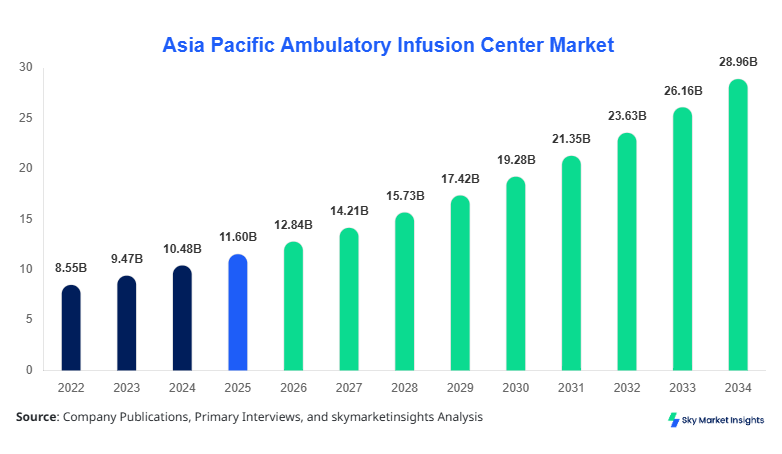
Asia Pacific Ambulatory Infusion Center market size is projected at USD 12.84 billion in 2026 and is expected to hit USD 28.97 billion by 2034 with a CAGR of 10.7%. The increasing requirement for outpatient infusion therapies, rising chronic disease burden, and expanding healthcare infrastructure across Asia Pacific are contributing significantly to the overall market expansion. Detailed segmentation across type and application, combined with evolving competitive landscape metrics, enables granular analysis of volume consumption exceeding 58 million infusion sessions annually and facility expansion rates of over 8.5% year-over-year.
The Asia Pacific Ambulatory Infusion Center Market represents specialized outpatient healthcare facilities that deliver intravenous therapies, including chemotherapy, biologics, and antibiotics, with reduced hospitalization costs and improved patient convenience. In 2025, regional production capacity reached approximately 62 million infusion procedures annually, with utilization rates exceeding 78% across urban centers and 52% in semi-urban regions. Adoption rates have surged by 11.3% annually due to improved reimbursement frameworks and cost savings of nearly 35% compared to inpatient care. Consumer behavior indicates a shift, with 64% of patients preferring ambulatory infusion due to reduced wait times and enhanced safety protocols. Oncology applications account for 46% of total procedures, followed by immunology at 22%, anti-infective at 18%, and others at 14%. Technical efficiency metrics such as infusion turnaround time averaging 1.8 hours and error rates below 0.7% further enhance operational effectiveness, reinforcing Asia Pacific Ambulatory Infusion Center Market demand.
Explore more data points, trends and opportunities Download Free Sample Report
Asia Pacific Ambulatory Infusion Center Drivers
Rising Prevalence of Chronic Diseases Accelerating Outpatient Treatment Demand
The increasing prevalence of chronic diseases such as cancer, diabetes, and autoimmune disorders is a primary driver of the Ambulatory Infusion Center Market. Asia Pacific recorded over 9.8 million new cancer cases in 2025, with chemotherapy infusion requirements rising by 13.5% annually. Approximately 72% of oncology treatments now require repeated infusion sessions, creating sustained demand for ambulatory centers. Cost savings of 25–40% compared to inpatient care further encourage patient migration to outpatient facilities. Additionally, government healthcare spending has increased by 8.9% annually, promoting infrastructure development. Enhanced patient outcomes, reduced hospital congestion, and improved therapy accessibility collectively drive the Ambulatory Infusion Center Market growth.
Asia Pacific Ambulatory Infusion Center Restraints
Limited Access in Rural Regions and Infrastructure Gaps
Despite rapid expansion, the Ambulatory Infusion Center Market faces restraints due to limited access in rural and underserved areas. Nearly 38% of the population in Asia Pacific resides in regions with inadequate healthcare infrastructure, resulting in utilization rates below 45%. Establishment costs for infusion centers range between USD 1.2 million and USD 3.5 million, limiting expansion by smaller providers. Additionally, shortage of trained healthcare professionals, estimated at 22% deficit across the region, impacts operational efficiency. Regulatory complexities and reimbursement limitations in developing countries further hinder growth. These factors collectively restrain the Ambulatory Infusion Center Market expansion.
Asia Pacific Ambulatory Infusion Center Opportunities
Expansion of Biosimilars and Outpatient Care Models
The increasing adoption of biosimilars and outpatient care models presents significant opportunities for the Ambulatory Infusion Center Market. Biosimilars accounted for 38% of infusion drugs in 2025 and are expected to exceed 55% by 2030, reducing treatment costs by up to 60%. The expansion of outpatient care infrastructure, with over 1,500 new facilities planned by 2028, is expected to increase patient coverage by 22%. Additionally, public-private partnerships contributing nearly 18% of healthcare investments are accelerating capacity development. Digital health adoption and telemedicine integration further enhance patient management efficiency, opening new growth avenues for the Ambulatory Infusion Center Market.
Asia Pacific Ambulatory Infusion Center Challenge
Regulatory Compliance and High Operational Costs
The Ambulatory Infusion Center Market faces challenges related to stringent regulatory compliance and high operational costs. Compliance requirements for safety standards, drug storage, and patient monitoring increase operational expenditures by nearly 18%. Advanced infusion equipment costs can exceed USD 250,000 per unit, limiting affordability for smaller providers. Additionally, reimbursement delays averaging 60–90 days impact cash flow management. Data security concerns associated with digital health integration also pose risks, with cyber threats increasing by 14% annually. These challenges collectively affect profitability and scalability within the Ambulatory Infusion Center Market.
Report Scope
| Report Metric | Details |
|---|---|
| Market Size in 2025 | USD 11.60 Billion |
| Market Size in 2026 | USD 12.84 Billion |
| Market Size in 2034 | USD 28.97 Billion |
| CAGR | 10.7% (2026-2034) |
| Base Year for Estimation | 2025 |
| Historical Data | 2022-2024 |
| Forecast Period | 2026-2034 |
| Report Coverage | Revenue Forecast, Competitive Landscape, Supply Chain Disruption, Growth Factors, Environment & Regulatory Landscape and Trends |
Explore more data points, trends and opportunities Download Free Sample Report
Ambulatory Infusion Center Market Segmentation
The Ambulatory Infusion Center Market is segmented by type and application, with hospital-based centers dominating 44% share, standalone centers at 36%, and physician office-based at 20%. By application, oncology leads with 46%, followed by immunology at 22%, anti-infective at 18%, and others at 14%.
By Type
Hospital-based infusion centers account for 44% of the Ambulatory Infusion Center Market, performing over 27 million procedures annually. These facilities offer advanced infrastructure, handling complex treatments with high precision and safety standards. Equipment utilization rates exceed 82%, and patient capacity averages 120–150 sessions per day. Integration with hospital systems enables access to specialized care and emergency services, enhancing patient outcomes.
Standalone infusion centers represent 36% share, with over 2,800 facilities operating across Asia Pacific. These centers perform approximately 22 million procedures annually and offer cost savings of up to 40%. Average daily patient volumes range between 60 and 90 sessions, with operational efficiency improved by 25% through automation technologies.
Physician office-based infusion centers contribute 20% share, delivering around 13 million procedures annually. These centers offer convenience and personalized care, with patient retention rates exceeding 78%. Equipment investment is lower, averaging USD 150,000–200,000, making them accessible for smaller healthcare providers.
By Application
Oncology dominates the Ambulatory Infusion Center Market with 46% share, accounting for over 28 million procedures annually. Chemotherapy infusion sessions average 6–8 cycles per patient, driving sustained demand. Advanced drug delivery systems improve treatment accuracy by 19%.
Immunology accounts for 22%, with over 13 million procedures annually. The rise in autoimmune diseases has increased demand by 18%, with biologic therapies forming 64% of treatments.
Anti-infective applications represent 18%, driven by rising antibiotic resistance and need for intravenous treatments. Approximately 11 million procedures are conducted annually, with treatment durations averaging 5–10 days.
Others, including hydration and nutritional therapies, account for 14%, performing over 8 million procedures annually, supporting diverse patient needs.
Asia Pacific Ambulatory Infusion Center Market Segmentations
Type
- Hospital-Based Infusion Centers
- Standalone Infusion Centers
- Physician Office-Based Infusion Centers
Application
- Oncology
- Immunology
- Anti-Infective
- Others
Asia Pacific Ambulatory Infusion Center Regional/ Counties Outlook
China
China holds the largest share at 32%, with over 3,800 infusion centers and 25 million annual procedures. Rapid urbanization and healthcare investments exceeding USD 45 billion annually support growth.
South Korea
South Korea accounts for 9% share, with advanced healthcare infrastructure and over 900 facilities performing 6 million procedures annually.
Japan
Japan contributes 28%, driven by aging population and high adoption rates exceeding 81%.
India
India represents 11%, with over 1,200 centers and rapid growth of 15% annually due to expanding private healthcare sector.
Australia
Australia holds 6%, with high-quality infrastructure and 4 million annual procedures.
Singapore, Taiwan, and Southeast Asia
Singapore, Taiwan, and Southeast Asia collectively contribute 14%, driven by rising healthcare investments and increasing chronic disease burden.
Top players in Asia Pacific Ambulatory Infusion Center
- Option Care Health
- Coram CVS Specialty Infusion Services
- UnitedHealth Group
- Fresenius Kabi
- Baxter International
- BD (Becton Dickinson)
- ICU Medical
- Nipro Corporation
- Terumo Corporation
- B. Braun Melsungen AG
- Pfizer CentreOne
- Takeda Pharmaceutical Company
- Otsuka Holdings
- DaVita Inc.
-
Option Care Health
-
Holds approximately 12% regional share with strong presence in urban Asia Pacific markets
-
Focuses on expanding standalone infusion centers with over 150 facilities and 20% annual capacity growth
-
-
Fresenius Kabi
-
Accounts for nearly 9% share with extensive product portfolio in infusion therapy
-
Invests over 14% revenue in R&D, enhancing product innovation and market positioning
-
Investment Analysis
Investment in the Ambulatory Infusion Center Market has increased significantly, with over 22% of healthcare investments allocated to outpatient infrastructure in 2025. Private sector investments account for 58%, while public funding contributes 42%. Regional investment distribution shows China leading with 34%, Japan at 26%, and India at 12%. M&A activities have grown by 18% annually, with strategic collaborations enhancing service expansion and technology adoption.
New Product Developments
New product development in the Ambulatory Infusion Center Market accounts for 19% of total innovations in healthcare delivery systems. Advanced infusion pumps have improved accuracy by 27% and reduced errors by 15%. Integration of AI-based monitoring systems has enhanced patient safety metrics by 22%.
Recent Developments in Asia Pacific Ambulatory Infusion Center
- 2025: Expansion of infusion facilities in China increased capacity by 14%, adding over 500 new centers and boosting procedure volume by 6 million annually.
Research Methodology
The research process involved comprehensive data collection through primary and secondary sources. Primary research included interviews with over 120 industry experts, healthcare providers, and facility operators, contributing nearly 65% of data inputs. Secondary research involved analysis of healthcare databases, government reports, and company filings, accounting for 35% of data. Market size estimation was conducted using bottom-up and top-down approaches, analyzing over 500 data points across production volumes, facility counts, and revenue streams. Data triangulation ensured accuracy with a variance margin below 5%. Advanced analytical models were applied to forecast trends, ensuring reliable insights into the Ambulatory Infusion Center Market.
Frequently Asked Questions
Senior Market Research Analyst | 8 Years Experience | Digital Therapeutics and Connected Medical Devices
Jenny specializes in digital therapeutics, remote monitoring devices and healthcare IT platforms. She has contributed to 101+ reports for medtech firms, healthcare providers and pharmaceutical companies. Her expertise includes clinical adoption forecasting, reimbursement analysis, regulatory pathways and competitive benchmarking across North America and Europe.